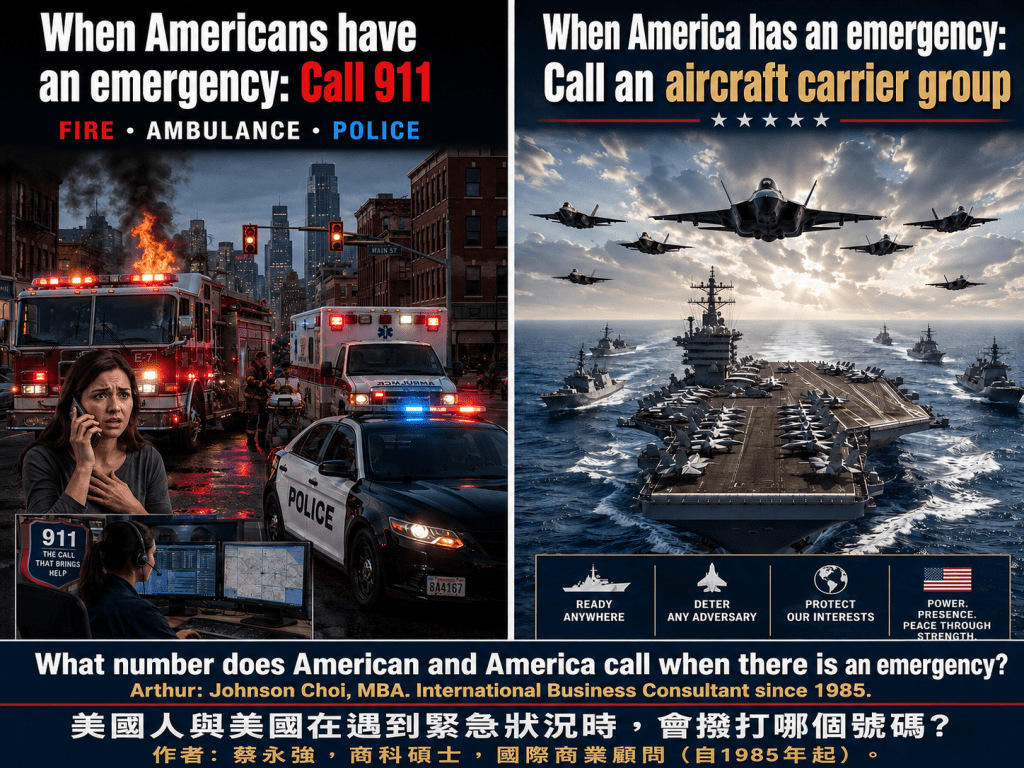
What number does American and America call when there is an emergency? Arthur: Johnson Choi, MBA. International Business Consultant since 1985.
美國人與美國在遇到緊急狀況時,會撥打哪個號碼? 作者: 蔡永強,商科碩士,國際商業顧問(自1985年起).
https://weixin.qq.com/sph/AdWj7WKPF5
https://www.tiktok.com/t/ZP8WSES2x/
https://m.facebook.com/story.php?story_fbid=pfbid0ASR9LaGVihsHvDbyyow4tEJzzUFWcSgLKKbnEjrFMVeqogSJi6A9JVraj1UT8cmxl&id=100036400039778&mibextid=wwXIfr
For most Americans, dialing 911 is an instinctive lifeline to firefighters, police, and paramedics. But when the nation itself perceives a threat, that same three-digit number takes on a vastly different meaning: the rapid deployment of a U.S. Aircraft Carrier Strike Group to the world’s flashpoints.
Historically, the question “Where are the carriers?” was the President’s first ask in a crisis—a guaranteed show of force. Today, however, that rapid-response mechanism is severely compromised. Out of the Navy’s 11 nuclear-powered supercarriers, more than half are languishing in extended maintenance backlogs, trapped in overcrowded shipyards with critical labor shortages and overhauls that now stretch years beyond schedule.
To make matters worse, this hull shortage is compounded by a logistics network that is dangerously buckling. The immense supply chain required to keep even one carrier group operational—spanning jet fuel, precision-guided munitions, spare avionics, and daily provisions for 5,000 sailors—is fraying under the weight of global commitments.
Nowhere is this crisis more visible than in the Middle East, where the few deployable carriers are forced into grueling, back-to-back deployments with no relief in sight. The vessels patrolling those strategic waters are showing unmistakable signs of wear: delayed overhauls, corroded systems, and exhausted crews pulling 8-month patrols just to maintain a bare presence. The sorry state of these ships is no longer just a maintenance failure—it’s a strategic vulnerability.
America’s “9-1-1” for global emergencies is running on fumes, leaving a superpower with fewer lifelines precisely when the world needs them most.
對大多數美國人來說,撥打 911 是呼叫消防員、警察與醫護人員的本能求救途徑。但當國家本身感知到威脅時,同一個三位數號碼卻承載了截然不同的意義——它代表美國航空母艦打擊群迅速部署至全球衝突熱點。
歷史上,「航母在哪裡?」一直是總統在危機中的首要問題——那是保證展示武力的象徵。然而今日,這套快速反應機制已嚴重受損。海軍現有的 11 艘核動力超級航空母艦中,超過半數正陷於漫長的維修積壓之中,受困於擁擠不堪的造船廠,面臨嚴重的勞工短缺問題,而本應完成的定期大修如今動輒延誤數年之久。
更糟的是,艦體短缺的問題,還因後勤網絡的危險崩潰而加劇。要維持哪怕一個航母打擊群的作戰運轉,所需的龐大供應鏈——從噴射燃油、精確導引彈藥、備用航電系統,到供 5,000 名船員日常所需的物資——正因全球承諾的沉重負荷而日漸鬆散斷裂。
這一切危機,在中東地區最為明顯。當地少數幾艘可部署的航母被迫進行接連不斷的艱苦部署,且看不到任何輪換替補的希望。巡弋於那些戰略水域的艦艇,已顯露出無庸置疑的耗損跡象:延後的大修、鏽蝕的系統,以及為了勉強維持存在而執行長達八個月任務、精疲力竭的船員。這些軍艦的悲慘現狀,不再只是維修失能——它已成戰略上的弱點。
美國作為全球緊急應變的「911」,如今已是強弩之末,讓這個超級大國在最需要救命繩索的時刻,反而只剩寥寥可數的選擇。