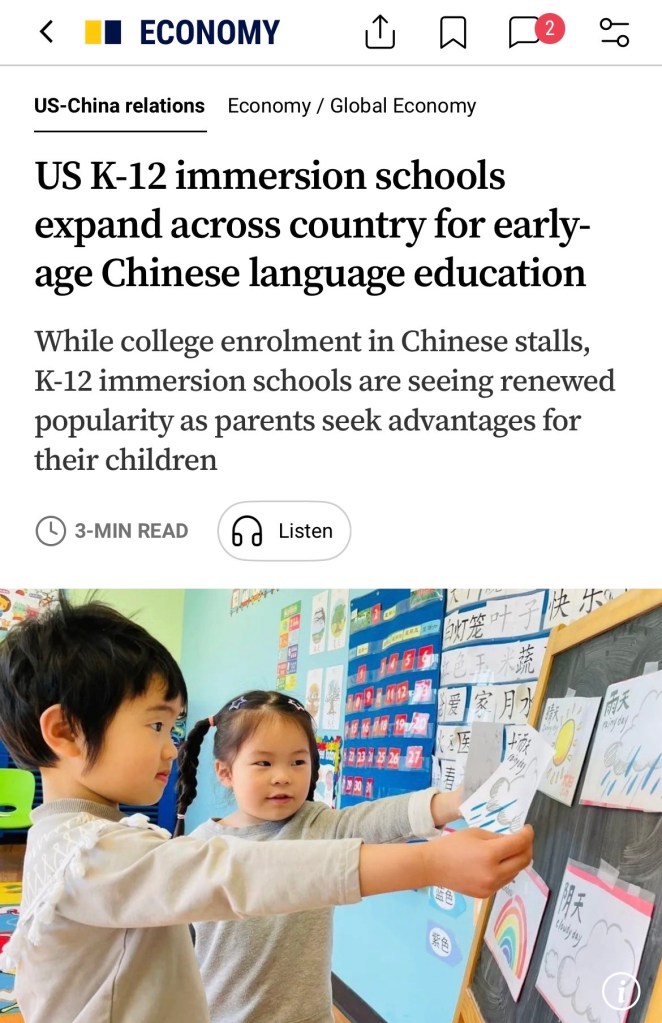
Speaking and reading Chinese is critical for your children’s future. US K-12 immersion schools expand across country for early-age Chinese language education” by Ralph Jennings, published by the South China Morning Post on August 15, 2026. 說和讀中文對您孩子的未來至關重要。美國K-12沉浸式學校在全國擴展,推動幼兒中文教育
美國K-12沉浸式學校遍佈全國,推動幼兒中文教育
大學中文選修人數停滯,K-12沉浸式學校卻因家長為子女尋求優勢而再度興起
拉爾夫·詹寧斯 於俄勒岡州波特蘭市報導
在俄勒岡州波特蘭市貝瑟尼郊區的「好時光中文學校」,一名美國孩童在走廊上攔住來自中國的校長周延卓,用英文問了一個問題。她請校長用中文回答,而這位沒有華裔背景的三年級學生,俐落地切換了語言。
這個孩子是數十名參加嚴格暑期中文課程的學生之一,他們正處於專家認為語言習得最為容易的年齡。
儘管美國大學回報中文選修人數持平,但K-12階段的中文沉浸式課程卻在成長。沒有華裔背景的學生家庭,將長期的職業價值或提升整體語言學習能力視為報名動機。
「中文是主要語言,這對孩子未來的發展是一項優勢。」該校創辦人、周延卓的丈夫舒炳毅表示。這所K-5校區每年收費14,000美元,提供全日制沉浸式課程。夫婦倆指出,目前在學的100名幼兒園學生中,超過半數沒有華裔背景,創下該校紀錄。
根據經營中文沉浸式教育家長部落格的伊麗莎白·魏瑟統計,自1981年第一所此類學校成立以來,今年全美K-12中文沉浸式學校的數量達到歷史新高,目前已達397所。
魏瑟表示,儘管因地緣政治緊張,中文在美國的受歡迎程度有所下降,但許多家庭仍視學習這門對英語母語者而言複雜的語言,為提升學習能力的方式。「美中關係目前不佳,但會好轉的。」魏瑟說。
美國的中文沉浸式學校最初在1980年代興起,當時美國政府在1970年代美中關係正常化後提供了資金。麻薩諸塞州威廉斯學院亞洲研究教授柯乃柏指出,這些學校在2000年代初期再度流行,當時中文是全球「熱門」的教學科目。
今年,《南華早報》調查的大學中,中文選修人數不是變化極小就是下降。阿拉斯加大學費爾班克斯分校指出自2022年以來中文選修人數下滑。波特蘭的里德學院則表示,初級中文課程的選修人數自2023年以來「基本持平」。
康乃爾大學亞洲研究系教學教授劉瑞表示,過去兩年中文一直是該校第三大受歡迎的語言,僅次於西班牙語和法語。
「我問過家長,他們說中國經濟越來越強,學中文意味著更多機會。」校長周延卓本月稍早在校園一個忙碌的早晨說道。
部分教育工作者認為,沉浸式學校過度集中在小學階段。他們指出,中學生和高中生可能會忘記幼時所學的中文。而原本為美國出生華裔設計、在週末或課後開課的傳統中文學校,或許能填補這一缺口。
中華公所代理校長甄文蒂表示,家長可能會在孩子於幼兒園和小學學習中文後,考慮高中階段的中文教育。「有些家長會思考未來。」她說,並規劃孩子參加高中的AP中文語言與文化考試。
現年18歲的尼蘭詹·納拉揚,今年高中畢業,他從2歲到18歲在加州就讀多所傳統中文學校。他認為自己已為今年秋季進入加州大學洛杉磯分校主修全球研究做好充分準備。出生於美國、父母為印度裔的尼蘭詹中文流利,並歸功於這些沉浸式學校。「他們幫了我很多,因為他們知道在家沒人跟我說中文。」他回憶道,「如果我有問題,他們會給我額外的複習時間。」
來源:《南華早報》,2026年8月15日
US K-12 immersion schools expand across country for early-age Chinese language education
While college enrolment in Chinese stalls, K-12 immersion schools are seeing renewed popularity as parents seek advantages for their children
Ralph Jennings in Portland, Oregon
At the Goodtime Chinese School in the Bethany suburb of Portland, Oregon, an American child stops school director Zhou Yanzhuo, of China, in the hallway to ask a question in English. She requests that he speak in Chinese and the third grader, who has no Chinese heritage, handily switches languages.
The child is one of several dozen students attending rigorous summer classes for Chinese language instruction at an age when experts believe language acquisition is easiest.
While American universities report that Chinese language enrolment is flat, Chinese language immersion courses at the K-12 level are growing. The families of students without Chinese backgrounds cite long-term professional value or a chance to sharpen overall ability to learn languages as their motivations for enrolment.
“Chinese is a major language, meaning that it’s an advantage to their children’s future development,” said Shu Bingyi, Zhou’s husband and founder of the school, a K-5 campus that charges US$14,000 per year for full-time immersion classes. The couple said more than half of their current cohort of 100 kindergarteners have no Chinese background, a record for the school.
The number of Chinese language immersion schools for students between kindergarten and high school reached a record this year since the first one opened in 1981, and that there were now 397 across the US, according to Elizabeth Weise, who runs a blog for parents of children in Chinese language immersion instruction.
Weise said that though Chinese had lost favour in the US over geopolitical tensions, families still see studying the language, which is complex for native English speakers, as a way to sharpen learning skills. “Relations between China and the US are not great, but they will get better,” Weise said.
Chinese immersion schools in the US initially gained popularity in the 1980s after funding was provided by the US government, following the normalisation of US-China relations in the 1970s. The schools recaptured that popularity in the early 2000s when Chinese language was a “hot” teaching subject across the globe, said Cornelius Kubler, a professor of Asian studies at Williams College in Massachusetts.
This year, universities surveyed by the South China Morning Post reported either minimal change or a decline in enrolment in the language. The University of Alaska Fairbanks noted a drop in Chinese enrolment since 2022. Reed College in Portland said enrolment in introductory Chinese language courses had been “basically static” since 2023.
At Cornell University, Chinese had remained the third most popular language after Spanish and French for the past two years, said Liu Rui, a teaching professor in the university’s Asian studies department.
“I’ve asked the parents and they say China’s economy is getting stronger, so studying the language means more opportunities,” said Zhou, the school director, on a busy morning at the campus earlier this month.
Some educators believe that immersion schools are over-concentrated at the primary school level. They say middle and high school students may forget the Chinese language they learned as younger children. Heritage schools, which hold weekend or after-school programmes and were originally designed for American-born Chinese, may fill the gap.
Parents may consider high school Chinese language education after their children take the language in kindergarten and primary school, said Wendy Zhen, interim principal at the Chinese Consolidated Benevolent Association. “Some parents think about the future,” she said, and plan for their children to take the AP Chinese Language and Culture Exam in high school.
For Nilanjan Narayan, 18, who graduated from high school this year after attending several heritage Chinese schools in California from age 2 to 18, he considers himself extra prepared to major in global studies at the University of California, Los Angeles from this fall. Born in the US to Indian parents, Nilanjan is fluent in Chinese and credits the immersion schools. “They would help me a lot because they knew no one was speaking Chinese with me at home,” he recalled. “If I asked, they’d give me extra review time.”