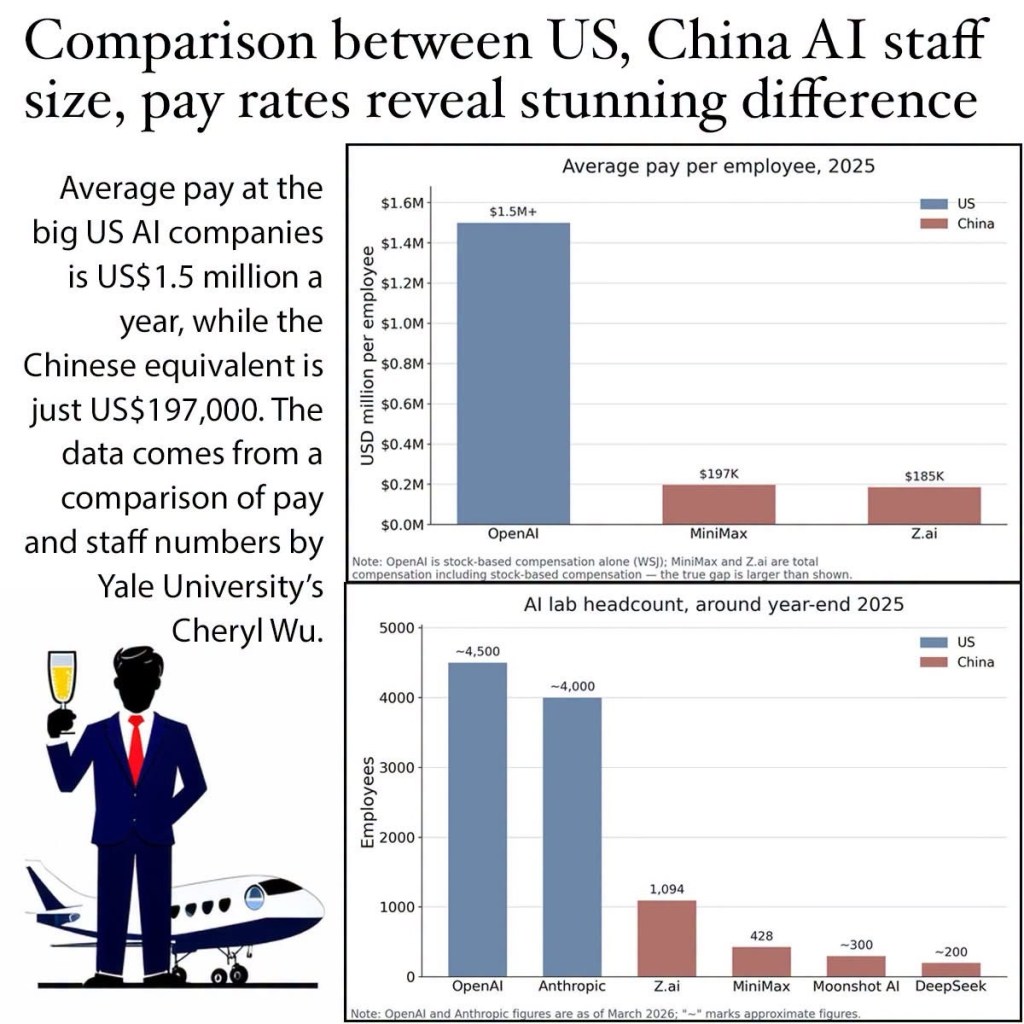
Nury Vittachi: BREAKING NEWS: Average pay at the giant US AI companies is a breathtaking US$1.5 million a year, while the equivalent in China is just US$197,000, China’s DeepSeek only need 200 AI engineers, US’s OpenAI和Anthropic each has 4,000 employees! They are both overpaid and underperforming, a new study showed yesterday. 突發新聞:一項昨日公佈的新研究顯示,美國大型人工智慧公司員工的平均年薪高達驚人的150萬美元,而中國同業的平均年薪僅為19.7萬美元,中國的DeepSeek只需要200位AI工程師,美國的OpenAI和Anthropic各自卻有4,000名員工!他們都是薪水過高、表現差!
https://weixin.qq.com/sph/Ax5kjGwRU4
https://www.tiktok.com/t/ZP8nvWeWH/
https://m.facebook.com/story.php?story_fbid=pfbid03PRU8AwuwHeGH7WLQXeiHY3EEUoVreX4ojpVo9pfTihhZv1bJ4FBB8zs5MwtZsgSl&id=100036400039778&mibextid=wwXIfr
此外,OpenAI和Anthropic各自擁有超過4,000名員工,而中國最知名的人工智慧公司DeepSeek僅有200名員工。
將這些數據綜合起來,成本差異之大令人震驚。
「規模差距相當明顯!」耶魯大學經濟學家、博士候選人Cheryl Wu昨晚在X平台上發表這項研究時寫道。
AI巨頭面臨巨大壓力
這些研究結果顯示了美國大型業者所承受的壓力。他們以百萬美元年薪僱用大量員工,卻完全沒有獲利——這顯然是一種不健全的商業模式。
即使中國也在進行類似的賽局,至少其頂尖人工智慧公司的員工人數少得多,薪資也低得多。
不過,從正面來看,Facebook當年也曾經連年虧損,之後才變得高度獲利——這正是全球人工智慧公司都希望效仿的商業模式。
生活成本較低
另一個因素當然是中國較低的生活成本。美國雇主別無選擇,只能支付更高的薪資——儘管這並不一定能合理化百萬美元以上的薪酬。
這種差距也可能對中國人工智慧產業造成壓力:資金雄厚的美國公司可以輕易從中國挖走最優秀的人才。
員工可負擔,產品也可負擔
美國大型業者面臨的壓力更加嚴峻,因為中國的人工智慧程式可免費採用,且營運成本低廉。
這些程式也是開源及/或開放權重,意味著全球各地(包括美國在內)的公司都可以根據自身需求進行微調——而它們也確實在這麼做。
雖然美國某些政府部門已禁止員工使用中國的人工智慧模型,但民間企業允許使用。
一家名為Cursor的科技公司(預計將以600億美元被SpaceX收購)表示,該公司使用了中國的Kimi AI模型來打造其關鍵產品Composer 2。
And while OpenAI and Anthropic have more than 4,000 staff each on their payrolls, the best-known Chinese AI company, DeepSeek, has just 200.
Multiply these facts together and you have an astonishing difference in costs.
“The scale gap is stark!” wrote Yale University economist Cheryl Wu, a PhD candidate, who published the work last night on X.
BIG PRESSURE ON AI GIANTS
These findings show the pressure on the big US players. They are paying million-dollar salaries to a huge number of staff, while making no profits at all – clearly a dysfunctional business model.
And even if China is playing a similar game, at least its top AI companies have much smaller staff numbers and get paid far less.
Yet, on the plus side, Facebook ran at a loss for years, and then became highly profitable—a business model that AI firms on both sides of the world would like to follow.
LOW LIVING COSTS
Another factor, of course, is the lower living costs in China. US employers have no choice but to pay more—although that may not justify multi-million-dollar salaries.
The difference could also be a weight on the Chinese AI industry: rich American firms could simply buy the best staff from China.
AFFORDABLE STAFF, AFFORDABLE PRODUCTS
The pressure on the big US players is compounded by the fact that Chinese AI programs are free to adopt and cheap to run.
They are also open-source and/ or open-weight, meaning that companies around the world, including in the United States, can fine-tune them to their own needs—and are doing so.
While some government departments in the US have prohibited their staff from using Chinese AI models, private companies allow it.
A tech firm named Cursor, due to be bought by SpaceX for US$60 billion, said it used China’s Kimi AI model to build a key product, Composer 2.