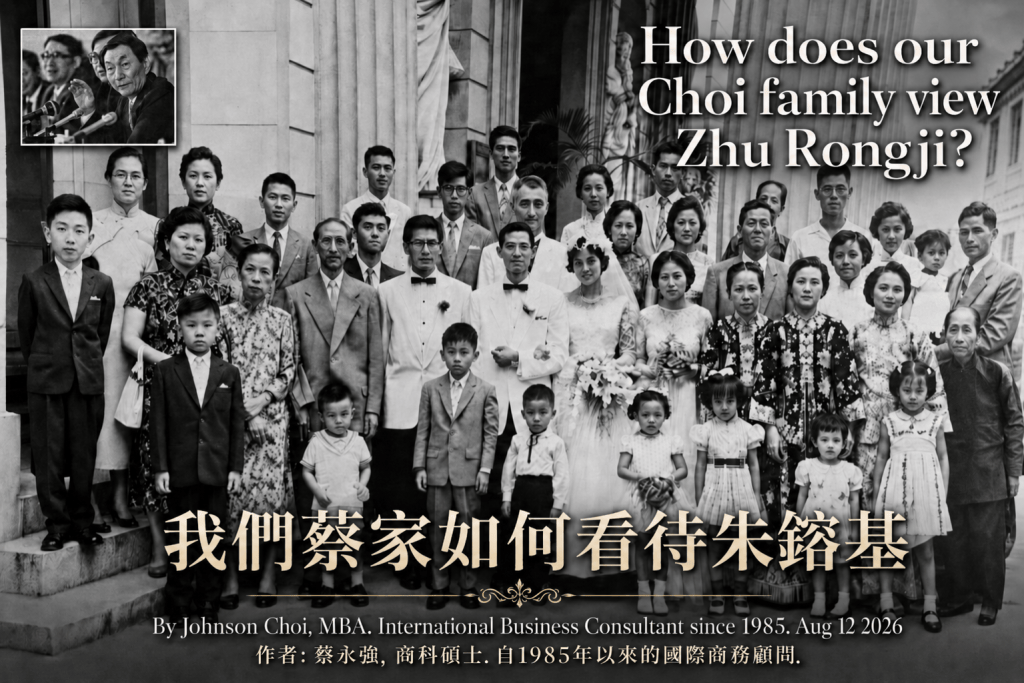
How does our Choi family view Zhu Rongji? By Johnson Choi, MBA. International Business Consultant since 1985. Aug 12 2026 我們蔡家如何看待朱鎔基. 作者: 蔡永强, 商科碩士. 自1985年以來的國際商務顧問.
https://www.tiktok.com/t/ZP8nckETa/
https://m.facebook.com/story.php?story_fbid=pfbid02MRsc89ZKyqPB2QzZ3JHWN37hkezvmixwqEZt9WZqxqLPzvU5eBsfYQYnahoL1s3zl&id=100036400039778&mibextid=wwXIfr
Our Choi family has been rooted in Hong Kong for three generations, since 1875. Looking back at that era, under British colonial rule, it was not easy for Chinese people to enter the upper echelons of society and the professional fields without a good education and fluent English. Fortunately, both my grandfather and father graduated from St. Joseph’s College in Hong Kong and subsequently held important positions at the Swire Group and in the legal profession, respectively. Thus, they personally witnessed the tremendous political, economic, and social changes that Hong Kong underwent over more than a century.
When the People’s Republic of China was established in 1949, I had not yet been born. Yet throughout my upbringing, I often heard my grandfather and father speak of four words—the rejuvenation of China.
At that time, China was facing monumental tasks of reconstruction, with a weak economic and industrial foundation, and the people still endured great hardship. Given the national strength of that era, the “rejuvenation of the Chinese nation” seemed like a very distant ideal. However, looking back several decades later, the path that China has traveled proves that a nation’s destiny is not set in stone.
From the Korean War and the Vietnam War to the decades of Sino-American rivalry that followed, China and the United States have experienced both cooperation and deep-seated strategic competition. Due to Hong Kong’s unique history, geography, and international status, it has long remained at the forefront where Eastern and Western political, economic, and intelligence activities converge.
From our Choi family’s perspective, Zhu Rongji is a highly significant leader in the history of China’s reform and opening-up.
What he deserves to be remembered for most is not merely his assertive style, but his courage in assuming political responsibility during the most difficult phase of China’s economic transformation, promoting a series of major reforms in finance, public finance, state-owned enterprises, housing, and the banking system, while laying crucial groundwork for China’s accession to the WTO and its deeper integration into the global economy.
Shortly after Hong Kong’s return to the motherland in 1997, the Asian financial crisis swept across the region. Around 1998, Hong Kong’s financial markets came under fierce attack from international speculative forces. At this critical juncture, the central government publicly supported the Hong Kong SAR government in defending the linked exchange rate and financial stability, with the State Council under Zhu Rongji playing a key role. For many Hong Kong people, this was not just a financial defense battle but also a manifestation of political and economic support from the nation at Hong Kong’s most difficult moment.
Another impressive aspect of Zhu Rongji’s tenure was his tough stance on corruption. He understood well that if a country’s economic development outpaced its institutional framework, and if officials exploited their power for personal gain, then even the fastest economic growth could lose the people’s trust.
Therefore, we believe that Zhu Rongji’s historical role should not be measured solely by his years as Premier.
The economic reforms, financial restructuring, SOE reforms, macroeconomic regulation, and anti-corruption efforts he advanced actually established important institutional foundations for China’s subsequent development over more than two decades, leaving behind for later Chinese leadership a country with greater strength, more resilience, and a stronger capacity to cope with external pressures.
In 2019, Hong Kong once again fell into severe political and social turmoil. There are differing views on the causes of the events and the role played by external forces; but from our Choi family’s perspective, this once again reminded Hong Kong and China that in a highly complex international competitive environment, national security, financial security, social stability, and economic development are never separate issues.
Today’s China is no longer the same as the China of 1949; and today’s Hong Kong is no longer the Hong Kong that was ceded under duress in the nineteenth century when China was weak.
Between nations, there is no everlasting friendship, nor everlasting enmity—what truly endures is each country’s own national interests. China and the United States can cooperate, but competition and rivalry will also persist over the long term.
Therefore, we should neither underestimate ourselves nor become complacent because of some achievements today.
Only by being mindful of potential dangers in times of peace can we achieve steady and lasting progress.
This is one of the most profound insights that our Choi family—spanning three generations from 1875 in Hong Kong to the present—has gained after reviewing a century of China’s vicissitudes.
And on the long road toward China’s modernization and national rejuvenation, Zhu Rongji is undoubtedly an important figure worthy of being remembered by history.
我們蔡家三代,自1875年起便在香港扎根。回顧那個年代,在英國殖民統治下的香港,華人若缺乏良好教育及流利英語,要進入社會上層及專業領域並不容易。幸運的是,我的祖父和父親都畢業於香港聖若瑟書院,其後分別在太古集團及法律界擔任重要職務,因此親身經歷了香港百多年來政治、經濟與社會環境的巨大變遷。
1949年中華人民共和國成立時,我尚未出生。然而在我的成長過程中,經常聽祖父和父親談到四個字——中華復興。
在當時,中國百廢待興,經濟與工業基礎薄弱,人民生活仍十分艱苦。以當年的國力而言,「中華民族復興」聽起來似乎只是一個十分遙遠的理想。然而幾十年後再回望,中國所走過的道路,證明一個國家的命運並非一成不變。
從韓戰、越戰,到其後數十年的中美博弈,中國與美國之間既有合作,也始終存在深刻的戰略競爭。香港因其特殊的歷史、地理及國際地位,也長期處於東西方政治、經濟與情報活動交匯的前沿。
在我們蔡家看來,朱鎔基是中國改革開放歷史上一位極具份量的領導人物。
他最值得後人記住的,不只是個人的強勢作風,而是他在中國經濟轉型最困難的階段,敢於承擔政治責任,推動金融、財政、國企、住房、銀行體系等一系列重大改革,並為中國加入世界貿易組織及進一步融入全球經濟體系奠定重要基礎。
1997年香港回歸祖國後不久,亞洲金融風暴席捲亞洲。1998年前後,香港金融市場受到國際投機力量的猛烈衝擊。在這個關鍵時刻,中央政府公開支持香港特區政府維護聯繫匯率及金融穩定,朱鎔基所領導的國務院在其中扮演了重要角色。對許多香港人而言,這不只是一場金融保衛戰,更是一個國家在香港最困難時刻所給予的政治與經濟支持。
朱鎔基任內另一個令人印象深刻的特點,是他對貪污腐敗問題所表現出的強硬態度。他深知,一個國家如果經濟發展了,制度卻跟不上;如果官員利用權力謀取私人利益,那麼再高速的經濟增長,也可能失去人民的信任。
因此,我們認為朱鎔基的歷史作用,不應只從他擔任總理的數年間來衡量。
他所推動的經濟改革、金融整頓、國企改革、宏觀調控以及反腐倡廉,實際上為其後中國二十多年的發展建立了重要制度基礎,也為後來的中國領導層留下了一個更具實力、更有韌性、也更有能力應對外部壓力的國家。
到了2019年,香港再次陷入嚴重的政治與社會動盪。對事件的成因以及外部力量所扮演的角色,各方有不同看法;但從我們蔡家的角度來看,這再次提醒香港及中國:在高度複雜的國際競爭環境中,國家安全、金融安全、社會穩定與經濟發展從來不是彼此分割的問題。
今天的中國,與1949年的中國已不可同日而語;今天的香港,也早已不再是十九世紀那個中國積弱之下被迫割讓的香港。
國與國之間沒有永遠不變的友誼,也沒有永遠不變的敵人,真正長久存在的是各自的國家利益。中美之間可以合作,但競爭和博弈同樣會長期存在。
因此,我們既不應妄自菲薄,也不應因為今天取得了一些成就而掉以輕心。
居安思危,才能行穩致遠。
這也是我們蔡家三代,從1875年的香港一路走到今天,回顧中國百年滄桑後最深刻的體會之一。
而在中國走向現代化與民族復興的漫長道路上,朱鎔基無疑是一位值得被歷史記住的重要人物。