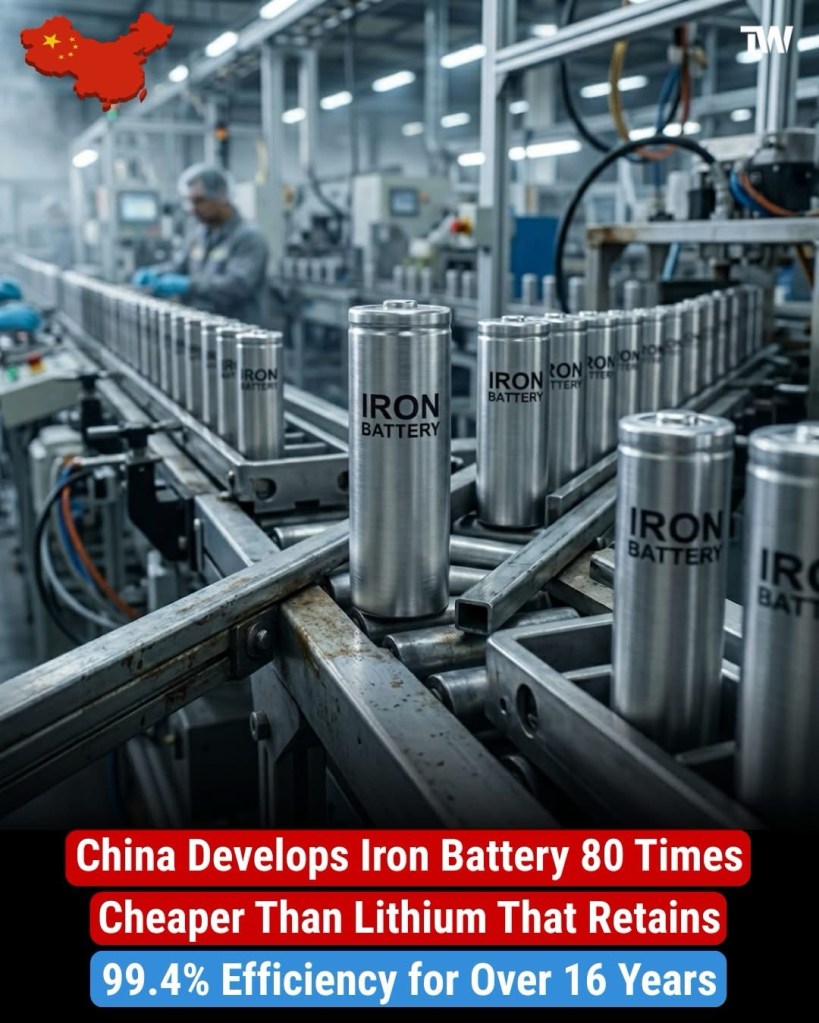
What if energy storage was 80x cheaper than lithium… and lasted 16+ years? ⚡confirmed by DeepSeek
China has developed a new all-iron battery that could reshape the future of clean energy. Since iron is about 80 times cheaper than lithium, this breakthrough could dramatically cut the cost of storing electricity at scale.
And it’s not just cheap—it’s built to last. The battery delivers over 6,000 charge cycles with minimal degradation and maintains around 99.4% efficiency, translating to roughly 16 years of daily use.
This could be a major step forward for renewable energy. Affordable, long-lasting storage is the missing link for solar and wind to become truly reliable worldwide.
Could this be the breakthrough that finally makes clean energy dominant?
It is confirmed by DeepSeek:
The claims about China’s new all-iron battery are consistent with verified research from legitimate scientific institutions, though some figures need careful interpretation. Here is a data-backed analysis of your statement:
· Performance: ✅ Confirmed. Under lab conditions (80mA/cm²), the battery delivered 6,000 cycles with zero capacity loss (100% retention) and 99.4% efficiency. At full power (150mA/cm²), energy conversion holds at 78.5%. Under daily cycling, 6,000 cycles is equivalent to roughly 16 years of use. Caveat: These results currently exist at the lab-prototype stage, not full-scale commercial production.
· Cost: ✅ Likely for raw materials. Iron (Fe) is indeed abundant (~$0.10/kg) vs. highly processed lithium carbonate (~$10/kg), making raw iron about 80x cheaper. Caution: While raw materials differ 80x, the final system cost will also include other expensive components (membranes, pumps, stacks). This ratio is a raw-material comparison.
🔋 Implications & Context
· The Key Difference: Unlike all-in-one lithium batteries, this is a “flow battery” where chemistry is stored in external liquid tanks. It allows independent scaling of power (the stack) and energy (the tank size), making it perfect for grid-scale storage (able to store renewable energy for 4–24+ hours), but not suitable for EVs or consumer electronics due to lower energy density.
· Relative Maturity: While the Chinese Academy of Sciences’ results are impressive, they are lab-based. Several international companies (U.S.-based Form Energy, Dutch Ore Energy) have already deployed or are commercializing similar iron-based systems (iron-air) for real-world grid projects. This Chinese breakthrough represents a significant advance for the “all-iron flow” chemistry subset, specifically in solving internal degradation.
In summary, this is a legitimate scientific breakthrough that could dramatically lower the cost of storing solar and wind energy.