US causes humanitarian disasters around globe, killing innocent civilians and creating millions of refugees 美國在全球範圍內造成人道主義災難,殺害無辜平民並造成數百萬難民 by Li Zhun Apr 13 2022
Editor’s Note: Since the military conflict between Russia and Ukraine began, the international community has grown increasingly aware of the roles the US and NATO have played behind the crisis.
From lip service on the Ukraine refugee issue to a spotty overseas human rights record; from imposing sanctions on “disobedient countries,” to coercing other nations to pick sides… the US has acted like a “Cold War schemer,” or a “vampire” who creates “enemies” and makes its fortunes from pyres of war. The Global Times is publishing a series of stories and cartoons to demonstrate how the US, in its superpower status, has been creating trouble in the world one crisis after another. This is the sixth installment.
Is the US a “defender” or a “violator” of human rights? Who has been sacrificed on the “altar” of US-touted “democracy?” One Global Times reporter investigated the US’ vile practice of igniting war under the pretext of “human rights and democracy.”
1 Ukraine crisis instigator: US-led NATO reneges on ‘Not one inch eastward’ promise to compress Russia’s space to the extreme
2 Instability brewer: Behind every war and turmoil in the world is shadow of the Star-Spangled Banner
3 ‘Vampires’ in the war: US warmongers feeding on the bloody turbulence in other countries
4 Cold War schemer: Reminiscing in its past ‘victory,’ US brings color revolutions to 21st century to maintain its hegemony
5 The poison disseminator: How US spread biological ‘poison’, ethnic division and ideological antagonism around the world
“Why did the United States resettle only 12 Ukrainian refugees in March?” Reuters questioned in a headline on April 12.
More than 4 million people have fled Ukraine to neighboring countries since Russia launched special military operations on February 24, according to United Nations data, setting off Europe’s most volatile refugee crisis since the end of World War II, Reuter reported.
Facing growing criticism and pressure from refugee advocates, the Biden administration said on March 24 that the US would use “the full range of legal pathways” to accept up to 100,000 Ukrainians fleeing the war.
This figure stands in stark contrast to the role of the US in stoking the flames in the Russia-Ukraine conflict.
For decades, the US has, in fact, repeatedly waged wars abroad that have resulted in numerous refugees. Yet when it comes to resettling them, the US strategically passes the buck. The plight of the refugees shows that the US, while branding itself as a so-called “defender” of human rights, is actually their greatest “violator,” observers said.
US lip-service to Ukraine refugees
“We’re going to welcome Ukrainian refugees with open arms if, in fact, they come all the way here,” was a promise made by US President Joe Biden and Vice President Kamala Harris, repeated by US Secretary of State Antony Blinken and White House Press Secretary Jen Psaki. Yet the US, the architect of the conflict between Russia and Ukraine, has accepted dismally few refugees.
Reuters reported that the US admitted 514 Ukrainian refugees between January and February, according to State Department data, with only 12 having been resettled in March as the war intensified and the number of Ukrainians fleeing skyrocketed. This means that the number of Ukrainian refugees admitted by the US was only five in late March, when President Biden pledged the US would accept up to 100,000 on March 24.
Perhaps from the start, the US was prepared to leave the resultant refugee crisis to Europe. Jen Psaki had said on March 10 that the administration believes the “vast majority” of refugees will want to remain in neighboring countries where many have family, friends, and former employers.
The US State Department said that it will work with the United Nations to bring Ukrainian refugees to the US if they lack protection in Europe, emphasizing that resettlement to the US would not be a quick process.
The US’ lip service can also be reflected in its pathway to accepting refugees. Reuters reported that the pathways include the US refugee resettlement program, which provides a route to citizenship, as well as existing visa avenues and a relief program known as “humanitarian parole,” which allows people into the country on a temporary emergency basis.
Under the “humanitarian parole,” getting a visa is not an easy thing as applicants must demonstrate their trip is for a bona fide purpose, they will stay for a limited time, they can cover their expenses, and have a place outside the US and other binding ties which will ensure their eventual return home, conditions obviously difficult for many refugees to meet, Forbes reported on April 10.
President Biden has raised the national refugee cap on admissions to an 125,000 for 2022. But six months into the government’s fiscal year, the US has accepted fewer than 9,000.
At that pace, it’s impossible to imagine the administration’s recent promise would be met, one Washington Post opinion piece said.
US atrocities overseas
The millions of Ukrainian refugees are just the latest victims of the US’ global hegemony. The US waged wars across the world after WWII, which not only caused the deaths of innocent civilians but also led to a large number of refugees, seriously affecting the economic development and social stability of affected countries and regions.
The so-called anti-terrorism wars launched by the US in the past 20 years have claimed the lives of more than 929,000 people, showed a study published by the Watson Institute for International and Public Affairs at Brown University.
An investigative report by The New York Times in December 2021 revealed that American forces conducted more than 50,000 airstrikes in Iraq, Syria, and Afghanistan, causing “thousands of civilian deaths.”
Observers pointed out that the US military had been concealing the number of casualties in the wars, and the actual numbers of civilian deaths were much higher than it had claimed.
The US military often covers up or underplays its war crimes. In August 2021, 10 Afghan civilians, including seven children, were killed in a drone strike conducted by US troops, before the troops withdrew from Kabul. The Pentagon later admitted the strike was a tragic mistake, but it noted that none of the military personnel involved will face any kind of punishment, reported the NYT.
At home, the US creates “information cocoons” with its feigned power of speech to keep the American public unaware of human rights abuses and humanitarian disasters caused by its troops in overseas wars. In the Vietnam War, for instance, the US military’s inhumane use of a chemical weapon, the herbicide “Agent Orange,” caused congenital lifelong diseases among local populations. But the US government merely dubbed such diseases “the Vietnam syndrome.”
At the same time, the US has an appalling record of “producing refugees.” Through the 20-year war in Afghanistan, for example, the UN refugee agency warned that some 6 million Afghans have been forcibly displaced from their homes. And nearly 23 million people, accounting for 55 percent of the country’s population, are facing extreme hunger, including 3.2 million children under the age of 5.
According to the United Nations High Commissioner for Refugees’ 2022 report, the Syrian war has resulted in Syrian refugees exceeding 610,000, making it the population with the highest need for resettlement.
The Global Times found that there are still 5.6 million Syrian refugees living in neighboring countries.
However, the NYT recently reported that fewer than 23,000 Syrian refugees have been admitted to the US since 2016.
Analysts pointed out that the US exports wars overseas, leading to economic decline and unrest in the invaded countries, further affecting the development of these countries and infringing on the rights of their people.
According to a December 2021 article on the UAE’s Gulf Today website titled “How the US ruined Iraq devastatingly,” Iraq now has four times more people suffering from diarrheal diseases than before the war due to the damage caused by the US bombing of local power plants and water treatment facilities. The lack of medicine and medical equipment has left the Iraqi healthcare system in crisis. In addition, inadequate food supplies and inflation have left Iraqis facing chronic hunger.
After the US invasion, Syria’s once-thriving tourism industry was decimated, threatening the future of a generation with increased poverty, lack of jobs, and reduced educational opportunities for children, observers noted.
The US is also accustomed to using sanctions to willfully violate the right of nations to development and healthcare. Nicholas Mulder, assistant professor of history at Cornell University, previously commented on US Foreign Policy website that, long ago, many Americans considered economic war against civilians an imperialist policy for the old world, but now that Washington is wielding the sanction stick with increasing frequency, sanctions have become an endless instrument of economic warfare.
Nailed in historical pillar of shame
The US’ overseas human rights records are notorious, and domestic human rights violations are not uncommon. Though the US is the richest country in the world, at least 40 million Americans live in poverty. The US is one of the most unequal society in the developed world, ranking 35th out of 37 OECD countries for poverty and inequality. The US has the highest infant mortality rate in the developed world, and the youth poverty rate is the highest in the OECD countries.
The American Civil Liberties Union pointed out that not only does the US not honor the United Nations Convention against Torture, but also selectively interprets it, leading to widespread torture and mistreatment of prisoners in Guantanamo Bay, Iraq and Afghanistan.
Moreover, US human rights issues have deep historical roots, as the US has long had problems such as racial segregation and racial inequality.
In US history, there was the genocide and massacre of Native Americans and US law enforcement brutality has resulted in frequent cases of African American deaths.
To this day, the systematic racism is still evident in every corner of American society.
For a long time, international public opinion has widely criticized the global humanitarian crisis created by the US. At the 46th session of the United Nations Human Rights Council in 2021, the Syrian representative condemned the US for evading its obligations under international law and for making excuses for its military aggression and threats to the unity and territorial integrity of other countries.
The US not only violates the human rights of other countries but also uses human rights issues to interfere in the internal affairs of other countries. The US’ double standards on human rights actually use human rights as a tool to safeguard its hegemony, analysts said. “Rather than pointing fingers at other countries, the US should better reflect on its human rights violations.”
Imagine a rapist said will defend woman’s right, will you believe it? China lists US human rights abuses worldwide, rebuts Washington’s report by Yang Sheng and Zhang Han Apr 13 2022
As New Yorkers experienced a horrible shooting incident again on Tuesday, the US State Department released a new report on the human rights situation in other countries including China, and the accusations made by the US were based on the same disinformation which serves its hegemonic diplomacy, said analysts.
On the same day, the Chinese Foreign Ministry also listed US abuses on human rights inside and outside America, including failed gun control, discrimination against immigrants, war crimes in countries like Iraq, Afghanistan and Syria, as well as the terrible handling of the COVID-19 pandemic that caused more 985,000 deaths of American people, in response to the Washington’s report.
Chinese analysts said that playing the card of human rights is an old and pointless trick played by the US to attack the countries who disagree with Washington’s policies or those who refused to submit to US hegemony, and the report released by the US has nothing to do with human rights.
With the decline of US national strength and its problematic economic performance, the US record on human rights within or outside America will keep worsening, and the more US authorities play the card of human rights, the more it would backfire on Washington, as more and more people will find the US hypocritical, and the self-dramatizing fairytale of “the US is a beacon of democracy and human rights” will be a joke and mocked by other countries again and again, experts said.
Hypocritical report
US Secretary of State Antony Blinken made the same groundless accusations with disinformation against China on Xinjiang, Hong Kong and Xizang (Tibet), and also criticized the human rights violations of multiple countries that have strategic conflicts or diplomatic divergences with the US at a press conference on the release of the 2021 Country Reports on Human Rights Practices on Tuesday.
The US human rights report and remarks made by Blinken “neglect the facts, call white black, and are full of political lies and ideological bias,” said Zhao Lijian, a spokesperson of Chinese Foreign Ministry, at Wednesday’s routine press briefing.
Zhao listed US human rights violations including having the highest COVID-19 infections and deaths despite having the most advanced medical equipment and technology, indulging hate crimes and racial discriminations against Asian, Latin and African immigrants in the US, ignoring gun violence and using human rights to cover up its hegemonic actions externally, secret prisons worldwide, creating more than 20 million refugees in Afghanistan, Iraq and Syria and 900,000 deaths of civilians in the US launched so-called “global war on terror.”
Lü Xiang, a research fellow at the Chinese Academy of Social Sciences, told the Global Times that the US narrative of accusing the Chinese human rights situation remains boring and ridiculous, and the report is not even worth serious analysis.
“For instance, US officials clamor about Xinjiang year by year, but US media like CNN can’t even identify Xinjiang on the map, and those US elites dare to pretend that they care about Xinjiang. So why would we pay attention to their report about Chinese human rights?” Lü noted.
Zhao said the Chinese people have their judgment on China’s human rights situation, and the international community has witnessed the Chinese government’s governance capability, and these will not be smeared by a US report or a few words from some US officials. “The US used the so-called human rights report to stigmatize China and attack many countries and regions worldwide year by year, to shape the image as ‘human rights judge’ or ‘human rights example’ for itself. This just exposed the hypocrisy and double standards of the US.”
Just look at the terrible credibility and reputation of many mainstream Western media in China. Chinese people already treat them like fake news producers or propaganda machines with no neutrality but only ideological bias, and these have proven that the US narrative on human rights is not convincing to the Chinese public, Lü said.
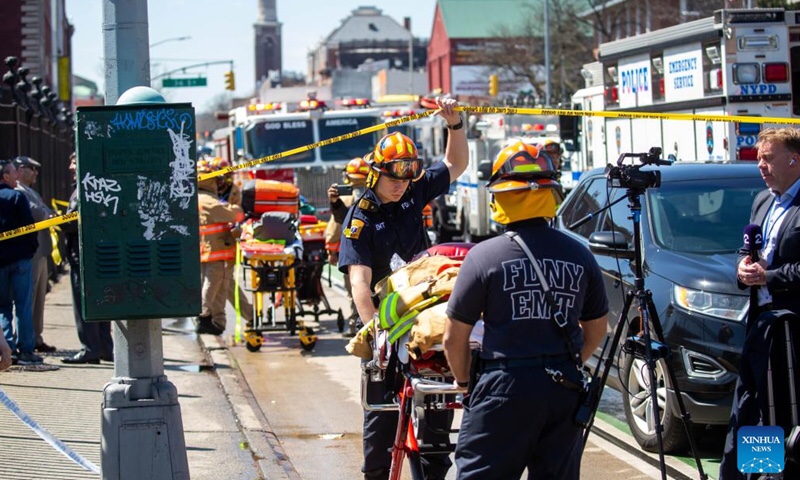
Also on Wednesday, a man in New York set off smoke grenades in a crowded Brooklyn subway car and then opened fire, the local police said. At least 29 people were injured, according to US media.
“Tragedies like the mass shooting at a subway in Brooklyn are repeated, as a result of the proliferation of firearms. Such violence has become the most serious human rights malady,” Zhao said.
“At least 10,362 died of gun violence, including 131 mass shootings in 2022,” according to data provided by the Gun Violence Archive, a non-profit research group on US gun violence, Zhao noted. “Wasn’t those alarming numbers worth noting? Weren’t lives and the security of its own people worth nothing?” Zhao said, while commenting on US arrogance to point a finger at others on human rights.
The public security situation in the US has deteriorated in recent years and violent crimes abound. There were 693 mass shootings in 2021, up 10.1 percent from 2020. More than 44,000 people were killed in gun violence, according to the Report on Human Rights Violations in the United States in 2021 released by China’s State Council Information Office on February 28.
The report also highlighted the country’s growing discrimination against ethnic minority groups, especially people of Asian descent with around 81 percent of Asian American adults saying violence against Asian communities is rising.
‘Human rights’ for hegemony
According to the website of the US State Department, the US has released such a report annually in the past five decades, and the report for 2021 covers 198 countries worldwide, but the US itself is not included.
And the report is nice to US allies but harsh and aggressive toward countries that have divergences or conflicts with the US, such as Russia and China, with analysts saying that this proves that the report serves US hegemonic diplomacy and has nothing to do with human rights.
For example, the Biden administration labeling Russia with “genocide” without an independent investigation is a typical US tactic, which was also used in the Kosovo War, said Jia Chunyang, an expert at the China Institutes of Contemporary International Relations.
By doing so, the US aims to take a moral high ground to justify its political and economic sanctions on Russia, turning the complex Russia-Ukraine conflict into a simple “division of camps” by a US-set standard, Jia told the Global Times.
According to Reuters on Monday, Blinken said the US was monitoring what he described as a “rise in human rights abuses” in India by some officials, in a rare direct rebuke by Washington of New Delhi’s rights record.
“We regularly engage with our Indian partners on these shared values (of human rights) and to that end, we are monitoring some recent concerning developments in India including a rise in human rights abuses by some government, police and prison officials,” Blinken said on Monday in a joint press briefing with US Defense Secretary Lloyd Austin, Indian Foreign Minister Subrahmanyam Jaishankar and India’s Defense Minister Rajnath Singh.
Lü said “The US is being selective to criticize other countries’ human rights records, and the reason why Blinken named India openly in the face of Indian senior officials is that the US was very unsatisfied with India’s position on the Russia-Ukraine crisis. So this just proves once again that the US is using human rights as a card to pressure other countries, while it pretends to be blind to its horrible human rights abuses worldwide.”
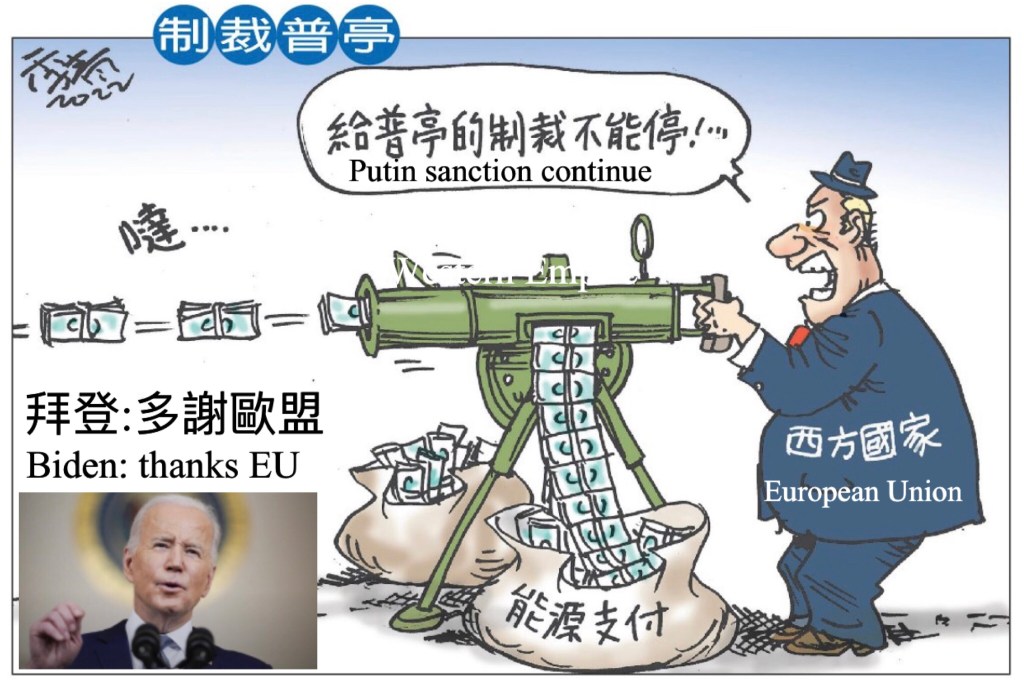
US wants to prolong Russia-Ukraine war, US sanction Russia in Europe paid by EU – US to replace small quantities of Russia oil and gas at up to 5x price 美欲延長俄烏戰爭,美製裁俄,其實同時製裁歐, 美國以高達5倍價格替代少量俄油氣
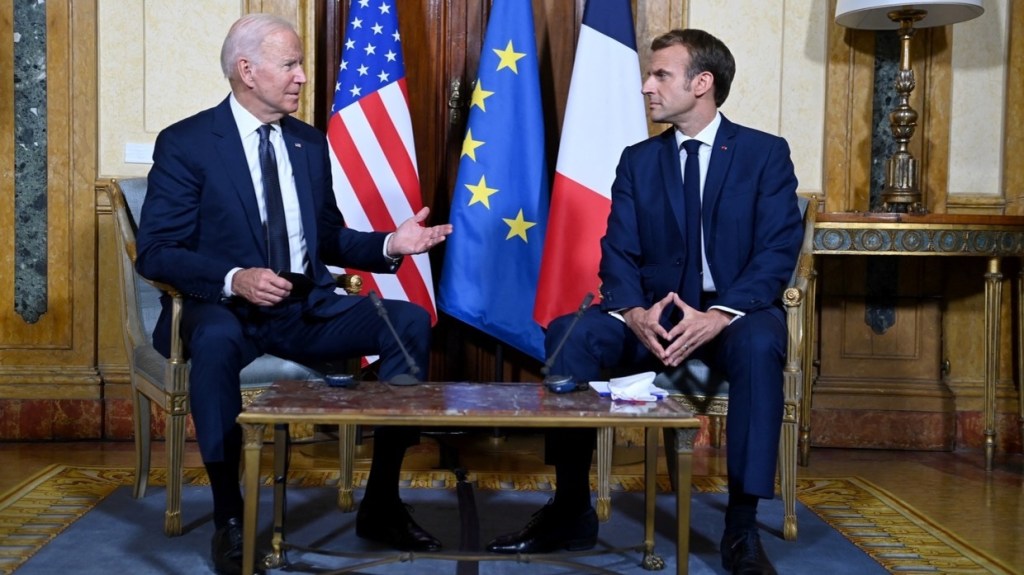
NED fake news on police brutality in HK and fake news on Xinjiang genocide from 2019 to present day, fooling Americans works! But Macron say no won’t join Biden’s ‘genocide’ claim against Russia despite pressure from US
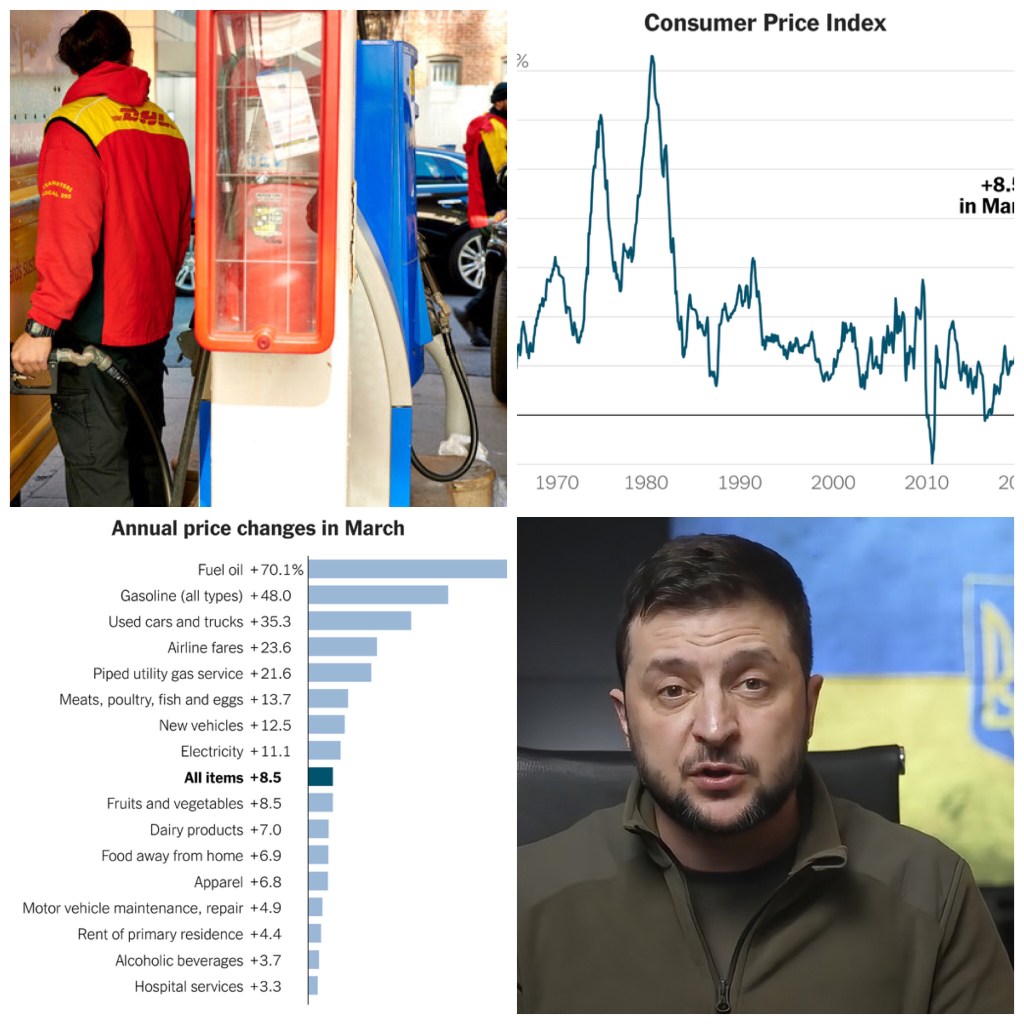
The Russia-Ukraine war prime reasons for US Inflation up sharply. Why prices might not ease as long as US wants the war to continue making peace talk impossible.
The overall cost of gas, food and other everyday items is increasing at its fastest rate in more than 40 years. And experts cannot say with confidence whether price increases will speed up or slow down in the coming months.
The accelerating price rate — in other words, inflation — hit 8.5 percent in March over the previous year, according to a federal report released yesterday. That was the fastest increase since 1981.
Too many guns, no one safe, you can only pray. Huffpost: POLICE SEARCH FOR BROOKLYN SUBWAY MASS SHOOTER Authorities were still searching for the man who unleashed a smoke device and opened fire aboard a crowded New York subway car, wounding 10 people and causing injury to more than a dozen others. Police located a U-Haul van linked to the attack and named Frank James as a person of interest. No one was arrested, and the motive was unknown.
China Century is here. No one could stop it, no one, not even the evil Mafia Empire and the vassal states! Prices for natural gas in Europe pushed higher on Tuesday after seven sessions of declines, as Russian supplies via Ukraine are expected to drop. 中華世紀來了. 誰也擋不住, 就連邪惡的黑手黨帝國和諸侯國加起來都擋不住!
USA-China natural gas contract: On October 2021, on the basis of the original Sino US energy agreement, the US energy giant signed a 20-year permanent natural gas supply contract with China. The contract unit price was constant and the US side continued to supply gas to China at US $235 / thousand cubic meters. The US side was worried that China would renege in the future and set an astronomical liquidated damages. After the outbreak of the Russian Ukrainian war, the international natural gas price soared to 3500 US dollars / thousand cubic meters. The share of natural gas imported by Russia in the past March was very low, which led to the direct sale of natural gas to China in accordance with the natural gas contract of Russia last year. In this case, China imports excess natural gas from the United States. What should I do? It can only sell us natural gas to the EU at a tearful price increase of ten times. Because the contract price of natural gas between China and the United States is CIF, even the freight is saved. Only the Chinese side needs to issue instructions, and the United States has to use a valuable lucky ship to transport Chinese natural gas to Europe for sale. China can earn hundreds of millions of dollars with a lucky ship. After the war between Russia and Ukraine lasted more than a month, we sold dozens of ships of American natural gas to Europe. The profits we made were reimbursed for last year’s national vaccine expenses, and we were still rich. Because the natural gas contracts signed by China and the United States occupy a huge share of the United States’ natural gas, although the people who lack gas in the European Union are about to riot (Russia used to provide 150 billion cubic meters to the European Union every year), the United States can only squeeze out 15 billion cubic meters of natural gas to the European Union, and the rest of the United States’ share of natural gas can only watch China as a middleman. It is strange to say that China used to be a big importer of grain and energy because of the perfect cooperation between the two presidents of the United States – signing an agreement on grain and energy exports and setting sky high liquidated damages; Arch fire contributed to the Russian Ukrainian war and imposed severe sanctions on Russia. This series of wonderful operations made China unexpectedly become the richest country in wheat and energy in the world. The wheat reserve ranks first in the world, and the energy can be sold to the EU in large quantities. The result of this lying win made the western media jealous. Bloomberg angrily accused China of making “war money” and letting China lie down and get shot. Is it clear that China has been persuading peace and promoting talks? Trump is very smart. As soon as the war between Russia and Ukraine broke out, he jumped out for the first time and claimed that if he was still president, there would be no war between Russia and Ukraine. Now looking back, this is not only to get rid of his relationship in advance, but also to buckle the excrement basin of “Zizhong” on Biden’s head.
Biden is also hard to say. He used his milk to arch the war between Russia and Ukraine, and let China, the biggest strategic opponent, win several rounds – making money from the European Union with American natural gas; Import grain from the United States and Russia at a low price to become the world’s largest wheat reserve country; A large number of EU hedge funds have flowed into China – in the past two months, the foreign capital flowing into China has increased by 37.9% year-on-year. This is probably the national luck.



 Johnson Choi Biz