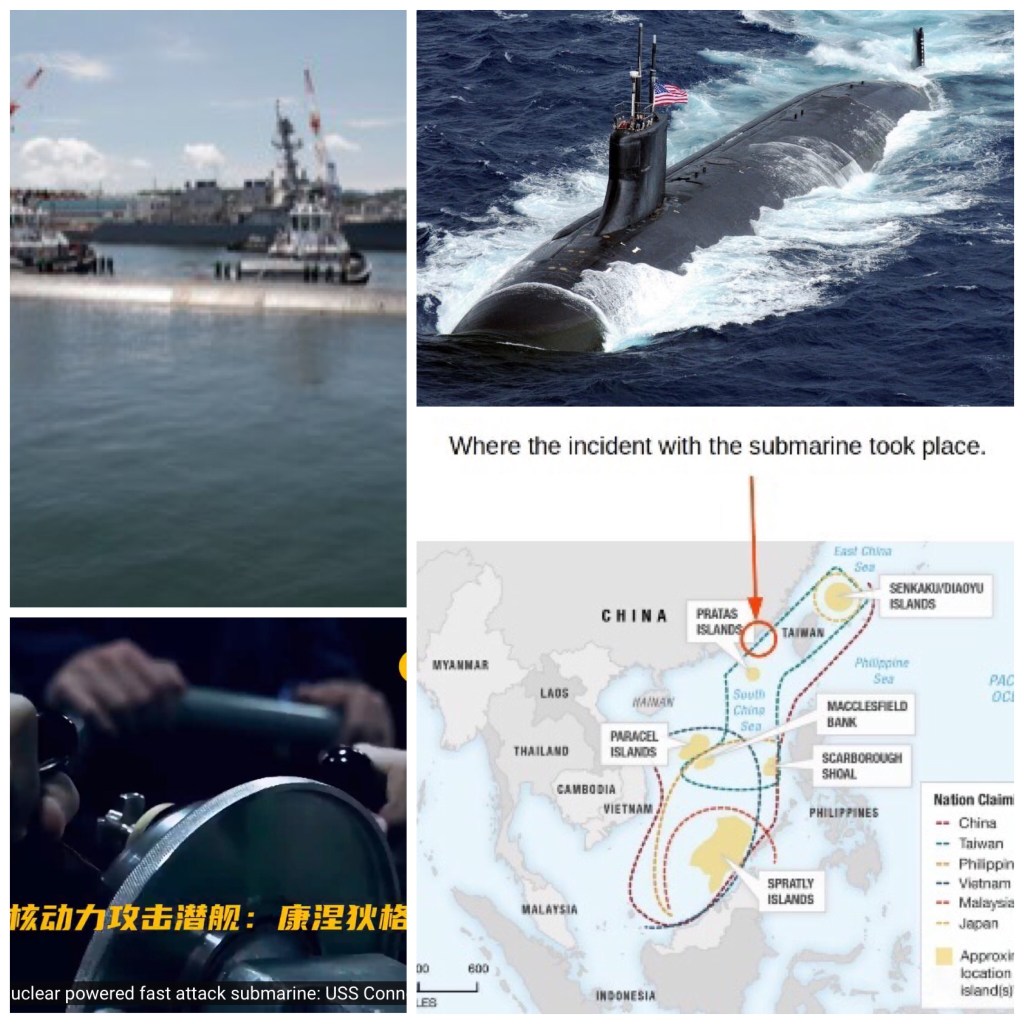
How the Chinese People’s Liberation Army hunted the most advanced USS Connecticut Seawolf-class attack nuclear submarine in the South China Sea.
-October 2, 2021 -The British aircraft carrier Queen Elizabeth, the American aircraft carrier Nimitz, the American aircraft carrier Roosevelt, and the Japanese aircraft carrier Izumo entered, with 17 other warships from the United States, Britain, Japan, the Netherlands, Canada and Australia into The South China Sea to conduct large-scale military exercises against China.
-October 2 to 4 2021 The People’s Liberation Army dispatched a large number of military aircraft to the South China Sea to conduct simulated attack exercises against these uninvited warships from the six countries of the United States, Britain, Japan, Holland, Canada and Australia.
-October 2, 2021 -China’s Guanlan Marine Science Guard observed the approximate position and depth of the USS Connecticut Seawolf class nuclear submarine when it entered the South China Sea. The Guanlan satellite sent data to the Super Measurement Center in Jinan to estimate the position of the Connecticut.
-China’s special detection device captured the ultra-low frequency sonar signals, from the bow of the Connecticut and transmitted the data to the Sonar Analysis Center in Shanghai, to accurately locate the position and depth of the Connecticut (1500 Meters).
-The Type 927 underwater acoustic detection ship, stationed on Yongshou Island and the anti-submarine helicopter stationed on Yongxing Island were dispatched for detection.
-The Yun-8 military plane took off from the Hainan Air Force Base, and carried out “sonic bombing” of the Connecticut with “sonic bombs”, causing the submarine’s personnel to be extremely uncomfortable, due to the sonic shock, and forcing the submarine to try to escape.
-The Chinese HSU001 unmanned submarine, slipped silently, to attach itself to the bow of the Connecticut, away from its nuclear power plant, for a close local explosion attack, causing serious damage to the bow of the Connecticut, and loss of its sonar navigation capabilities. The nuclear power plant of the Connecticut was are not affected, thus preventing nuclear leaks from the submarine into the sea.
-The Connecticut nuclear submarine, which lost its underwater submarine capability, was forced to float up and surrender. Due to the close surveillance of the navy and air force of the Chinese People’s Liberation Army, military aircraft and ships from the six countries of the United States, Japan, Britain, Australia, Holland, and Canada, dared not come to rescue the Connecticut in their South China Sea exercise. Instead the Connecticut was “escorted” by the Chinese Navy, and Air Force underwater before being released to the US.
-October 7, 2021 -The United States announced the Connecticut accident in an obscure manner.
-October 7, 2021 -The Chinese Foreign Ministry urgently requested for details of the USS Connecticut incident from the US.
-October 22, 2021 -The Chinese monitoring system detected another US nuclear submarine entering the South China Sea again, near Huangyan Island. The Chinese military also forced the submarine to float up and limped to Guam.
The US nuclear submarines can no longer hide in the Waters off CHINA.
Game over for US submarines.
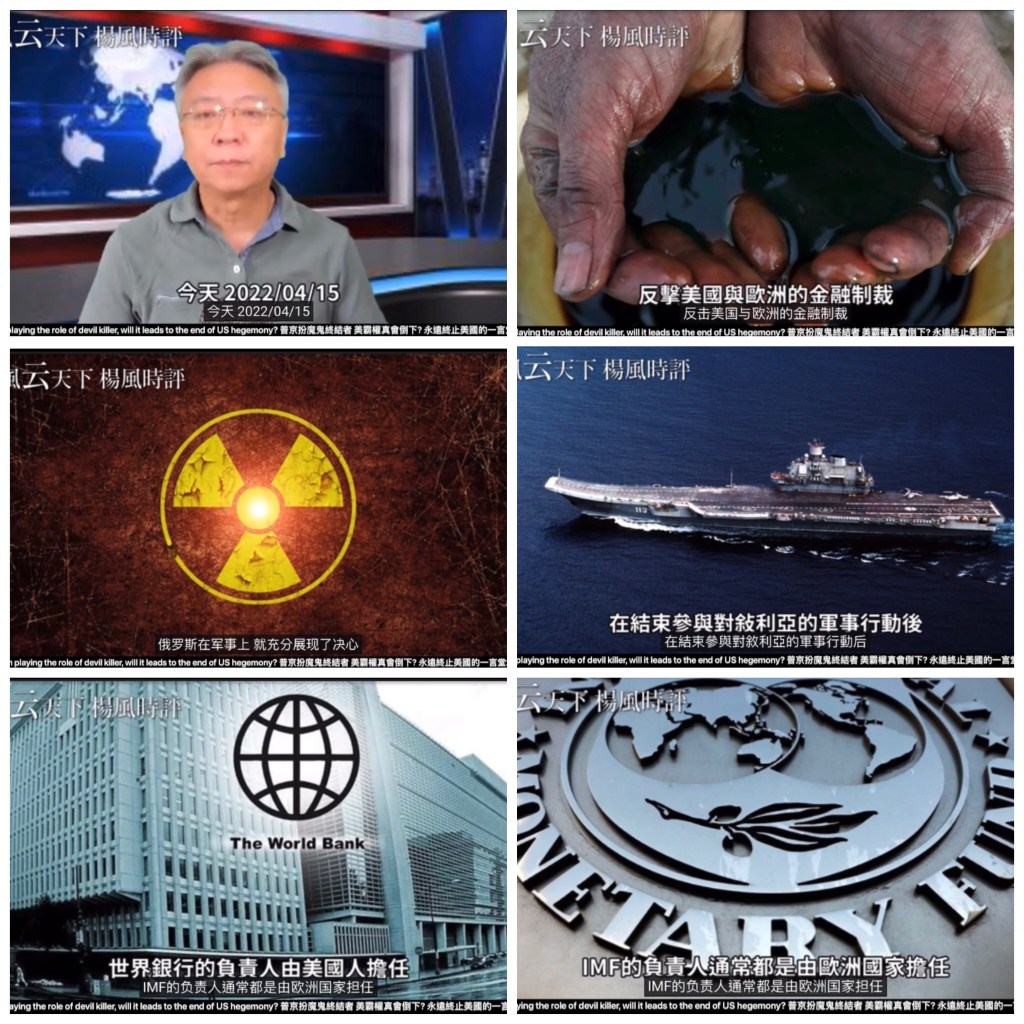
Without the protection of its submarines, the US aircraft carrier fleet can only become the target of China’s Dongfeng 21D, Dongfeng 26 and Dongfeng 17. Without the strength of its aircraft carrier fleet, it will soon be game over for the US military in the South China Sea.
After living in US for almost 50 years, US branded ‘white supremacy’ state is absolutely correct. US has been trying to “blur” discrimination against Asian Americans, a report by a Chinese NGO has claimed. 在美國生活了近 50 年後,美國被打上“白人至上”的烙印是絕對正確的.
Anti-Asian sentiments are on the rise in the US and they are being covered up by the country’s authorities, China’s largest human rights NGO has claimed.
On Friday, the China Society for Human Rights Studies published a report entitled, ‘Increasing Racial Discrimination Against Asians Exposes Overall Racist Nature of U.S. Society’.
Noting that while the problem of discrimination and violence against Asian Americans cannot be considered a new one, the authors of the report argue that the coronavirus outbreak, which supposedly started in China before turning into a global pandemic, “has exposed various racial discrimination problems existing in the society.”
According to the AAPI Hate, a national coalition that tracks and responds to racially motivated hate crimes towards Asian Americans and Pacific Islanders, more than 9,000 anti-Asian incidents took place between March 2020 and June 2021, during the peak of the pandemic.
However, the health crisis isn’t the only thing that should be blamed for the “sufferings” which the US allegedly caused to Asian Americans, the authors of the report claim.
“The racial discrimination against Asian Americans that has continued to the present time is probably a built-in and natural product of American colonialism, and it also reflects a mindset of the United States: bullying the weak,” the report said.
Some of the other causes of anti-Asian sentiments listed by the NGO are an “upsurge of xenophobia” and “white supremacy,” which, as the report claims, “is embodied in the racial structure and social atmosphere of the United States.”
The stereotypical representation of Asian Americans as “well-educated with high incomes” has prevented many of them from “enjoying favorable policies for US ethnic minorities,” the report said. Another factor contributing to negative sentiments towards Asian Americans is their long-standing antagonism with other ethnic minorities, reflecting, according to the NGO, “the complex racial relations and conflicts within the United States.” Finally, the researchers pointed out that “the tension between the United States and a foreign country frequently led to discrimination and racist attacks against the immigrants from that foreign country.”
Considering the strained relations with China, the report suggests that even if the racial discrimination against Asian Americans in the post-pandemic era subsides, “the racial attacks against Chinese Americans will continue to rise.”
“The United States has never compensated for or reflected on the sufferings it has caused to Asian Americans, and even tries its best to cover up or blur relevant facts. As such, the deep-rooted malice toward Asian Americans in U.S. society can never be eliminated,” the report stated.
The researchers justify this accusation by claiming that Asian Americans are portrayed in the US as “outsiders in racial conflicts; the mainstream society denies the history of racial discrimination against Asian Americans and refuses to admit that there are racist attacks against Asian Americans at present.”
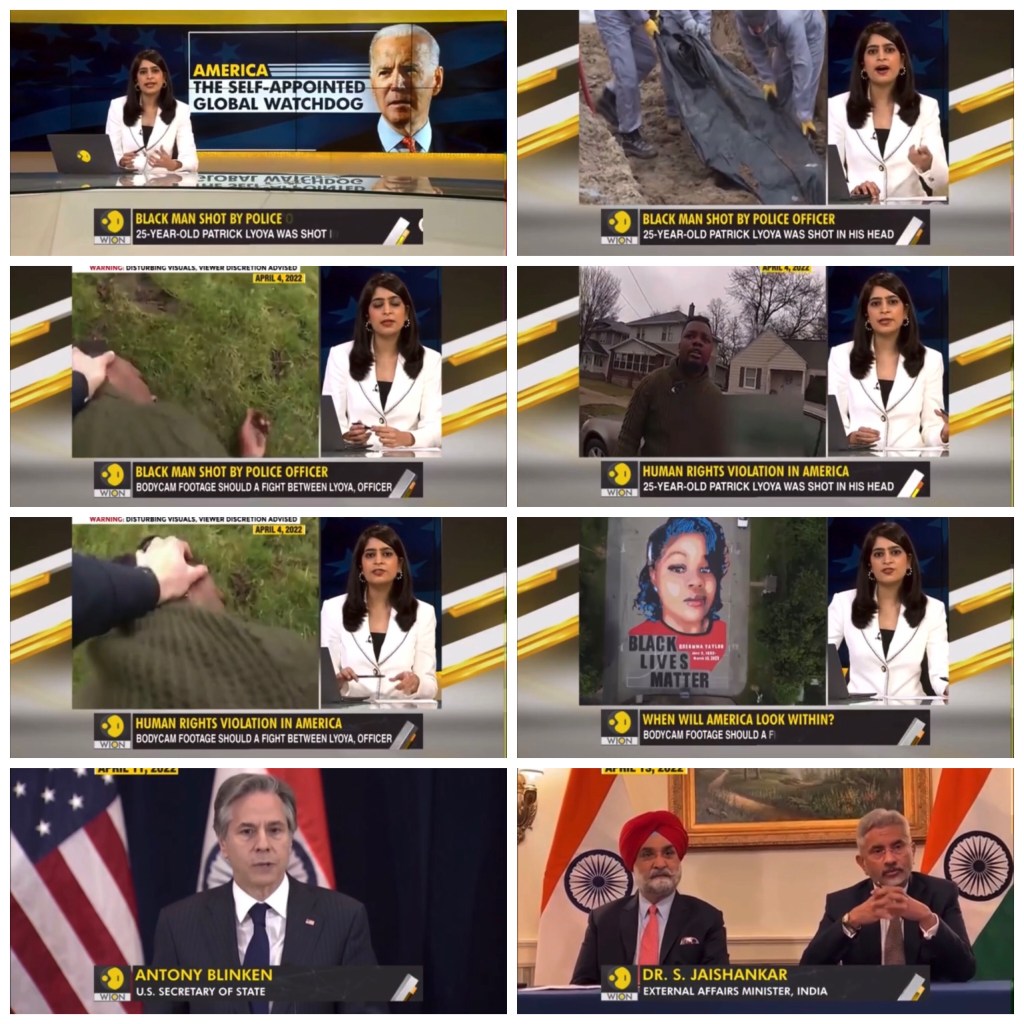
On Thursday, Chinese Foreign Ministry spokesperson Zhao Lijian addressed the problem of racial discrimination in the US. During a regular press briefing, he was asked to comment on the State of Black America report, published on April 12 by the National Urban League. Lijian said the report “again exposes the persistent systemic racial discrimination in the US, which has seeped into all aspects of social life.” Underlining that “the sufferings of African Americans are not unique to them, but experienced by other ethnic minority groups as well,” the foreign ministry spokesman went on to urge the US government to take “a hard look at the country’s own human rights issues.”
These remarks came just a day after India made similar accusations against the US. Following a New York incident in which two Sikh men were assaulted with fists and a stick, Nikki Singh, a senior policy and advocacy manager at The Sikh Coalition, pointed to an increase in the number of hate crimes against members of the religious community in the US. Indian Minister of External Affairs Subrahmanyam Jaishankar said that his country was tracking human rights abuses in the US, including those targeting Americans of Indian origin.
Jaishankar’s statement came in response to comments by US Secretary of State Antony Blinken who said that Washington was “monitoring some recent concerning developments in India, including a rise in human rights abuses by some government, police, and prison officials.”
On April 12, the US State Department published its own annual report on human rights around the world, in which it blamed both Beijing and New Delhi for “significant human rights issues.” China is accused by the State Department, among other things, “of arbitrary or unlawful killings by the government,” tortures, arbitrary detentions, and life-threatening prison conditions.
RMB $10 millions, deadline Jun 1 2022 – World Laureates Association Prize “WLA Prize” is an international science prize established in Shanghai, in 2021, initiated by WLA managed by the WLA Development Foundation, and funded by Sequoia China.
The WLA Prize aims to recognize and support eminent researchers and technologists worldwide for their contributions to science. It is intended to support global science and technology advancement, address the challenges to mankind and promote society’s long-term progress.
Each year, the WLA Prize consists of two single prizes, namely the “WLA Prize in Computer Science or Mathematics” and the “WLA Prize in Life Science or Medicine”.
The total award for each Prize, which may be divided among up to four laureates, is RMB 10 Million.
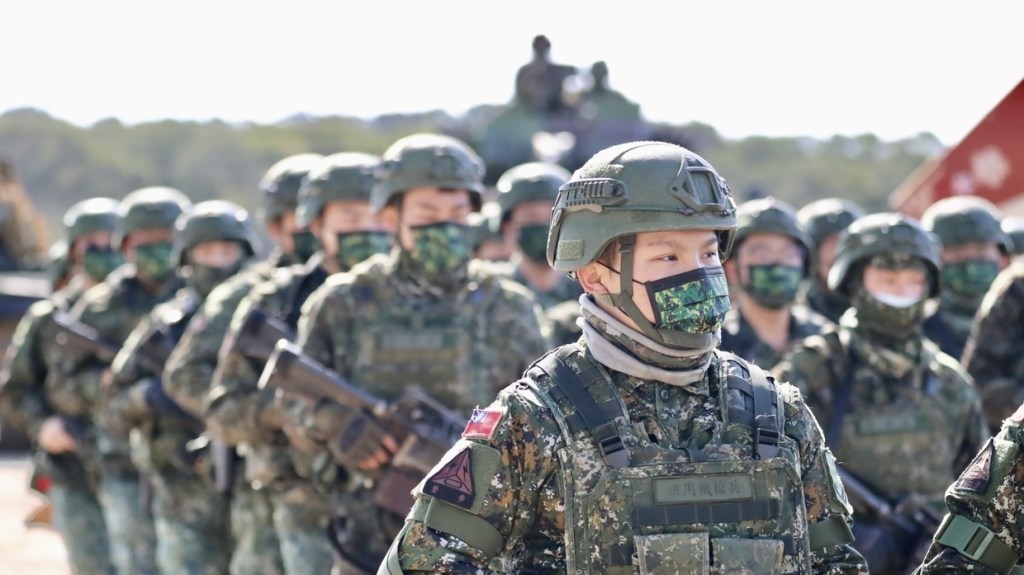
US comments on possibility of China attacking Taiwan – haha 😂 good luck, not going to happen 美國自己去打飛機吧! Washington has pledged to take “every step” to prevent an assault on the island by Beijing. 美國好惡毒, 美國自1882年通過排華法案後至今便用盡一切辨法要弄死在美華人, 今天還給台灣漢奸走狗和留在台灣的日本人後代像菜英文之類小人敗類要把台灣變成美國殖民地, 其心可誅.
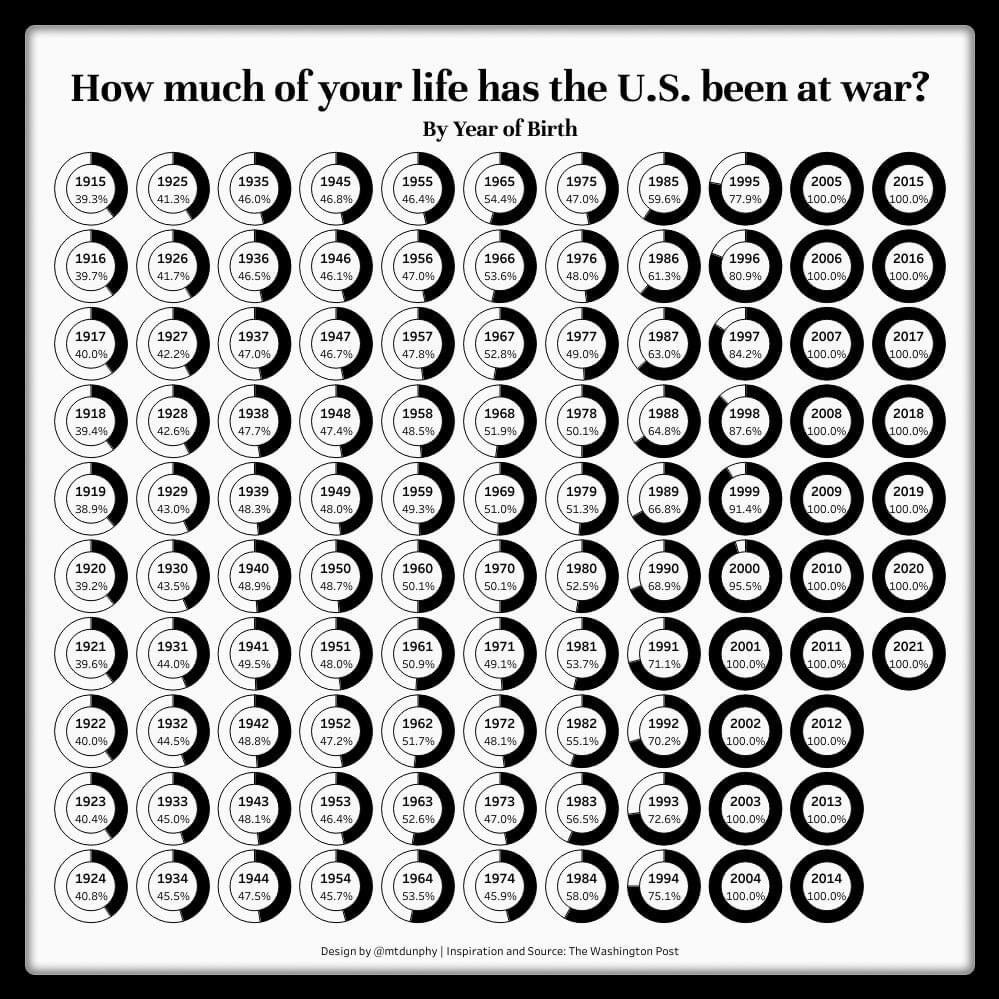
‘CHINA HAS NOT WASTED A SINGLE PENNY ON WAR’ President Jimmy Carter – who normalized diplomatic relations between Washington and Beijing in 1979 suggested that China’s breakneck growth had been facilitated by sensible investment and buoyed by peace. “Since 1979, do you know how many times China has been at war with anybody?” Carter asked. “None. And we have stayed at war.” The U.S., he noted, has only enjoyed 16 years of peace in its 242-year history, making the country “the most warlike nation in the history of the world,” Carter said. This is, he said, because of America’s tendency to force other nations to “adopt our American principles.” In China, meanwhile, the economic benefits of peace were clear to the eye. “How many miles of high-speed railroad do we have in this country?” he asked. While China has some 18,000 miles of high-speed rail, the U.S. has “wasted, I think, $3 trillion” (in 2019) on military spending. “It’s more than you can imagine. China has not wasted a single penny on war, and that’s why they’re ahead of us. In almost every way.” “And I think the difference is if you take $3 trillion and put it in American infrastructure you’d probably have $2 trillion leftover. We’d have high-speed railroad. We’d have bridges that aren’t collapsing, we’d have roads that are maintained properly. Our education system would be as good as that of say South Korea or Hong Kong,” Carter told his church congregation on Sunday, April 14, 2019. (By 2022 China will have 40,000 km of high speed rail. )
US causes humanitarian disasters around globe, killing innocent civilians and creating millions of refugees 美國在全球範圍內造成人道主義災難,殺害無辜平民並造成數百萬難民 by Li Zhun Apr 13 2022
Editor’s Note: Since the military conflict between Russia and Ukraine began, the international community has grown increasingly aware of the roles the US and NATO have played behind the crisis.
From lip service on the Ukraine refugee issue to a spotty overseas human rights record; from imposing sanctions on “disobedient countries,” to coercing other nations to pick sides… the US has acted like a “Cold War schemer,” or a “vampire” who creates “enemies” and makes its fortunes from pyres of war. The Global Times is publishing a series of stories and cartoons to demonstrate how the US, in its superpower status, has been creating trouble in the world one crisis after another. This is the sixth installment.
Is the US a “defender” or a “violator” of human rights? Who has been sacrificed on the “altar” of US-touted “democracy?” One Global Times reporter investigated the US’ vile practice of igniting war under the pretext of “human rights and democracy.”
1 Ukraine crisis instigator: US-led NATO reneges on ‘Not one inch eastward’ promise to compress Russia’s space to the extreme
2 Instability brewer: Behind every war and turmoil in the world is shadow of the Star-Spangled Banner
3 ‘Vampires’ in the war: US warmongers feeding on the bloody turbulence in other countries
4 Cold War schemer: Reminiscing in its past ‘victory,’ US brings color revolutions to 21st century to maintain its hegemony
5 The poison disseminator: How US spread biological ‘poison’, ethnic division and ideological antagonism around the world
“Why did the United States resettle only 12 Ukrainian refugees in March?” Reuters questioned in a headline on April 12.
More than 4 million people have fled Ukraine to neighboring countries since Russia launched special military operations on February 24, according to United Nations data, setting off Europe’s most volatile refugee crisis since the end of World War II, Reuter reported.
Facing growing criticism and pressure from refugee advocates, the Biden administration said on March 24 that the US would use “the full range of legal pathways” to accept up to 100,000 Ukrainians fleeing the war.
This figure stands in stark contrast to the role of the US in stoking the flames in the Russia-Ukraine conflict.
For decades, the US has, in fact, repeatedly waged wars abroad that have resulted in numerous refugees. Yet when it comes to resettling them, the US strategically passes the buck. The plight of the refugees shows that the US, while branding itself as a so-called “defender” of human rights, is actually their greatest “violator,” observers said.
US lip-service to Ukraine refugees
“We’re going to welcome Ukrainian refugees with open arms if, in fact, they come all the way here,” was a promise made by US President Joe Biden and Vice President Kamala Harris, repeated by US Secretary of State Antony Blinken and White House Press Secretary Jen Psaki. Yet the US, the architect of the conflict between Russia and Ukraine, has accepted dismally few refugees.
Reuters reported that the US admitted 514 Ukrainian refugees between January and February, according to State Department data, with only 12 having been resettled in March as the war intensified and the number of Ukrainians fleeing skyrocketed. This means that the number of Ukrainian refugees admitted by the US was only five in late March, when President Biden pledged the US would accept up to 100,000 on March 24.
Perhaps from the start, the US was prepared to leave the resultant refugee crisis to Europe. Jen Psaki had said on March 10 that the administration believes the “vast majority” of refugees will want to remain in neighboring countries where many have family, friends, and former employers.
The US State Department said that it will work with the United Nations to bring Ukrainian refugees to the US if they lack protection in Europe, emphasizing that resettlement to the US would not be a quick process.
The US’ lip service can also be reflected in its pathway to accepting refugees. Reuters reported that the pathways include the US refugee resettlement program, which provides a route to citizenship, as well as existing visa avenues and a relief program known as “humanitarian parole,” which allows people into the country on a temporary emergency basis.
Under the “humanitarian parole,” getting a visa is not an easy thing as applicants must demonstrate their trip is for a bona fide purpose, they will stay for a limited time, they can cover their expenses, and have a place outside the US and other binding ties which will ensure their eventual return home, conditions obviously difficult for many refugees to meet, Forbes reported on April 10.
President Biden has raised the national refugee cap on admissions to an 125,000 for 2022. But six months into the government’s fiscal year, the US has accepted fewer than 9,000.
At that pace, it’s impossible to imagine the administration’s recent promise would be met, one Washington Post opinion piece said.
US atrocities overseas
The millions of Ukrainian refugees are just the latest victims of the US’ global hegemony. The US waged wars across the world after WWII, which not only caused the deaths of innocent civilians but also led to a large number of refugees, seriously affecting the economic development and social stability of affected countries and regions.
The so-called anti-terrorism wars launched by the US in the past 20 years have claimed the lives of more than 929,000 people, showed a study published by the Watson Institute for International and Public Affairs at Brown University.
An investigative report by The New York Times in December 2021 revealed that American forces conducted more than 50,000 airstrikes in Iraq, Syria, and Afghanistan, causing “thousands of civilian deaths.”
Observers pointed out that the US military had been concealing the number of casualties in the wars, and the actual numbers of civilian deaths were much higher than it had claimed.
The US military often covers up or underplays its war crimes. In August 2021, 10 Afghan civilians, including seven children, were killed in a drone strike conducted by US troops, before the troops withdrew from Kabul. The Pentagon later admitted the strike was a tragic mistake, but it noted that none of the military personnel involved will face any kind of punishment, reported the NYT.
At home, the US creates “information cocoons” with its feigned power of speech to keep the American public unaware of human rights abuses and humanitarian disasters caused by its troops in overseas wars. In the Vietnam War, for instance, the US military’s inhumane use of a chemical weapon, the herbicide “Agent Orange,” caused congenital lifelong diseases among local populations. But the US government merely dubbed such diseases “the Vietnam syndrome.”
At the same time, the US has an appalling record of “producing refugees.” Through the 20-year war in Afghanistan, for example, the UN refugee agency warned that some 6 million Afghans have been forcibly displaced from their homes. And nearly 23 million people, accounting for 55 percent of the country’s population, are facing extreme hunger, including 3.2 million children under the age of 5.
According to the United Nations High Commissioner for Refugees’ 2022 report, the Syrian war has resulted in Syrian refugees exceeding 610,000, making it the population with the highest need for resettlement.
The Global Times found that there are still 5.6 million Syrian refugees living in neighboring countries.
However, the NYT recently reported that fewer than 23,000 Syrian refugees have been admitted to the US since 2016.
Analysts pointed out that the US exports wars overseas, leading to economic decline and unrest in the invaded countries, further affecting the development of these countries and infringing on the rights of their people.
According to a December 2021 article on the UAE’s Gulf Today website titled “How the US ruined Iraq devastatingly,” Iraq now has four times more people suffering from diarrheal diseases than before the war due to the damage caused by the US bombing of local power plants and water treatment facilities. The lack of medicine and medical equipment has left the Iraqi healthcare system in crisis. In addition, inadequate food supplies and inflation have left Iraqis facing chronic hunger.
After the US invasion, Syria’s once-thriving tourism industry was decimated, threatening the future of a generation with increased poverty, lack of jobs, and reduced educational opportunities for children, observers noted.
The US is also accustomed to using sanctions to willfully violate the right of nations to development and healthcare. Nicholas Mulder, assistant professor of history at Cornell University, previously commented on US Foreign Policy website that, long ago, many Americans considered economic war against civilians an imperialist policy for the old world, but now that Washington is wielding the sanction stick with increasing frequency, sanctions have become an endless instrument of economic warfare.
Nailed in historical pillar of shame
The US’ overseas human rights records are notorious, and domestic human rights violations are not uncommon. Though the US is the richest country in the world, at least 40 million Americans live in poverty. The US is one of the most unequal society in the developed world, ranking 35th out of 37 OECD countries for poverty and inequality. The US has the highest infant mortality rate in the developed world, and the youth poverty rate is the highest in the OECD countries.
The American Civil Liberties Union pointed out that not only does the US not honor the United Nations Convention against Torture, but also selectively interprets it, leading to widespread torture and mistreatment of prisoners in Guantanamo Bay, Iraq and Afghanistan.
Moreover, US human rights issues have deep historical roots, as the US has long had problems such as racial segregation and racial inequality.
In US history, there was the genocide and massacre of Native Americans and US law enforcement brutality has resulted in frequent cases of African American deaths.
To this day, the systematic racism is still evident in every corner of American society.
For a long time, international public opinion has widely criticized the global humanitarian crisis created by the US. At the 46th session of the United Nations Human Rights Council in 2021, the Syrian representative condemned the US for evading its obligations under international law and for making excuses for its military aggression and threats to the unity and territorial integrity of other countries.
The US not only violates the human rights of other countries but also uses human rights issues to interfere in the internal affairs of other countries. The US’ double standards on human rights actually use human rights as a tool to safeguard its hegemony, analysts said. “Rather than pointing fingers at other countries, the US should better reflect on its human rights violations.”




 Johnson Choi Biz