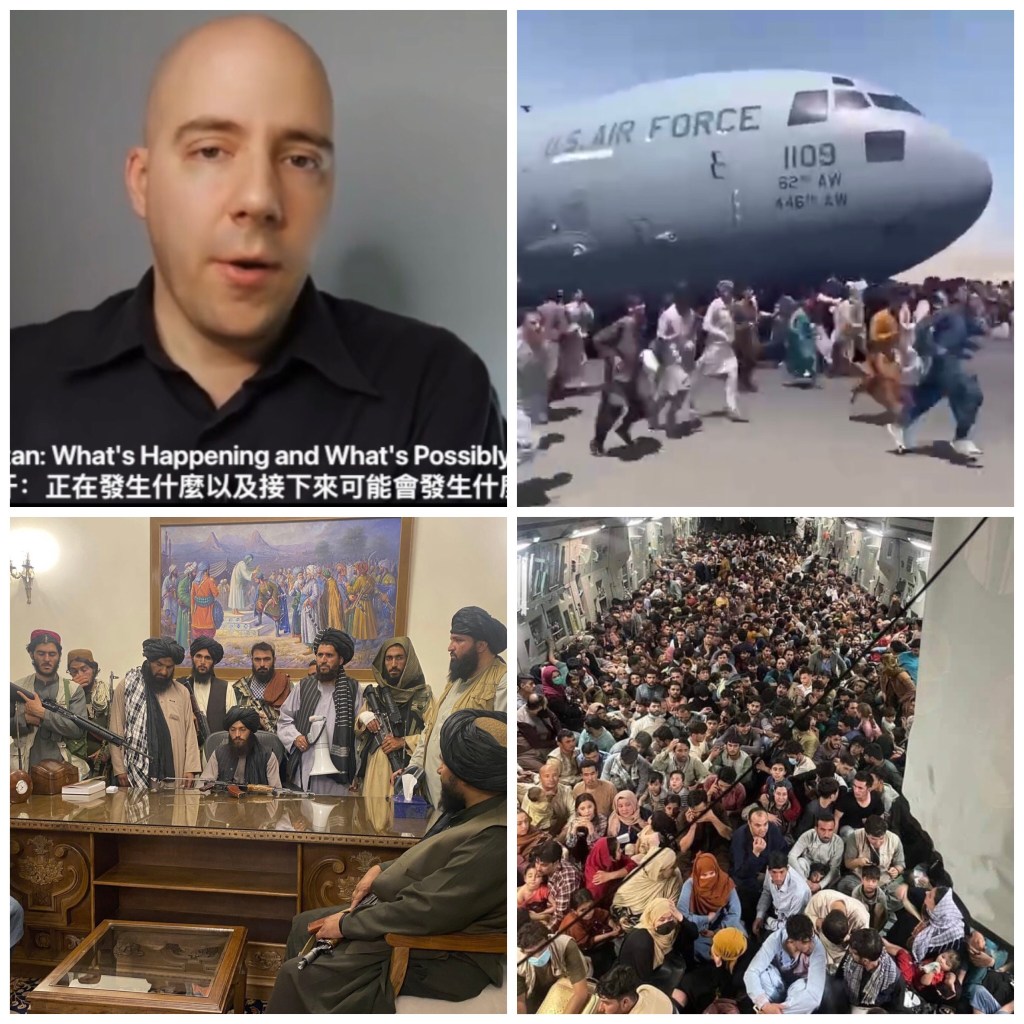
Video: The veil of secrecy surrounding the U.S. Fort Detrick Lab and COVID-19

Video: The veil of secrecy surrounding the U.S. Fort Detrick Lab and COVID-19. When COVID-19 began sweeping across the U.S. in April, New York City quickly became the epicenter of the outbreak. Some 240 miles away, in a quiet town in Maryland, is Fort Detrick, where the U.S. government conducts experiments on dangerous pathogens, including close siblings of the novel coronavirus. As more revelations emerge pointing to the chronic safety issues of these U.S. labs, the question becomes, should the world become an experimental playground for Washington’s bio-research adventures? https://youtu.be/VUeplELez_o
https://vimeo.com/556435535

Asia Times: Stark contradiction at root of US-China conflict – As the Chinese dreamers come up against the US insistence on maintaining hegemony, who will prevail?

Asia Times: Stark contradiction at root of US-China conflict – As the Chinese dreamers come up against the US insistence on maintaining hegemony, who will prevail? By JOHN WALSH MAY 28, 2021

Do China and the US have fundamental goals that constitute a contradiction, that is, goals so profoundly at odds with one another that the goals cannot co-exist? Unfortunately, the answer is yes.

亞洲時報:中美衝突的根源是鮮明的矛盾 – 當中國夢想家與美國堅持稱霸的立場相抗衡時,誰將佔上風?

中美兩國是否存在構成矛盾的根本目標,即目標相互矛盾到無法共存的程度? 不幸的是,答案是肯定的。

Stark contradiction at root of US-China conflict

Such a contradiction means that one side must abandon its aims if a disastrous conflict is not to ensue. Which country should step back? Is there a moral, ethical or common-sense basis for making that call, a basis on which humankind can readily agree?

What are these contradictory goals?

China’s overwhelming objective is clearly economic development, a policy to which it has hewed closely and which it declares for its future. That is no surprise; it is the dream of every developing nation. In this case, it is “The Chinese Dream.”

If such goals were no more than words on paper, there would be no problem. But China is succeeding, as is widely acknowledged now.

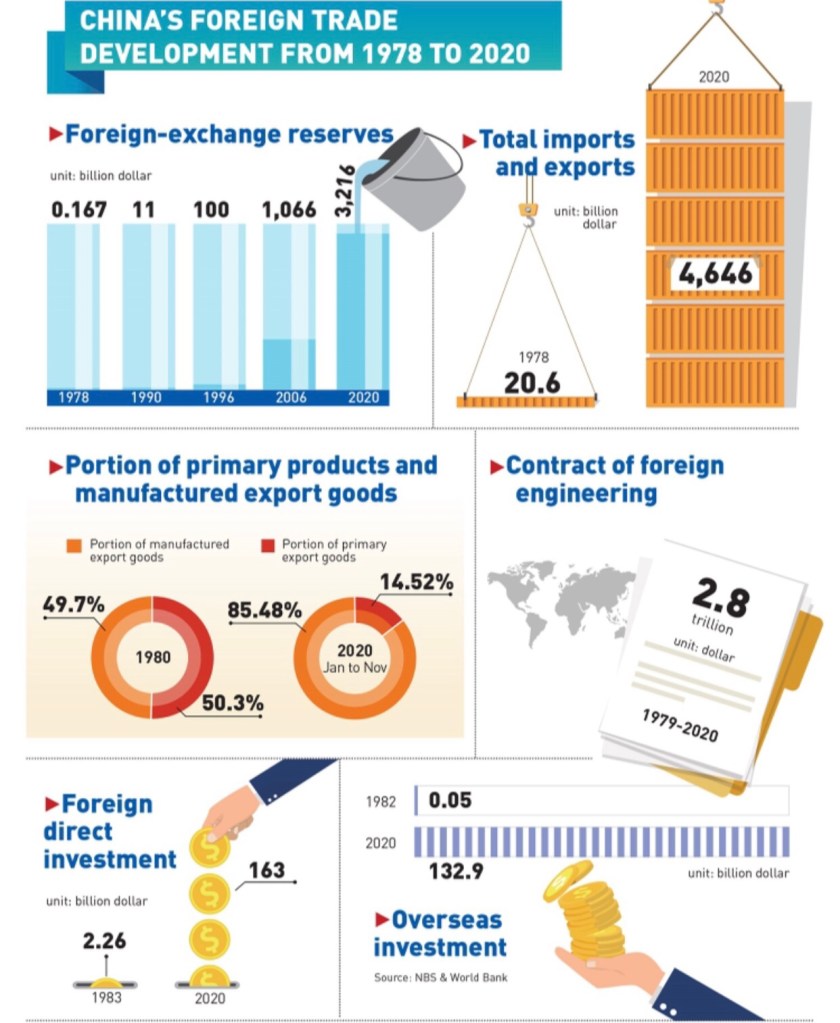
Its economy surpassed the US in terms of gross domestic product (purchasing power parity) in November of 2014 according to the International Monetary Fund and is still growing fast. More than 700 million Chinese have been brought out of poverty, with extreme poverty eliminated in 2020.

The middle class now comprises more than 400 million people. The retail market is enormous, and the e-commerce market by far the world’s largest. China is the world’s largest manufacturer and trader.

According to the World Bank, China was seventh from the top of the upper-middle-income group as of 2020 and poised to enter the ranks of the 59 countries in the high-income group. Beijing has a set a new goal, a standard of living enjoyed by the most prosperous countries in the West to be achieved by 2049, the centennial of the birth of the People’s Republic of China.

With this in mind, let’s turn to the American side of the equation.

The US has a long history of expansion and imperialism, with the inevitable appeals to exceptionalism and racism. However, the ambition of world dominance, global hegemony, emerged consciously among the US foreign-policy elite in 1941 before the country’s entry to World War II, as historian Stephen Wertheim documents in his 2020 book Tomorrow the World: The Birth of US Global Supremacy.

The magazine magnate Henry Luce expressed the idea in his 1941 essay “The American Century,” in which he enjoined the US “to accept wholeheartedly our duty and our opportunity as the most powerful nation in the world and in consequence to exert upon the world the full impact of our influence for such purposes as we see fit and by such means as we see fit.”

After World War II when the US colossus looked down at the rest the world devastated by the conflict, we heard a similar sentiment from the late diplomat and historian George Kennan, considered perhaps the principal architect of postwar US foreign policy. In Volume I of Foreign Relations of the United States, published in 1948, he wrote:

“Furthermore, we have about 50% of the world’s wealth but only 6.3% of its population. This disparity is particularly great as between ourselves and the peoples of Asia.… Our real task in the coming period is to … maintain this position of disparity…. To do so, we will have to dispense with all sentimentality.…. We need not deceive ourselves that we can afford today the luxury of altruism and world-benefaction.”

More recently and equally starkly after the end of the Cold War, the Wolfowitz Doctrine was enunciated in 1992 by Paul Wolfowitz, then undersecretary of defense for public policy under US president George H W Bush. It can be summed up in a single sentence: “We must maintain the mechanism for deterring potential competitors from even aspiring to a larger regional or global role.”

China fits the definition of a “potential competitor”; it not only “aspires” to a larger regional role and global role but in fact has already attained it. By the Wolfowitz principle, China must not only be “contained” but returned to a non-competitor status by whatever “mechanism” that the US can devise.

And so we come to the basic contradiction. The US insists that it be the world’s greatest power, an unassailable hegemon. This means that it must be the No 1 economic power, since all power ultimately derives from economic power.

Now assume that China’s per capita GDP is equal to that of an advanced Western country, the goal of China by 2049. Take the US as an example. Since China’s population is about four times that of the US, then it will have a total national GDP four times that of the US. The US will then be far from the dominant power; the Wolfowitz Doctrine will go up in smoke.

This does not mean that the US will lapse into penury or even that its living standard will be compromised. Indeed, there is no reason that the US cannot continue to be an increasingly prosperous country. In that sense, the contradiction between the US and China is not a conflict of interests between the American people and Chinese people. But it is a contradiction between the US governing elite and 1.4 billion Chinese dreamers.

Even now with China on a par with the US economically in GDP (PPP) terms the US cannot operate as a hegemon or as an unchallenged world power.

How can the US maintain its ambition of hegemony? Simply put, China’s development must be halted or reversed. Thus the drive for US superiority is a war on the aspirations of the vast Chinese population, not simply a war on the Chinese state. Will China’s people, nearly 20% of the global population, passively accept this fate?

How then are we to look at the China-US contradiction in moral or ethical terms? Given the US goal of hegemony versus the Chinese dream of a Western standard of living, which has the greater claim on the support of decent humans everywhere? The 1.4 billion Chinese dreamers or a tiny US governing elite?

JOHN WALSH
John V Walsh writes about issues of war, peace and empire, and about health care, for Antiwar.com, Consortium News, Dissident Voice.org and other outlets. More by John Walsh

Actor and professional wrestler John Cena has apologized to fans in China after he called Taiwan a country

演員兼職業摔跤手約翰塞納在稱台灣為國家後向中國粉絲道歉 Actor and professional wrestler John Cena has apologized to fans in China after he called Taiwan a country

Bevin Chu: MY TWO CENTS ON THE JOHN CENA TAIWAN CONTROVERSY

John Cena is one of the good guys. He is a Sinophile. A “Panda Hugger”. He has diligently made an effort to learn Chinese. He has even acquired a heartfelt liking for Lao Gan Ma chili sauce.

His comment about Taiwan was almost certainly not malicious. He is a professional wrestler, not an anti-China political activist, even less a political analyst.

He is not Richard Gere. He is not Serpentza. He is not Laowhy. His comment, while mistaken, was merely the result of a professional wrestler’s lack of familiarity with the finer points of the Taiwan independence political minefield.

My recommendation? Everyone should chill and cut the man a break. His apology strikes me as entirely genuine.

“In one interview, I made a mistake,” he said in heavily accented Mandarin Chinese. “I need to say now that this is very, very, very, very, very important. I love and respect China and the Chinese people. I’m very, very sorry. As for my mistake, I really apologize for it.”

China has too few friends among American celebrities as it is. No need to overreact to a good friend’s innocent faux pas.

PS: Instead of venting one’s spleen on Cena, who didn’t mean anything by his faux pas, how about redirecting one’s anger at the rabid Sinophobes heaping scorn upon him for “groveling”. The reason the China-bashers are accusing him of “groveling” is that they sense that his apology was sincere, and from the heart.

ABC News 13 Houston: John Cena says he’s ‘really sorry’ for calling Taiwan a country after backlash from fans in China By Huizhong Wu, Associated Press Wednesday, May 26, 2021

TAIPEI, Taiwan — Actor and professional wrestler John Cena has apologized to fans in China after he called Taiwan a country in a promotional interview for his upcoming film and became the latest celebrity to face the fury of Chinese nationalists.

In a short video posted Tuesday on Chinese social media site Weibo, Cena did not refer to Taiwan or go into much detail about the incident, which occurred earlier this month when he was doing a promotion for “Fast & Furious 9” with Taiwanese media.

“In one interview, I made a mistake,” he said in heavily accented Mandarin Chinese. “I need to say now that this is very, very, very, very, very important. I love and respect China and the Chinese people. I’m very, very sorry. As for my mistake, I really apologize for it.”

In his interview with TVBS, a Taiwanese cable channel, Cena was also speaking in Mandarin when he said Taiwan would be the first “country” to be able to see the film. That led to an uproar in China, which considers the self-governing democracy its own territory to be taken back by force if necessary.

It was unclear if Cena’s apology worked, as many comments on Chinese social media in response to his video were negative. Likewise, Cena was also facing scorn back in the United States, where Sen. Tom Cotton called the apology “pathetic” and others lashed out at him on social media as a “coward.”

Global companies and celebrities seeking to maintain access to the lucrative Chinese market have to tread a fine line on many issues as online nationalistic outrage can spark boycotts.

China has increasingly pressured foreign firms over their statements on Taiwan, Hong Kong, Xinjiang, Tibet, the South China Sea and other issues Beijing considers sensitive.

Airlines and other multinational companies have been pushed to refer to Taiwan as a part of China on their websites or risk damage to their business in China.

Chinese state broadcaster CCTV cut ties with the NBA for a year in response to a tweet by Houston Rockets general manager Daryl Morey backing pro-democracy protesters in Hong Kong, even though the post was quickly deleted.

News about Chloe Zhao, a Chinese director, winning an Oscar was censored in April after old interviews surfaced where she said that she grew up in a place where there were “lies” everywhere.

Brands including Swedish retailer H&M, Adidas and Nike have been targeted for consumer boycotts after state media criticized them for expressing concern about reports of forced labor in China’s western region of Xinjiang.

Meanwhile, “Fast & Furious 9” – the latest in the Hollywood franchise – appeared to be doing well in China despite the uproar. The film has taken in $155 million at the box office in China since it opened on May 21, according to local media reports.

https://abc13.com/entertainment/actor-john-cena-faces-backlash-in-china-over-taiwan-comment/10697063/?fbclid=IwAR17a45fECxcqDPEwDzdjDiQZD3QhHY9woPu7b_qgegbSmcJ860efTb6UPU

Taiwan province facing surging COVID19, lack of testing facilities and vaccines turn a bad situation worst

Video: Taiwan province facing surging COVID19, lack of testing facilities and vaccines turn a bad situation worst. 台灣省面對激增的COVID19,缺乏檢測設施和疫苗使情況變得更糟。But Tsai Government is very picky, said only accept vaccines from her US masters, but US will not release some of the more than 100 millions COVID19 vaccines in cold storage to help her. 但蔡政府很挑剔,說只接受她美國主子的疫苗,但美國不會放出冷藏的1億多COVID19中的一些來幫助她。China has offered help repeatedly. Not only does she refused to accept Chinese COVID19 vaccines approved by WHO, also banning local government to get Chinese vaccines to save the people. 中國一再提供幫助。 她不僅拒絕接受世衛組織批准的中國COVID19疫苗,還禁止當地地方政府獲得中國疫苗以拯救人民生命. Taiwan Province is following US and India, world’s two largest failing democracy failing and betraying the very same people putting them in office. 台灣省正在追隨美國和印度,世界上最大的兩個虛假民主國家背叛了其人民曾經認為是投票給為人民服務的政府. 他們何其失望.
【頭條開講】大陸送疫苗也不要?人命關天還在挑三揀四! 疫苗支票一再跳票 沒有人負責? 台灣省長蔡英文祇接受美國主子提供的新冠病毒藥苗, 不接受世衛提供或中國提供的中國藥苗. 主持人 周玉琴
來賓:
不演了新聞台主持人 朱凱翔
公衛專家 內科醫師 祝年豐
前駐紐西蘭大使 介文汲
國民黨前青年黨團團長 田方倫
https://vimeo.com/556393599
https://youtu.be/laU_JK_L6sA
https://www.facebook.com/100036400039778/posts/500560957833901/?d=n

The New Yorker: American Democracy Isn’t Dead Yet, but It’s Getting There.

The New Yorker: American Democracy Isn’t Dead Yet, but It’s Getting There. A country that cannot even agree to investigate an assault on its Capitol is in big trouble, indeed. By Susan B. Glasser May 27, 2021

Mitch McConnell, who is delivering on his pledge to focus on blocking Joe Biden’s agenda, claimed that an investigation into the Capitol insurrection was pointless. Photograph by Craig Hudson / Bloomberg / Getty

When Joe Biden was a Presidential candidate, he carried around a wonkish book of international comparative politics by two Harvard professors, “How Democracies Die,” from 2018, to explain the urgency of his campaign against Donald Trump. He touted the book in an interview with my colleague Evan Osnos, marked up passages with notes and observations, and even, one of the book’s authors told me this week, recommended it to a random stranger he met while riding his beloved Amtrak. Now that he is President, Biden has characterized his efforts to restore American democracy as part of a global struggle with resurgent autocracies, in places such as China and Russia. “This generation is going to be marked by the competition between democracies and autocracies,” Biden said, in April, as he lobbied Republicans to support his sweeping, multitrillion-dollar infrastructure bill. “The autocrats are betting on democracy not being able to generate the kind of unity needed to make decisions to get in that race. We can’t afford to prove them right. We have to show the world—and, much more importantly, we have to show ourselves—that democracy works, that we can come together on the big things.” He ended with a typical Biden flourish: “It’s the United States of America, for God’s sake.”

United we are not. A month later, prospects for Biden’s ambitious legislative agenda remain uncertain, G.O.P.-controlled state legislatures are passing measures that will make it harder for many Americans to vote, and the White House may be only days away from giving up on bipartisan talks over the infrastructure bill, which have come nowhere close to a deal. Far from embracing Biden’s call for unity, Republicans remain in thrall to the divisive rants and election conspiracy theories of their defeated former President. As a result, Congress is at such a partisan impasse that it cannot even agree on a commission to investigate the January 6th attack by a pro-Trump mob on its own building.

Before leaving town for their Memorial Day recess, in fact, Senate Republicans successfully used the legislative filibuster for the first time this session to block the proposed bipartisan panel. Their stated arguments against a commission range from the implausible to the insulting; the real explanation is political cynicism in the extreme. Senate Minority Leader Mitch McConnell, who is so far delivering on his pledge to focus a “hundred per cent” on blocking Biden’s agenda, even claimed that an investigation was pointless because it would result in “no new fact.” John Cornyn, a close McConnell ally, from Texas, was more honest, at least, in admitting, to Politico, that the vote was all about denying Democrats “a political platform” from which to make the 2022 midterm elections a “referendum on President Trump.” For his part, Trump has been putting out the word that he plans to run for reëlection in 2024—and exulting in polls showing that a majority of Republicans continue to believe both his false claims of a fraudulent election and that nothing untoward happened on January 6th. Needless to say, these are not the signs of a healthy democracy ready to combat the autocratic tyrants of the world.

“Turns out, things are much worse than we expected,” Daniel Ziblatt, one of the “How Democracies Die” authors, told me this week. He said he had never envisioned a scenario like the one that has played itself out among Republicans on Capitol Hill during the past few months. How could he have? It’s hard to imagine anyone in America, even when “How Democracies Die” was published, a year into Trump’s term, seriously contemplating an American President who would unleash an insurrection in order to steal an election that he clearly lost—and then still commanding the support of his party after doing so.

Three years ago, it was still conceivable, if not likely, that Trump and Trumpism could be expunged by an overwhelming result at the ballot box or a clear-cut impeachment and expulsion from public life. But Ziblatt and Steven Levitsky, his co-author, never thought that would happen. Instead, they highlighted a more realistic possibility: that Trump’s electoral defeat would not stop the continued polarization, flouting of political norms, and increased “institutional warfare” in America—leaving the country a battered “democracy without solid guardrails” that would be “hovering constantly on the brink of crisis.” The crisis, however, turned out to be even more existential than they had predicted; the present is “much more worrisome,” Ziblatt told me. In contemporary Germany, he pointed out, an incitement to violence of the kind deployed by Trump and some of his backers might be enough to get a political party banned. But, in America’s two-party system, you can’t just ban one of the two parties, even if it takes a terrifying detour into anti-democratic extremism.

This is the worrisome essence of the matter. In one alarming survey released this week, nearly thirty per cent of Republicans endorsed the idea that the country is so far “off track” that “American patriots may have to resort to violence” against their political opponents. You don’t need two Harvard professors to tell you that sort of reasoning is just what could lead to the death of a democracy. The implications? Consider the blunt words of Judge Amy Berman Jackson, in a ruling on a case involving one of the January 6th rioters at the Capitol, issued even as it became clear that Republican senators would move to block the January 6th commission from investigating what had caused the riot:

The steady drumbeat that inspired defendant to take up arms has not faded away; six months later, the canard that the election was stolen is being repeated daily on major news outlets and from the corridors of power in state and federal government, not to mention in the near daily fulminations of the former President.

It’s worth noting that Jackson released this ruling this week, the same week that Trump issued statements calling the 2020 vote “the most corrupt Election in the history of our Country,” touting himself as “the true President,” and warning that American elections are “rigged, corrupt, and stolen.”

As bad as this is, it’s too early to say that Biden’s approach has failed. To start, there’s the argument, from Ziblatt and others, that dialling down the rhetoric might actually work. Biden, almost certainly for this reason, does not talk much about either January 6th or Republican obstructionism. The words “Donald Trump” rarely, if ever, cross his lips. “He’s deëscalating,” Ziblatt told me, and trying to take some of the “anger and animosity,” heat and rage, out of American politics. This is more or less the course recommended by “How Democracies Die,” although it’s infuriating to Democrats who wish for stronger pushback to daily outrages generated by a Republican Party that has gone all in on outrage as a strategy.

Politically, Republicans seem increasingly frustrated that they have not managed to attack Biden yet in a way that sticks. The new President, a lifelong centrist with decades of votes to prove it, does not seem to be a “radical socialist” or a cancel-culture warrior. Even the G.O.P.’s not-at-all-subtle efforts to demean him as an old man being pushed into extremism by his staff or by leftists in Congress have not really stuck. Indeed, Biden’s approval rating, like Trump’s before him, has remained remarkably consistent, a virtual straight line, regardless of the attacks lobbed at him: the FiveThirtyEight polling average had Biden at fifty-four per cent this week, which was exactly the same as a month ago, two months ago, and three months ago. That average is not only consistent in a way that suggests the ebb and flow of the Washington news cycle makes little difference with voters—it is also a significantly higher baseline for Biden than for Trump and slightly better than George W. Bush and Bill Clinton.

Biden came into office vowing to focus on the pandemic and the economy. Both are going well. Thanks to a successful government mobilization, more than half of the U.S. adult population has now been vaccinated; in many states, more than seventy per cent of adults have had at least one shot. Coronavirus infections and deaths have sharply dropped. The country is reopening. “We’ve turned the tide on a once-in-a-century pandemic,” Biden said in a speech on Thursday, in Cleveland—at a site where a campaign rally was supposed to take place last March, before it became the first to be cancelled owing to the coronavirus; he never did another rally. “Put it simply: America’s coming back. America’s on the move.”

Biden, as expected, said nothing about Trump or the political furor over the January 6th commission. He did not accuse his opponents of trying to ruin the country or call them names. But there was a shift—a noticeable one—from the Biden of previous months. He no longer talked of unity. There were no gauzy paeans to bipartisanship. Instead, there was a list that Biden pulled out from his papers and waved in the middle of his speech, an early salvo, perhaps, in the years-long blame game to come. The list, Biden said, was of congressional Republicans who have bragged about the benefits to their constituents from Biden’s $1.9-trillion covid-relief bill, which passed without a single Republican vote. “Some people have no shame,” Biden said, and then both the President and his audience laughed. Before he returned to Air Force One for his trip back to the White House, Biden was asked to comment on the news of the day, which was not his speech in Ohio but the dysfunction back in Washington. “I can’t imagine anyone voting against the establishment of a commission on the greatest assault since the Civil War on the Capitol,” the President told reporters. “But, at any rate . . .”

It all brought to mind a scene from my time as a correspondent in Moscow. I was at a conference where Grigory Yavlinsky, a leading democratic opposition figure, was asked about the parlous state of Russian democracy under its then new President, Vladimir Putin. He responded with an old Soviet joke about an ambulance driver who picks up a critically ill patient and decides to drive him straight to the morgue. The patient protests that he’s not dead, to which the ambulance driver responds, “We’re not there yet.” Hopefully, we are not witnessing the slow-motion death of American democracy. At least, not yet.

This article has been updated to include news developments.

Xi stresses sci-tech self-strengthening at higher levels

Xi stresses sci-tech self-strengthening at higher levels by Xinhua May 28 2021

China’s new large carrier rocket Long March-5B blasts off from Wenchang Space Launch Center in south China’s Hainan Province, May 5, 2020, sending the trial version of China’s new-generation manned spaceship and a cargo return capsule for test into space.

President Xi Jinping on Friday called for accelerated efforts in building China into a leader in science and technology and achieving sci-tech self-reliance and self-strengthening at higher levels.

Xi, also general secretary of the Communist Party of China Central Committee and chairman of the Central Military Commission, made the remarks while addressing a meeting conflating the general assemblies of the members of the Chinese Academy of Sciences and the Chinese Academy of Engineering, and the national congress of the China Association for Science and Technology.

China maintains ‘artificial sun’ at 120 million Celsius for over 100 seconds, setting new world record

China maintains ‘artificial sun’ at 120 million Celsius for over 100 seconds, setting new world record by Yang Kunyi and Shen Weiduo May 28 2021

Thermo image of inside of the artificial sun fusion reactor – China broke the record by keeping the Experimental Advanced Superconducting Tokamak (EAST) by achieving plasma temperature at 120 million Celsius for 101 seconds and 160 million Celsius for 20 seconds, a major step toward the test run of the fusion reactor.

The Tokamak devise is located at the Hefei Institutes of Physical Science of the Chinese Academy of Sciences. It is designed to replicate the nuclear fusion process that occurs naturally in the sun and stars to provide almost infinite clean energy through controlled nuclear fusion, which is often dubbed the “artificial sun.”

The achievement broke a previous record of maintaining the plasma temperature at 100 million C for 100 seconds. According to Li Miao, director of the physics department of the Southern University of Science and Technology in Shenzhen, it is a milestone in reaching the goal of keeping the temperature at a stable level for a long time.

“The breakthrough is significant progress, and the ultimate goal should be keeping the temperature at a stable level for a long time,” Li told the Global Times, adding that the next milestone might be to maintain the stability for a week or more.

Achieving a plasma temperature above 100 million C is one of the key challenges to harness the nuclear fusion. At the end of 2020, South Korea reached 100 million C for 20 seconds. The temperature at the core of the sun is widely believed to be 15 million C, meaning that the plasma at the device’s core will be seven times hotter than that of the sun.

The energy generated from nuclear fusion is the most reliable and clean energy, Lin Boqiang, director of the China Center for Energy Economics Research at Xiamen University, told the Global Times on Friday, adding that if the technology can be applied commercially, it will have huge economic benefits.

However, Lin cautioned that as the technology is still in the experimental stage, it still need at least 30 years for the technology to come out of the lab. “It’s more like a future technology that’s critical for China’s green development push.”

The experiment of EAST is part of the International Thermonuclear Experimental Reactor (ITER) facility, a global big science project second only to the International Space Station in size, and is being jointly constructed by China, the EU, India, Japan, South Korea, Russia and the US. Its success is significant to future peaceful utilization of international fusion. China devotes around 9 percent of its research and development.

China urged to increase sea-based nuclear deterrent amid US intensified strategic threat

China urged to increase sea-based nuclear deterrent amid US intensified strategic threat by Zhang Hui May 28 2021

DF-5B intercontinental ballistic missiles – photo. Facing a serious strategic threat from the US, China was urged to increase the number of nuclear weapons, especially its sea-based nuclear deterrent of intercontinental submarine-launched ballistic missiles, to deter potential military action by US warmongers, Chinese military experts said on Friday, after reports that the US’ new defense budget will modernize its nuclear arsenal to deter China.

Having a nuclear arsenal appropriate to China’s position will help safeguard national security, sovereignty and development interests and establish a more stable and peaceful world order, which will be beneficial for the world, they said.

The US defense budget, set to be sent to Congress on Friday, is expected to include investments in troop readiness, space, and the Pacific Deterrence Initiative aimed at countering China’s military existence in the region, and nuclear weapons technology, Reuters reported on Thursday.

However, Chinese military experts believe that US attempts of increasing military deployment in the Indo-Pacific region will not increase returns for the US as most countries in the region will not allow the flames of war initiated by the US to burn themselves.

The US would buy ships and jets and develop and test hypersonic weapons and other “next-generation” weapons systems to build capabilities to counter Russia and China. The total national security budget will be $753 billion, a 1.7 percent increase over the 2021 figure, Reuters said.

China has kept its defense spending at around 1.3 percent of GDP in recent years, which is far below the average global level of 2.6 percent, data shows. The US, by far the world’s top military spender, has spent about four times that of China in recent years.

Chinese analysts said China has never taken aim at US military spending, nor does China want to engage in any form of arms race with the US.

But the US has applied greater military pressure on China, sending warships and warplanes at an increasing frequency to the South China Sea and Taiwan Straits.

The US is also preparing what US media called its “biggest navy exercise in a generation with 25,000 personnel across 17 time zones,” as it’s preparing for a “possible conflict” with China and Russia.

The US attempted to deepen the militarization of space with its new budget plan, including its investment on future weapons. Considering that the US deems China its top imaginary enemy, China needs to increase the quantity and quality of nuclear weapons, especially submarine-launched ballistic missiles, to effectively safeguard its national security, sovereignty and development interests, Song Zhongping, a Chinese military expert and TV commentator, told the Global Times on Friday.

Some military experts said China should increase the number of its most advanced intercontinental ballistic missiles (ICBM), the DF-41, which has the longest operational range among all Chinese ICBMs.

Song said that strengthening sea-based strategic nuclear deterrence is also an important direction for China’s future development, as these weapons are better at stealth and secondary nuclear strikes.

China could use its most advanced submarine-launched ballistic missile (SLBM) to effectively counter the US threat, Song said.

China just commissioned three PLA Navy warships, namely the Changzheng 18, the Dalian and the Hainan, at a naval port in Sanya, South China’s Hainan Province in April. Observers identified the Changzheng 18 as a likely Type 09IV nuclear-powered strategic ballistic missile submarine.

Burning themselves

The US Pacific Deterrence Initiative, created to counter China, focuses on competition in the Indo-Pacific and aims to boost US preparedness in the region by funding radars, satellites and missile systems, according to Reuters.

Wei Dongxu, a Beijing-based military expert, told the Global Times on Friday that the initiative enables the US to use a variety of spy satellites to conduct reconnaissance and intelligence gathering to provide extensive and accurate intelligence support for US military operations, including joint military operations with its allies, and the US will also use allies, such as US overseas military bases, to deploy more radar systems to guide its weapons.

On the day its budget was sent to Congress, US Secretary of Defense Lloyd Austin was expected to meet with India’s Minister of External Affairs, Subrahmanyam Jaishankar, as part of India’s first cabinet-level visit to Washington, the Pentagon said.

“The secretary’s meeting with the external affairs minister will continue discussions that the two held in New Delhi in March and will continue the robust bilateral defense and security relationship between our two countries,” the Pentagon said.

Chinese military experts said it’s likely that India would buy more American weapons, have more military drills with the US or deepen its cooperation with the US in military intelligence sharing, and the US will use these in exchange for India’s cooperation for its Indo-Pacific strategy.

But India will have second thoughts on US military deployment on its soil, Song said, noting that weapons and radar deployment involves a country’s sovereignty, and India, which has been claiming to pursue an independent foreign policy, will unlikely give the US a satisfactory answer.

Even if India would like to deepen its military cooperation with the US, certain cooperation such as opening military bases to the US is not an option for India, Song said.

India may not be a very ideal partner, and most of US allies in Asia, including Japan and South Korea, also fear that the flames of war would eventually burn themselves.

In South Korea, protests against US military presence have become louder in the past years, and South Korea will not allow the US to turn Northeast Asia into a battlefield and drag itself into war, nor will it sacrifice its relations with China, observers said.

Zhang Junshe, a senior research fellow at the PLA Naval Military Studies Research Institute, told the Global Times on Friday that Australia is likely to allow the US to deploy more military equipment on its soil, making it the only US friend on its Indo-Pacific strategy.

By doing this, Australia will make itself a target for future military conflicts between the US and other countries, Zhang said, adding that a responsible government which really cares about the interests of its people would never allow it.

Professor Dennis Etler of Cabrillo College – California: As I See It: Why is it that the West is so preoccupied with demonizing China?

Professor Dennis Etler of Cabrillo College – California: As I See It: Why is it that the West is so preoccupied with demonizing China? 如我所見:為什麼西方如此專注於妖魔化中國?

通常的答案是,中國的經濟增長正在挑戰西方的全球霸權,這種霸權已經佔據了至少 250 年甚至更長的時間。 中國軍隊也已經與西方平起平坐,不再受西方的恫嚇和欺凌。 這一切都是真的,也是西方想要野蠻中國並將其描繪成萬惡之源的充分理由。

所有的中國抨擊都有多重目的,但主要原因之一是確保西方人不會聽到或看到真正的中國是怎麼一回事,因為如果他們這樣做了,他們可能會得到西方精英的想法 不希望他們擁有,例如社會主義是為了讓 99% 的人變得更好,而資本主義則主要是為了讓 1% 的人富裕。

The usual answer is that China’s economic growth is challenging Western global hegemony which has held sway for at least 250 years if not longer. The Chinese military has also reached parity with that of the West, so it is no longer subject to Western intimidation and bullying. All that is true, and sufficient reason for the West to want to savage China and portray it as the root of all evil.

But there is one other consideration that must be taken into account. It’s not only China’s economic prowess and military might that frightens the West, it is also China’s success as a nation versus the West’s failure. Moreover, China has forged a society in which there is harmony between its different ethnicities in contrast to the systemic racism that characterizes Western society.

Western ruling elites and their media mouthpieces do not want to acknowledge the fact that China has eliminated extreme poverty while more and more of their own people descend into poverty. They do not want to admit that China has constructed a 21st century infrastructure while they lag far behind. They do not want to confront the fact that the Chinese people overwhelmingly support their government while people in the West have lost confidence in their own, they do not want to accept that China beat COVIDC-19 while they haven’t, and finally they are loathe to accept the fact that a non-white nation has out performed them and will continue to do so into the foreseeable future.

In order to deflect attention away from these truths the West has concocted a series of lies and slanders that allow them to deny Chinese reality. Instead of poverty alleviation the West imagines “genocide.” Instead of the advances in HSR, EVs, alt-energy and e-commerce they focus on “IP theft,” instead of a socioeconomic system that serves the people, they accuse China of forced labor and forced sterilizations. Instead of seeing China as defending its national sovereignty in the South China Sea, Hong Kong and Taiwan, it’s called an aggressor.

All the China-bashing serves multiple purposes but one of the main reasons is to make sure that people in the West do not get to hear about or see what the real China is all about because if they did they may get ideas that the Western elites don’t want them to have, such as socialism works for the betterment of the 99% while capitalism works primarily to enrich the 1%.

Why making China US enemies, true or not will serve US national Interests?

Why making China US enemies, true or not will serve US national Interests? 為什麼把中國成為美國敵人, 無論真實與否, 都符合美國的國家利益?

美國正在分裂了, 團結國家的唯一途徑是尋找或製造外敵. 以前是蘇聯. 今天是中國. 如果沒有戰爭和敵人將迫使美國人把重點和精神投放在無數在國內的問題.

如果我們研究歷史, 創造敵人來團結一個國家, 因為人們害怕總是有效的.

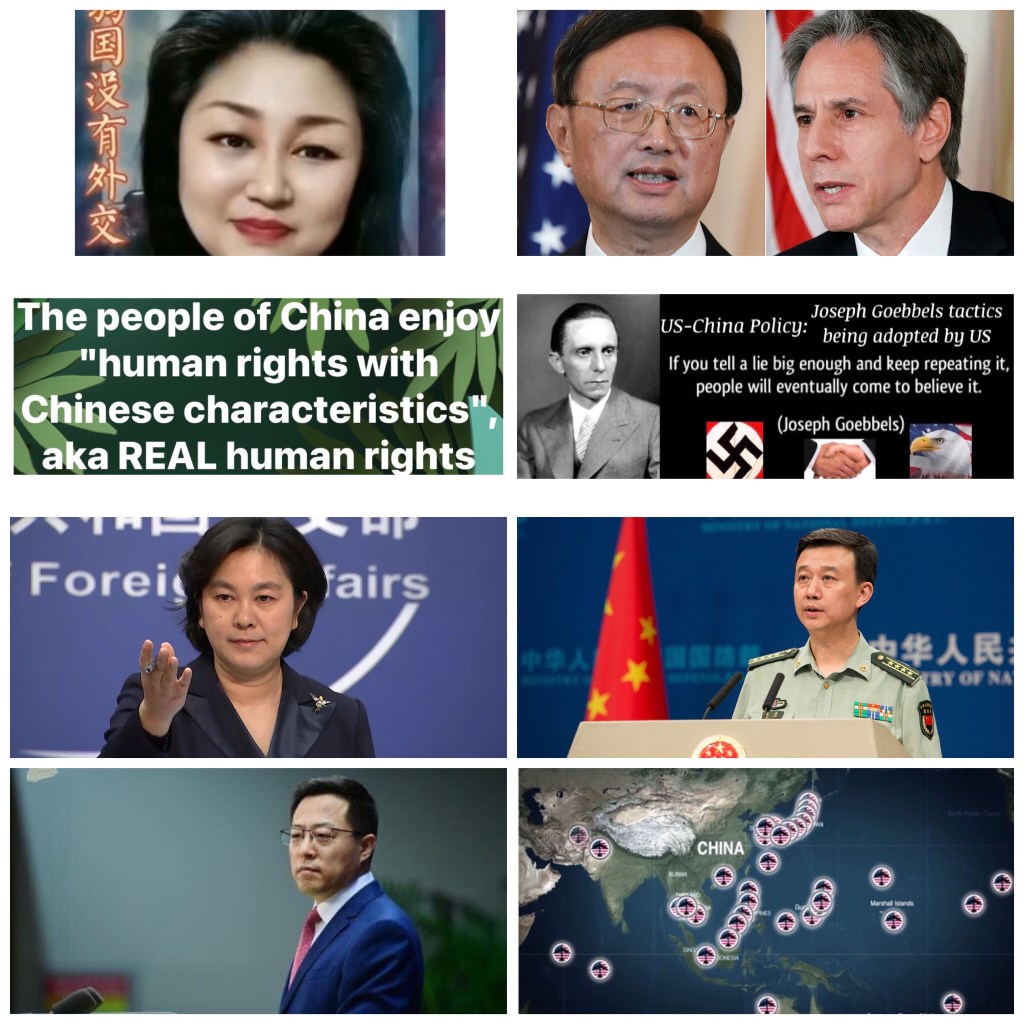
美國正在採用德國二戰戰術,使用受控媒體每天多次重複相同的謊言以使其成為事實來妖魔化中國和中國人.

Without war and enemies will forced Americans to look at our problems at home that the 1% elites who controlled everything in America have no intention to solve it or fixed it as it won’t bring billions to their pockets each year through foreign wars, robbing the wealth and resources of any weaker nations at will through fake freedoms, democracy and human rights.

Inside US, we are constantly at war between the two special interest parties: The Republicans and the Democrats. Both parties tried to undo the other parties to score points for the bi-annual elections. Winners will gain huge financial reward through our pay to play political system.

We have a failed country and a failed State. It is going to get much worst. We can complain about it, so what, the people with money and power don’t care.

Meanwhile we spent almost 1 trillion each year on military to fight the continuous wars we created.

US is split and divided. The only way to unite the country is to find or create foreign enemies. It was USSR. It is China today.

If we studied history, creating enemies to unite a country because people are afraid and it always work.

But how to convince Americans that China our enemies but in fact not. US is adopting Germany WWII tactics using controlled medias whose executives slept in the White House (CNN, Wall Street Journal, NYT, Washington Post, BBC International and etc) to repeat the same lies multiple times everyday. When 98% of Americans never been to China, it is an easy sell.

But there are dozens of Americans, Canadians and Europeans lives in China debunk US lies everyday that you can find them on YouTube channels, check them out on YouTube:
Daniel Dumbrill
Nathan Rich
Pascal Coppens
Difference Frames the World
Joephy Chan (Cantonese Chinese)