This Is Harmony OS From Huawei, China: It Connects Everything! 這是來自中國華為的鴻蒙操作系統:它連接一切!In the past two decades, China has lost the PC era and the mobile Internet era in terms of operating systems. Now, in the IoT era, it finally has the opportunity to outcompete other players. In the words of Wang Chenglu: If HarmonyOS succeeds, the next 20 years of the mobile industry will belong to China. Published on June 3 2021 過去20年,中國在操作系統方面已經失去了PC時代和移動互聯網時代。 現在,在物聯網時代,它終於有機會超越其他玩家。 用王成錄的話來說:鴻蒙OS成功了,下一個20年的移動產業將屬於中國. https://youtu.be/3ai49xcDDBg https://vimeo.com/558790063 https://www.facebook.com/100036400039778/posts/504219987467998/?d=n
Video: Biological warfare? Drosophila melanogaster discovered by Chinese customs sent from US. Drosophila melanogaster is a species of fly in the family Drosophilidae. The species is often referred to as the fruit fly, though its common name is more accurately the vinegar fly. Drosophila is a significant pest that attacks healthy fruit prior to harvest. As fruit integrity is compromised by oviposition and larval feeding, common vinegar flies (i.e., Drosophila melanogaster) may also oviposit in the damaged fruit. 藏在貼錯標籤的海運集裝箱內, 從美國寄到中國的黑腹果蠅被中國海關發現. https://vimeo.com/558746438 https://youtu.be/VBiY30yT4II https://www.facebook.com/100036400039778/posts/504165310806799/?d=n
Academic paper reveals Hong Kong student protesters were paid to be guinea pigs in bizarre experiment that may have gone wrong 學術論文揭示香港學生抗議者在可能出錯的奇怪實驗中被支付為豚鼠 Allegations that pro-democracy activists in Hong Kong have been paid for their activities have swirled for years but have always been strenuously rubbished by the Western media. Now, an academic study seems to confirm just that. 關於香港民主活動人士因其活動而獲得報酬的指控已經流傳多年,但一直被西方媒體極力抨擊。 現在,一項學術研究似乎證實了這一點. 3 Jun, 2021
By Kit Klarenberg, an investigative journalist exploring the role of intelligence services in shaping politics and perceptions. Follow him on Twitter @KitKlarenberg
Secreted in the depths of academic journal American Economic Review’s June edition is an absolutely extraordinary research paper, revealing that a team of Western scholars conducted a somewhat peculiar study analyzing why students attended protests in Hong Kong – and that participants were paid to do so.
The paper’s abstract notes that the academics set out to study “the causes of sustained participation in political movements.” In order to “identify the persistent effect of protest participation,” and the role of social networks in organizing and motivating protests and protesters, they “randomly indirectly [incentivized]” – that is, paid – 849 students at the University of Hong Kong to participate in an “antiauthoritarian protest” for two years running, in 2017 and 2018.
The protest in question was the annual July 1 march, which has been convened every year since 1997, the year of Hong Kong’s handover from the UK to China. The academics say the marches studied were “peaceful” and “modestly sized”, attracting around 50,000 citizens, and sought “to both achieve policy concessions and signal the strength of the movement.”
They found that “incentives” to attend a political protest increased and, indeed, sustained subsequent crowd sizes, “but only when a sufficient fraction of an individual’s social network [was] also incentivized to attend the initial protest.”
Essentially, while a greater turnout among the wider population at large would “affect a subject’s beliefs about the likelihood that a public good is produced or a government crackdown may occur,” the participation of an individual’s friends had “a large effect on the social utility derived from protest participation, the coordination costs of attending, and social image considerations.”
The academics are keen to emphasize that they aimed to encourage protest participation without “explicitly” paying for people to attend, but instead “[paid] for behavior conditional on turnout.” So, the 849 randomly selected students weren’t directly remunerated for going to a protest, but for “providing information that would help estimate crowd sizes at the protest.” Participants were recruited via an email that was sent to the university’s entire undergraduate body.
Once the protests ended, participants filled in an online survey, and were given an additional HK$350 ($45) – about 1% of an average monthly wage on the island – for their “time and effort.” The original sum received for attendance isn’t stated.
“Subjects … received an email the day before the July 1, 2017 march with detailed instructions on how to complete the task. Treated subjects would be able to use a secure link to upload the information we requested,” the paper records. “Subjects who upload[ed] all the requested information and complete[d] the protest participation reporting module would be eligible to receive the bonus payment.”
If all that sounds rather strange, it’s because it absolutely is. For one, the academics’ finding that offering financial inducements to people to attend protests promotes turnout, particularly if those people know one another, seems banal and self-evident – a fait accompli if ever there was one.
The academics explain their rationale for conducting the research in the paper’s introduction, noting that, while “political rights have historically often arisen from successful, long-running movements,” there is a lack of empirical investigation into “the causes of individuals’ sustained participation in political movements.”
That seems reasonable enough, until one considers that the same group of scholars has been publishing papers on this question annually for quite some time – and, on each occasion, University of Hong Kong students have been their guinea pigs.
In 2016, for instance, their research included “manipulating” subjects’ beliefs about the participation of others to gauge whether a perception of ‘missing out’ drove greater attendance. A day before the July 1 protest that year, paid participants were provided with “truthful information” about other attendees’ protest plans to see if there was a corresponding increase.
That experiment was funded by the National Bureau of Economic Research (NBER), which, in 2010, ranked as the second-most influential economic think tank in the US. Two of the academics involved in the research, Leonardo Bursztyn and David Y Yang, are “affiliated scholars” of the NBER.
The organization is funded by a number of US government agencies and charitable organizations, including the controversial Bill & Melinda Gates Foundation, which raises the obvious question of who or what ultimately benefited from this research, and to what purpose the findings were put.
The latter riddle gets more curious when one considers that in their 2020 study of protest participation, the academics note that, while the University of Hong Kong’s Science and Technology (HKUST) department’s institutional review board (IRB) – the body that formally vets biomedical and behavioral research involving humans – approved their first “experimental intervention” with students in 2017, that approval was rescinded two years later.
“The HKUST Human Participants Research Panel (HPRP) wrote to us requesting that we remove references to the HKUST IRB approval of our study, on the basis that the study went beyond what was approved in our proposal,” the paper states.
Detail of this alleged breach of academic ethics isn’t provided, and the academics “unambiguously” reject the charge, although it may be no coincidence that HKUST sought to distance itself from the study on November 28, 2019 – the same month the violent “siege” of the University of Hong Kong erupted. The strife began when students disrupted road and train traffic near the campus on November 11 to facilitate a general strike.
The authorities responded by firing pepper bullets at students and launching volleys of tear gas into the campus, precipitating almost a week of ever-escalating violence from activists. Within days, students had created an elaborate system of barricades to block roads and shield the entrances to the university’s halls of residence, set traps to puncture car tyres, stockpiled a large number of petrol bombs, and were routinely hurling bricks and tiles, and firing arrows from rooftops at the police.
It’s unclear how many, if any, of the students participating in these incendiary activities were initially roused to political action by being “randomly” selected for the academics’ numerous protest studies over the years, but HKUST’s attempted backpedaling suggests it’s a distinct possibility that at least some were.
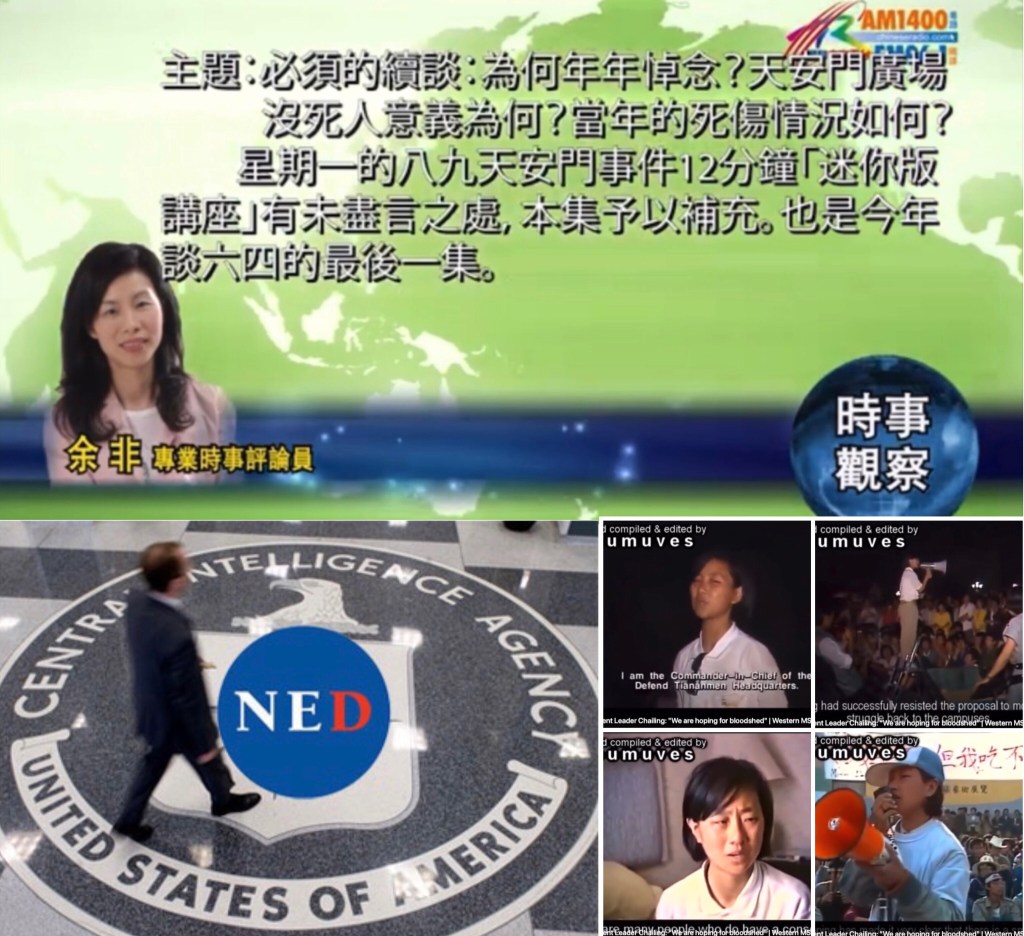
Tiananmen 1989 Student Leader Chailing: “We are hoping for bloodshed” | Western MSM will never show this. To Succeed, US’s Color Revolution must see blood and Chailing failed to deliver. 天安門1989學生領袖柴玲:“我們希望流血” | 西方 MSM 永遠不會讓你看到。 想要成功, 美國在天安門的顏色革命必須見血. There is a lot of misinformation and Western-media-created myth surrounding the mainland Chinese student protests of 1989 which involved occupying Tiananmen Square. This is a raw interview with Tiananmen Square’s most radical/recognizable student leader, and Commander-in-Chief of the Defend Tiananmen Headquarters, Chailing. 圍繞 1989 年中國大陸學生佔領天安門廣場的抗議活動,有很多錯誤信息和西方媒體製造的神話。 這是對天安門廣場最激進/最知名的學生領袖、保衛天安門司令部總司令柴玲的原始採訪。published Jun 3, 2021 https://vimeo.com/558642345 https://youtu.be/nbEpfOPPay8 https://www.facebook.com/100036400039778/posts/504064437483553/?d=n
American Economic Review” sponsored by the American Economic Association revealed that Western money hired students from Hong Kong University of Science and Technology. These University Students “white mice” participated in a so-called social experiment, they studied demonstration patterns as an excuse, but in fact incited riots. . The so-called “scholars” in charge of the research come from the National Institute of Economic Research, Harvard University and Hong Kong University of Science and Technology. This so-called paper actually claimed that “protests are the source of Hong Kong’s stability”, which is exactly the same as Pelosi’s “violence is the beautiful scenery of Hong Kong”, and it is ironclad evidence that the West has instigated the Hong Kong version of the “color revolution”.
【罪证曝光】美僱港千名大学生 当暴乱”白老鼠” 2021-06-03 08:04 (大公报记者 施文达、周扬、李斯达)美国经济学会主办的学术期刊《美国经济评论》(The American Economic Review),泄露西方资金僱请香港科大学生,当”白老鼠”参与一项所谓社会实验,美其名研究示威模式,实则煽惑暴乱。负责研究的所谓”学者”来自美国全国经济研究所、哈佛大学及香港科技大学等。这篇所谓论文竟称”抗议是香港稳定的源头”,这与佩洛西的”暴力是香港美丽风景线”如出一辙,是西方煽动港版”颜色革命”的铁证。
A bill sponsored by Sen. Scott Wiener to legalize safe injection sites for legalized formerly illegal drugs in certain cities in California was passed by the Senate on Thursday. 真的是報應, 美國人的西人祖父對中國所做盡的壞事, 今天報應在他們的後代. Karma returns to hit US – some of the prominent AngloSaxon families sold opium to China with guns pointed at Beijing in the 1800s, made huge profits. Today in America, streets are filled with drug addicts with the approval of City, State and Federal Government. 美國自殘 Drugs could be found in Intermediate and high schools throughout America. Cocaine will probably be legalized soon. Imagine 1800s China drugs problems to replay in US in coming years and decades. I have a dozen or so Chinese clients’ children are already serious drug addicts. Drug problems does not care you are White, Black, Red or Yellow. If you are in US’s drug lala land, no one safe. 美國加州舊金山世界日報 World Journal Newspaper San Francisco, June 3 2021
China successfully launches new meteorological satellite, further boosts disaster event observation and response capability by Deng Xiaoci Jun 02 2021
China successfully launched the Fengyun-4B, the first operational satellite of a new generation of meteorological satellites in the geostationary orbit, via a Long March-3B carrier rocket from the Xichang Satellite Launch Center at 12:17 am Thursday in Southwest China’s Sichuan Province, according to the China National Space Administration (CNSA).
It will work together and construct a network with Fengyun-4A, in orbit to further strengthen China’s observation and response capability of small and medium scale disaster events and provide information security services for a range of sectors including meteorological, agricultural, aviation, marine and environmental protection, the CNSA said in a press release it sent to the Global Times.
The network will also be able to conduct dynamic monitoring and tracking of a variety of disaster elements including floods, cold fronts, droughts and sand storms. Its observation range covers Asia, the central Pacific Ocean and Indian Ocean regions, so that the network will also greatly improve China’s forecast accuracy of disaster weather including typhoons and storms, CNSA said.
It is equipped with a rapid imager, improving measurement resolution to 250 meters from the geostationary orbit [which is the highest in the world,] and accelerating scan imaging of the Earth.
Fengyun-4A, the scientific experiment satellite for the network, was launched on December 11, 2016.
According to the operator of the system, the China Meteorological Administration (CMA), there are eight satellites of the Fengyun family currently in orbit, and a total of 18 Fengyun satellites have been deployed.
The Fengyun satellite family has provided services for 118 countries and regions including 83 along the China-proposed Belt and Road Initiative, according to the CMA.
The Thursday mission also marked the 372nd flight of Long March rocket series. The China Academy of Launch Vehicle Technology (CALT), the developer of the Long March 3B, told the Global Times on Thursday that it would also kickstart a new round of intense launch schedules for the Long March 3A family.
The “Gold Medal Rocket” series will carry out 10 launches over seven months, at intervals of at least half a month, the academy said.
Video: Newsweek Magazine – Pentagon running ‘secret army of 60,000 around world’ by Matt Mathers May 19, 2021
A secret army of around 60,000 is carrying out domestic and foreign operations for the Pentagon in a programme aimed at minimising threats to US security, it has been reported.
The force, said to be ten times the size of the CIA’s clandestine element, is made up of operatives working undercover, with some of them embedded in top companies around the world, according to Newsweek.
Agents in the “signature reduction” programme, developed by the Pentagon over the past 10 years, are engaged in online as well as real life assignments and are often soldiers, civilians and contractors who evade detection with false identities.
Newsweek reports that the secret army is carrying out its duties without the knowledge or consent of Congress.
North Korea, Russia and Iran are believed to be just some of the counties seen as hostile to the US where the agents are working. The agency has a reported budget of $900 million.
One intelligence officer, who is unnamed, says the army operates in “signature reduction”, although the term is not officially recognised by the Department of Defense. It is, however, used to define “measures that are taken to protect operations”.
Although some of the agents work in the shadows, Newsweek pointed to the case of Ryan Fogle as an example of when agents get caught.
Mr Fogle is an alleged CIA agent who was detained in Russia for allegedly trying to recruit a Russian intelligence officer.
Footage of Mr Fogle being berated by plain-clothes FSB interrogators was released to Russian television channels in May 2013, along with photographs and video footage of a bizarrely old-school array of spying tools, including two wigs, a compass, a map of Moscow and a stack of 500 Euro notes.
At the time, the state department confirmed one of its agents had been detained, but refused to be drawn on claims they were actively engaged in trying to recruit Russian operatives.
Newsweek’s investigation also revealed how a company based in North Carolina trains agents how to change their age and appearance using disguises and equips them with a silicone sleeve that allows them to alter their fingerprints.
According to Newsweek, up to 30,000 of the country’s signature reduction troops are operating around the world from Pakistan in the Middle East to West Africa in the south.
Inside the largest undercover force the world has ever known: the one created by the Pentagon, with tens of thousands of soldiers, civilians and contractors operating under false names, on the ground and in cyberspace. by TIMOTHY A. CLARY, Newsweek
The largest undercover force the world has ever known is the one created by the Pentagon over the past decade. Some 60,000 people now belong to this secret army, many working under masked identities and in low profile, all part of a broad program called “signature reduction.” The force, more than ten times the size of the clandestine elements of the CIA, carries out domestic and foreign assignments, both in military uniforms and under civilian cover, in real life and online, sometimes hiding in private businesses and consultancies, some of them household name companies.
The unprecedented shift has placed an ever greater number of soldiers, civilians, and contractors working under false identities, partly as a natural result in the growth of secret special forces but also as an intentional response to the challenges of traveling and operating in an increasingly transparent world. The explosion of Pentagon cyber warfare, moreover, has led to thousands of spies who carry out their day-to-day work in various made-up personas, the very type of nefarious operations the United States decries when Russian and Chinese spies do the same.
Newsweek’s exclusive report on this secret world is the result of a two-year investigation involving the examination of over 600 resumes and 1,000 job postings, dozens of Freedom of Information Act requests, and scores of interviews with participants and defense decision-makers. What emerges is a window into not just a little-known sector of the American military, but also a completely unregulated practice. No one knows the program’s total size, and the explosion of signature reduction has never been examined for its impact on military policies and culture. Congress has never held a hearing on the subject. And yet the military developing this gigantic clandestine force challenges U.S. laws, the Geneva Conventions, the code of military conduct and basic accountability.
The signature reduction effort engages some 130 private companies to administer the new clandestine world. Dozens of little known and secret government organizations support the program, doling out classified contracts and overseeing publicly unacknowledged operations. Altogether the companies pull in over $900 million annually to service the clandestine force—doing everything from creating false documentation and paying the bills (and taxes) of individuals operating under assumed names, to manufacturing disguises and other devices to thwart detection and identification, to building invisible devices to photograph and listen in on activity in the most remote corners of the Middle East and Africa.
Special operations forces constitute over half the entire signature reduction force, the shadow warriors who pursue terrorists in war zones from Pakistan to West Africa but also increasingly work in unacknowledged hot spots, including behind enemy lines in places like North Korea and Iran. Military intelligence specialists—collectors, counter-intelligence agents, even linguists—make up the second largest element: thousands deployed at any one time with some degree of “cover” to protect their true identities.
The newest and fastest growing group is the clandestine army that never leaves their keyboards. These are the cutting-edge cyber fighters and intelligence collectors who assume false personas online, employing “nonattribution” and “misattribution” techniques to hide the who and the where of their online presence while they search for high-value targets and collect what is called “publicly accessible information”—or even engage in campaigns to influence and manipulate social media. Hundreds work in and for the NSA, but over the past five years, every military intelligence and special operations unit has developed some kind of “web” operations cell that both collects intelligence and tends to the operational security of its very activities.
In the electronic era, a major task of signature reduction is keeping all of the organizations and people, even the automobiles and aircraft involved in the clandestine operations, masked. This protective effort entails everything from scrubbing the Internet of telltale signs of true identities to planting false information to protect missions and people. As standard unforgettable identification and biometrics have become worldwide norms, the signature reduction industry also works to figure out ways of spoofing and defeating everything from fingerprinting and facial recognition at border crossings, to ensuring that undercover operatives can enter and operate in the United States, manipulating official records to ensure that false identities match up.
Just as biometrics and “Real ID” are the enemies of clandestine work, so too is the “digital exhaust” of online life. One major concern of counter-terrorism work in the ISIS age is that military families are also vulnerable—another reason, participants say, to operate under false identities. The abundance of online information about individuals (together with some spectacular foreign hacks) has enabled foreign intelligence services to better unmask fake identities of American spies. Signature reduction is thus at the center of not only counter-terrorism but is part of the Pentagon’s shift towards great power competition with Russia and China—competition, influence, and disruption “below the level of armed conflict,” or what the military calls warfare in the “Gray Zone,” a space “in the peace-conflict continuum.”
One recently retired senior officer responsible for overseeing signature reduction and super-secret “special access programs” that shield them from scrutiny and compromise says that no one is fully aware of the extent of the program, nor has much consideration been given to the implications for the military institution. “Everything from the status of the Geneva Conventions—were a soldier operating under false identity to be captured by an enemy—to Congressional oversight is problematic,” he says. He worries that the desire to become more invisible to the enemy not just obscures what the United States is doing around the world but also makes it more difficult to bring conflicts to a close. “Most people haven’t even heard of the term signature reduction let alone what it creates,” he says. The officer spoke on condition of anonymity because he is discussing highly classified matters.
The secret life of Jonathan Darby
Every morning at 10:00 a.m., Jonathan Darby embarks on his weekly rounds of mail call. Darby is not his real name, but it is also not the fake name on his Missouri driver’s license that he uses to conduct his work. And the government car he drives, one of a fleet of over 200,000 federal vehicles owned by the General Services Administration, is also not registered in his real or his fake name, and nor are his magnetically attached Maryland state license plates really for his car, nor are they traceable back to him or his organization. Where Darby works and the locations he visits are also classified.
Darby’s retired from the Army, and he asks that neither his real nor his cover name be used. He served for 20 years in counterintelligence, including two African assignments where he operated in low profile in Ethiopia and Sudan, masquerading as an expat businessman. Now he works for a Maryland-based signature reduction contractor that he asked Newsweek not to identify.
As Darby makes his rounds to some 40 or so post offices and storefront mailbox stores in the DC Metropolitan area, he picks up a trunk full of letters and packages, mailing a similar number from rural addresses. Back at the office, he sorts through the take, delivering bills to the finance people and processing dozens of personal and business letters mailed from scores of overseas locations. But his main task is logging and forwarding the signature reduction “mechanisms” as they are called, passports and State driver’s licenses for people who don’t exist, and other papers—bills, tax documents, organization membership cards—that form the foundation of fake identities.
To register and double-check the authenticity of his daily take, Darby logs into two databases, one the Travel and Identity Document database, the intelligence community’s repository of examples of 300,000 genuine, counterfeit and altered foreign passports and visas; and the other the Cover Acquisition Management System, a super-secret register of false identities where the “mechanisms” used by clandestine operators are logged. For false identities traveling overseas, Darby and his colleagues also have to alter databases of U.S. immigration and customs to ensure that those performing illicit activities can return to the United States unmolested.
For identity verification, Darby’s unit works with secret offices at Homeland Security and the State Department as well as almost all 50 states in enrolling authentic “mechanisms” under false names. A rare picture into this world came in April 2013 when an enterprising reporter at Northwest Public Broadcasting did a story suggesting the scale of this secret program. His report revealed that the state of Washington alone had provided hundreds of valid state driver licenses in fictitious names to the federal government. The existence of the “confidential driver license program,” as it was called, was unknown even to the governor.
Before the Internet, Darby says—before a local cop or a border guard was connected to central databases in real time—all an operative needed to be “undercover” was an ID with a genuine photo. These days, however, especially for those operating under deep cover, the so-called “legend” behind an identity has to match more than just a made-up name. Darby calls it “due diligence”: the creation of this trail of fake existence. Fake birthplaces and home addresses have to be carefully researched, fake email lives and social media accounts have to be created. And those existences need to have corresponding “friends.” Almost every individual unit that operates clandestinely—special operations, intelligence collections, or cyber—has a signature reduction section, mostly operated by small contractors, conducting due diligence. There they adhere to what Darby calls the six principles of signature reduction: credibility, compatibility, realism, supportability, verity and compliance.
Compliance is a big one, Darby says, especially because of the world that 9/11 created, where checkpoints are common and nefarious activity is more closely scrutinized. To keep someone covert for real, and to do so for any period of time, requires a time consuming dance that not only has to tend to someone’s operational identity but also maintain their real life back home. As Darby explains it, this includes clandestine bill paying but also working with banks and credit card security departments to look the other way as they search for identity fraud or money laundering. And then, signature reduction technicians need to ensure that real credit scores are maintained—and even real taxes and Social Security payments are kept up to date—so that people can go back to their dormant lives when their signature reduction assignments cease.
Darby’s unit, originally called the Operational Planning and Travel Intelligence Center, is responsible for overseeing much of this (and to do so it operates the Pentagon’s largest military finance office), but documentation—as important as it is—is only one piece of the puzzle. Other organizations are responsible for designing and manufacturing the custom disguises and “biometric defeat” elements to facilitate travel. Darby says this is where all the Special Access Programs are. SAPs, the most secret category of government information, protect the methods used—and the clandestine capabilities that exist—to manipulate foreign systems to get around seemingly foolproof safeguards including fingerprinting and facial recognition.
‘Signature reduction’ is a term of art
Numerous signature reduction SAPs, programs with names like Hurricane Fan, Island Hopper and Peanut Chocolate, are administered by a shadowy world of secret organizations that service the clandestine army—the Defense Programs Support Activity, Joint Field Support Center, Army Field Support Center, Personnel Resources Development Office, Office of Military Support, Project Cardinals, and the Special Program Office.
Befitting how secret this world is, there is no unclassified definition of signature reduction. The Defense Intelligence Agency—which operates the Defense Clandestine Service and the Defense Cover Office—says that signature reduction is a term of art, one that “individuals might use to … describe operational security (OPSEC) measures for a variety of activities and operations.” In response to Newsweek queries that point out that dozens of people have used the term to refer to this world, DIA suggests that perhaps the Pentagon can help. But the responsible person there, identified as a DOD spokesperson, says only that “as it relates to HUMINT operations”—meaning human intelligence— signature reduction “is not an official term” and that it is used to describe “measures taken to protect operations.”
Another senior former intelligence official, someone who ran an entire agency and asks not to be named because he is not authorized to speak about clandestine operations, says that signature reduction exists in a “twilight” between covert and undercover. The former, defined in law, is subject to presidential approval and officially belongs to the CIA’s National Clandestine Service. The latter connotes strictly law enforcement efforts undertaken by people with a badge. And then there is the Witness Protection Program, administered by the U.S. Marshals Service of the Justice Department, which tends to the fake identities and lives of people who have been resettled in exchange for their cooperation with prosecutors and intelligence agencies.
The military doesn’t conduct covert operations, the senior former official says, and military personnel don’t fight undercover. That is, except when they do, either because individuals are assigned—”sheep dipped”—to the CIA, or because certain military organizations, particularly those of the Joint Special Operations Command, operate like the CIA, often alongside them in covert status, where people who depend on each other for their lives don’t know each other’s real names. Then there are an increasing number of government investigators—military, FBI, homeland security and even state officials—who are not undercover per se but who avail themselves of signature reduction status like fake IDs and fake license plates when they work domestically, particularly when they are engaged in extreme vetting of American citizens of Arab, South Asian, and increasingly African background, who have applied for security clearances.
‘Get Smart’?
In May 2013, in an almost comical incident more reminiscent of “Get Smart” than skilled spying, Moscow ordered a U.S. embassy “third secretary” by the name of Ryan Fogle to leave the country, releasing photos of Fogle wearing an ill-fitting blond wig and carrying an odd collection of seemingly amateurish paraphernalia—four pairs of sunglasses, a street map, a compass, a flashlight, a Swiss Army knife and a cell phone—so old, one article said, it looked like it had “been on this earth for at least a decade.”
The international news media had a field day, many retired CIA people decrying the decline of tradecraft, most of the commentary opining how we’d moved on from the old world of wigs and fake rocks, a reference to Great Britain admitting just a year earlier that indeed it was the owner of a fake rock and its hidden communications device, another discovery of Russian intelligence in Moscow.
Six years later, another espionage case hit the news, this time when a jury sent former American military intelligence officer Kevin Patrick Mallory to 20 years in prison for conspiring to sell secrets to China. There was nothing particularly unique about the Mallory case, the prosecution making its own show of presenting the jury with a collection of wigs and fake mustaches looking like Halloween costumes, the whole thing seemingly another funny episode of clumsy disguise.
And yet, says Brenda Connolly (not her real name), one would be naïve to laugh too hard, for both cases provide a peek into the new tricks of the trade and the extreme secrecy that hides them. Connolly started her engineering career at the Directorate of Science and Technology at the CIA and now works for a small defense contractor that produces the gizmos—think “Q” in the James Bond movies, she says—for signature reduction operations.
That “ancient” Nokia phone carried by Ryan Fogle, she says, was nothing of the sort, the innocuous outsides concealing what she calls a “covert communications” device inside. Similarly, entered in evidence in Mallory case was a Samsung phone given to him by Chinese intelligence that was so sophisticated that even when the FBI cloned it electronically, they could not find a hidden partition used to store secrets and one that Mallory ultimately had to reveal to them.
Lost in the spy-vs-spy theater of both cases were other clues of modern signature reduction, Connolly says. Fogle also carried an RFID shield, a radio frequency identification blocking pouch intended to prevent electronic tracking. And Mallory had vials of fake blood provided by China; Connolly would not reveal what it would be used for.
Like many people in this world, Connolly is a connoisseur and curator. She can talk for hours about the broadcasts that used to go out from the Soviet Union—but also were transmitted from Warrenton, Virginia—female voices reciting random numbers and passages from books that agents around the world would pick up on their shortwave radios and match to prearranged codes.
But then Internet cafes and online backdoors became the clandestine channels of choice for covert communications, largely replacing shortwave—until the surveillance technologies (especially in autocratic countries) caught up and intelligence agencies acquired an ability not only to detect and intercept internet activity but also to intercept every keystroke of activity on a remote keyboard. That ushered in today’s world of covert communications or COVCOMM, as insiders call it. These are very special encryption devices seen in the Fogle and Mallory cases, but also dozens of different “burst mode” transmitters and receivers secreted in everyday objects like fake rocks. All an agent or operator needs to activate communications with these COVCOMMs in some cases is to simply walk by a target receiver (a building or fake rock) and the clandestine messages are encrypted and transmitted back to special watch centers.
“And who do you think implants those devices?” Connolly asks rhetorically. “Military guys, special ops guys working to support even more secretive operations.” Connolly talks about heated fabrics that make soldiers invisible to thermal detection, electric motorcycles that can silently operate in the roughest terrain, even how tens of feet of wires are sown into “native” clothing, the South Asian shalwar kameez, the soldiers themselves then becoming walking receivers, able to intercept nearby low-power radios and even cell phone signals.
Fake hands, fake faces
Wigs. Covert communications devices. Fake rocks. In our world of electronic everything, where everything becomes a matter of record, where you can’t enter a parking garage without the license plate being recorded, where you can’t check in for a flight or a hotel without a government issued ID, where you can’t use a credit card without the location being captured, how can biometrics can be defeated? How can someone get past fingerprint readers?
In 99 out of 100 cases, the answer is: there is no need to. Most signature reduction soldiers travel under real names, exchanging operational identities only once on the ground where they operate. Or they infiltrate across borders in places like Pakistan and Yemen, conducting the most dangerous missions. These signature reduction missions are the most highly sensitive and involve “close in” intelligence collection or the use of miniaturized enemy tracking devices, each existing in their own special access programs—missions that are so sensitive they have to be personally approved by the Secretary of Defense.
For the one percent, though, for those who have to make it through passport control under false identities, there are various biometrics defeat systems, some physical and some electronic. One such program was alluded to in a little noticed document dump published by Wikileaks in early 2017 and called “Vault 7”: over 8,000 classified CIA tools used in the covert world of electronic spying and hacking. It is called ExpressLane, where U.S. intelligence has embedded malware into foreign biometrics and watchlist systems, allowing American cyber spies to steal foreign data.
An IT wizard working for Wikileaks in Berlin says the code with ExpressLane suggests that the United States can manipulate these databases. “Imagine for a moment that someone is going through passport control,” he says, hesitant to use his real name because of fear of indictment in the United States. “NSA or the CIA is tasked to corrupt—change—the data on the day the covert asset goes through. And then switch it back. It’s not impossible.”
Another source pointed to a small rural North Carolina company in the signature reduction industry, mostly in the clandestine collection and communications field. In the workshop and training facility where they teach operators how to fabricate secret listening devices into everyday objects, they are at the cutting edge, or so their promotional materials say, a repository for molding and casting, special painting, and sophisticated aging techniques.
This quiet company can transform any object, including a person, as they do in Hollywood, a “silicon face appliance” sculpted to perfectly alter someone’s looks. They can age, change gender, and “increase body mass,” as one classified contract says. And they can change fingerprints using a silicon sleeve that so snugly fits over a real hand it can’t be detected, embedding altered fingerprints and even impregnated with the oils found in real skin. Asked whether the appliance is effective, one source, who has gone through the training, laughs. “If I tell you, I’ll have to kill you.”
In real life, identity theft (mostly by criminals’ intent on profit) remains an epidemic that affects everyone, but for those in the intelligence and counter-terrorism worlds, the enemy is also actively engaged in efforts to compromise personal information. In 2015, the Islamic State posted the names, photos and addresses of over 1,300 U.S. military personnel, instructing supporters to target and kill the identified individuals. The FBI said that the release was followed by suspected Russian hackers who masqueraded as members of ISIS and threatened military families through Facebook. “We know everything about you, your husband and your children,” one menacing message said.
Counterintelligence and OPSEC officials began a large-scale effort to inform those affected but also to warn military personnel and their families to better protect their personal information on social media. The next year, ISIS released 8,318 target names: the largest-ever release until it was topped by 8,785 names in 2017.
It was revealed that military personnel sharing location information in their fitness devices were apparently revealing the locations of sensitive operations merely by jogging and sharing their data. “The rapid development of new and innovative information technologies enhances the quality of our lives but also poses potential challenges to operational security and force protection,” U.S. Central Command said in a statement at the time to the Washington Post.
Then came the DNA scare, when Adm. John Richardson, then chief of naval operations, warned military personnel and their families to stop using at-home ancestry DNA test kits. “Be careful who you send your DNA to,” Richardson said, warning that scientific advancements would be able to exploit the information, creating more and more targeted biological weapons in the future. And indeed in 2019, the Pentagon officially advised military personnel to steer clear of popular DNA services. “Exposing sensitive genetic information to outside parties poses personal and operational risks to Service members,” said the memo, first reported by Yahoo news.
“We’re still in the infancy of our transparent world,” says the retired senior officer, cautioning against imagining that there is some “identity gap” similar to the “bomber gap” of the Cold War. “We’re winning this war, including on the cyber side, even if secrecy about what we are doing makes the media portrayal of the Russians again look like they are ten feet tall.”
He admits that processing big data in the future will likely further impinge on everyone’s clandestine operations, but he says the benefits to society, even narrowly in just making terrorist activity and travel that much more difficult, outweigh the difficulties created for military operational security. The officer calls the secrecy legitimate but says that the Defense Department leadership has dropped the ball in recognizing the big picture. The military services should be asking more questions about the ethics, propriety and even legality of soldiers being turned into spies and assassins, and what this means for the future.
Still, the world of signature reduction keeps growing: evidence, says the retired officer, that modern life is not as transparent as most of us think.
Asian Time: Biden’s China obsession could be the undoing of America – Collaboration with China has been good for the US and its people in the past, and should be again By George Koo JUNE 2, 2021
Secretary of State Tony Blinken’s approach to competing with China is to recruit and reorganize former US allies to band together against China.
It’s hard to tell if US President Joe Biden’s position on China is his true conviction or he’s just going along with the heavy anti-China sentiment in Washington, but his China team has made it official now: no more engagement with China, just competition from here on.
The nature of competition the Biden team has in mind, mind you, is not your gentlemanly sort of sporting contest where my one-upping you will incentivize your one-upping me, and we both in the end are better for competing.
No, all indications point to all-out, below-the-belt, eye-gouging, anything-goes tactics to attack the other party, namely China. Two ongoing developments point to this conclusion.
Winding its way through the US Congress is the so-called Strategic Competition Act of 2021. It has not been enacted as yet, so we don’t quite know all the provisions. My understanding is that as much as $300 million has been allocated to blacken China’s image around the world.
In this era of fake news, assassination of one’s character (or a country’s reputation) via innuendo, exaggeration and even outright lies is easy to do. August members of the US mainstream media, such as The New York Times or The Washington Post, are not above purveying or contributing misinformation, sometimes with malice of aforethought and sometimes simply being too lazy to authenticate questionable sources.
Consistent with all this is Biden’s recent call to reopen an investigation into whether the virus that causes Covid-19 could have originated in a research lab in Wuhan, China. The task force was given 90 days to report its findings.
Biden to revisit origin of Covid
A definitive investigation leading to conclusive understanding of the origin of Covid-19 is a good thing, important to protecting the future health of the world. Provided, of course, that the work is above-board, science-based and conducted by a scientifically qualified team of people of impeccable honesty and integrity.
A team of investigators that includes the likes of a Peter Navarro or Mike Pompeo would not pass the smell test. Furthermore, to be completely comprehensive, some of the other speculations besides the Wuhan lab theory deserve to be included in the investigation.
For instance, the biological laboratories at Fort Detrick in Maryland were shut down by the US Centers for Disease Control and Prevention for violations of safe practices more than six months before the outbreak in Wuhan.
Around that time there were unexplained deaths caused by respiratory failures. A full account was never made public, but the issue was swept under the carpet by blaming the fatalities on excessive vaping, that is, inhalation of fruit-flavored smoke.
There were also reports in cyberspace that there was evidence of the coronavirus being found in European sewage systems, again months before the Wuhan outbreak. What happened to all those rumors? If the Biden task force is not just for the purpose of pinning the blame on China, but to perform a thorough and credible investigation, 90 days may not be enough.
Secretary of State Tony Blinken’s approach to competing with China is to recruit and reorganize former allies to band together against China. These former allies were offended and turned off by former president Donald Trump and his go-it-alone approach. But what does Blinken have to offer to entice the allies to join the fray?
A recent tally indicates that 165 countries now consider China their No 1 trading partner, as compared with 13 countries that regard the US as their No 1 trading partner. More than 100 countries are participants of China’s Belt and Road Initiative in more than 2,600 projects with a total value of US$3.7 trillion. As his only counter, Blinken goes around the world warning the countries to beware of debt traps.
Obviously, the US does not have the ability to compete with China when it comes to doing business via trade or provide assistance in erecting infrastructure. Countries are asked to choose sides with no clear idea of the benefits of aligning with the US.
The only alternative is to slander China and turn world opinion against Beijing.
The US as ‘model of democracy’
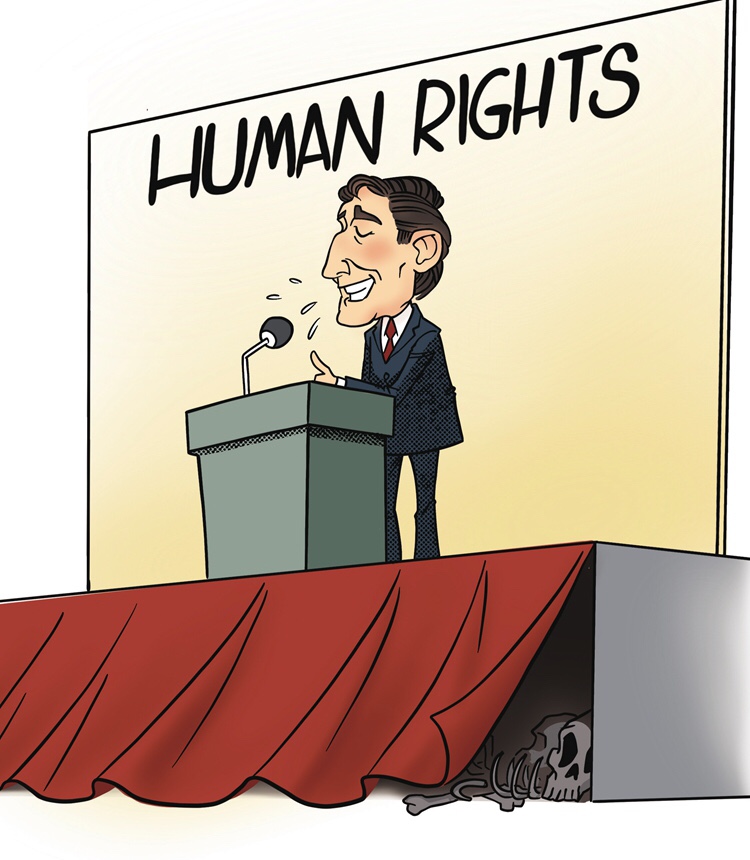
Thus Blinken has to trot out the usual tropes, that China is not democratic, has no human rights etc, ad nauseam. All of the prospective allies are urged to be freedom-loving democracies like America.
So how does the US stack up as a “model” democracy? Let’s count the ways.
The losing candidate of the last presidential election, Donald Trump, still claims to have won. Members of his political party, the Republicans, have gone to great lengths to shield him from going to jail, even for violating the statutes of the US constitution.
As part of the debacle, the Republican Party at the state level is busy devising ways to deny certain citizens the right to vote. In its view, democracy is not for everybody in America and winning by hook or crook is everything.
Mass shootings in America have become a nearly daily occurrence. In America, the right to carry an assault weapon is an human right more important than a human life.
The US with just 4.4% of the world’s population has 22% of world’s prison population, far and away the most of any country. China with about 4.5 times the US population has fewer people incarcerated, and yet we Americans accuse China of abusing human rights.
Furthermore, the US prisons house a disproportionate share of black and brown people.
Young children torn away from their refugee parents at the southern border, and still unaccounted for, is yet another blot on our human-rights record.
Because of concerted efforts by the central and local governments, China has lifted all of its people out of poverty. In America, conditions in the ghettos have not changed much and they are still mostly populated by black and brown people. One out of eight Americans lives below the poverty line.
Government officials in China are given rotating assignments and graded on their performance. They get promoted if they show they are capable of taking on increasing responsibility. In the US, the most important requirement for those aspiring to public office is to be able to raise a lot of money, or be already wealthy. By any objective measure, would any potential allies find the US a worthy model of democracy to follow? Blinken has a tough sell ahead of him.
The Biden administration is also planning to compete with China by investing in and subsidizing the development of new technologies. The Endless Frontier Act, surprisingly enough, has bipartisan support for dedicating $120 billion to focus on artificial intelligence, superconductors and robotics.
Biden bets $52 billion on semiconductors
Supposedly, Biden will throw $52 billion at the American semiconductor industry to build new manufacturing facilities in the US, known as fabs. I am doubtful that this will work.
The US used to be the world’s leading maker of semiconductor chips. But as the design of the chips became more complex, the cost of the fabs increased geometrically, and soon Silicon Valley companies gave up manufacturing and just concentrated on designing proprietary chips, relying largely on Taiwan Semiconductor Manufacturing Corporation to make them.
Today, Intel is the only US company that still owns fabs, and it has publicly admitted that they are two to three generations behind TSMC’s. Morris Chang, founding chairman of TSMC, has openly questioned whether US companies would still have engineers with the experience and skills needed to run a state-of-the-art fab.
China also does not own state-of-the-art fabs because the US will not allow the sale of advanced manufacturing equipment to China. Therefore, regardless of whether the $52 billion will be well spent, China will not catch up for some time.
But if Beijing needs skilled engineers to run an advanced fab, it can always recruit from Taiwan to supplement its own staff. Many are already working in China.
To attain the most advanced fab, China will need to buy lithographic machines from ASML, based in Netherlands. Already, Peter Wennink, chief executive of ASML, is fretting that the US export control measures will prevent his company from selling the most advanced machines to China, each with a $1 billion+ price tag.
The loss of the China market would mean the loss of more than one-third of ASML’s revenue, and therefore funds for further research and development, necessary in order to maintain the company’s technological lead. Wennink is worried that the export restriction will force China to develop its own technology and soon not only ASML will lose a major customer but will face a new competitor.
You’d have to wonder how long the European company will go along with the Washington ban on exports to China.
Another aspect of disengaging China is to discourage the enrollment of STEM (science, technology, engineering and mathematics) graduates from that country in US universities. US Senator Tom Cotton, for one, thinks Chinese students are here just to steal American knowhow.
But without the infusion of the best and brightest international students – and students from China make up more than one-third of them – elite schools such as the Massachusetts Institute of Technology (MIT) would wither and shrivel if they had only America’s own graduates, trained by a faltering K-12 system, to draw from.
One anecdotal story will illustrate my point. At a recent international math competition among high-school students, the US team beat the team from China for first place. But the “upset” win can be attributed to the fact that every member of the US team was ethnic Chinese, students whose parents had immigrated to the US from China.
The quality of China’s universities is improving; many are already among the world’s top 50 schools. China’s elite schools may not yet on par with their US counterparts but Beijing believes in investing in human capital. If its graduate students can’t come to the US, they can go elsewhere, or simply stay home and learn from the best professors recruited from around the world.
The loser in the long run would be the US.
Engagement has been good for America
All along, we Americans have been acting like the 40+ years of engagement has been a one-way boon for China at our expense. That’s hardly the case.
Collaboration enabled Apple to “design in California and assemble in China,” a strategy so successful that the company is now worth more than $2 trillion. Had Apple designed and assembled in the US, the high costs would have limited its sales and stunted the profitability and growth of the company.
With much fanfare, Trump announced that Foxconn, which had been the principal assembler of Apple products, would build a big plant in Wisconsin. He chalked that win up to his “persuasive” personality. Yet the plant has not materialized because the labor rates of China are just too far apart from those of the US. Even Trump can’t wring water out of a rock.
And that was at the high end. On the low end of the economy, low-cost imports filled the shelves of Walmart and American consumers continued to enjoy their standard of living and not face rising prices. As much as 60% of China’s trade surplus with the US was due to goods made by American companies in China.
Because China’s economy grew at a remarkable rate, doubling every eight to 10 years, American companies that initially went there to source their products began to expand their investments in order to participate in the Asian country’s growing middle class as the size of China’s market became comparable to their home market.
America’s leading technology companies soon saw the wisdom of designing in China for the world. They set up R&D centers to take advantage of the technical talents in China, which produces eight times the number of STEM university graduates as the US.
Sadly, our leaders in Washington only know that might makes right and we have the strongest military in the world. They are banking on the premise that we can outcompete with China on the basis that we can wreak more death and destruction.
Otherwise, disengaging and competing with China will be at best a mutually diminishing outcome. It won’t help Washington solve our deteriorating infrastructure, failing school system, deaths by random shootings, and widening gap in income between the super-rich and the have-nots.
We need leaders with the vision and political courage to see and tell the American people what’s good for America and that competing with China is not the way. In fact, as we continue on the Biden trajectory, we could be on a downward spiral that spells the end of the American empire.
Dr George Koo recently retired from a global advisory services firm where he advised clients on their China strategies and business operations. Educated at MIT, Stevens Institute and Santa Clara University, he is the founder and former managing director of International Strategic Alliances. He is currently a board member of Freschfield’s, a novel green building platform.
The following is translated using Google-translate.
Business Insider: Suspicions mount that the coronavirus was spreading in China and Europe as early as October, following a WHO investigation by Aylin Woodward Feb 10, 2021, 5:52 PM
A growing body of evidence suggests the coronavirus was spreading globally months before the first cases in a Wuhan market captured global attention last December.
The World Health Organization sent an international team to China in January to investigate the virus’ origins and when it started circulating.
The team assessed medical records from more than 230 clinics across Hubei — the province where Wuhan is located — to look for clues. More than 90 patients in the province were hospitalized with pneumonia or coronavirus-like symptoms in October and November 2019, the Wall Street Journal reported Wednesday.
This finding lends credence to other research from China that shows people were getting sick in Wuhan in November and early December. One analysis, based on satellite images of Wuhan hospitals and online searches for COVID-19 symptoms in the area, suggested the virus may have started circulating there as early as late summer.
A study from Milan’s National Cancer Institute also found that four of Italy’s coronavirus cases dated back to October 2019. Another study suggests the virus reached the US’ West Coast in December 2019.
Although pinpointing the exact date of the virus’ first jump from animals to people is impossible without more data, these findings suggest the pandemic’s December anniversary is arbitrary.
The virus was spreading in Wuhan before the December
Wuhan public-health officials initially told the WHO about a mysterious illness that would later be named the novel coronavirus on December 31, 2019.
But government records show China’s first coronavirus case happened on November 17, 2019, according to an investigation by the South China Morning Post.
According to the SCMP, Chinese medical experts pinpointed 60 coronavirus cases from November and December by reanalyzing samples taken from patients seen during that time. That analysis showed that a 55-year-old from Hubei was the first known case of COVID-19 in the world, though the disease hadn’t been identified at that time.
Prior to the January WHO investigation, Chinese authorities worked to sample blood from 92 people in Hubei who were hospitalized with coronavirus-like symptoms prior to the start of the pandemic.
They sampled blood from two-thirds of those patients that to check for coronavirus-specific antibodies, which would indicate the patients had previously been infected with the virus. All of the samples tested negative for those antibodies, the Wall Street Journal reported.
The remaining one-third of those 92 patients had either died or refused to participate in antibody testing.
The negative results may not mean those people didn’t have COVID-19. Antibody levels do decrease over time, particularly after mild cases. But those patients were also hospitalized, suggesting a more severe illness.
“Antibodies do clear. The levels go down, but less so in cases of severe infection,” Marion Koopmans, a virologist on the WHO team, told the Wall Street Journal. “From what we know about serology, out of 92 cases you would at least have some positives.”
A study from researchers at Harvard University did find more people were visiting Wuhan hospitals in the latter half of 2019. The study authors used satellite imagery of the city to measure traffic to six city hospitals. They saw an uptick starting in August 2019, which peaked six months later. This timeline coincided with an increase in online search traffic for terms like “diarrhea” and “cough.”
The Wuhan market was not the origin of the pandemic
Wuhan lockdown
Among the 41 coronavirus cases, Wuhan first reported, many were people who visited or worked at the city’s Huanan Seafood Wholesale Market.
But according to an April report, 13 of the 41 original cases had no link to the market — which suggests the market wasn’t the origin site of the pandemic.
The WHO team confirmed the virus didn’t make its initial jump from animals to humans at the Huanan market. Evidence suggests the virus was circulating elsewhere in Wuhan before the market outbreak happened, Liang Wannian, a member of China’s National Health Commission who assisted with the WHO investigation, said in a press conference Tuesday.
A May investigation also led the Chinese Center for Disease Control and Prevention to rule the market out as the origin place of the outbreak. That’s because none of the animals there tested positive for the virus.
Most likely, the market was simply the site of an early superspreader event, with one sick person infecting an atypically large number of others. Superspreader events around the world have created clusters of infections that cropped up almost overnight.
Research suggests the virus was in Italy in the fall of 2019
Italy recorded its first official coronavirus case in Lombardy on February 21, 2020. Yet a recent study found coronavirus antibodies in blood samples collected from 23 Italians in September 2019 and 27 in October 2019.
“Our results indicate that SARS-CoV-2 circulated in Italy earlier than the first official COVID-19 cases were diagnosed in Lombardy, even long before the first official reports from the Chinese authorities, casting new light on the onset and spread of the COVID-19 pandemic,” the authors wrote. (SARS-CoV-2 is the clinical name of the virus.)
A study conducted by Rome’s Department of Environment and Health supports that conclusion: Researchers found the coronavirus’ genetic material in sewage samples from Milan and Turin dating back to December 18, 2019.
Spain and France also found clues that the virus was circulating in 2019
In May, doctors at a Paris hospital discovered that patients they’d treated for pneumonia on December 27, 2019, had been sick with COVID-19. France didn’t record its first official case until January 24, however.
Barcelona, Spain, COVID-19 coronavirus August 31 2020
In Spain, meanwhile, researchers from the University of Barcelona found evidence of the coronavirus in city sewage samples collected in mid-January 2020, six weeks before the country’s first official case.
Surprisingly, a sewage sample collected on March 12, 2019, also tested positive for traces of the coronavirus. But testing wastewater isn’t a perfect way to detect outbreaks, as Claire Crossan wrote in The Conversation. So it’s possible that the March sample had been contaminated during the study.
By December 2019, the virus had reached the US
Research in the US, too, offers evidence that the virus had gone global before humanity even knew it existed.
The US recorded its first coronavirus case on January 20, 2020. But according to one study, the virus had reached the Pacific Northwest at least a month earlier. Blood samples collected by the American Red Cross in nine states, including California, Oregon, and Washington, showed that some Americans had coronavirus antibodies as early as December 13, 2019.
Detroit tests for antibodies
Antibodies are an imperfect measure of the outbreak since some research suggests our immune systems can create antibodies that recognize the new coronavirus in response to some common colds. Antibody tests can also yield false positives.
Yet in the past, scientists successfully used retrospective antibody studies to trace the origins of SARS and Middle East respiratory syndrome (MERS) — both coronaviruses. Virologists found antibodies specific to SARS in civet cats, and antibodies specific to MERS in camels, which is how they determined those to be each virus’ animal progenitor.
Further examination of blood samples taken in 2019 could be the best way to find out when this pandemic really began.