GT Voice: External forces in no position to interfere in China-EU deal by Global Times Jun 09 2021
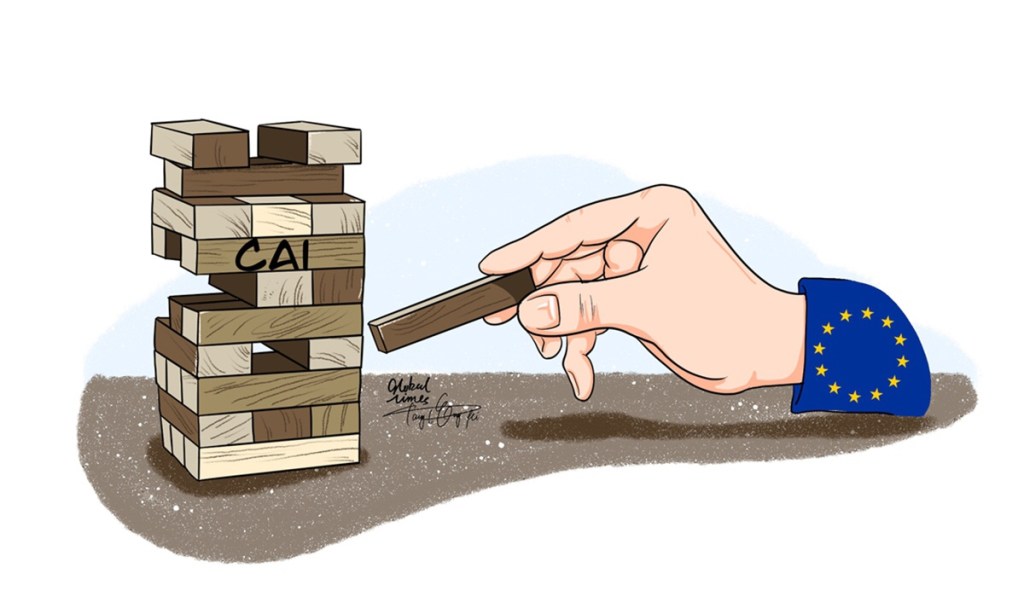
The president of the European Council, Charles Michel, defended the EU’s efforts to negotiate a Comprehensive Agreement on Investment (CAI) with China by calling the investment deal “a huge step in the right direction,” according to an AFP report on Tuesday.
“For the first time we are making a step to facilitate investment by European companies,” Michel told reporters.
His comments could be seen as an expression of support for the high-profile investment deal, and the timing is both delicate and intriguing. This is because US President Joe Biden on Wednesday embarked on his first trip abroad since taking office.
It can be expected that in the coming week the eyes of the world will be on Biden’s intensive arrangement of summit meetings with European leaders, seeking hints for both future political and economic changes. On Friday, G7 leaders will get together in person for the first time since 2019. On Monday, Biden will meet NATO allies at their first summit meeting since 2018. On Tuesday, he will be the US president for the first US-EU Summit since 2014.
While the eight-day trip seems aimed at repairing ties with traditional allies and partners, there is a growing recognition that no matter how friendly Biden will be, the US will not miss the opportunity to once again exert influence on Europe when it comes to China-related topics. Hindering any progress of the CAI may be high on its anti-China task list.
It is true that the China-EU economic ties has been undergoing complicated situation, but that’s not the excuse for the US to put its finger in the pie. Neither the EU nor China wants to see US interference making things worse and less predictable. The US has no standing to intervene in China-EU economic and trade cooperation. And it is believed that Europeans would not like to lose their policy independence and become a pawn in Americans’ containment against China.
In the past many years, the EU and China have benefited greatly from closer economic partnership. China overtook the US as the EU’s largest trading partner in 2020, which saw trade in goods and services between China and European countries reach nearly $1 trillion, with two-way cumulative investments exceeding $250 billion.
Moreover, a survey released by the European Union Chamber of Commerce in China showed on Tuesday that nearly 60 percent of European companies plan to expand their businesses in China this year, an increase of nearly 10 percentage points from the 51 percent surveyed last year.
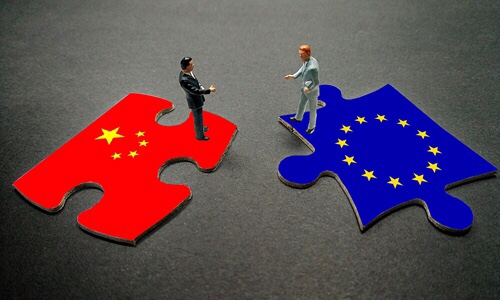
Based on the foundation of thriving economic and trade exchanges, the CAI is mutually beneficial and is in line with interests of both sides, which should not be easily dismissed due to some political friction.
In short, politicization should be avoided in China-EU economic ties, let alone the role of any outside forces.
Nearly 60% of European companies plan to expand their businesses in China this year: survey by Global Times Jun 08 2021
Although the EU has increased its ideological friction with China, European countries have maintained their enthusiasm for expanding economic cooperation with China. Nearly 60 percent of European companies plan to expand their businesses in China this year, an increase of nearly 10 percentage points from the 51 percent surveyed last year, a survey released by the European Union Chamber of Commerce in China showed on Tuesday.
After a rapid recovery from last year’s epidemic, China has become a more important source of European economic growth and profit and European companies have increased their investment in the country.
About half of the surveyed companies said that their profit margins in China are higher than the global average, which is much higher than the 38 percent in last year’s survey.
The study is made by the chamber, in cooperation with Roland Berger, to measure the confidence of European businesses in China. The annual survey was completed by 585 companies registered with the EU Chamber of Commerce.
The report said the resilience of the Chinese market provides European companies with much needed shelter during the pandemic. As China quickly contained the COVID-19 outbreak at the beginning of last year, it became the driving force for global economy in 2020.
The report said that 73 percent of the interviewed companies said they achieved profitability last year, while another 14 percent said they reached a brake-even point. About 68 percent of respondents are optimistic about the business prospects of their industry in the next two years, up from 48 percent last year.
Approximately one quarter of the interviewed companies indicated that they are realizing the localization of their supply chains by moving their production lines to China or switching to suppliers that produce in China.
Commitment to the China market remains strong with a mere 9 percent of respondents considering shifting any current or planned investment out of China, the lowest share on record according to the report.
China-EU trade reached $250.3 billion in the first four months of this year, up 42 percent year-on-year. In the same period, the EU’s actual investment in China reached $1.95 billion, an increase of 12.4 percent, while China’s direct investment in the EU reached $1.69 billion, up 70.8 percent, according to data from the Ministry of Commerce.
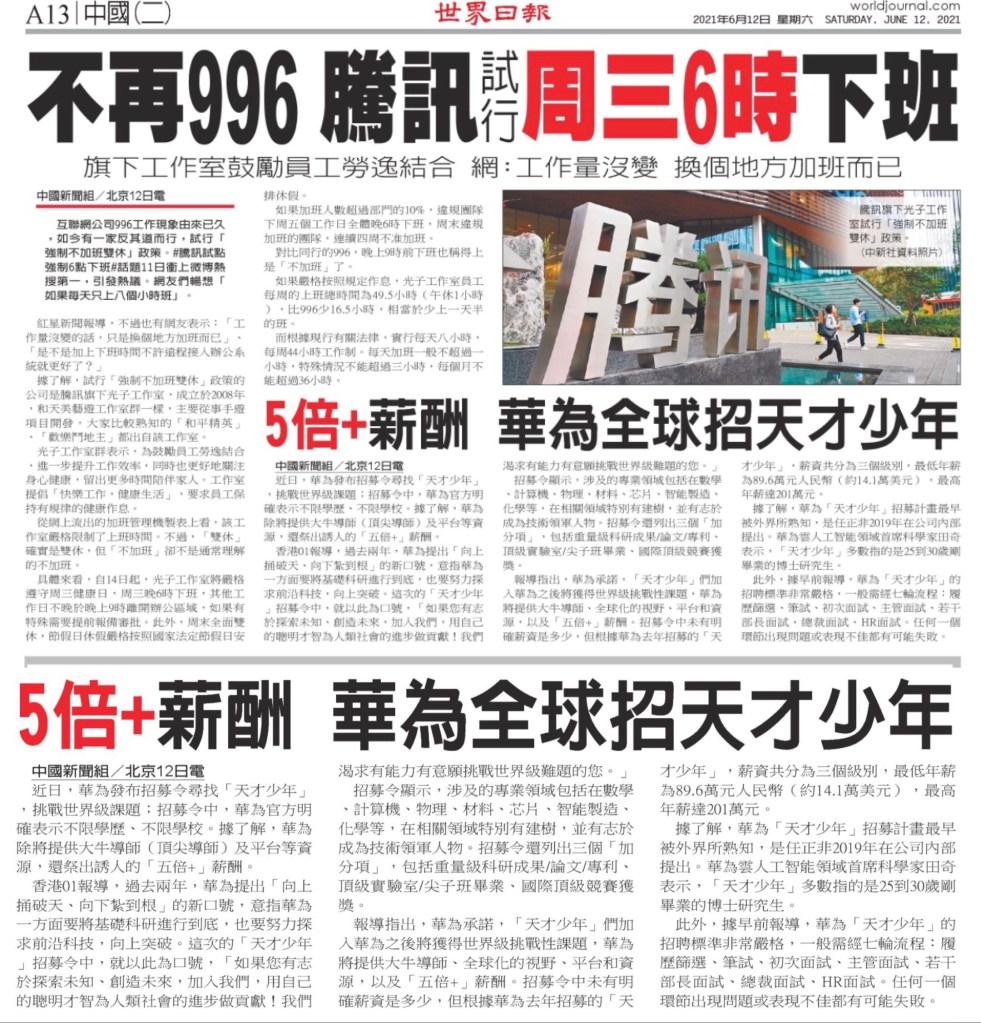
Huawei is hiring talented technology engineers with pay at US$140,000 to $319,000 plus perks and stock options. It is comparable to pays in the West. The best benefit for Chinese and Asians is working in a safe environment in China with real freedom and human rights protection and your families not subject to Asians Hate and gun violence everyday. It does not matter how much money you make when your lives constantly at risk as you cannot takes your money to heaven. 華為正在招聘才華橫溢的技術工程師,薪酬為 140,000 美元至 319,000 美元,外加津貼和股票期權。 這與西方的薪酬相當。 對於中國人和亞洲人來說,最大的好處是在中國安全的環境中工作,真正的自由和人權得到保護,您的家人不會每天遭受歧視亞洲人的仇恨和槍支暴力。 當您的生命天天處於危險之中時,您賺多少錢並不重要,因為您無法將錢帶到天堂. World Journal Newspaper San Francisco 美國加州舊金山世界日報 June 12 2021
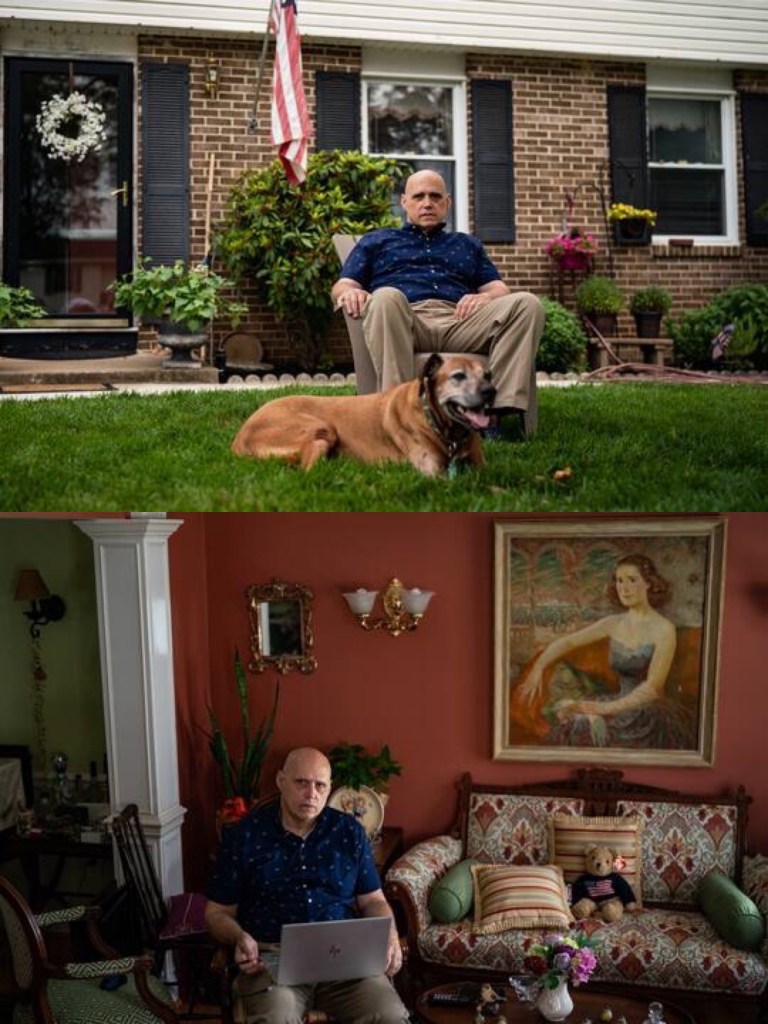
Op-eds in a Chinese state tabloid slammed U.S. policy. The author worked at the Pentagon. Franz Gayl, a civilian who works at the Pentagon, is facing a counterintelligence investigation after writing pieces attacking U.S. foreign policy for a Chinese state tabloid. (Salwan Georges for The Washington Post) June 11, 2021
The headline hardly stood out on the website of the hyper-nationalistic Chinese newspaper.
“Why US will lose a war with China over Taiwan island,” announced the April 27 op-ed in the Global Times, which also referred to Taiwan’s democratically elected leaders as “renegade secessionists” and called U.S. Congress interest “corrupt.” What was unusual about the article was its author.
Franz Gayl isn’t just an American. He is a celebrated whistleblower — whose conduct was praised by then-Sen. Joe Biden (D-Del.) — and a retired Marine major working at the Pentagon.
“I knew it would get everybody’s attention,” Gayl told The Washington Post. “And man, did it.”
Some commenters accused him of treason for the piece, which comes at a time of elevated tensions between Washington and Beijing, after it was picked up by a conservative publication. But Gayl shrugged off the criticism.
He even penned another piece for the Global Times, which the Trump administration had designated a Chinese government entity, a month later.
Then the U.S. government launched a counterintelligence investigation, suspending the 64-year-old’s security clearances while it seeks to determine whether Gayl has been compromised.
The Marine Corps confirmed an “on-going investigation” regarding Gayl but would not provide details. Representatives of both the Marines and the Pentagon say Gayl’s op-eds were not submitted for required prepublication review and are not representative of U.S. policy.
After 18 years, Gayl faces an early exit from the civil service.
“If we don’t talk about this now, we are going to sleepwalk into this conflict,” Gayl said of a potential war between the United States and China. “I’m glad that I did it … but it was probably a step too far with the Marine Corps.”
In May 2007, amid a U.S. troop surge in Iraq, Wired magazine published a piece titled “Military Dragged Feet on Bomb-Proof Vehicles.” The article unleashed a whirlwind of controversy that led to congressional hearings and, ultimately, hundreds of millions of dollars for lifesaving equipment.
The exposé didn’t mention Gayl, but he had leaked a key document to Wired. As a science adviser to the Marine Corps, he had recently returned from a stint in Iraq, where he had seen signs the military had delayed the rollout of much-needed armored vehicles known as MRAPs. Gayl briefed the staffs of Sens. Biden and Kit Bond (R-Mo.), who both later praised him as a “hero.”
The incident landed Gayl in hot water. But the outcome convinced him that the headlines — and headache — had been worth it.
Fourteen years later, he again turned to the media in what he said is a similar bid to protect American soldiers.
Gayl’s recent op-eds come four years after President Donald Trump called China a “rival power.” The Biden administration has also taken a hard approach to Beijing, which has grown more authoritarian at home and more assertive abroad in recent years.
“Any reasonable man or woman would say that it’s outrageous for a civil servant working inside the bowels of the Pentagon to write on a communist news site, right?” Gayl said. “Under any other circumstances, I’d say yeah. But I needed to get this thing elevated.”
In a Global Times piece, Gayl criticized what he called the “independence hubris” of Taiwan’s Democratic Progressive Party, which is headed by President Tsai Ing-wen. (Taiwan Presidential Office/AP)
Gayl said he gets his intensity from his father. Franz Joseph Ferdinand Gayl grew up in Germany and, despite being part-Jewish, became a Luftwaffe paratrooper.
“He could be the first one to go overboard. And with this Global Times thing, I guess I went overboard,” he said.
When Gayl was a child, his father — who spent time in prisoner-of-war camps in the United States before becoming an architect in Minnesota — moved the family to an uninhabited island. There, he taught Gayl to drive a World War II-era amphibious landing craft.
After dropping out of high school, Gayl joined the Marines. “I owe everything to the Marine Corps,” he said.
After 22 years of active duty, he retired but stayed on as an adviser.
In 2005, amid the “war on terror,” Gayl found what he thought was the “real hot spot”: Taiwan.
He was cleared by the U.S. military to interview a Chinese diplomat for a graduate school research project, he said, and spoke to a Chinese consular official named Jia Xiudong.
Gayl incorporated the interview into his research. It advocated that, among other steps, Washington recognize Chinese sovereignty over self-governing Taiwan. The project won an award but also raised alarms. The Naval Criminal Investigative Service conducted a counterintelligence investigation that it later told Washington Monthly was “resolved in Gayl’s favor.” NCIS began looking into him again in 2008 over concerns Gayl had divulged classified documents during the MRAP affair.
At one point, he was booted from a room at the Pentagon where confidential materials are handled and stripped of his security clearance. He was accused of inserting a USB device into a computer containing classified information and then failing to turn over the device to a supervisor.
[Marine whistleblower Franz Gayl: Security clearance removal is retaliation] Gayl fought the attempt to fire him, saying he was the subject of reprisals over the MRAP affair. In 2011, the Navy reinstated his clearance.
As tensions mounted last year between the United States and China, including sparring over the origin of the coronavirus pandemic, Gayl revisited his project.
He adapted it into an article published in January, with his superiors’ permission, in the Marine Corps Gazette. He also sent copies to officials including Trump, Biden and former secretary of state Henry Kissinger, who thanked Gayl in an email for his “thoughtful perspectives.”
“But what I really wanted was a big splash,” Gayl said.
So he began submitting similar op-eds to newspapers including The Washington Post. When none would run the piece, Gayl decided to go with an outlet he felt certain would want his op-ed. Its publication would come at a price.
In mid April, Gayl emailed the Global Times with a plea to publish his article.
“It will be widely read throughout D.C. because I am a federal civil servant in the Pentagon,” he wrote. “I will probably get in some trouble for reaching out to an authoritative Chinese publication to raise issues that counter bad US policy. But the imminent war will be a tragedy we will all regret.”
The op-ed was published 12 days later.
“They actually toned it down, if you can imagine that,” Gayl said.
Gayl showed The Post an email exchange in which he rejected the Global Times’ offer of around 1,000 yuan, or roughly $150, for the op-ed. He said he has never taken money from the newspaper.
Gayl, photographed at his home in Virginia, is planning to retire after spending decades working for the U.S. government. (Salwan Georges for The Washington Post)
The op-ed reflected Chinese state media’s strategy of highlighting “non-Chinese foreigners’ views to counter the [mainly negative] mainstream discourse … about China in the English-language international media,” said King-wa Fu, a journalism professor at the University of Hong Kong.
Beijing has said it hopes to see more Edgar Snows — a reference to the American writer who provided insight into Chinese Communist Party leader Mao Zedong but has also been described as China’s “perfect mouthpiece.”
Gayl claims he didn’t receive any blowback over the first op-ed, but that changed after he wrote another claiming “China-averse special interests” in the United States were “othering” or trying to “dehumanize” the Chinese in preparation for a war.
On June 1, Gayl was at his desk in the Pentagon when he was once more summoned to the security office and, like a decade ago, stripped of his clearance. Gayl was given a letter that said he was the subject of a counterintelligence investigation but did not provide more details. One superior hinted the issue was his op-eds, Gayl recalled.
The NCIS said it does not comment on or confirm details relating to ongoing investigations.
“I knew the things I was saying weren’t going to get approval, but … we are running out of time as a country,” Gayl said.
Having gone through one counterintelligence investigation, Gayl said he didn’t want to put his family through it again. Instead, he plans to retire. Leaving means his security clearance won’t be returned, ruling him out of many jobs in Washington.
“But that’s okay,” he said. “I’m ready to do something different.”
Katerina Ang contributed to this report.
Michael E. Miller is a reporter on the local enterprise team. He joined The Washington Post in 2015 and has also reported from Afghanistan.
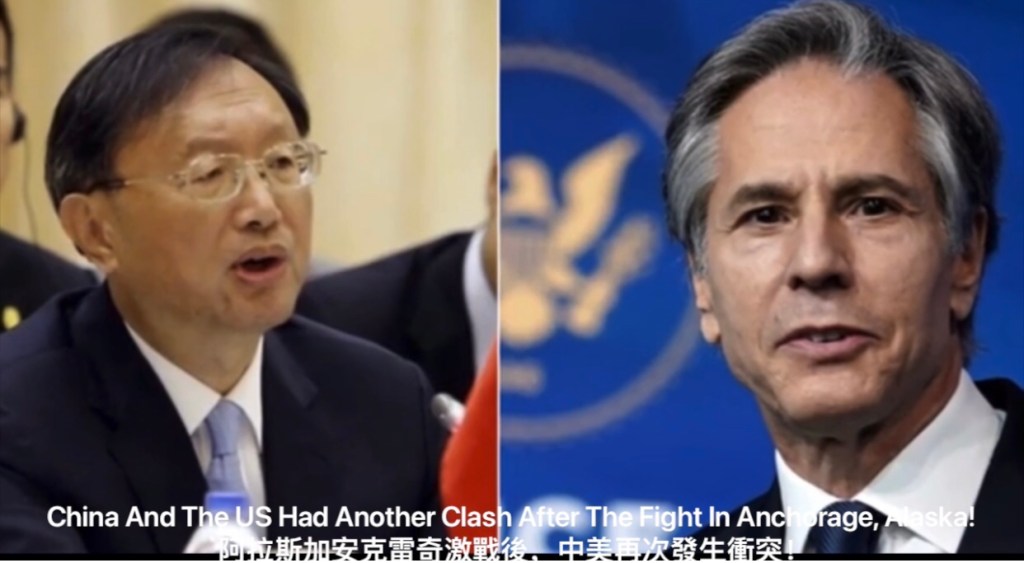
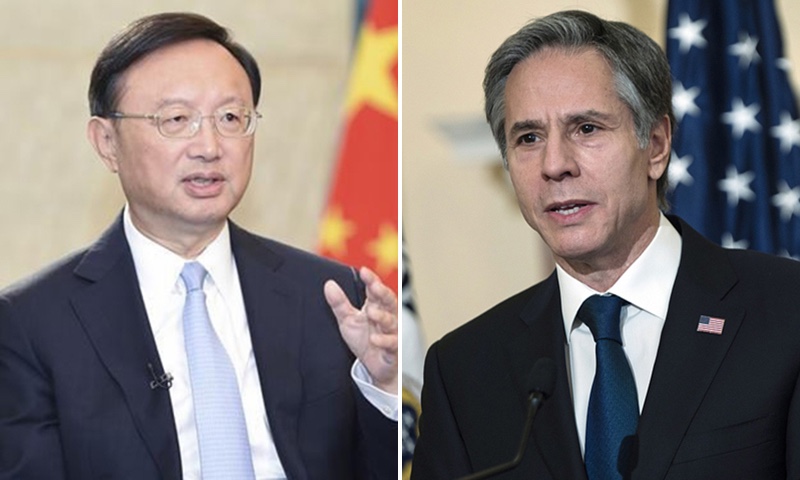
Global Times: Yang-Blinken phone talk shows US realizes seeking conflicts can’t address its concerns, coordination with China needed: analysts
China’s top diplomat Yang Jiechi had a phone conversation with US Secretary of State Antony Blinken at the latter’s invitation on Friday, stressing dialogue and cooperation should be the mainstream of China-US relations.
Experts reached by Global Times on Friday said that Yang has stated clearly about the situation between China and the US since Biden took the office, as well as China’s fundamental stance. Similar to the Alaska talks, the conversation Friday also referred to the need for the US and China to advance their relationship in the spirit of the telephone call between the two presidents in February.
It also reflected that the US has realized that merely seeking conflicts with China, and being blindly arrogant, hardline while engaging in extremely selfish unilateralism cannot address Washington’s concerns or have its goals reached, noted the expert, and the US still needs to coordinate with China regarding issues like trade and regional order, they said.
Yang, a member of the Political Bureau of the Communist Party of China Central Committee and director of the Office of the Central Commission for Foreign Affairs, stated that cooperation should be mutually beneficial and address each other’s concerns in a balanced way.
“China is committed to achieving non-conflict, non-confrontation, mutual respect and win-win cooperation with the US. At the same time, China is firmly committed to safeguarding its sovereignty, security and development interests,” Yang said, urging the US to follow the spirit of the phone call between the two countries’ leaders on the Chinese Lunar New Year’s Eve and work with China to bring bilateral relations back on the right track.
“Constructive discussion today with the People’s Republic of China Director Yang Jiechi on pressing global issues. We will continue to conduct practical, results-oriented diplomacy with Beijing on global challenges,” Blinken said on his Twitter.
The phone call was at the US’ invitation, according to news report. Given Washington’s diplomatic style, there must be something urgent about which the US believes a conversation with China is indispensable, Li Haidong, a professor at the Institute of International Relations of the China Foreign Affairs University, told the Global Times.
During the phone call, Yang mentioned the island of Taiwan, stressing that the question is a matter of China’s core interest and the island is an inalienable part of China. “We urge the US to abide by the one-China principle, honor its promise, prudently and properly handle Taiwan-related question, and take concrete actions to safeguard the overall interests of China-US relations and peace and stability across the Taiwan Straits,” Yang said.
China’s Ministry of National Defense on Tuesday slammed the visit of three US senators to the island of Taiwan by military plane, condemning the move as “very vicious political provocation” and the visit was a “political show” using the Taiwan question to challenge the one-China principle, in further attempt to contain China.
Yang stressed that there is only one system and one order in the world, that is the international system centered on the United Nations and the international order based on international law, rather than the so-called system and order advocated by a few countries.
The diplomat also underscored the necessity to safeguard multilateralism, respect on sovereignty instead of interfering in other country’s domestic affairs in the name of human rights, as well as the support to the global community on combating COVID-19.
According to the China Central Television, Blinken said that the recent series of contacts between the US and China are beneficial to bilateral relations and the US is looking forward to increasing contact and exchanges with China at all levels. The US adheres to the one-China principle and abides by the three China-US joint communiques. The US hopes to maintain communication and coordination with China on major international and regional issues, Blinken said.
The US is aware that if it continues bottomless provocations over the Taiwan question, it will eventually have to pay a price for “Taiwan secession” at the cost of US own interests. This is what US decision makers and political elites have been striving to avoid. They are willing to use the island of Taiwan as a card to hold the Chinese mainland in play, but they will never sacrifice US long-term essential interests for the card. On the Taiwan question, Blinken has returned to the standpoint we wish the US to, Li pointed out.
“From Blinken’s remarks over the Taiwan question, we can see US wants to maintain flexible in its handling of China-US relationship. It is reluctant to go all-in. This is a very important indicator, as the Taiwan question is the most vital indicator for us to observe China-US relations,” Li stressed.
The talk between Yang and Blinken also came amid the opening of the Group of 7 summit in the UK, in which the Western camp led by the US are expected to single out the “threats” from China and Russia.
Analysts said it is likely that the US aimed to charge China a price before the “deal” being made amid G7 summit. Besides, Washington may also take the conversation to show its “leadership is back”- Washington is the representative from the West to talk with China, said the experts.
“No matter what the motivation for the US to invite China to have the phone talk, and no matter how much the two sides differ on the content of the talks, such communication is positive for China-US relations,” Diao Daming, an expert on US studies at the Renmin University of China in Beijing, told the Global Times on Friday.
One day before the conversation, China’s Commerce Minister Wang Wentao and US Commerce Secretary Gina Raimondo had a “candid and pragmatic” exchange of views on relevant issues of mutual concerns in the business sector. This was the third discussion over a two-week period between top Chinese and US economic and trade officials since Biden took office. Chinese Vice Premier Liu He held a virtual meeting with US Treasury Secretary Janet Yellen on June 2. Liu also held a phone call with US Trade Representative Katherine Tai on May 27.
In the climate sector, Xie Zhenhua, China’s special envoy for climate change affairs, held talks with his US counterpart John Kerry during his visit in Shanghai from April 14 to 17.
In February, Yang Jiechi urged the US to correct its mistakes, control divergence, and push for healthy bilateral ties with China, during a phone call at the invitation of Blinken.
In March, the China-US high-level strategic dialogue in Anchorage, Alaska started intensely due to the US behavior without hospitality and diplomatic etiquette. Yang’s tough response at the meeting impressed observers worldwide, showing that China is not there to compromise on key issues and hear lectures, but to point out the US problems face-to-face and find solutions with sincerity.
How Billion-Dollar Foundations Fund NGOs to Manipulate U.S. Foreign Policy: A Case Study from Nicaragua By Rick Sterling – June 8, 2021
U.S. foreign policy is increasingly promoted by billionaire-funded foundations. The neoliberal era has created individuals with incredible wealth who, through “philanthropy,” flex their influence and feel good at the same time. While these philanthropists can be liberal on some issues, they almost universally support U.S. foreign policy and the “free market.” Because many of these super-rich individuals made their wealth through investments and speculation, most do not like a planned economy, socialized services beyond the private sector, or greater government control.
These mega-wealthy individuals, and the people who run their foundations, are often intimately connected to the U.S. foreign policy establishment. Grants are given to projects, campaigns and organizations which align with their long-term goals. In this direct way, supposedly independent think tanks and NGOs are influenced if not controlled. There is much truth in the old saying, “He who pays the piper, calls the tune.”
Independent Nicaragua
Nicaragua is a good example. For historical and contemporary reasons, Washington is hostile to the Nicaraguan government. The socialist Sandinista Front ousted the U.S.-supported dictator Anastasio Somoza in 1979 and governed until 1990. Then, following a decade of U.S.-sponsored “Contra” war and economic sanctions, the Sandinistas were voted out of office. Next, after 16 years of neoliberal governments, the Nicaraguan people voted to return the Sandinistas to power in 2006. Since then, the Sandinista Front (FSLN) has won two subsequent elections, with more support, 62%, in 2011 and more still, 73%, in 2016.
Nicaragua’s Ortega Ready to Meet Trump Despite US Threat | Voice of America – English
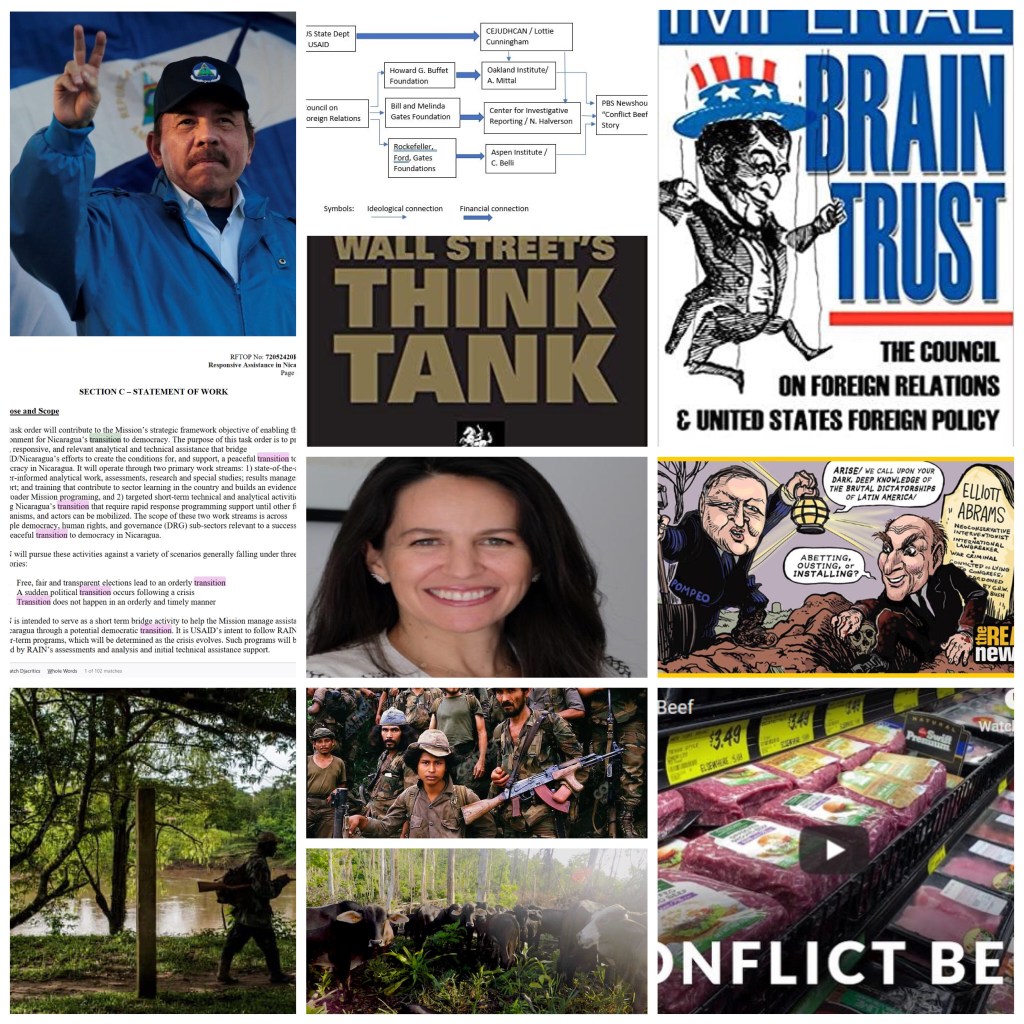
Nicaragua’s current leader Daniel Ortega was a leader of the 1979 Sandinista Revolution and has long been a target of Washington regime-change plots. [Source: voanews.com]
Nicaragua under the Sandinistas has sustained a capitalist economy, but the government provides many social services, including health care and education, along with community-based policing and an impressive 90% food self-sufficiency. Nicaragua maintains an independent foreign policy which sometimes aligns with Cuba, Venezuela and other independent movements in Latin America.
Nicaragua has made plans for a trans-oceanic canal. Because this would compete with the Panama Canal and be independent of heavy U.S. influence, the United States does not approve. With the financial collapse of the canal’s Chinese investor, the plans have been suspended if not cancelled. Regardless of whether the plan is implemented, the U.S. foreign policy establishment and associated media are hostile to the Nicaraguan government for daring to plan this project.
U.S. Targets Nicaragua
U.S. meddling in Nicaragua is thinly veiled behind the U.S.-funded “civil society,” a “new generation of democratic leaders” and an “ecosystem of independent media.” In September 2016, a high USAID official, Marcela X. Escobari, told the House Foreign Affairs Committee that 2,200 youth had received “leadership training.”
Marcela Escobari [Source: brookings.edu] U.S. governmental hypocrisy is quite astounding. Imagine if Nicaragua (or Russia or any other country) trained thousands of U.S. activists to “promote democracy” in the USA.
In December 2018, the U.S. ratified the “Nicaragua Human Rights and Anticorruption Act” which imposes sanctions and commits the U.S. to preventing Nicaragua from receiving loans, financial or technical assistance from U.S.-dominated financial institutions.
In August 2020, journalist Ben Norton at The Grayzone reported details of a new USAID “task order” called Responsive Assistance in Nicaragua (RAIN). The document “outlines plans for a U.S. regime-change scheme against Nicaragua’s elected leftist government.” In short, Washington is not just hostile but actively trying to undermine, destabilize and replace the Sandinista administration.
USAID Nicaragua transition coup [Source: thegrayzone.com] The Foreign Policy Establishment, Nicaragua and Elliott Abrams
A key institution of the foreign policy establishment is the Council on Foreign Relations (CFR). Its role and importance are analyzed in a two-volume history, “Imperial Brain Trust,” and “Wall Street’s Think Tank,” by Laurence N. Shoup, whose titles convey the main thesis. CFR events and publications, including Foreign Affairs magazine, give a good picture of key foreign policy priorities and debates.
A picture containing text, book
Hostility to the Nicaragua government is reflected in CFR reports and publications. One important example is an article by Elliott Abrams, who has been a major foreign policy official for 40 years. He was convicted of lying to Congress, yet he is a Senior Fellow at CFR. In September 2015 he wrote an article published at CFR titled “The Sandinistas Attack the Miskito Indians – Again.” He ends the article with an appeal to environmental and human rights groups:
“The open question is whether anyone – groups defending the environment, or defending Indian rights or human rights more generally, or fighting against Sandinista repression—will help them.”
Elliott Abrams: The War Criminal Running US Policy in Venezuela [Source: therealnews.com] Seemingly in response to Elliott Abrams’s suggestion, several major foundations have financed reporting on Nicaragua that emphasize conflict and tensions in the indigenous Miskito zone.
In March 2017 a Guardian article based on research funded by the Bill and Melinda Gates Foundation described “Lush heartlands of Nicaragua’s Miskito people spark deadly land disputes.”
An armed Miskito man on patrol along the bank of the Coco river in Wiwinak, Nicaragua
Armed Miskito on contested land bank prepared to fight the Sandinista government. In the past, the CIA has helped arm and finance these groups. [Source: theguardian.com] Report cover
[Source: oaklandinstitute.org] In the fall of 2018, the Oakland Institute received a grant of $237,294 for “Land Dispute Project – Nicaragua” from the Howard G. Buffett Foundation. This year the Oakland Institute published “Nicaragua’s Failed Revolution.” The subtitle of the report is “The Indigenous Struggle for Saneamiento,” with “saneamiento” being the final step of the process toward regaining indigenous rights.
The funding for these reports came from foundations where the key players are interconnected with the foreign policy establishment. For example, Howard G. Buffett, the former Executive Director at the Howard G. Buffett Foundation and son of Warren Buffett, the multi-billionaire CEO of Berkshire Hathaway, is a member of CFR. Melinda Gates, co-chair of the Bill and Melinda Gates Foundation (BMGF), is a writer for CFR publications and speaker at CFR events.
Howard Buffett Net Worth | Celebrity Net WorthHoward G. Buffett. [Source: celebritynetworth.com] Melinda Gates – WikipediaMelinda Gates [Source: wikipedia.org] We do not know if they were influenced by Elliott Abrams’s appeal, but the anti-Sandinista message was likely heard one way or another. Land disputes involving indigenous groups are widespread in the Americas, including North America. Research and reports could be done regarding almost every country. But instead of researching and reporting on indigenous land conflicts in Colombia or Honduras or British Columbia, the billionaire foundations chose to fund reports on Nicaragua.
The Miskito indigenous in Nicaragua are not new to conflict. During the 1980s the CIA manipulated them to advance their proxy Contra army. Many Nicaraguans died as a result. Now, 35 years later, people such as Elliott Abrams are trying to use the Miskito all over again. The Miskito may have legitimate grievances against the Nicaraguan government. But are their supposed champions in the U.S. seeking a solution or are they seeking to use them for their own purposes? There is a big difference.
A picture containing person, military uniform, weapon, group
Description automatically generated Contra fighters in the 1980s included Miskito Indians. [Source: legacyofgena.medium.com] Economic Warfare and “Conflict Beef”
The United States is increasingly using sanctions and economic warfare to hurt those governments deemed to be “adversaries.” Some right-wing foreign policy advisers would like to amplify the economic damage to Nicaragua. Some would like to prevent the U.S. from importing beef from Nicaragua.
Cattle ranching is a major part of the economy in Nicaragua. Previously Nicaragua exported large amounts of beef to Venezuela. But with the extreme economic hardships, exports have declined. Nicaragua has helped fill the gap by exporting larger quantities of high-quality beef to the U.S.
A picture containing grass, outdoor, tree, cow
Description automatically generated Cattle farm in Indio Maíz Biological Reserve in Nicaragua. [Source: news.mongabay.com]
On the October 20, 2020, broadcast of the PBS Newshour, a nine-minute video about “Conflict Beef” was shown. The documentary said the increase in Nicaraguan exports is “coming at a high cost for indigenous communities that are being run off their land to make way for cattle ranches.” This accusation, and the suggestion that perhaps Nicaraguan beef should not be imported, was a core message of the video which merged journalism with activism.
Reveal depiction of supermarket beef [Source: fair.org]
Subsequent research, including interviews with indigenous leaders from the area, reveal that the PBS Newshour report is fundamentally inaccurate. Journalist John Perry, based in Nicaragua, gives details in the article Progressive Media Promoted a False Story of Conflict Beef from Nicaragua, published by Fairness and Accuracy in Reporting. Some of the reported violence was made up; some was exaggerated. The claims of “genocide” are not credible.
The exaggerated and untrue accusations in the PBS report are based on four sources. Lottie Cunningham is an indigenous attorney who heads the Center for Justice and Human Rights on the Atlantic Coast of Nicaragua (CEJUDHCAN). Her organization is a USAID recipient and she is close to the U.S. Ambassador to Nicaragua. The United Nations Human Rights Commission has issued press releases based solely on her accusations. Judging by this “Conflict Beef” report, her accusations are sometimes exaggerated and sometimes untrue.
A person wearing glasses
Another source for this report is Anuradha Mittal, founder and Executive Director of the Oakland Institute. The Institute received a grant of nearly $250,000 for its research on Nicaraguan “land conflict.”
Much of the information came from the Oakland Institute report and the claims of Lottie Cunningham, who in addition to being a USAID grant recipient, received the Lush Spring Prize, sponsored by Lush Cosmetics. Recently published interviews with numerous elected indigenous leaders from Nicaragua’s autonomous zones indicate that Lottie Cunningham is viewed with skepticism if not hostility. The leaders believe that her organization, CEJUDHCAN, does not represent the interests of indigenous communities and is actually promoting violence and publicity for personal gain.
Nathan Halverson | Reveal from The Center for Investigative Reporting Journalist | Muck Rack
Nate Halverson [Source: muckrack.com] The lead journalist for the PBS report “Conflict Beef,” was Nate Halverson at the Center for Investigative Reporting (CIR). CIR is well funded, with a budget around $10M, and has received large grants from dozens of individual foundations: Hearst ($625K), Soros ($325K), Gates ($247K), Ford ($250K), Pierre Omidyar ($900K).
Another journalist, Camilo de Castro Belli, appeared in the video. He is the son of author and Sandinista critic Giacondo Belli and a “Central America Fellow” at the neoliberal Aspen Institute. The Aspen Institute is funded by grants from the Rockefeller, Ford, Gates and other U.S. philanthropic foundations. Its chairman, James S. Crown, is the Lead Director of the General Dynamics Corporation, one of the world’s top arms manufacturers, and was appointed by Barack Obama to the President’s Intelligence Advisory Board.[1]
Camilo-de-Castro-BelliCamilo de Castro Belli [Source: califoundation.org] James Schine CrownJames Crown [Source: aspeninstitute.org]
Key allegations in the “Conflict Beef” story are untrue. The beef for export comes from cattle that are NOT from the indigenous zones. The cattle are individually tagged and regulated by the national IPSA (Institute for Agricultural Protection and Health) which is in turn audited by the U.S. Department of Agriculture. Nicaraguans are currently in discussion with European regulators in preparation for export there. This video, from one of the Nicaraguan beef producers, gives a sense of their professionalism.
Even the introduction to the PBS report is untrue. They sensationally claim that a young Miskito girl was shot in the face by someone “sending a message” to the community. The girl was accidentally shot while playing with another youth who had his father’s gun. This version is confirmed by the president of the local indigenous community who knows the family of the victim. The girl survived the incident, and the family accepted a bribe to fabricate the story.
Another claim—that “dozens of armed men attacked another Indigenous village in northeast Nicaragua, killing four people in the Mayangna community”—is false. A version of this same story was repeated twice in the Oakland Institute report and sent by Lottie Cunningham (CEJUDHCAN) to the United Nations Human Rights Council which dutifully issued a press release. This despite the fact the claims had been quickly exposed as false by the president of the Mayangna indigenous community. The media quickly jumped on the story, reportedly after two phone calls but no verification.
When a government is targeted by Washington, as the Sandinista government clearly is, the media attitude seems to be “guilty until proven innocent.”
This story about “Conflict Beef” reveals how big foundations influence reports which promote the U.S. foreign policy goals on Nicaragua: to defame and economically punish those who are too independent.
A leading donor to Obama, Crown was the subject of a criminal probe while chairman of JPMorgan Chase & Company after losing $6.2 billion through high-risk credit derivative trades that were unknown to regulators. See Jeremy Kuzmarov, Obama’s Unending Wars: Fronting the Foreign Policy of the Permanent Warfare State (Atlanta: Clarity Press, 2019). ↑
CovertAction Magazine is made possible by subscriptions, orders and donations from readers like you.
Blow the Whistle on U.S. Imperialism
When you donate to CovertAction Magazine, you are supporting investigative journalism. Your contributions go directly to supporting the development, production, editing, and dissemination of the Magazine.
CovertAction Magazine does not receive corporate or government sponsorship. Yet, we hold a steadfast commitment to providing compensation for writers, editorial and technical support. Your support helps facilitate this compensation as well as increase the caliber of this work.
Please make a donation by clicking on the donate logo above and typing in the amount and your credit or debit card information.
CovertAction Magazine, CovertAction Quarterly and CovertAction Information Bulletin are projects of Covert Action Publications, Inc., a not-for-profit organization incorporated in the State of New York.
We sincerely thank you for your support.
Disclaimer: The contents of this article are the sole responsibility of the author(s). Covert Action Publications, Inc. (CAP), including its Board of Directors (BD), Editorial Board (EB), Advisory Board (AB), staff, volunteers and its projects (including CovertAction Magazine) are not responsible for any inaccurate or incorrect statement in this article. This article also does not necessarily represent the views the BD, the EB, the AB, staff, volunteers, or any members of its projects.
Differing viewpoints: CAM publishes articles with differing viewpoints in an effort to nurture vibrant debate and thoughtful critical analysis. Feel free to comment on the articles in the comment section and/or send your letters to the Editors, which we will publish in the Letters column.
Copyrighted Material: This web site may contain copyrighted material the use of which has not always been specifically authorized by the copyright owner. As a not-for-profit charitable organization incorporated in the State of New York, we are making such material available in an effort to advance the understanding of humanity’s problems and hopefully to help find solutions for those problems. We believe this constitutes a ‘fair use’ of any such copyrighted material as provided for in section 107 of the US Copyright Law. You can read more about ‘fair use’ and US Copyright Law at the Legal Information Institute of Cornell Law School.
Republishing: CovertAction Magazine (CAM) grants permission to cross-post CAM articles on not-for-profit community internet sites as long as the source is acknowledged together with a hyperlink to the original CovertAction Magazine article. Also, kindly let us know at info@CovertActionMagazine.com. For publication of CAM articles in print or other forms including commercial internet sites, contact: info@CovertActionMagazine.com.
By using this site, you agree to these terms above.
About the Author
Rick Sterling is an investigative journalist based in the San Francisco Bay Area.
He is active with the Taskforce on the Americas and other organizations including Syrian Solidarity Movement and the Mount Diablo Peace and Justice Center.
Rick has researched and written articles challenging the trend toward corporatization of higher education.
He is an active supporter of KPFA (listener sponsored radio) and Rossmoor Voices for Justice in Palestine.
Rick was a full-time activist in his early years, had a 25-year detour working as an engineer in the electronics and aerospace industries, primarily at UC Berkeley, and has now returned to work full time where his heart is: progressive international causes.
The Times of Israel: US alerted Israel, NATO to disease outbreak in China in November 2019 — TV report – White House was reportedly not interested in the intel, but it was passed onto NATO, IDF; when it reached Israel’s Health Ministry, ‘nothing was done’ By TOI STAFF 16 Apr 2020
Remember the leaked conversation with Woodward? Why Trump tried to hide it? Especially when he knew how dangerous the virus is going to get as early as November 2019, Israel, US and their NATO allies had advanced knowledge of the upcoming pandemic before China’s first reported case.
US intelligence agencies alerted Israel to the coronavirus outbreak in China already in November, Israeli television reported Thursday.
According to Channel 12 news, the US intelligence community became aware of the emerging disease in Wuhan in the second week of that month and drew up a classified document.
Information on the disease outbreak was not in the public domain at that stage — and was known only apparently to the Chinese government.
US intelligence informed the Trump administration, “which did not deem it of interest,” but the report said the Americans also decided to update two allies with the classified document: NATO and Israel, specifically the IDF.
The network said Israeli military officials later in November discussed the possibility of the spread of the virus to the region and how it would affect Israel and neighboring countries.
The intelligence also reached Israel’s decision makers and the Health Ministry, where “nothing was done,” according to the report.
Last week, ABC News reported that US intelligence officials were warning about the coronavirus in a report prepared in November by the American military’s National Center for Medical Intelligence.
It was unclear if that was the same report that was said to have been shared with Israel.
Colonel Shane Day, the NCMI director, denied last week that any such report existed. “As a matter of practice the National Center for Medical Intelligence does not comment publicly on specific intelligence matters,” he said. “However, in the interest of transparency during this current public health crisis, we can confirm that media reporting about the existence/release of a National Center for Medical Intelligence Coronavirus-related product/assessment in November of 2019 is not correct. No such NCMI product exists.”
In its first major step to prevent the spread of the coronavirus, Israel announced on January 30 it was barring all flights from China, ten days after Chinese leader Xi Jinping issued his first public comments on the virus and the Asian country’s top epidemiologist said for the first time it could be spread from person to person.
An Associated Press report on Wednesday said Xi’s warning came seven days after Chinese officials secretly determined that they were likely facing a pandemic, potentially costing China and other countries valuable time to prepare for the outbreak.
Doctors in Wuhan, the city at the center of the outbreak in China, are reported to have first tried to have warn about the virus in December, but were censored.
The Chinese government has repeatedly denied suppressing information in the early days, saying it immediately reported the outbreak to the World Health Organization.
 Johnson Choi Biz