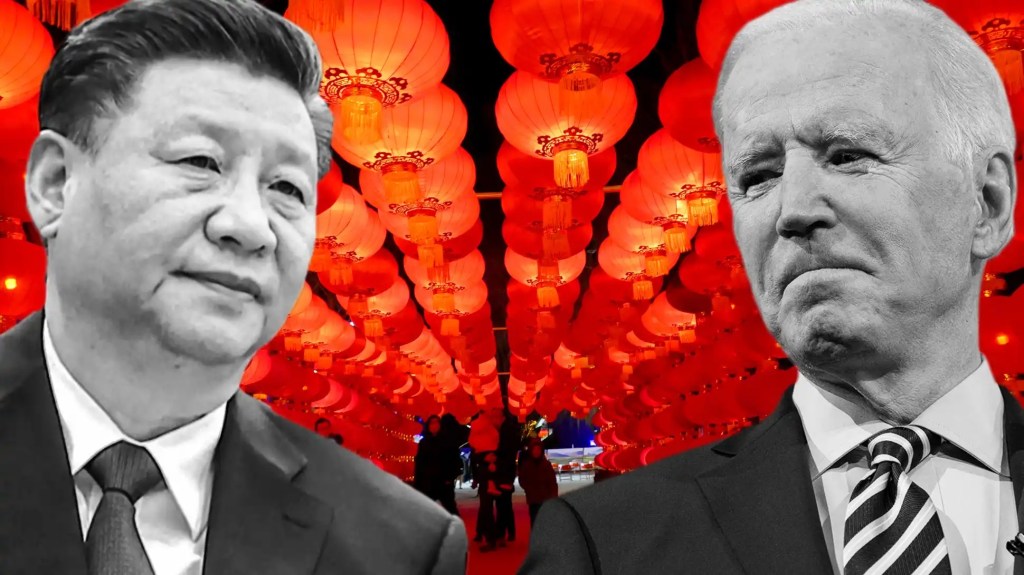
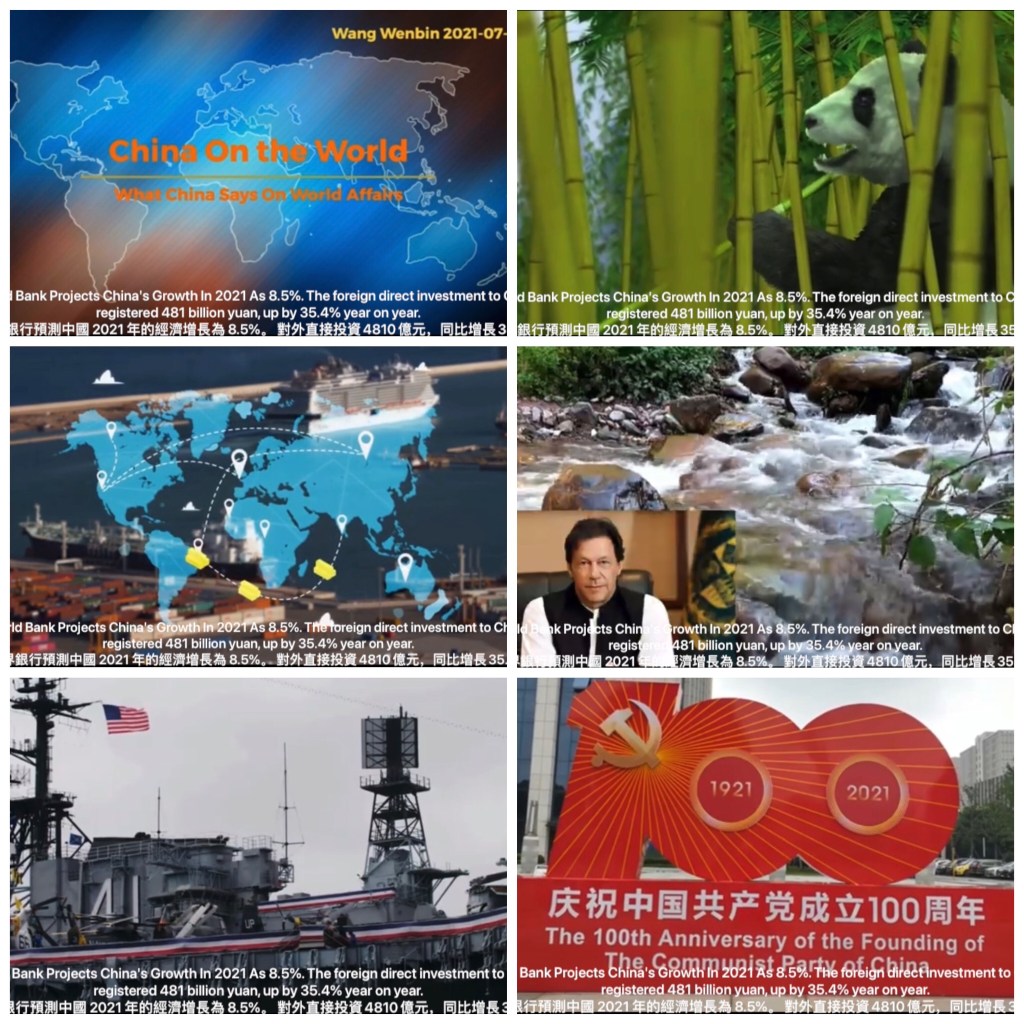
Video: US & Western Empires soft power, cleverly using Hollywood movies playing the minds games to demonize Chinese and China.

Video: US & Western Empires soft power, cleverly using Hollywood movies playing the minds games to demonize Chinese and China. 美國和西方帝國的軟實力,巧妙地利用好萊塢電影玩心理遊戲妖魔化中國和中國人.
https://youtu.be/D9MZkRrERUk
https://vimeo.com/568666944
https://www.facebook.com/100036400039778/posts/519531499270180/?d=n

Video: The WSJ protends to be politically correct, and it implies the effectiveness of Sinovac’s covid 19 vaccines to smear China.

Video: The WSJ protends to be politically correct, and it implies the effectiveness of Sinovac’s covid 19 vaccines to smear China. 《華爾街日報》自稱政治正確,暗示科興新冠病毒疫苗的有效性來抹黑中國.

We need to credit the WSJ for praising the Chinese vaccine’s high efficacy and effectiveness with nasty words. The article is politically correct by saying bad words about China and scientifically right by pointing out the superb performance of Chinese vaccines. 我們需要讚揚華爾街日報用下流的話稱讚中國疫苗的高效和有效性。 這篇文章說中國的壞話政治正確,指出中國疫苗的卓越表現科學正確.

Indonesia Approved China’s Sinovac Vaccine For Kids 12 – 17. 印度尼西亞批准了中國 12-17 歲兒童的賽諾興疫苗.
https://vimeo.com/568612068
https://youtu.be/LP_2GshiKeo
https://www.facebook.com/100036400039778/posts/519451145944882/?d=n

Video: Would US open its biological base at Fort Detrick for international investigation? Uncovering link between U.S. biological lab at Fort Detrick and Japan’s WWII germ warfare unit 731

Video: Would US open its biological base at Fort Detrick for international investigation? Uncovering link between U.S. biological lab at Fort Detrick and Japan’s WWII germ warfare unit 731 美國會開放其在德特里克堡的生物基地進行國際調查嗎? 發現美國德特里克堡生物實驗室與日本二戰細菌戰部隊 731 之間的聯繫.
https://vimeo.com/568512187
https://youtu.be/ZXP8wVZPZi8
https://www.facebook.com/100036400039778/posts/519334819289848/?d=n
The USAMRIID at Fort Detrick, notorious for conducting gruesome experiments on human beings and possibly associated with deadly disease outbreaks, was recently restored to full operation after being shut down by the CDC. Here’s the mysterious dark history surrounding Fort Detrick. 位於德特里克堡的 USAMRIID 因對人類進行可怕的實驗而臭名昭著,並且可能與致命的疾病爆發有關,最近在被 CDC 關閉後恢復全面運作。 這是圍繞德特里克堡的神秘黑暗歷史.

Inside Fort Detrick – America’s secretive biolabs by Alison Young and Nick Penzenstadler, USA TODAY

Inside Fort Detrick – America’s secretive biolabs by Alison Young and Nick Penzenstadler, USA TODAY May 28 2015

Biohazard suits hang inside a biosafety level 4 laboratory suite at the U.S. Army Medical Research Institute of Infectious Diseases in Fort Detrick, Md., in 2011. The BSL-4 lab, which is the the highest security-level lab possible, is used for handling deadly pathogens that have no vaccine or cure.

Vials of bioterror bacteria have gone missing. Lab mice infected with deadly viruses have escaped, and wild rodents have been found making nests with research waste. Cattle infected in a university’s vaccine experiments were repeatedly sent to slaughter and their meat sold for human consumption. Gear meant to protect lab workers from lethal viruses such as Ebola and bird flu has failed, repeatedly.

A USA TODAY Network investigation reveals that hundreds of lab mistakes, safety violations and near-miss incidents have occurred in biological laboratories coast to coast in recent years, putting scientists, their colleagues and sometimes even the public at risk.

Oversight of biological research labs is fragmented, often secretive and largely self-policing, the investigation found. And even when research facilities commit the most egregious safety or security breaches — as more than 100 labs have — federal regulators keep their names secret.

Of particular concern are mishaps occurring at institutions working with the world’s most dangerous pathogens in biosafety level 3 and 4 labs — the two highest levels of containment that have proliferated since the 9/11 terror attacks in 2001. Yet there is no publicly available list of these labs, and the scope of their research and safety records are largely unknown to most state health departments charged with responding to disease outbreaks. Even the federal government doesn’t know where they all are, the Government Accountability Office has warned for years.

A team of reporters who work for the USA TODAY Network of Gannett newspapers and TV stations identified more than 200 of these high-containment lab facilities in all 50 states and the District of Columbia operated by government agencies, universities and private companies. They’re scattered across the country from the heart of New York City to a valley in Montana; from an area near Seattle’s Space Needle to just a few blocks from Kansas City’s Country Club Plaza restaurant and shopping district.

High-profile lab accidents last year with anthrax, Ebola and bird flu at the Centers for Disease Control and Prevention and the discovery of forgotten vials of deadly smallpox virus at the National Institutes of Health raised widespread concerns about lab safety and security nationwide and whether current oversight is adequate to protect workers and the public. Wednesday the Department of Defense disclosed one of its labs in Utah mistakenly sent samples of live anthrax — instead of killed specimens – to labs across the USA plus a military base in South Korea where 22 people are now being treated with antibiotics because of their potential exposure to the bioterror pathogen. As many as 18 labs in nine states received the samples, the CDC said Thursday.

“What the CDC incidents showed us … is that the very best labs are not perfectly safe,” says Marc Lipsitch, a Harvard University professor of epidemiology. “If it can happen there, it certainly can happen anywhere.”

Some people find little reassurance that nobody was sickened in the CDC accidents or in the historically low numbers of serious infections among lab workers generally, or that infections spreading into communities surrounding labs have been rarer still.

“Many of us think that’s really a matter of good fortune,” said Beth Willis, who chairs a citizen lab advisory panel in Frederick, Md., home to one of the nation’s largest high-containment research campuses at the Army’s Fort Detrick.

The country’s best labs have robust safety programs, said Kenneth Berns, co-chair of a panel of outside lab safety advisers currently examining biosafety at CDC and other federal labs. Yet the systemic safety problems identified at the CDC’s prestigious labs have raised questions about what’s happening elsewhere. “It’s a matter of some concern,” said Berns, a distinguished professor emeritus of molecular genetics and microbiology at the University of Florida.

The consequences could be devastating if accidents were to occur with lab-created strains of deadly influenza viruses that are purposely engineered to be easier to spread than what’s found in nature, said David Relman, a microbiology professor at Stanford University who is a federal adviser on lab safety and a past president of the Infectious Diseases Society of America.

“You’re talking about something that has the ability to take off, and we could not be confident of being able to contain it,” he said.

Relman said that not enough is known about the state of safety at labs that perform infectious disease research but emphasized that the kinds of labs drawing concern are the same ones the public needs to discover important new treatments and vaccines. “We have to find some happy blend of minimized risk and enhanced benefit,” he said.

At the high-containment labs identified by USA TODAY, experiments are underway involving drug-resistant tuberculosis, exotic strains of flu, the SARS and MERS viruses, plague, anthrax, botulism, ricin and the Ebola and Marburg hemorrhagic fever viruses, according to interviews and more than 20,000 pages of internal lab safety records and incident reports obtained from labs across the country.

Studies are also being done on a wide range of bioterrorism pathogens that are less known to the public, such as the agents that cause exotic diseases like tularemia, Q fever and melioidosis. Still others are focused on pathogens that pose serious economic risks to agriculture, such as foot-and-mouth disease, brucellosis and “mad cow” disease.

At a few labs, experiments have been done with strains of flu and other viruses purposely made to be more dangerous in studies that seek to understand how they might mutate naturally. White House science advisers called for a temporary halt of that kind of “gain of function” research last fall while expert scientific panels spend the next year studying its risks and benefits.

The research at BSL-3 and BSL-4 labs — which use special equipment, negative air pressure and numerous safety and security procedures — seeks to better understand how organisms cause disease and ways to protect against them. It’s the kind of work that the public doesn’t give much thought to until people with Ebola arrive on planes in the United States from an outbreak in Africa, or the current avian flu outbreak forces farmers to kill millions of chickens raising the specter of higher egg prices.

It’s impossible to obtain a full accounting of lab accidents or lab-acquired infections because there is no universal, mandatory requirement for reporting them and no system to analyze trends to assess emerging biosafety risks and disseminate lessons learned on a regular basis.

The Federal Select Agent Program, which inspects and regulates the subset of research labs that experiment with about four dozen types of pathogens deemed to pose bioterror threats, requires labs to report potential exposure or release incidents, as well as thefts or losses of specimens.

From 2006 through 2013, labs notified federal regulators of about 1,500 incidents with select agent pathogens and, in more than 800 cases, workers received medical treatment or evaluation, limited public data in program annual reports show. Fifteen people contracted laboratory-acquired infections and there were three unintended infections of animals, according to the reports, which do not identify labs and mostly provide aggregated counts of incidents by type. Reported incidents involve events ranging from spills to failures of personal protective equipment or mechanical systems to needle sticks and animal bites.

The program, jointly run by the Centers for Disease Control and Prevention and the U.S. Department of Agriculture, refuses to release copies of detailed incident reports, citing a 2002 bioterrorism law.

Incident records the USA TODAY Network obtained directly from individual labs provide a window on the kinds of mistakes that happen. An animal caretaker in Georgia was potentially exposed to a bird flu virus that kills 60% of the people it infects when a defective respirator hose supplying purified air detached from its coupling in September. A researcher in Wisconsin was quarantined for seven days in 2013 after a needle stick with a version of the same H5N1 influenza virus. A lab worker in Colorado failed to ensure specimens of the deadly bacterium Burkholderia pseudomallei had been killed before shipping them in May 2014 to a co-worker in a lower-level lab who handled them without critical protective gear. None of the workers was infected.

The public and the lab community tend to learn only about the rare instances of serious or fatal lab infections, which sometimes are published as case reports in scientific journals or make national news.

In 2009, Malcolm Casadaban, a University of Chicago scientist with an underlying medical condition, died from an infection with a weakened strain of plague bacteria. In 2012, 25-year-old researcher Richard Din died after being infected during vaccine research involving Neisseria meningitides bacteria at a lab inside San Francisco’s VA medical center. Both of their deaths involved research in biosafety level 2 labs, where pathogens are considered to be less dangerous than those worked with in high-containment labs.

Din, who became a researcher to cure diseases like the cancer that killed his mother, developed a fever and started feeling dizzy while out to dinner with friends. He had no idea how serious his symptoms were, his friends and family told USA TODAY. By morning, Din was covered in a splotchy rash and could barely talk, recalled Lawrence Tsai, who raced to Din’s apartment to help.

Tsai carried his friend down two flights of stairs and drove him to the hospital. “His body was very hard, very straight,” Tsai said. “Only his eyes were open. He could not say anything.”

A few hours later, Din was dead. And Tsai said he and his friends were told they, too, were at risk and needed to take antibiotics because of their close contact with him. The bacteria that killed Din can spread from person to person by direct contact with respiratory secretions. About two dozen emergency room workers also were treated with antibiotics as a precaution, according to a presentation about the case at a scientific conference. Nobody else was sickened.

Federal workplace safety investigators, who investigated because the case involved a death, said Din died because the VA failed to adequately supervise and protect workers in the research lab. Among the “serious” issues they cited: Din and other workers in the lab were manipulating specimens of the dangerous bacteria out on tabletops — not inside protective biosafety cabinets that would have reduced potential exposures to droplets or splashes. The lab also failed to train workers about warning signs of infection, violation records show.

Although lab-created outbreaks that spread to people or animals in the surrounding community are rare, they have happened.

“That’s what you would worry about,” said Gigi Kwik Gronvall, of the UPMC Center for Health Security, an independent think tank that studies biosecurity and epidemics. “But even then the consequences up to now have been limited to the very close contacts of the person who was infected.”

A small, deadly outbreak of severe acute respiratory syndrome in China in 2004 was traced to lab workers at the National Institute of Virology in Beijing. In 2007, an outbreak of foot and mouth disease among cattle in England that required herds to be slaughtered was blamed on leaking drainage pipes at a nearby research complex.

In Louisiana, tests are underway to make sure a deadly bioterror bacterium hasn’t colonized the soil and water around the Tulane National Primate Research Center near New Orleans. Late last year, the bacteria got out of one of the center’s BSL-3 labs, likely hitching a ride on workers’ clothing, sickening two monkeys that lived in outdoor cages and later infecting others. Tulane will spend the next five years testing its outdoor monkey colony as well as wildlife and feral cats around the 500-acre facility to ensure the bacteria haven’t contaminated the environment. The CDC and Tulane say they think the bacteria spread only inside the center’s buildings, and so far tests outdoors have not detected the bacterium, Burkholderia pseudomallei, which can cause severe and difficult-to-treat illness in people and animals infected by coming into contact with contaminated soil or water.

On a global scale, a lab accident is considered by many scientists to be the likely explanation for how an H1N1 flu strain re-emerged in 1977 that was so genetically similar to one that had disappeared before 1957 it looked as if it had been “preserved” over the decades. The re-emergence “was probably an accidental release from a laboratory source,” according to a 2009 article in the New England Journal of Medicine.

However, most pathogens studied in labs, unlike the flu, don’t spread easily from person to person. Often, to become infected a person needs to have direct contact with a pathogen, which is why lab workers are most at risk, experts said. For example, people can become infected with anthrax by inhaling the bacterium’s spores, but once sickened they are not contagious, according to the CDC.

“I don’t think the public needs to be too concerned,” said Marian Downing, president of the American Biological Safety Association. “There are multiple levels of checks and balances in place.”

Beyond accidental lab-associated outbreaks, federal auditors consider the deliberate theft and misuse of a deadly pathogen to be one of the most significant risks of biolab research. That’s what the FBI says happened in the 2001 anthrax letter attacks that killed five and sickened 17. Bruce Ivins, a biologist and anthrax researcher at the U.S. Army Medical Research Institute of Infectious Diseases (USAMRIID) at Fort Detrick, Md., was the perpetrator, the FBI concluded.

The GAO, the investigative arm of Congress, has issued repeated warnings since 2007 that the proliferation of BSL-3 and BSL-4 laboratories has increased the aggregate risk of accidental or intentional releases of viruses, bacteria or toxins.

No single agency tracks the overall number or location of these labs, the GAO has said. Little is known about high-containment labs working with dangerous pathogens such as tuberculosis, the MERS virus and others that aren’t on the select agent list and tracked by the Federal Select Agent Program.

National standards for constructing and operating these kinds of labs are lacking, which means labs vary by local building requirements. While voluntary guidance exists for safe lab design and operations, the GAO has found it is not universally followed.

The documents obtained by USA TODAY show power failures at BSL-3 labs at Texas A&M University repeatedly resulted in the labs losing their negative air pressure during 2013, a key safety feature that is among several used to keep pathogens contained inside the lab. The CDC’s labs in Atlanta also have had airflow problems over the years, the newspaper previously reported.

“The public is concerned about these laboratories because exposing workers and the public to dangerous pathogens, whether deliberate or accidental, can have disastrous consequences,” the GAO’s Nancy Kingsbury told Congress at a hearing on the CDC lab incidents last summer.

Lab regulators at the Federal Select Agent Program — whose departments often fund the research they oversee — would not grant interviews despite repeated requests since last year. The program oversees about 262 organizations that operate BSL-3 and eight organizations that operate BSL-4 labs.

The two federal agencies that jointly run the program — the CDC and USDA — operate their own labs, which have been involved in recent high-profile incidents.

“We believe the current system of inspecting/overseeing laboratories is adequate, but we are always open to continued improvements,” the CDC said in an emailed statement. USDA officials also declined to be interviewed.

Lab safety officials at the National Institutes of Health, a major research funding agency that operates its own labs and helps set national biosafety guidelines, also declined interview requests.

“There is no ‘zero-risk’ proposition in the conduct of research,” the agency said in a statement. “NIH works extremely hard to minimize all research-related risks.”

More than 100 labs experimenting with potential bioterror agents have been cited by regulators at the CDC and USDA for serious safety and security failings since 2003, USA TODAY has learned.

Yet so much of select agent oversight is cloaked in secrecy, making it difficult to assess regulators’ effectiveness in ensuring safety. In several instances, troubled labs and even federal regulators appeared to misrepresent the significance of the government’s enforcement efforts.

Since 2003, the CDC has referred 79 labs for potential enforcement actions by the U.S. Department of Health and Human Services’ Office of Inspector General. It has levied fines against 19 of them totaling more than $2.4 million, the CDC said in response to questions.

Some are repeat offenders. Five labs have had “multiple referrals” for enforcement actions, the CDC said. Two labs have been kicked out of the program, and five labs have been suspended from doing any select agent research, the agency said.

Which labs repeatedly failed to address safety problems? The CDC won’t name names — not even for the two labs kicked out of the select agent program. The CDC and its regulatory partners at the USDA say the 2002 bioterrorism law requires keeping this information secret.

Yet earlier this year, the CDC publicly announced its suspension of the Tulane National Primate Research Center — after the center’s accidental release of a bioterror bacterium became publicly known and was the subject of news reports. The CDC said it balances the public’s right to transparency with the risk posed by information being made available to those who might use it to threaten public health or security.

Currently seven labs are under the extra scrutiny of a federal select agent lab performance improvement program, the CDC said. The program is offered as a voluntary alternative to suspension or other regulatory action, the agency said, for labs with a “repeated failure to correct past observation, biosafety and security concerns” or failures to comply with extra security requirements for work with “Tier 1” select agents. Tier 1 agents are those deemed to pose the greatest risk of deliberate misuse with the most significant potential for mass casualties or devastating economic effects.

While under scrutiny of the program, an individual researcher or project must halt the research that has been found in violation, but other select agent research at the institution generally is allowed to continue, the CDC said.

Thirty-three labs have been put on performance improvement programs since 2008, CDC said. Their names are secret too.

Dozens more labs have faced regulatory actions from the USDA, which takes the lead overseeing select agent labs primarily working with animal or agricultural pathogens. The USDA says it has conducted 48 investigations that have resulted in $116,750 in fines.

The USDA said all of its enforcement records about these fines are required to be kept secret because of the 2002 bioterrorism law. The USDA did release a spreadsheet it says documents its actions, but the agency redacted almost all the information on it: lab names, violation types and even dates. Only a few references to warning letters and fines were spared the agency’s black marker.

The Federal Select Agent Program says no law or regulation bars the labs themselves from discussing their select agent research. And universities and other research institutions routinely publish their research on select agent pathogens in scientific journals.

Registered labs just aren’t supposed to share details of specific security measures, such as locations of keys and codes, that would give access to pathogens. The CDC and USDA said there is nothing that prohibits labs from releasing information or answering questions about any regulatory problems they’ve had. Yet few were willing to readilydiscuss violations or failed inspections.

Labs at the University of Hawaii-Manoa are among those in the federal performance improvement program, at least as of January, records obtained by USA TODAY show. Although the secrecy provisions of the 2002 bioterrorism law apply only to certain federal agencies, officials at the state-run university cited that law among its reasons for denying requests for records about safety violations and the performance improvement program.

The university inadvertently confirmed that its Honolulu labs had been put in the performance improvement program in records it filed in January with Hawaii’s Office of Information Practices, which is deciding USA TODAY’s public records appeal. The university wrote that being put on a PIP is something it is “proud” of.

“We do not believe entering into the program is an embarrassment, we think it should be showcased, but that would be improper because as participants in the Federal Select Agent Program, we are obligated to keep this information private,” the university wrote to the appeals agency, adding that it “has been an exemplary participant in the Federal Select Agent Program.”

University of Hawaii officials declined to be interviewed.

Last year, two labs agreed to pay fines handed down by the HHS Office of Inspector General for select agent violations, records show.

A lab that federal officials would describe only as an “Arizona research university” agreed in 2014 to pay a $165,000 fine for failing to keep accurate inventory records for select agents and not having biosafety procedures adequate for the risks associated with the pathogens they worked with. The lab, the USA TODAY Network’s reporting found, was Northern Arizona University in Flagstaff. Lab director Paul Keim said the issues date back to 2010 when the university had difficulty keeping up with changing federal regulations. Since then the university’s labs have passed several inspections, he said.

An unnamed Florida laboratory agreed to pay $50,000 to resolve violations that included failing to ensure accurate inventories of select agents and failing to notify the CDC and appropriate law enforcement agencies after discovering a missing select agent.

The inspector general’s office, citing regulations stemming from the 2002 bioterrorism law, redacted the names of these labs, as well as all other labs receiving fines, in documents it provided to USA TODAY under the Freedom of Information Act. Other labs that have been fined over the years for select agent violations are located in Alabama, California, Missouri, South Dakota, Texas, Virginia and Wisconsin, records show.

As a way of providing some oversight, Congress requires a report each year on the number of thefts, losses and releases of bioterror pathogens at labs regulated by the Federal Select Agent Program.

Yet regulators provide scant details of their activities and the problems identified at labs. Usually just three pages long plus a cover page, the reports contain only aggregated counts of lab incidents by type, plus vague information on a few serious incidents.

The select agent program told Congress it had “imposed a $425,000 civil money penalty” on an unnamed lab where a serious biosafety lapse in 2008 had resulted in a cow in a nearby disease-free herd becoming infected with Brucella bacteria, which cause brucellosis.

Brucellosis is a contagious and economically significant agricultural disease — which causes cattle and other livestock to abort their fetuses, produce less milk, suffer weight loss, infertility and lameness. It has been the subject of eradication efforts for decades.

The $425,000 fine would have been one of the largest in the overall select agent program’s history — if it had actually been imposed.

But it wasn’t imposed, USA TODAY’s investigation found, and the USDA never corrected the record with Congress.

USA TODAY was able to identify the Brucella research program at Louisiana State University’s AgCenter in Baton Rouge as the likely recipient of the $425,000 fine by examining USDA animal health reports that tallied what states reported brucellosis cases in 2008. Louisiana, which had a case that year, had been declared brucellosis-free in 2000.

LSU officials spent months denying USA TODAY access to its records about the incident, citing among other things select agent regulations unrelated to the requested information. In statements and interviews, LSU downplayed its violations and provided information that was later contradicted by federal records.

“The incident was not found to be caused by a violation of federal regulations; no fines were imposed upon LSU, and the regulatory agencies had uncertainty as to whether the strain of bacteria in the affected cow was the same strain that was being used in the LSU research,” LSU officials said in a November 2014 email to USA TODAY.

Yet, in December 2014, when USA TODAY received copies of the incident investigation reports from the USDA and Louisiana’s state agriculture department, the documents showed no uncertainty.

USDA records show that investigators documented serious violations. In levying the $425,000 fine, regulators cited LSU for failing to have adequate biosafety measures, resulting in the release of the bacteria that caused the cow’s infection. The USDA also cited LSU for violating regulations by sending Brucella-infected cattle that had been part of select agent vaccine experiments to an unregistered slaughter facility where their meat was sold for human consumption.

LSU’s Phil Elzer, who at the time ran the Brucella studies and now is a university administrator, said in an interview the practice of sending research cattle to slaughter was declared in the lab’s operating procedures that were reviewed and signed off on at each inspection by Federal Select Agent Program regulators. “To all of a sudden say we were doing it wrong was very surprising,” Elzer said. LSU appealed, and the USDA eventually dropped the fine, he said.

In January 2010, records show, the USDA sent a letter to LSU saying the case was being closed but reiterating the issues with the infected cow and the use of the unauthorized slaughter plant.

USDA officials acknowledge that they never imposed the $425,000 fine and made a mistake touting it in their report to Congress.

“It should have stated that we were proposing a fine, instead of stating we issued a fine,” said Freeda Isaac, USDA’s director of Agriculture Select Agent Services, in an emailed statement. Isaac added that the USDA suspended a portion of LSU’s select agent registration because of the Brucella incident and “that portion of the registration is still suspended,” Isaac said last fall.

For those labs not in the select agent program — and even those that are — self-policing is the front line of biosafety. Biosafety committees at research institutions, often staffed by scientists’ colleagues, assess the risks of proposed research and grant or deny approval for studies. Labs also have other safety staff who may do internal inspections and lab audits, plus additional committees overseeing the use of animals in research.

Yet some researchers appear ignorant of their institutions’ biosafety rules. Others brazenly ignore repeated requests by biosafety staff to stop experiments and address issues.

Documents obtained by the USA TODAY Network include at least 50 incidents since 2012 in which researchers were conducting experiments with genetically manipulated organisms without proper approval from internal safety committees. In some cases, records show researchers flaunting their institutional rules.

• At the University of Tennessee Health Science Center in, biosafety staff concluded in a 2013 report that the root causes of a researcher failing to get her experiments approved included “general indifference of the investigator to institutional rules governing the need for biosafety compliance” as well as a “lack of oversight of research activities.” The scientist, the investigation revealed, knowingly launched unapproved experiments — exposing mice to a genetically manipulated strain of Burkholderia thailandensis — in a quest to get a vaccine study manuscript published that reviewers said needed additional data. The research was halted after veterinarians found several cages containing dead and dying mice, yet none of the cages was labeled with the infectious agent and they were in an area not approved for experiments with a BSL-2 pathogen. The incident was “an extremely unusual event,” said Sheila Champlin, an assistant vice chancellor at the center, noting corrective actions were taken before the scientist was allowed to resume research.

• At the University of Iowa, a biosafety officer in February 2014 discovered that a scientist had been conducting experiments with a genetically manipulated strain of the MERS virus since September 2013 without biosafety committee approval. The biosafety officer ordered the investigator to stop all experiments, and the scientist was put on probation and received increased safety monitoring. The work was being done in a BSL-3 lab at the time it was discovered, but started in a BSL-2 lab, the safety officer’s investigation found. The university concluded that the scientist did not “effectively communicate” to his staff the importance of getting safety committee approval before starting the experiments with the virus, which can cause a deadly, contagious respiratory disease in people.

• At the University of California-Irvine, a researcher ignored repeated notices from biosafety staff during 2012 and 2013 that a research project’s approval had expired, that it needed further revisions and that all work must cease — yet the scientist continued the experiments with a lentivirus, anyway, in the BSL-2 lab. As a result of the incident, the university now sends researchers four notices starting 90 days before approvals expire, said James Hicks, the university’s associate vice chancellor of research. As the deadline nears, Hicks is copied on the notices so he can intervene if necessary. “We take a very strong view and a very correct view of the importance of following the regulations and the guidelines,” he said in an interview.

• At the University of Nebraska, a biosafety officer in 2013 found that a researcher had continued growing plants as part of an experiment using a transgenic tobacco rattle virus vector — despite being told repeatedly over two months that additional approval was needed from the biosafety committee before research could begin. As a result of the incident, the university said it revised its biosafety guidelines to describe consequences of unapproved research and sent a letter to faculty. “This was an isolated instance that was fully and successfully resolved,” the university said.

• At the University of Hawaii-Manoa, biosafety staff discovered a scientist was doing a type of cancer research in 2012 despite being denied biosafety committee approval and being repeatedly told not to do the experiments. Separately, at a March 2013 biosafety committee meeting at the university, members discussed the need for penalties when researchers fail to comply with biosafety rules, stating “there must be some consequence and corrective action other than an email” to the scientist, the minutes say.

Labs that receive funding from the National Institutes of Health and some other federal agencies are required to report incidents to the NIH involving certain types of genetically engineered organisms and recombinant DNA technology. From 2010 through 2014, the NIH received 644 reports of lab incidents during this kind of research.

Most of the reports the NIH receives are for what it says are non-serious incidents, such as small spills, splashes, cuts and equipment failures. Failure to obtain required biosafety committee approvals to do this type of research are among the more common types of non-compliance.

Although it is not a regulatory agency, the NIH said in a statement that agency staff have made site visits to 100 institutions in recent years in an effort to help improve biosafety committee resources and adherence to the NIH Guidelines for operating their labs.

“Most instances of non-compliance result from a lack of full understanding of the requirements of the NIH Guidelines, rather than willful disregard, and our emphasis has been on corrective actions through education, which institutions seem uniformly responsive to,” the NIH said.

In September 2014, the NIH contacted the University of Louisville after a whistle-blower alleged the university had knowingly failed to report lab incidents as required, according to records obtained under the federal Freedom of Information Act. In response, the university told the NIH that it discovered three incidents that were not reported to the NIH but should have been, the records show.

The records indicate that University of Louisville biosafety officials were aware of some of the unreported incidents as much as six months before the NIH opened its inquiry. William Pierce Jr., the university’s executive vice president for research and innovation, in a statement to USA TODAY, said “there was apparent confusion regarding the authority and responsibility for reporting violations to the NIH.” Pierce said the university has hired an outside firm to oversee its biosafety committee and created training courses for scientists. “We feel confident the current system is working,” he said

The NIH closed its inquiry after the university answered the agency’s questions, filed reports on the previously unreported incidents and agreed to take actions to ensure better reporting in the future.

“In investigating the incident, we did not find any evidence of willful non-compliance,” the NIH said in response to USA TODAY’s questions.

For some residents living near labs, the lack of transparency is frustrating — and worrisome. It’s not enough to tell the public the labs have robust safety procedures. “What people are really interested in is how well it’s working,” said Beth Willis, the citizen lab safety representative near Fort Detrick. “The more people in the community feel that there’s secrecy, the more they’re distrustful, whether their distrust is warranted or not.”

Inside Americans secretive biolabs
https://www.usatoday.com/story/news/2015/05/28/biolabs-pathogens-location-incidents/26587505/

It is a major development for a mainstream newspaper like San Francisco Chronicle came out debunking US Government and most major newspapers fake news propaganda on Wuhan Laboratory leak. And the Last–And Only–Foreign Scientist in the Wuhan Lab Speaks Out – Australian Virologist Danielle Anderson paints a very different picture of the Wuhan Institute.

It is a major development for a mainstream newspaper like San Francisco Chronicle came out debunking US Government and most major newspapers fake news propaganda on Wuhan Laboratory leak despite by both World Health Organization (WHO) and Chinese Government.

The Last–And Only–Foreign Scientist in the Wuhan Lab Speaks Out – Australian Virologist Danielle Anderson paints a very different picture of the Wuhan Institute.

對於像舊金山紀事報這樣的主流報紙來說,儘管世界衛生組織和中國政府都在揭穿美國政府和大多數主流報紙關於武漢實驗室洩漏的虛假新聞宣傳,這是一個重大發展。

武漢實驗室最後一位也是唯一一位外國科學家直言不諱 – 澳大利亞病毒學家丹妮爾·安德森(Danielle Anderson)描繪了一幅截然不同的武漢研究所圖景。

Editorial: The COVID lab leak theory is still probably wrong San Francisco Chronicle Editorial Board Updated: June 27, 2021

Based on the recent ravings of such virological giants as Jon Stewart and Donald Trump, a casual observer might think critical evidence had emerged to support the notion that the novel coronavirus escaped from a Chinese lab — or to refute the suspicion that it entered the human population the way of countless predecessors, by naturally spilling over from bats or other species. But the recent resurgence of the so-called lab leak theory among journalists, politicians and scientists largely outside the relevant fields means less than it seems to.

What has dawned is a collective realization that the possibility of the Wuhan Institute of Virology’s involvement hasn’t been thoroughly disproved nor the probability of a spillover conclusively proved. That doesn’t mean the laboratory is a more or even similarly likely source. All the reliable evidence still points to the same species-jumping that caused the previous two coronavirus pandemics. Yes, a lab origin remains a possibility, but it’s a comparatively remote one unsupported by scientific data.

That clearly isn’t the impression left by the latest discourse, however. Recent polls show that up to 60% of Americans believe the virus that causes COVID-19 emerged from the lab in central China.

Baseless accusations of Chinese culpability for the virus have already fueled xenophobia and violence against Asian Americans and Pacific Islanders in the Bay Area and across the country. The more mainstream but equally reckless recent exaggeration of the likelihood of a lab leak portends more grim consequences for too many.

The political motives and machinations that powered much of the dark speculation about the virus’ origins early on continue to play an important role. In its waning days, the Trump administration propagated unsubstantiated intimations that researchers at the Wuhan lab were hospitalized with a suspicious illness in November 2019, and ex-officials up to and including the former president continue to grasp at the chance to deflect blame for their gross mishandling of the pandemic.

The lab leak “theory,” which is not a theory at all by any scientific definition, rests on a host of such unfounded and circumstantial claims. Purported genetic evidence of human manipulation keeps emerging and then withering under examination. The mere location of a lab studying coronaviruses in the city where the outbreak occurred is often cited as well. But the region is home to the lab because of its propensity to propagate pathogens such as the first SARS coronavirus less than two decades ago.

That the natural provenance of the virus hasn’t been conclusively demonstrated is also frequently and spuriously presented as evidence of lab origins. While it’s true that the source of SARS-CoV-2 hasn’t been found — though related bat viruses have — that’s not remarkable given the vast diversity of coronaviruses, limited animal sampling and the novelty of the pathogen. It took 14 years to trace SARS-CoV-1 to a bat cave in Yunnan province, and the precise origins of such familiar and deadly viruses as HIV and Ebola have yet to be identified.

https://www.sfchronicle.com/opinion/editorials/article/Editorial-The-COVID-lab-leak-theory-is-still-16275564.php


The Last–And Only–Foreign Scientist in the Wuhan Lab Speaks Out – Virologist Danielle Anderson paints a very different picture of the Wuhan Institute.

By Michelle Fay Cortez on June 27, 2021, 2:00 PM PDT

Danielle Anderson was working in what has become the world’s most notorious laboratory just weeks before the first known cases of Covid-19 emerged in central China. Yet, the Australian virologist still wonders what she missed.

An expert in bat-borne viruses, Anderson is the only foreign scientist to have undertaken research at the Wuhan Institute of Virology’s BSL-4 lab, the first in mainland China equipped to handle the planet’s deadliest pathogens. Her most recent stint ended in November 2019, giving Anderson an insider’s perspective on a place that’s become a flashpoint in the search for what caused the worst pandemic in a century.

The emergence of the coronavirus in the same city where institute scientists, clad head-to-toe in protective gear, study that exact family of viruses has stoked speculation that it might have leaked from the lab, possibly via an infected staffer or a contaminated object. China’s lack of transparency since the earliest days of the outbreak fueled those suspicions, which have been seized on by the U.S. That’s turned the quest to uncover the origins of the virus, critical for preventing future pandemics, into a geopolitical minefield.

The work of the lab and the director of its emerging infectious diseases section—Shi Zhengli, a long-time colleague of Anderson’s dubbed ‘Batwoman’ for her work hunting viruses in caves—is now shrouded in controversy. The U.S. has questioned the lab’s safety and alleged its scientists were engaged in contentious gain of function research that manipulated viruses in a manner that could have made them more dangerous.

It’s a stark contrast to the place Anderson described in an interview with Bloomberg News, the first in which she’s shared details about working at the lab.

Half-truths and distorted information have obscured an accurate accounting of the lab’s functions and activities, which were more routine than how they’ve been portrayed in the media, she said.

“It’s not that it was boring, but it was a regular lab that worked in the same way as any other high-containment lab,” Anderson said. “What people are saying is just not how it is.”

Now at Melbourne’s Peter Doherty Institute for Infection and Immunity, Anderson began collaborating with Wuhan researchers in 2016, when she was scientific director of the biosafety lab at Singapore’s Duke-NUS Medical School. Her research—which focuses on why lethal viruses like Ebola and Nipah cause no disease in the bats in which they perpetually circulate—complemented studies underway at the Chinese institute, which offered funding to encourage international collaboration.

A rising star in the virology community, Anderson, 42, says her work on Ebola in Wuhan was the realization of a life-long career goal. Her favorite movie is “Outbreak,” the 1995 film in which disease experts respond to a dangerous new virus—a job Anderson said she wanted to do. For her, that meant working on Ebola in a high-containment laboratory.

Anderson’s career has taken her all over the world. After obtaining an undergraduate degree from Deakin University in Geelong, Australia, she worked as a lab technician at the Dana-Farber Cancer Institute in Boston, then returned to Australia to complete a PhD under the supervision of eminent virologists John Mackenzie and Linfa Wang. She did post-doctoral work in Montreal, before moving to Singapore and working again with Wang, who described Anderson as “very committed and dedicated,” and similar in personality to Shi.

“They’re both very blunt with such high moral standards,” Wang said by phone from Singapore, where he’s the director of the emerging infectious diseases program at the Duke-NUS Medical School. “I’m very proud of what Danielle’s been able to do.”

On the Ground

Anderson was on the ground in Wuhan when experts believe the virus, now known as SARS-CoV-2, was beginning to spread. Daily visits for a period in late 2019 put her in close proximity to many others working at the 65-year-old research center. She was part of a group that gathered each morning at the Chinese Academy of Sciences to catch a bus that shuttled them to the institute about 20 miles away.

As the sole foreigner, Anderson stood out, and she said the other researchers there looked out for her.

“We went to dinners together, lunches, we saw each other outside of the lab,” she said.

Anderson in Wuhan in 2019.

Source: Danielle Anderson

From her first visit before it formally opened in 2018, Anderson was impressed with the institute’s maximum biocontainment lab. The concrete, bunker-style building has the highest biosafety designation, and requires air, water and waste to be filtered and sterilized before it leaves the facility. There were strict protocols and requirements aimed at containing the pathogens being studied, Anderson said, and researchers underwent 45 hours of training to be certified to work independently in the lab.

The induction process required scientists to demonstrate their knowledge of containment procedures and their competency in wearing air-pressured suits. “It’s very, very extensive,” Anderson said.

Entering and exiting the facility was a carefully choreographed endeavor, she said. Departures were made especially intricate by a requirement to take both a chemical shower and a personal shower—the timings of which were precisely planned.

Special Disinfectants

These rules are mandatory across BSL-4 labs, though Anderson noted differences compared with similar facilities in Europe, Singapore and Australia in which she’s worked. The Wuhan lab uses a bespoke method to make and monitor its disinfectants daily, a system Anderson was inspired to introduce in her own lab. She was connected via a headset to colleagues in the lab’s command center to enable constant communication and safety vigilance—steps designed to ensure nothing went awry.

However, the Trump administration’s focus in 2020 on the idea the virus escaped from the Wuhan facility suggested that something went seriously wrong at the institute, the only one to specialize in virology, viral pathology and virus technology of the some 20 biological and biomedical research institutes of the Chinese Academy of Sciences.

Virologists and infectious disease experts initially dismissed the theory, noting that viruses jump from animals to humans with regularity. There was no clear evidence from within SARS-CoV-2’s genome that it had been artificially manipulated, or that the lab harbored progenitor strains of the pandemic virus. Political observers suggested the allegations had a strategic basis and were designed to put pressure on Beijing.

And yet, China’s actions raised questions. The government refused to allow international scientists into Wuhan in early 2020 when the outbreak was mushrooming, including experts from the U.S. Centers for Disease Control and Prevention, who were already in the region.

Beijing stonewalled on allowing World Health Organization experts into Wuhan for more than a year, and then provided only limited access. The WHO team’s final report, written with and vetted by Chinese researchers, played down the possibility of a lab leak. Instead, it said the virus probably spread via a bat through another animal, and gave some credence to a favored Chinese theory that it could have been transferred via frozen food.

Never Sick

China’s obfuscation led outside researchers to reconsider their stance. Last month, 18 scientists writing in the journal Science called for an investigation into Covid-19’s origins that would give balanced consideration to the possibility of a lab accident. Even the director-general of the WHO, Tedros Adhanom Ghebreyesus, said the lab theory hadn’t been studied extensively enough.

But it’s U.S. President Joe Biden’s consideration of the idea—previously dismissed by many as a Trumpist conspiracy theory—that has given it newfound legitimacy. Biden called on America’s intelligence agencies last month to redouble their efforts in rooting out the genesis of Covid-19 after an earlier report, disclosed by the Wall Street Journal, claimed three researchers from the lab were hospitalized with flu-like symptoms in November 2019.

What the World Wants China to Disclose in Wuhan Lab Leak Probe

Anderson said no one she knew at the Wuhan institute was ill toward the end of 2019. Moreover, there is a procedure for reporting symptoms that correspond with the pathogens handled in high-risk containment labs.

“If people were sick, I assume that I would have been sick—and I wasn’t,” she said. “I was tested for coronavirus in Singapore before I was vaccinated, and had never had it.”

World Health Organization experts were provided limited access at the Wuhan Institute of Virology when they visited in February this year.

Not only that, many of Anderson’s collaborators in Wuhan came to Singapore at the end of December for a gathering on Nipah virus. There was no word of any illness sweeping the laboratory, she said.

“There was no chatter,” Anderson said. “Scientists are gossipy and excited. There was nothing strange from my point of view going on at that point that would make you think something is going on here.”

The names of the scientists reported to have been hospitalized haven’t been disclosed. The Chinese government and Shi Zhengli, the lab’s now-famous bat-virus researcher, have repeatedly denied that anyone from the facility contracted Covid-19. Anderson’s work at the facility, and her funding, ended after the pandemic emerged and she focused on the novel coronavirus.

‘I’m Not Naive’

It’s not that it’s impossible the virus spilled from there. Anderson, better than most people, understands how a pathogen can escape from a laboratory. SARS, an earlier coronavirus that emerged in Asia in 2002 and killed more than 700 people, subsequently made its way out of secure facilities a handful of times, she said.

If presented with evidence that such an accident spawned Covid-19, Anderson “could foresee how things could maybe happen,” she said. “I’m not naive enough to say I absolutely write this off.”

And yet, she still believes it most likely came from a natural source. Since it took researchers almost a decade to pin down where in nature the SARS pathogen emerged, Anderson says she’s not surprised they haven’t found the “smoking gun” bat responsible for the latest outbreak yet.

The Wuhan Institute of Virology is large enough that Anderson said she didn’t know what everyone was working on at the end of 2019. She is aware of published research from the lab that involved testing viral components for their propensity to infect human cells. Anderson is convinced no virus was made intentionally to infect people and deliberately released—one of the more disturbing theories to have emerged about the pandemic’s origins.

Gain of Function

Anderson did concede that it would be theoretically possible for a scientist in the lab to be working on a gain of function technique to unknowingly infect themselves and to then unintentionally infect others in the community. But there’s no evidence that occurred and Anderson rated its likelihood as exceedingly slim.

Getting authorization to create a virus in this way typically requires many layers of approval, and there are scientific best practices that put strict limits on this kind of work. For example, a moratorium was placed on research that could be done on the 1918 Spanish Flu virus after scientists isolated it decades later.

Even if such a gain of function effort got clearance, it’s hard to achieve, Anderson said. The technique is called reverse genetics.

“It’s exceedingly difficult to actually make it work when you want it to work,” she said.

Anderson’s lab in Singapore was one of the first to isolate SARS-CoV-2 from a Covid patient outside China and then to grow the virus. It was complicated and challenging, even for a team used to working with coronaviruses that knew its biological characteristics, including which protein receptor it targets. These key facets wouldn’t be known by anyone trying to craft a new virus, she said. Even then, the material that researchers study—the virus’s basic building blocks and genetic fingerprint—aren’t initially infectious, so they would need to culture significant amounts to infect people.

Anderson is convinced no virus was made intentionally to infect people and deliberately released—one of the more disturbing theories to have emerged.

Despite this, Anderson does think an investigation is needed to nail down the virus’s origin once and for all. She’s dumbfounded by the portrayal of the lab by some media outside China, and the toxic attacks on scientists that have ensued.

One of a dozen experts appointed to an international taskforce in November to study the origins of the virus, Anderson hasn’t sought public attention, especially since being targeted by U.S. extremists in early 2020 after she exposed false information about the pandemic posted online. The vitriol that ensued prompted her to file a police report. The threats of violence many coronavirus scientists have experienced over the past 18 months have made them hesitant to speak out because of the risk that their words will be misconstrued.

The elements known to trigger infectious outbreaks—the mixing of humans and animals, especially wildlife—were present in Wuhan, creating an environment conducive for the spillover of a new zoonotic disease. In that respect, the emergence of Covid-19 follows a familiar pattern. What’s shocking to Anderson is the way it unfurled into a global contagion.

“The pandemic is something no one could have imagined on this scale,” she said. Researchers must study Covid’s calamitous path to determine what went wrong and how to stop the spread of future pathogens with pandemic potential.

“The virus was in the right place at the right time and everything lined up to cause this disaster.”

https://www.bloomberg.com/news/features/2021-06-27/did-covid-come-from-a-lab-scientist-at-wuhan-institute-speaks-out?utm_source=url_link

Video: US & Canada continues crimes against humanity & Asians Hates Are Not Qualified To Talk About Xinjiang!

US & Canada continues crimes against humanity & Asians Hates Are Not Qualified To Talk About Xinjiang! 美國和加拿大繼續犯下反人類罪行,仇恨亞洲人和有色人種沒有資格談論新疆 published 6-27-2021
https://youtu.be/sOLciNZJgd8

https://vimeo.com/568326735
https://www.facebook.com/100036400039778/posts/518751882681475/?d=n
According to reports, over 150,000 Indigenous children were forced to leave their families to attend the so-called residential schools, where discipline was harsh and conditions were worse than other schools. The traces of Indigenous language and culture were strictly removed, and their daily curriculum was not about learning but heavy chores. The students were physically and sexually abused and malnourished. More than 4,000 eventually died at such schools. 據報導,超過150,000名原住民兒童被迫離開家人到所謂的寄宿學校就讀,那裡紀律嚴酷,條件比其他學校更差。 原住民語言和文化的痕跡被嚴格清除,他們的日常課程不是學習而是繁重的家務。 這些學生受到身體和性虐待和營養不良。 最終有 4,000 多人死於此類學校。

The Marieval Indian Residential School, where the unmarked graves were found, wasn’t closed until 1997. 發現無標記墳墓的瑪麗瓦爾印第安寄宿學校直到 1997 年才關閉。

Video: Fresh catch Tenualosa reevesii fish at Bonneville Lock and Dam in Oregan – I will immediately think of a famous dish, Bitter Melon Tenualosa reevesii

Video: Fresh catch Tenualosa reevesii fish at Bonneville Lock and Dam in Oregan – I will immediately think of a famous dish, Bitter Melon Tenualosa reevesii 鰣魚(台灣俗稱:三來魚;港澳俗稱:三泥魚,三黎魚) 一定會馬上想起一道家鄉名菜,涼瓜三泥.
https://vimeo.com/568112358
https://youtu.be/64Mms0F8xJw
https://www.facebook.com/100036400039778/posts/518747816015215/?d=n

Scott Morrison, Prime Minister of Australia is descendant of Criminals. Morrison is descended from William Roberts, a convict convicted felons and transported to Australia on the First Fleet in 1788.

Scott Morrison, Prime Minister of Australia is descendant of criminals, 澳大利亞總理斯科特·莫里森是犯罪分子的後裔 born in Waverley, Sydney, New South Wales, the younger of two sons born to Marion (née Smith) and John Douglas Morrison (1934–2020). … Morrison is descended from William Roberts, a convict convicted felons and transported to Australia on the First Fleet in 1788 莫里森是威廉·羅伯茨的後裔,他是一名被判重罪的罪犯,於 1788 年隨第一艦隊被運送到澳大利亞.
https://vimeo.com/568076010
https://youtu.be/_uFXdQ_SfiA
https://www.facebook.com/100036400039778/posts/518658299357500/?d=n
There is a saying in Cantonese to advise people not to quarrel: “Say one less sentence”, because when people quarrel, they will turn out bad words and old stinking history. No one is perfect. Everyone has a dead spot. If you don’t want to be smashed, don’t make trouble. 广东人有句劝人别吵架的话:“少说一句”,因为人一吵架,就会把难听的话、陈年臭史翻出来互数互揭。没有人是完人,每个人都有死穴,不想被笃中,就先不要撩事。

In recent years, the Western Empire has been arguing, discrediting, vilifying, and slandering China. Silence is not cowardice. The Chinese have always been gentlemen, but when the iron hoof steps on the throat, don’t blame our subordinates for being merciless 近年,西方不断向我们国家叫阵、抹黑、丑化、污蔑,沉默不是懦弱,中国人向来君子,但当铁蹄踩到喉咙,就别怪我们手下不留情。

For a while, Australia has followed the British and American batons and has been accusing China of the COVID19 epidemic, Taiwan, Hong Kong and Xinjiang. At the G7 summit recently, Australian Prime Minister Scott Morrison even threatened that it is his duty to prepare for a war with China 这阵子,澳洲跟随英美的指挥棒,一直就新冠疫情、台湾香港及新疆问题指责中国。近日在G7峰会,澳洲总理莫里森(Scott Morrison)更扬言,为与中国爆发战争做准备是他的职责。

Want to declare war on China? Morrison, you descendant of thieves, why 要向我们宣战?莫里森你这盗贼的后裔,凭什么?

The Chinese never take the initiative to turn over other people’s old accounts, but since you paint us as demons every day, then we use historical facts to tell everyone who is the devil. 中国人从来不主动翻别人旧帐,但既然你们天天把我们绘成恶魔,那我们就用历史事实告诉大家谁才是魔鬼。

During the recent G7 summit in the UK, Australian Prime Minister Morrison went privately to the small town of St Keverne in Cornwall to find out the footprints and roots of his ancestors in the UK 澳洲总理莫里森日前在英国参加G7峰会期间,私下跑到康沃尔郡的圣凯文(St Keverne)小镇,访寻自己祖辈在英国的生活足迹。

It turned out that William Roberts, Morrison’s ancestor, was originally born in St. Kevin, but was convicted of theft and was later sent into exile in Australia, where she met a female prisoner who was sentenced to seven years in prison for stealing her master’s clothes and was exiled to Australia. The two got married and gave birth to ten children. In other words, Morrison’s ancestors turned out to be thieves, criminals exiled to Australia by the British. 原来,莫里森的祖辈William Roberts本来出生在圣凯文,但因为盗窃被定罪,之后更被流放澳州,并在那里认识了一个因偷窃主人衣物被判刑7年并流放来澳的女囚犯,两人结了婚,生下十个孩子。换句话说,莫里森的祖辈原来是贼,是英国流放到澳洲的罪犯。

In fact, the British, American, Australian, New Zealand, Canadian and other Western AngloSaxon men standing on the moral high ground of the world today are the descendants of thieves and murderers? 其实,今天站在世界道德高地上指点江山的英、美、澳、纽、加等西方白人,哪一个不是盗贼杀人犯的后裔?

In 1770, Captain Cook from the United Kingdom landed ashore in Australia, ignoring the original aborigines, and declared Australia a colony of the British Empire. Before that, in fact, Dutch navigators had discovered Australia, but they were not stationed on a large scale, so Britain decided to seize the opportunity. 1770年,来自英国的库克船长在澳洲登了岸,懒理原有的土著,宣布澳洲成为大英帝国殖民地。在此之前,其实荷兰已有航海家发现了澳洲,但未在大规模进驻,于是英国决定抢此先机。

To occupy Australia, a large number of immigrants are required first, but the UK is too far away from Australia, it takes half a year to arrive by boat, and the journey is dangerous, so the average British people are reluctant to settle in Australia. So the British thought of a coup, which is to exile the criminals to Australia 要占领澳洲,先要大量移民,但英国离澳洲太远,坐船要半年才到,且路途凶险,故一般英国民众都不愿意去澳洲定居。于是英国想到一条妙计,就是把罪犯流放到澳大利亚。

On January 26, 1788, the first group of prisoners in British exile arrived in Australia and established a colony in Sydney, the largest city today. This day has since been designated as National Day. Australia has also become the UK’s largest overseas prison. The “Criminal Exile Project” came to an end in 1868, but for 87 years, the UK has exported nearly 160,000 criminals to Australia 1788年1月26日,英国流放的第一批犯人到达澳洲,在如今最大的城市悉尼建立了殖民地,从此这一天亦被定为国庆日。而澳洲,亦成了英国一个最大的海外监狱,直至1868年这个“罪犯流放计划”才告终结,但87年来,英国已向澳洲输出近16万罪犯。

After these criminals have finished their service, most of them are reluctant to take the risk of crossing the ocean to return to the United Kingdom. They will settle down in Australia and thrive. The same is true for the grandparents of Australian Prime Minister Morrison 这些罪犯服役完毕,大都不愿意再冒险飘洋过海回英国,他们会在澳洲定居下来,繁衍生息,澳洲总理莫里森的祖辈亦如是。

This time he went to the UK for a G7 meeting. Morrison took the opportunity to run to find his roots and went to three bars for drinks along the way. The Prime Minister who also called on citizens not to travel to prevent the epidemic, but ran around without abiding by the ban, and finally discovered that he was the descendant of thieves. This trip to find the roots really made Australian citizens angry and ashamed. 这次去英国开G7会议,莫里森趁机开小差跑去寻根,还沿途去了三间酒吧喝酒。这边还呼吁国民别旅游严防疫的总理,自己却不守禁令四处跑,最后更发现自己是盗贼后裔,这趟寻根之旅,实在让澳洲国民既怒且羞,太丢人了。

Ha ha 龍生龍 鳯生鳯 老鼠生來會打洞 Dragon give birth to dragon Phoenix give birth to Phoenix Rat 🐀 is born to dig holes But this phrase is most fitting Morrison 過街老鼠 a Cantonese slang ….. 人人喊打 
But this Cantonese slang fits him best a rat running on the street ! ( every person shouts to slam ) 
A joke for today 

Video: Fresh catch Tenualosa reevesii fish at Bonneville Lock and Dam in Oregan – I will immediately think of a famous dish, Bitter Melon Tenualosa reevesii

Video: Fresh catch Tenualosa reevesii fish at Bonneville Lock and Dam in Oregan – I will immediately think of a famous dish, Bitter Melon Tenualosa reevesii 鰣魚(台灣俗稱:三來魚;港澳俗稱:三泥魚,三黎魚) 一定會馬上想起一道家鄉名菜,涼瓜三泥.
https://vimeo.com/567988927
https://youtu.be/7OhNZe6ZAh0
https://www.facebook.com/100036400039778/posts/518423466047650/?d=n

Video: US & Western Empires, China 2021 is not 1921, your extortion & fake news propaganda not going to work

Video: US & Western Empires, China 2021 is not 1921, your extortion & fake news propaganda not going to work. 美國和西方帝國,中國 2021 年不是 1921 年,你們的勒索和假新聞宣傳是行不通的.
https://vimeo.com/567934880
https://youtu.be/QU_-3EvkYBI
https://www.facebook.com/100036400039778/posts/518298402726823/?d=n

Design a site like this with WordPress.com
Get started