Narcissistic Western elites regard themselves ‘civilized’ in face of China, Russia

Narcissistic Western elites regard themselves ‘civilized’ in face of China, Russia by Lin Lan Jul 20 2021

“Civilized nations’ efforts to deter Russia and China are starting to add up” – this is the title of an opinion written by George Will in the Washington Post on Friday. The article took the examples of the British Royal Navy destroyer HMS Defender’s Black Sea mission, the HMS Queen Elizabeth’s acts in the South China Sea and US-Japan joint military exercises, trying to explain how “civilized nations are, in word and deed, taking small but cumulatively consequential measures that serve deterrence” of China and Russia.

By using the word “civilized,” the author is obviously implying China and Russia are the “uncivilized” ones. This is a typical Western condescension, with a strong sense of superiority that tries to conceal its inner anxiety.

The title has also triggered criticism from many Chinese and foreign netizens. A comment on Twitter reads, “So it seems the Washington Post isn’t even bothering to hide its imperialism anymore. This narrative of ‘civilized’ countries versus the implied ‘uncivilized’ is a racist and Western-centric narrative.”

The US and some Western countries regard themselves as “civilized,” but their acts are brutal. The examples mentioned in the article prove how barbaric these countries are. These countries have wantonly interfered in other countries’ internal affairs and even promoted law of the jungle in the international community. As a Chinese netizen commented on Weibo, “The US and the West have stigmatized concepts of freedom and democracy, and now they are doing the same thing to the word ‘civilized.'”

Western countries have stubbornly ignored the facts, and are obsessed with the dualistic thinking of black or white when it comes to the differences between East and West – civilization and barbarism, progress and degradation, democracy and autocracy. The US and its “like-minded” countries narcissistically regard themselves as the bright side, and others are the dark side. “Washington hopes to form a so-called alliance of global ‘civilizations’ to fight China and Russia,” Zhang Tengjun, an assistant research fellow at the China Institute of International Studies, told the Global Times on Tuesday.

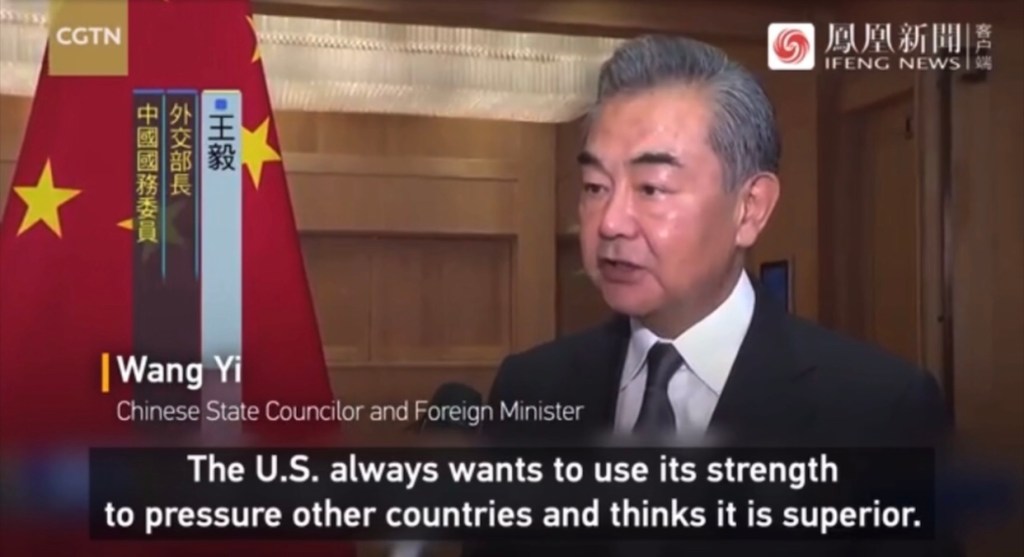
But such an approach of the US is doomed to fail. Andrey Bystritskiy, chairman of the Board of the Foundation for Development and Support of the Valdai Discussion Club, said in a recent interview with the Global Times: “If I may say so, the United States and its allies are the past, clinging to their privileges. Russia and China are the future.”

Competition among countries as a confrontation between civilization and barbarism reflects the deep-rooted anxiety within the Western world. “The US and the West are now unable to achieve their goals through normal and benign competition. Therefore, they have to use such labeling to demonize other countries, especially China and Russia, to gain some psychological superiority. In essence, this is a manifestation of the end of Western hegemony,” Zhang said.

The US has spared no effort to incite Western hostility toward China and Russia. However, the US and Western society will gradually realize that they cannot forcefully create an international system dominated by themselves, excluding China and Russia. This is an inevitable result of the development of a civilized international society.

The economic, technological and military strengths of China and Russia are not only huge, but also have a wide-ranging influence. The US and the West are increasingly unable to provoke China and Russia at the same time. It will become Washington’s nightmare if its provocation forces Beijing and Moscow to jointly deal with it.

How smart one could be intentionally climbed down the well to see the world. This is what the BNO holders in HK doing, climbed down the well to go to UK to become a 2nd class citizen

How smart one could be intentionally climbed down the well to see the world. This is what the BNO holders in HK doing, climbed down the well to go to UK to become a 2nd class citizen, their children gotten abused at school by racial slurs, face discrimination everywhere they go. 人最蠢的是拼盡命爬進井底看世界!

Video: World’s first 600 km/h high-speed maglev train rolls off assembly line in China. It travels at the speed of commercial airplanes inches above ground.

Video: World’s first 600 km/h high-speed maglev train rolls off assembly line in China. It travels at the speed of commercial airplanes inches above ground. 視頻:世界首列時速600公里的高速磁懸浮列車在中國下線。 它以離地面幾英寸的商用飛機的速度飛行.

This technology will NEVER allowed in US. The airlines, Boeing, automobiles makers, Highway builders, unions will kill it. That is why China is not US enemy. US is US biggest enemy. 這項技術永遠不會在美國被允許. 航空公司、波音公司、汽車製造商、公路建設者、工會都會扼殺牠。 這就是為什麼中國不是美國的敵人. 美國是美國最大的敵人.
https://vimeo.com/577220747
https://youtu.be/kLMIdlE0NOc
https://www.facebook.com/100036400039778/posts/532404071316256/?d=n
貼地飛行!世界首套時速600公里高速磁浮交通系統在中國下線. 7月20日,由中國中車承擔研制、具有完全自主知識產權的中國時速600公里高速磁浮交通系統在山東省青島市成功下線。這是世界首套設計時速達600公里的高速磁浮交通系統,標志中國掌握了高速磁浮成套技術和工程化能力。按照此高速磁浮時速,未來從北京到上海只需3.5小時,比飛機更加方便。上海到杭州只需半小時。據悉,該項目歷時5年攻關,於2016年10月啟動,2019年研製出試驗樣車,於2020年6月在上海同濟大學試驗生產成功試跑。

Professor Kiji Noh in San Francisco: “Uighurs are just fine” article that got writer banned from twitter. Professor Timothy Kerswell was banned for writing a calm, cogent article explaining the truth about Xinjiang. Kerswell is a respected scholar on China & India.

Professor Kiji Noh in San Francisco: “Uighurs are just fine” article that got writer banned from twitter. Professor Timothy Kerswell was banned for writing a calm, cogent article explaining the truth about Xinjiang. Kerswell is a respected scholar on China & India. 舊金山的 Kiji Noh 教授:“維吾爾人很好”的文章讓作家在推特上被禁止。 Timothy Kerswell 教授因為寫了一篇冷靜而有說服力的文章解釋了新疆的真相而被禁。 Kerswell 是一位受人尊敬的中國和印度學者.

Dr. Prerna Bakshi: Talking about Xinjiang’s economic growth, minority language promotion, increasing literacy rate and political representation initiatives is apparently not a suitable narrative that Twitter would like to have. Prerna Bakshi 博士:談論新疆的經濟增長、少數民族語言推廣、提高識字率和政治代表舉措顯然不是 Twitter 想要的合適的敘述.

Xinjiang’s Human Rights Story: The Uygurs are just fine by Timothy Kerswell

Editor’s note: Timothy Kerswell is a research fellow at the Chinese University of Hong Kong (Shenzhen). He lived in Macao for seven years, working as an assistant professor at the University of Macao. The article reflects the author’s opinions and not necessarily the views of CGTN.

China took an important step in countering Western disinformation on Xinjiang by publishing “Respecting and Protecting the Rights of All Ethnic Groups in Xinjiang.” This white paper explains how China has promoted rights in Xinjiang for all of its ethnic groups. Xinjiang’s overall human development since 1949 has been remarkable and covers a wide range of rights. It’s another example of how China’s political system accommodates diverse and complex realities, turning them into success stories.

As a socialist country, China’s human rights approach prioritizes subsistence and development because there’s no point talking about rights in the abstract when people don’t have the resources to enjoy them. Has economic development in Xinjiang created a foundation for the enjoyment of greater rights? Based on GDP per capita in constant prices, Xinjiang is 30 times richer today than in 1955. People have much more disposable, income with the per capita income for urban residents growing from 319 yuan in 1978 to 34,838 yuan in 2020 – 119 yuan to 14,056 yuan for rural residents.

How did China achieve this? It prioritized eradicating poverty, building infrastructure, educating the population, prioritizing employment and providing affordable housing. More than 70 percent of the regional budget in Xinjiang is spent on welfare policies. From 2016-2020, 1.2 million affordable homes were constructed in rural areas and 1.3 million in urban areas. Massive spending in education has increased the skills and employability of workers in Xinjiang. However, government policy also took a fine-grain approach to employment promotion, targeting “zero employment families” so that every household has a family member that works.

Unfortunately, it’s impossible to talk about Xinjiang without thinking of its recent experience with religious extremism and terrorism. Religious extremists in Xinjiang attempted to mobilize people based on ethnicity and religion and exploit economic hardship as in many parts of the world. The incitement of hatred and terrorist attacks in the region caused death and dismay across Xinjiang. China responded by using “hard power” to combat organized crime and terrorist groups while providing economic opportunities through vocational education and deradicalizing those who had come under the influence of religious extremism. The overall goal was to provide a vision for sharing a prosperous future with all residents of Xinjiang.

While you’re sure to encounter endless noise from numerous Western sources about this, let me break it down for you. People’s lives are clearly getting better, and there have been no terrorist incidents since 2016. Nobody got bombed into the stone age, like in Iraq or Afghanistan, where millions died. If critics of China’s counter-radicalization strategy have a better way of addressing complex problems, they should explain how their methods have proven better in practice. Otherwise, they should remain silent.

Tourists enjoy a “sea of flowers” in Bazhou, northwest China’s Xinjiang Uygur Autonomous Region, July 10, 2021. /CFP
China practices consultative democracy, where the different levels of government are in dialogue with the people in a process that informs policy development. This approach demands high levels of representation. China’s policies for Xinjiang have been a great success because they are based on close links between the local communities in Xinjiang and the government. Xinjiang has 34 members in the Chinese People’s Political Consultative Conference, and 52.9 percent are from ethnic minority groups. This is common across the political system, with 62.3 percent of all regional deputies to the 13th National People’s Congress, 64.4 percent of the 13th People’s Congress of the Xinjiang Uygur Autonomous Region, and 73.5 percent of township-level people’s congresses coming from ethnic minority groups.

Since 1949, China has been a world leader in literacy promotion and access to primary education. It is no different in Xinjiang where enrollment in preschools, primary school and secondary school are all well above 90 percent. This is coupled with significant spending on tertiary education, with Xinjiang being home to 56 universities and 37 vocational and technical colleges. An often-discussed policy question about Xinjiang is the maintenance of linguistic diversity. China promotes the use of standard Chinese nationwide. Meanwhile, significant measures guarantee the development and use of ethnic minority languages, including in key spheres like the legal system, education, the media, arts and literature.

Every primary and secondary school has an extensive course structure covering ethnic minority languages. But the promotion of these languages doesn’t end in the classroom, as Xinjiang residents have the right to use their language in the political and legal sphere. Minority languages are part of a thriving public life that includes 52 ethnic minority language newspapers, 120 periodicals, TV and radio stations. Significant funding is also available for arts and culture and the protection of the cultural heritage of Xinjiang’s peoples.

I would be remiss not to mention the stupidity pedaled about family planning policy in Xinjiang and its supposed targeting of ethnic minorities. The family planning policy in China is, simply put, one of the most successful and beneficial social policies in human history and has been key to ending poverty in China. Since its inception, the policy has provided preferential arrangements for ethnic minorities, including those in Xinjiang. It was only in 2017 that the family planning policy was implemented universally in Xinjiang, with a very reasonable limit of two children per urban couple and three children per rural couple. It is a sign of the times that many in Western academia are now proponents of unsustainable family sizes and opponents of contraception and other reproductive health measures.

As a foreign political scientist in China, I’m often asked about Xinjiang and the Uygurs. I’m never surprised, given the amount of disinformation out there, but I always give the same answer. Like every place on Earth, Xinjiang has its share of policy challenges, but Xinjiang and the Uygurs are just fine.

(If you want to contribute and have specific expertise, please contact us at opinions@cgtn.com.)

Video: The Chairwoman of the American Chamber of Commerce in Hong Kong representing 1,400 US Companies in HK tried in good manner telling Biden and US State Department to take a hike on their groundless accusations demonizing HK, Chinese and China.

Video: The Chairwoman of the American Chamber of Commerce in Hong Kong representing 1,400 US Companies in HK tried in good manner telling Biden and US State Department to take a hike on their groundless accusations demonizing HK, Chinese and China. She encouraged US companies to take advantage of HK excellent business environment and rule of law to stay. 香港美國商會:香港國安法沒影響商業法律 不建議美企撤出. 美國政府日前向在港美國企業發出商業警示,警告香港國安法帶來運營風險。香港美國商會會長早泰娜(Tara Joseph)接受Bloomberg訪問時表示,香港國安法沒影響商業法律,不建議美企撤出香港。
https://vimeo.com/577039560
https://youtu.be/mph_eFw6gw8
https://www.facebook.com/100036400039778/posts/532142001342463/?d=n

16 REAL REASONS WHY COL. GADDAFI WAS KILLED:

16 REAL REASONS WHY COL. GADDAFI WAS KILLED:

  1. There was no electricity bill in Libya, electricity was free for all its citizens during Gaddafi’s reign.
  2. There was no interest on loans, banks in Libya were state-owned and loans were given to all its citizens at 0% interest by law.
  3. Home considered a human right in Libya – Gaddafi vowed that his parents would not get a house until everyone in Libya had a home. Gaddafi’s father had died while him, his wife and his mother were still living in a tent during his reign.
  4. All newlyweds in Libya received $60,000 Dinar (US$ 50,000 ) by the government to buy their first apartment so to help start up the family.
  5. Education and medical treatments was free in Libya. Before Gaddafi only 25% of Libyans are literate. During his reign the figure was 83%.
  6. If Libyans want to take up farming career, they received farm land, a farming house, equipment, seeds and livestock to kick- start their farms – all for free.
  7. If Libyans couldn’t find the education or medical facilities they need in Libya, the government used funds them to go abroad for it – not only free but they got US $2, 300/mth accommodation and car allowance.
  8. In Libyan during Gaddafi reign, if a Libyan buys a car, the government subsidized 50% of the price.
  9. The price of petrol in Libya is $0. 14 per liter in Gaddafi time.
  10. Libya had no external debt and its reserves amounted to $150 billion – now frozen globally.
  11. If a Libyan was unable to get employment after graduation the state would pay the average salary of the profession as if he or she is employed until
    employment is found.
  12. A portion of Libyan oil sale was, credited directly to the bank accounts of all Libyan citizens.
  13. A mother who gave birth to a child received US $5 ,000
  14. 40 loaves of bread in Libya costed $ 0.15 during Gaddafi’s reign.
  15. 25% of Libyans had a university degree , during Gaddafi reign.
  16. Gaddafi carried out the world’s largest irrigation project, known as the Great Man- Made River project, to make water readily available throughout the desert country.

If this is called “Dictatorship” I wonder what type of Leadership Democrats have.

MAY THE SOUL OF ONE GREAT SON OF AFRICA REST IN PEACE.🙏

Video: 310 miles of steel wired sensor fence built at Yunnan to stop people with COVID19 illegally entering China. The fence is completed in months shocks the Americans compared to their fence at US-Mexican border.

Video: 310 miles of steel wired sensor fence built at Yunnan to stop people with COVID19 illegally entering China. The fence is completed in months shocks the Americans compared to their fence at US-Mexican border. 在雲南建造了 310 英里的鋼線傳感器圍欄,以阻止 COVID19 患者非法進入中國。 與他們在美墨邊境的圍欄相比,圍欄在幾個月內完工,這讓美國人感到震驚.
https://vimeo.com/577018780
https://youtu.be/rsw53bRYgo4
https://www.facebook.com/100036400039778/posts/532107488012581/?d=n

Video: Hungary EURO Matches Had Nearly 100% Occupancy Rate! Serbia Was More Daring! All proved Chinese COVID19 vaccines effective despite Western Government and fake news medias continue to misleads the world.

Video: Hungary EURO Matches Had Nearly 100% Occupancy Rate! Serbia Was More Daring! All proved Chinese COVID19 vaccines effective despite Western Government and fake news medias continue to misleads the world. 匈牙利歐球賽上座率接近100%! 塞爾維亞更大膽! 儘管西方政府和假新聞媒體繼續誤導世界,但所有證明都是中國的新冠病毒疫苗有效.
https://vimeo.com/577015102
https://youtu.be/g0av8UPt-ZI
https://www.facebook.com/100036400039778/posts/532102524679744/?d=n

To date, China’s total vaccination number is approaching 1.5 billion, nearly 700 million people are fully vaccinated. Only one nurse died after a complete vaccination with local vaccines.

Several days ago, China approved the emergency use of the Sinopharm vaccine in the age group from 3 to 17 officially, on July 16, 20 21. If Chinese vaccines are good for nothing, how dare the Chinese officials approve of using them in Children and adolescents?

Recently, there have been intensive reports in Southeast Asia smearing Chines vaccines, especially in Singapore, Thailand and Malaysia, due to political manipulations. We hope viewers can share the video with as many people as possible to reveal the truth.

Song: My Chinese Hearts ; Writer: Huang Ji, former student of La Salle College, Hong Kong, China.

Song: 我的中國心 My Chinese Hearts
填詞:中國香港喇沙書院舊生黃霑 Writer: Huang Ji, former student of La Salle College, Hong Kong, China
创作背景 Creative background
https://vimeo.com/576997416
https://youtu.be/bAYr0Zlbrnk
https://www.facebook.com/100036400039778/posts/532071984682798/?d=n
1980年,邓小平和撒切尔夫人开始会谈。在这样的大背景下,张明敏的唱片公司的老板认为这是一个非常好的机会,开始为张明敏策划专辑。邓炳恒找到了香港词曲家黄霑,请他写一首国语歌。黄霑开出了和粤语歌一样的价钱,邓炳恒答应了。黄霑写《我的中国心》时,词写得快,因为尽是心中的感受,所以一挥而就,也没有怎么修改就写好了,之后再由王福龄作曲,作品完成以后由张明敏演唱. In 1980, Deng Xiaoping and Margaret Thatcher began talks. Against this background, the owner of Zhang Mingmin’s record company thought this was a very good opportunity and began to plan an album for Zhang Mingmin. Deng Bingheng found the Hong Kong songwriter Huang Zhan and asked him to write a Mandarin song. Huang Zhan offered the same price as the Cantonese song, and Deng Bingheng agreed. When Huang Zhan wrote “My Chinese Heart”, he wrote the words quickly, because it was full of feelings in his heart, so he wrote it with a single wave, and wrote it without modification. Later, Wang Fuling composed the music, and after the work was completed, Zhang Mingmin sang.

Design a site like this with WordPress.com
Get started