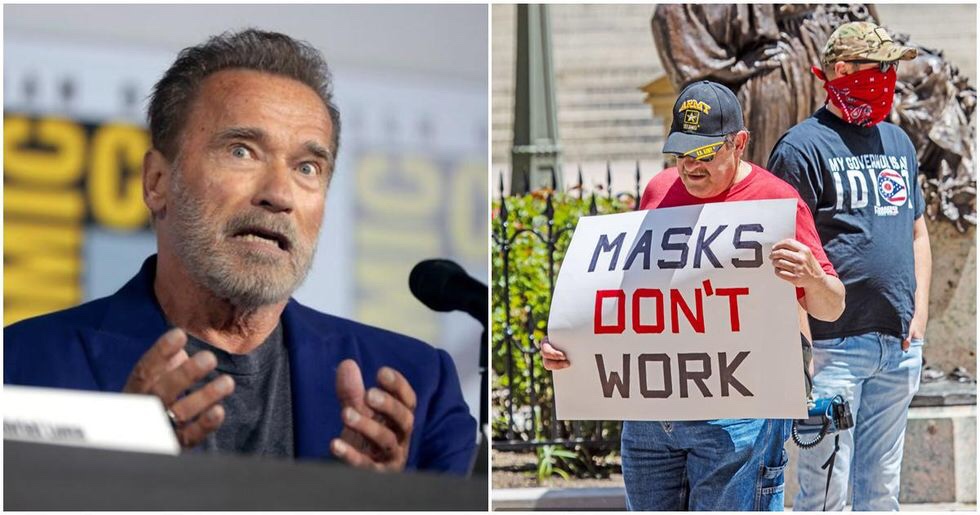
Arnold Schwarzenegger uses the perfect analogy to explain ‘real freedom’ to anti-maskers
There is a big, gaping hole in the center of the belief that refusing to wear a mask or get vaccinated is a patriotic expression of the personal freedoms we enjoy as Americans.
Sure, you’re free to do as you wish, but the fastest way for people to invite tyranny into their lives is to forget that freedom is predicated on responsibility and accountability.
Refusing to wear a mask in a place where COVID-19 is likely to spread puts yourself and others at risk. Refusing to get vaccinated only promotes the spread of the virus. The longer this pandemic goes on, the more likely it is that freedom-loving people will be subjected to punitive restrictions from lawmakers and businesses seeking to crack down on those who aren’t being accountable.
Actor and former Republican California Governor Arnold Schwarzenegger perfectly explained this delicate balance on Monday in an interview with CNN’s Bianna Golodryga and former National Security Council staffer Alexander Vindman.
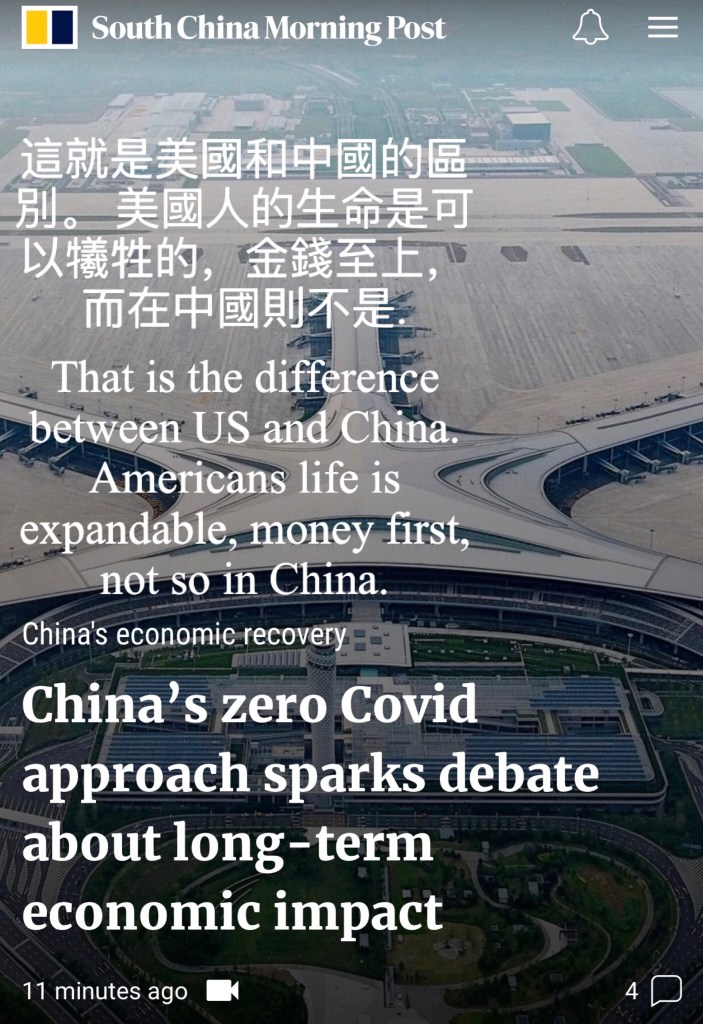
That is the difference between US and China. Americans life is expandable, money first, not so in China. That is the essence of US freedom democracy human rights and rules of laws. That is how US allowing 600,000 Americans died from COVID19, trying to blame everyone else except herself for being incompetent 這就是美國和中國的區別。 美國人的生命是可以被犧牲的,金錢至上,而在中國則不是. 這是美國自由民主人權和法治的精髓. 這就是為什麼美國允許 600,000 美國人死於 COVID19 而無動於衷, 並試圖責怪別人以掩飾自己的無能.
San Francisco Chronicle: ‘Comfort women,’ from WWII to Andrew Cuomo by Lillian Sing with Gitika Nalwa Aug. 12, 2021
“Comfort Women” Justice Coalition Last Friday, Albany County Sheriff Craig Apple stood before a scrum of reporters to announce the allegations by “Executive Assistant #1” against New York Governor Andrew Cuomo. “I had a female victim come forward, which had to be the hardest thing she’s ever done in her life, and make an allegation of criminal conduct against the governor,” he said.
The woman has since identified herself and Cuomo has resigned, despite attributing his alleged sexual misconduct to misinterpretation.
What is particularly shocking is that Cuomo was a widely held champion of women. But recall how Bill Cosby was “America’s Dad” for a generation before he was accused by 60-odd women of rape and sexual battery. Despite being convicted, Cosby was released after just three years because of a prosecutor’s alleged verbal promise, epitomizing the worst nightmare of women who publicly disclose their sexual harassment and assault.
It is no surprise then that victims of sexual harassment and assault are extremely reluctant to speak out: The likelihood of denial, debilitating accusations, shame and retaliation is far greater than that of justice.
Imagine, then, how much courage it takes to publicly accuse a government of sexual enslavement.
Thirty years before Cuomo’s resignation, a South Korean woman named Kim Hak-sun broke her silence and testified to the press in Seoul about the “comfort women” system of the Japanese Imperial Army, in which she and hundreds of thousands of women and girls from 13 Asian-Pacific countries were sexually enslaved between 1931 to 1945. Since 2018, South Korea and other countries have sought to commemorate Aug. 14, the day of Kim Hak-sun’s testimony, as International Memorial Day for “comfort women.”
“Comfort women,” a euphemism and ironically also an apt description of the attitudes toward gender held by many powerful men like Cuomo, are no doubt among the most neglected victims of WWII. Japan steadfastly refuses to unambiguously acknowledge its crime while apologists seek to discredit victim testimonies. Consequently, Japan has been accused of trying to whitewash its wartime past.
In denying its past, Japan is committing yet another crime. Victims deserve an acknowledgment of their trauma. Japan’s refusal to admit to its systematic enslavement of hundreds of thousands of women damns its victims again. It tells them that they do not matter and condemns them to relive their rape, mutilation and torture.
I was the first Asian American female judge in Northern California, serving for three decades. And I loved my job. But I nevertheless decided to retire in 2015 so that I could dedicate myself to building a memorial to “comfort women” free of professional constraints — before history erased all trace of them.
In 2017, I and former San Francisco Superior Court Judge Julie Tang unveiled the “Comfort Women” Memorial in San Francisco, a sculpture of an elderly woman gazing up at three young girls standing on a pedestal in a circle, clasping hands.
The woman in the memorial is modeled after Kim Hak-sun. One girl on the pedestal is Chinese, another Korean, and the third Filipina — representing the three largest ethnic groups of “comfort women.” The three girls in the memorial are neither submissive nor sexualized. The strength of their grips and their steady gazes belie their bloodied lower halves. Kim Hak-sun appears to be reliving her trauma through the circularity of the girls’ formation. But the girls are looking forward, trying to put their trauma behind them.
This small acknowledgment of the trauma of “comfort women” in one small corner of the world matters, because it tells survivors of sexual assault that they matter.
Even in resigning, Cuomo refused to accept responsibility for his alleged misconduct and wrote off the pain of his accusers to “cultural and generational shifts.” Whataboutism, victim-blaming and flat-out denial are clearly not unique to one culture or race. For every story of sexual assault or rape that comes to light, there are many times more that die in the shadows.
The “comfort women” memorial, intended to memorialize the sexually enslaved victims of the Japanese Imperial Army, is thus a monument to the courage of all victims of sexual assault who come forth with little hope of acknowledgment or justice.
Lillian Sing was the first Asian American female judge in Northern California and is co-chair of the “Comfort Women” Justice Coalition. Gitika Nalwa, a recent graduate of UC Berkeley, is a research fellow at Stanford’s Center for Asian Health and Research Education.
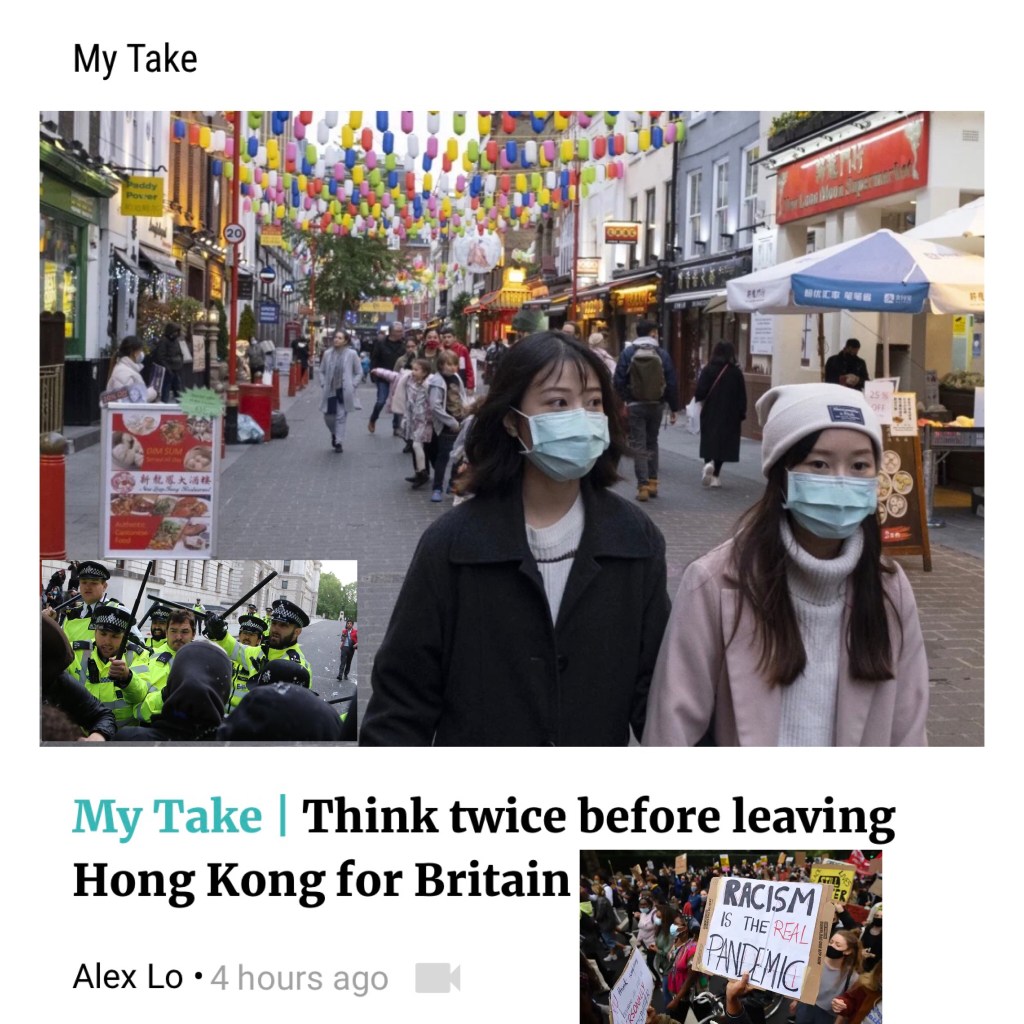
Welcome to Britain. What? You are Asians! You got money? Money can stay! But you, not sure? Are you a spy? 歡迎來到英國。 什麼? 你們是亞洲人! 你有錢嗎? 錢可以留! 但你,我們不確定嗎? 你是間諜嗎?
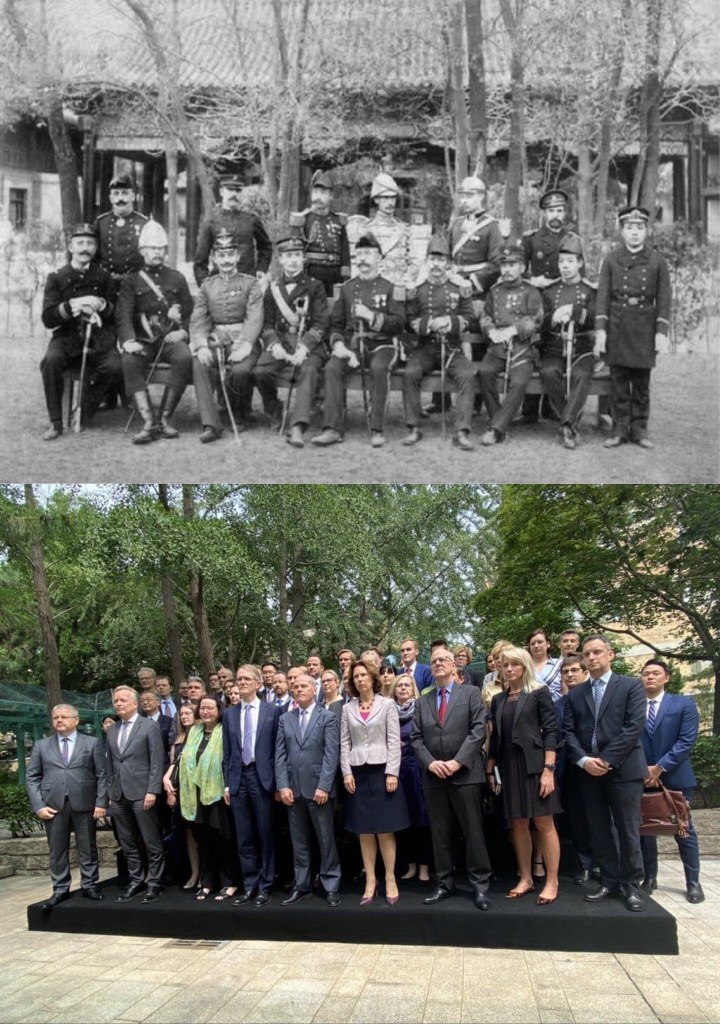
The Face of Imperialism Never Changed! 1900: The Eight-Nation Alliance occupied Beijing. 2021: Diplomats from 25 countries gathered in Beijing to show support for Michael Spavor, a spy worked for the Western Empires got caught sentenced to 11 years in jail. 帝國主義的面貌從未改變! 1900年八國聯軍佔領北京。 2021 年:來自 25 個國家的外交官齊聚北京表示支持邁克爾·斯帕沃爾,一名為西方帝國工作的間諜在中國被捕判入獄 11 年. (notice little Japan’s rep standing on the sidelines at the same spot)
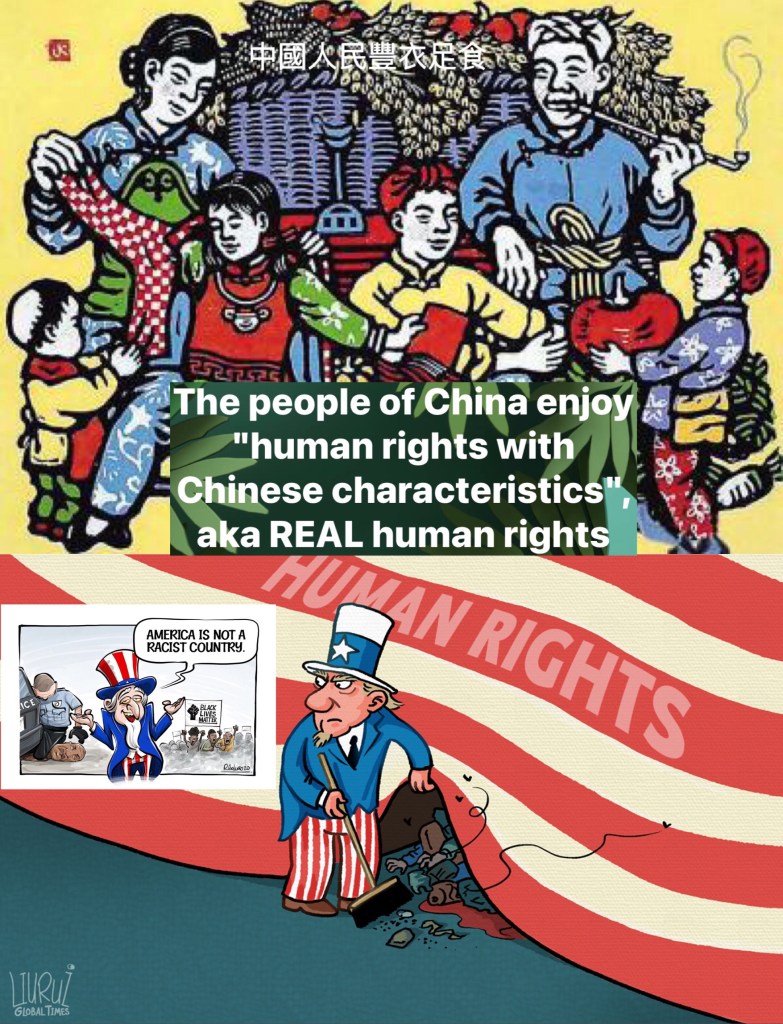
This is exactly the happening in the United States and the Western Empires right in front of our eyes who continues to commit crimes against humanity in the name of fake freedom democracy human rights and rules of laws. 這正是發生在我們眼前的美國和西方帝國,他們繼續以虛假的自由民主人權和法律規則的名義犯下危害人類罪.
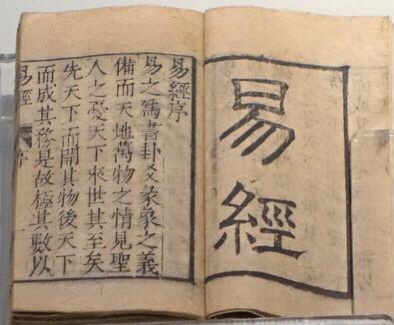
中國經典《易經》名言:積善
積善之家,必有餘慶; 積不善之家,必有餘殃。
積德行善的家庭, 天賜的祝福會遺留給子孫, 不積德行善的家庭, 代代都會遭受天譴。
The house that keeps doing good deeds will be blessed for generations.
However those keep acting evily will incur retribution for generations.
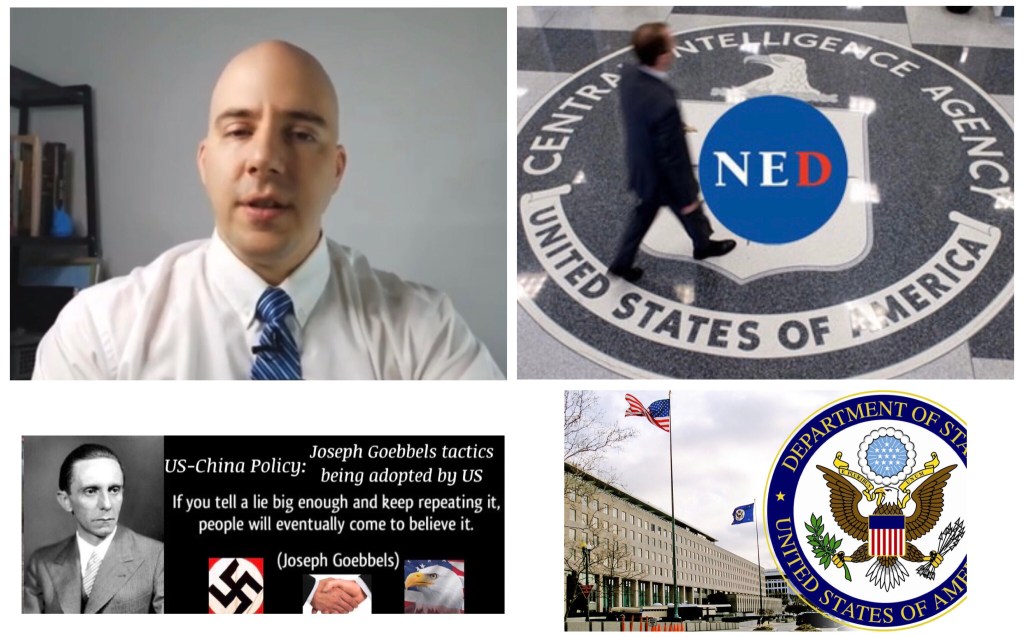
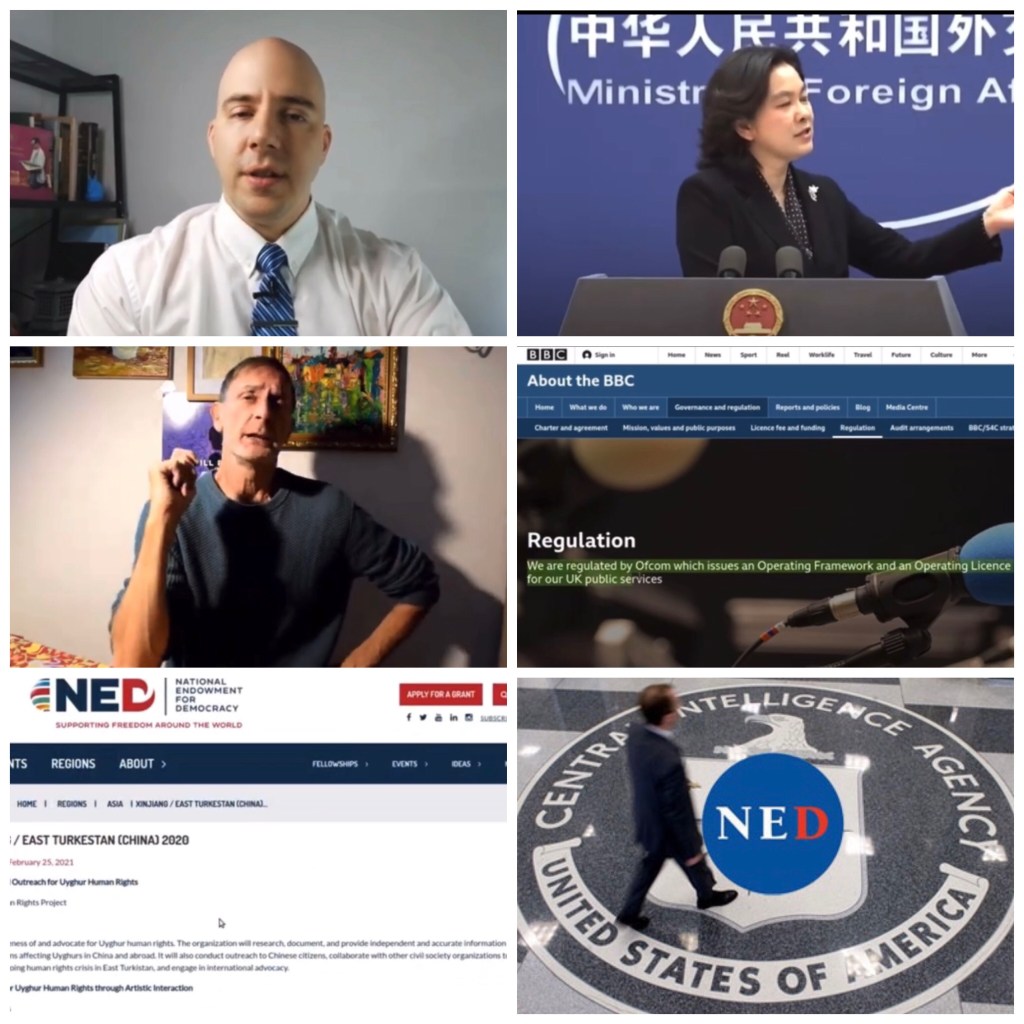
British media org Sky News has been caught lying about “uncovered evidence” of cultural genocide in China’s Xinjiang region. In fact, all Sky News has done in its recent June 2021 report is repeat lies made by the Western media for the past 3-4 years, citing fake rights groups funded by the US government through the National Endowment for Democracy.
One claim is that the Xinjiang city of Hotan’s skyline has been disfigured by the “eraser” of a Islamic-style tower – which in reality was just a 360 degree cafe built in 2010 and went out of business not even 10 years later.
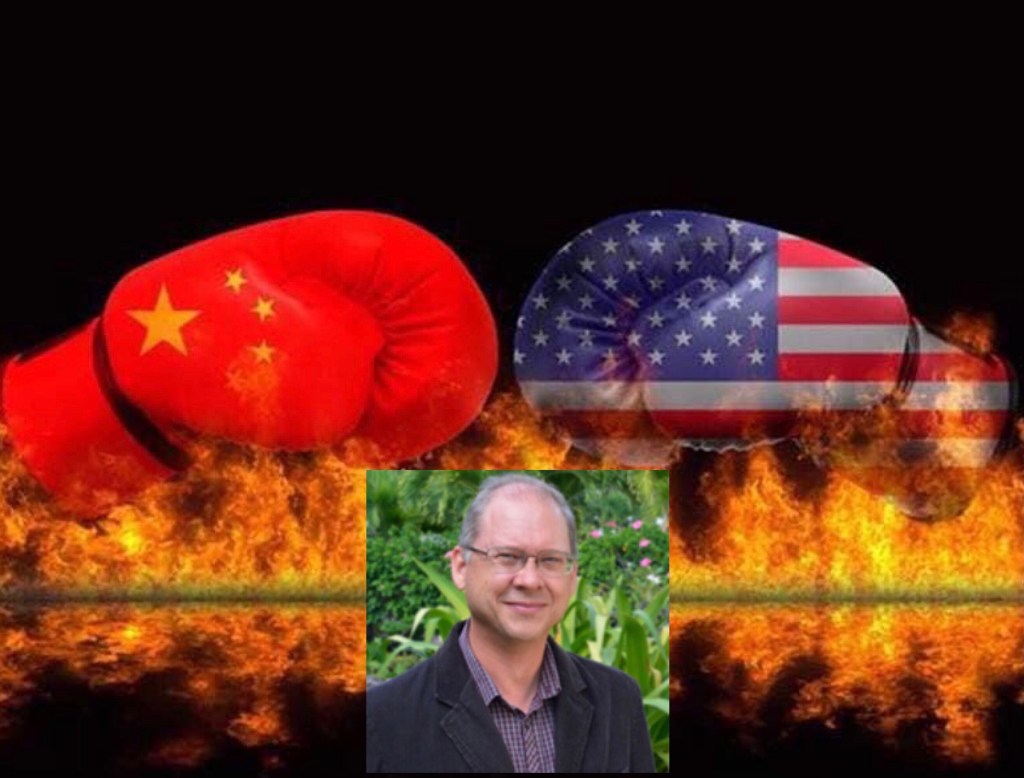
CHINA-US FOCUS – The China-U.S. Trade War and Reformist Statism under Xi Jinping. 中美聚焦 – 中美關係 習近平領導下的貿易戰和改革主義國家主義by Christopher A. McNally, Professor of Political Economy, Chaminade University Aug 11, 2021
After U.S. President Donald Trump began to levy tariffs and other trade restrictions on China in the first half of 2018, a tit-for-tat trade war rapidly escalated. Even once the “Phase One Trade Agreement’ was reached in January 2020, tensions between the two largest economies on earth persisted. Neither did a new administration in the White House deliver respite. After three years, there is no end in sight for the China-U.S. trade war.
This was reflected at the recently concluded meetings between U.S. Deputy Secretary of State Wendy Sherman and Chinese Foreign Minister Wang Yi in Tianjin. Although it seemed to go better than when the two sides met last time in Alaska, no outcomes were announced except for combative statements. Overall relations between Beijing and Washington appear to be at an impasse. Both sides blame the other for the problems facing the relationship, indeed questioning each other’s global standing and sincerity.
U.S.-China relations have thus descended into an ever more adversarial feedback loop with little end in sight. Is there a way out? Prospects certainly look dim, but perhaps better mutual understanding in certain issue areas could help.
On the economic front, American analysts and diplomats are fond of arguing that the reasons for frictions lay with China’s model of development, especially a lurch towards greater state centrality under Xi Jinping. China hawks are fond of pointing out that Xi was never serious about economic reform. His policies are moving China backwards, introducing greater “command and control” over economic matters harking back to the Maoist era. Some have even suggested that China has been deceiving Washington since the 1980s, merely feigning intentions to liberate the economy and introduce market forces.
In reality, China has undertaken massive efforts to liberalize and reform the economy since 1979. However, as Xi began to lead the Communist Party of China (CPC) in 2012, many of the easy liberalizing reforms had been completed, and China faced the pitfalls of the middle-income trap. Xi thus set out with a bold reform program that sought to give market forces the “decisive” role in allocating economic resources.
A range of reforms were proposed, ranging from price liberalization and the reigning in of large state-owned monopolies to a slew of social reforms. This major reform push is best conceptualized by the “China 2030” report, a collaboration between the World Bank and the Development Research Center of the Chinese State Council.
Evidently, far reaching economic reforms seemed high on the agenda as Xi ascended to power. However, many market liberalization moves were either only partially successful or ended in disappointment over subsequent years. A second and newer argument in American policy circles is therefore that Xi tried economic reform, but that each effort created a mini-crisis that prompted rapid retrenchment. According to this line of thought, Xi didn’t resist reform and was not intent on moving backwards in time to the centrally planned economy. Rather, Chinese policy makers attempted liberalization but retreated each time it got out of hand. This created a decade of failed reforms.
Officially, Beijing has denied this, but there are plentiful examples of attempted liberalization followed by rapid retrenchment and assertion of state control. For example, in 2015 the People’s Bank of China attempted to create a more market-driven exchange rate for the yuan, leading to a devaluation of nearly three percentage points against the U.S. dollar in two days. This then created a sharp decline in the stock market and rapidly increasing capital outflows. To quell market panic the Chinese government imposed harsh capital controls, cracked down on margin-financing in equities, and spent nearly US$320 billion of its foreign currency reserves to support the yuan’s value.
Clearly, liberalization was followed by retrenchment and the assertion of greater state control. This narrative is certainly more convincing than the one asserting that Beijing was never sincere about economic reform. But it still misconstrues part of the dynamic.
The need for continuous reform and adaptation has become deeply ingrained in the CPC’s thinking ever since Deng Xiaoping. And not just rhetorically. Reform efforts are continuing in various crucial areas, ranging from the residency permit system and social services to market pricing and, perhaps most prominently, finance. In fact, the last couple of years have seen a substantial opening of China’s financial sector with more market-driven dynamics, such as growing bond defaults and a repricing of risk.
In this context, the recent clampdown on China’s internet giants, including finance and education tech companies, is often interpreted in the West as another effort by the CPC to assert its “control and command” economic ideology over what has become an increasingly free wheeling and powerful economic sector. This interpretation is not incorrect, but again leaves out the major rationale shaping Beijing’s economic reform philosophy.
Although Beijing never fully bought into the laissez-faire economics so adamantly preached by Washington in the 1990s, key aspects of Chinese reform were deeply influenced by market liberalism. Much of what Chinese reformers did in the early years was to get the state and bureaucrats out of the way to give markets greater sway, while allowing private enterprise to grow.
By the time Xi came to power, disillusionment with laissez-faire economics had become more pronounced due to the Global Financial Crisis of 2008. Nonetheless, many of Beijing’s economic policy-makers, including Xi’s economic lieutenant Liu He, a well-known proponent of marketization, had been educated in the West and thus continued to be deeply influenced by market liberalism. Difficult reforms of the financial system, however, showed that pure liberalization seldom worked. In fact, many of the failed reforms, such as yuan exchange rate and outward investment liberalization, failed not due to insufficient liberalization, but because liberalization was implemented without sufficient institutional safeguards and controls.
Economic policy-makers in Beijing thus grew increasingly disenchanted with the mantra of simple market liberalization. They became convinced that for markets to work in the interests of society, the state had to step in. Though emphasis on state centrality in economic policy had never quite retreated, a new statism was born. Quite unlike that of the Maoist era, its single-minded focus is to reform the state and its role in the economy to undertake successful marketization and technology development.
Nowhere is this clearer than in financial reform, an area Beijing is still struggling with due to very high debt, institutional dysfunction, and the continuation of speculative manias. Here the state has more forcefully inserted itself, ranging from regulatory blasts to more subtle influence over Big Tech and beyond. Nonetheless, reform continues. Perhaps the key aspect of financial opening, the capital account, is being relaxed in a controlled manner through market access programs such as the Bond Connect, Stock Connect, and Wealth Management Connect scheme with Hong Kong.
This turn to increased state intervention and a statist philosophy of economic management is not only confined to China. In an ironic twist, both the Trump and Biden administrations see Washington playing a much more forceful role in the American economy, including in trade, technology development, industrial policy, and aggregate demand management. The new economic statism is well and alive, not only in Beijing, but in most Western capitals. Neo-liberal laissez-faire ideology, in contrast, is finding fewer and fewer adherents, especially among politicians.
By recognizing this global shift towards a new statist economic philosophy, perhaps Washington and Beijing could stake out some common ground. Many of the policies Washington is proposing to counter Beijing, such as new industrial policy programs, are exactly what American policy-makers have chided Beijing for. An open, pragmatic, and less ideologically tainted understanding of the two economies could perhaps yield a foundation for more effective dialogue and even cooperation. Alas, with so many issue areas dividing the United States and China, the ever more adversarial tone characterizing the relationship is likely to continue. Hope is low for an open dialogue on how to manage economic competition and finally resolve the trade war.
Christopher A. McNally is a Professor of Political Economy at Chaminade University and Adjunct Senior Fellow at the East-West Center in Honolulu, USA. His research focuses on comparative capitalisms, especially the nature and logic of China’s capitalist transition and Sino-Capitalism. He is also working on a research project that studies the implications of China’s international reemergence on the global order.
Video: China’s MFA vs. Western Media Lies (BBC, CNN, NYT, WSJ and etc): Lessons for the Rest of Asia 中國外交部與西方媒體的謊言(BBC、CNN、NYT、WSJ 等): 亞洲其他地區的教訓. China’s Ministry of Foreign Affairs has recently begun standing up to Western bullying and aggression, setting a precedent and an example for other nations in the region and around the world to follow. I discuss this as well as some more indirect ways to begin addressing the humiliation the West subjects nations to in the event a nation may not be strong enough to fully follow China’s example. https://vimeo.com/586120875 https://youtu.be/kHUMMiBh6tM https://www.facebook.com/100036400039778/posts/546049359951727/?d=n

 Johnson Choi Biz