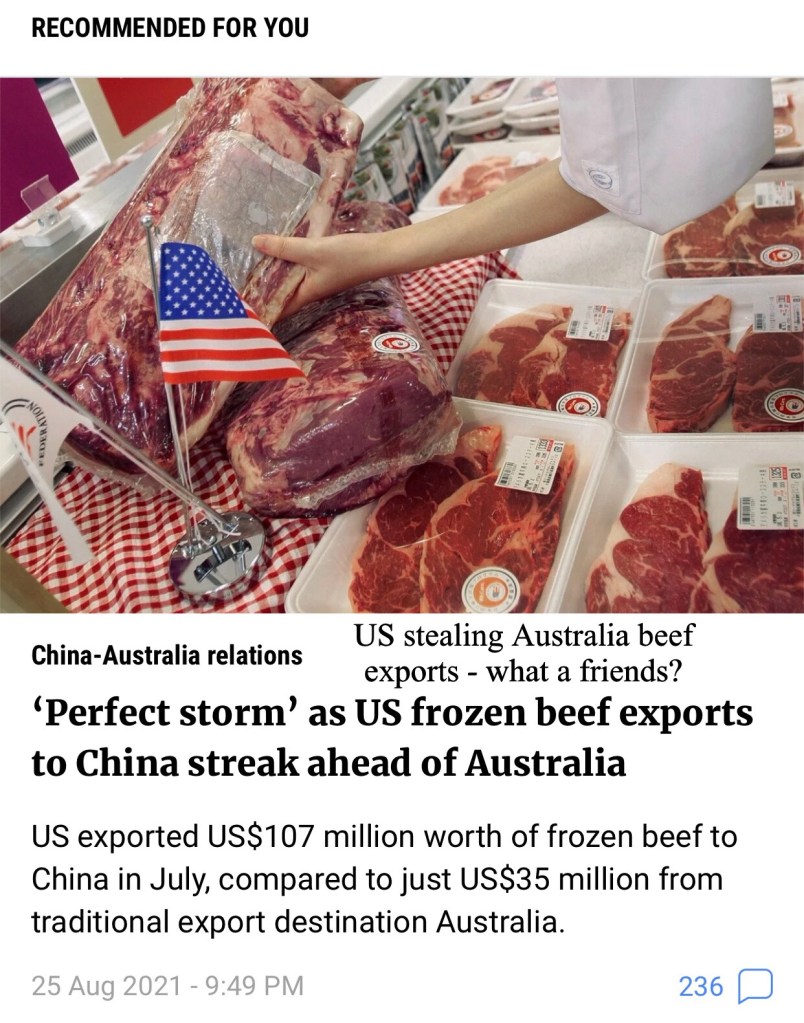
US stealing Australia beef exports – what a friends? 美國竊取澳大利亞牛肉出口 – 美國的朋友是用來出賣的?
US stealing Australia beef exports – what a friends? 美國竊取澳大利亞牛肉出口 – 美國的朋友是用來出賣的?
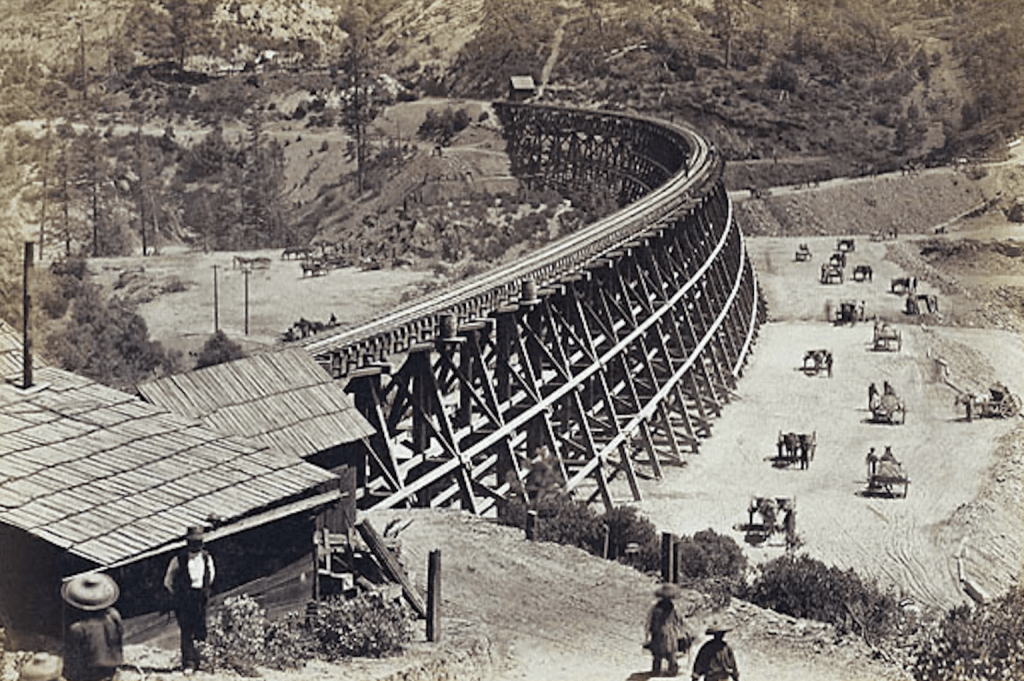
Birth of the Cruel: How Truckee Pioneered Modern Anti-China Hate in the United States BY PETER LEE August 26 2021
The Achilles’ heel of American capitalism in the 19th century was the shortage of sufficient manpower at hand to transform eager capital and vast raw materials into profitable infrastructure, products, and commodities, let alone rescue snowbound emigrants.
In the 1860s, the labor shortage was a matter of desperation to the capitalists known as the Big Four, who were striving to drive the Central Pacific line through the unforgiving terrain of the Sierras, so it could reach the basin land of Nevada and Utah and slap down track (and claim land grants) in competition with the Union Pacific railroad racing over the Midwest flatlands.
As usual, California was short of labor, at least white labor.
So the Central Pacific made the decision to Go Chinese!, recruiting local Chinese and also immigrants from Guangdong province via labor contractors. At peak construction season somewhere around 16,000 Chinese, the vast majority of the workforce, toiled for the Central Pacific in the Sierras.
The brief, relatively happy episode of the history of the Chinese in Truckee and the Sierras is told in the book “Ghosts of Gold Mountain”, written by what must be reflexively stated is the “good” Gordon Chang, Gordon H. Chang of Stanford University.
Chang’s book is a supremely inspiring account of the stupendous achievements of the “Railroad Chinese” in constructing the Central Pacific railroad tracks, tunnels, and snow sheds through the Sierra Nevadas to reach Truckee. The Chinese railroad men displayed a mastery of excavation, the explosives technology needed to tackle the iron-hard Sierra granite, and sophisticated masonry skills, all of which they subsequently applied to railroad projects throughout North America.
If you want to keep score of fatalities by race, the Donner Party lost 39 people; an estimated 1600 Chinese railroad workers died in the Central Pacific project in avalanches (including at least 19 in once incident), industrial accidents, and occasionally by murder during the work above Truckee. Estimates of California Native Americans murdered by whites in the 19th century–in addition to Luis and Salvador, who were shot and eaten by the Forlorn Hope party– range from 4,500 up to 100,000.
The railroad Chinese and their supporting community—virtually all men since immigration by Chinese women wasn’t allowed–created a vibrant community of over a thousand in Truckee during the construction of the railroad and for a time afterward.
Chang writes that by 1870 30% of Truckee’s population and 45% of its workforce, including 4 of its 5 doctors, were Chinese. Whole streets had only Chinese signage, and Chinese were found throughout the commercial and industrial trades.
But by the 1870s, the railroad was completed and Chinese laborers lost the protection they had enjoyed thanks to employment by the Central Pacific Railroad. And a crippling national recession had swung the pendulum away from labor shortage to labor oversupply.
In the US West, anti-Chinese hostility became the default.
In 1879, California amended its state constitution with the notorious Article XIX, which forbade any California state corporation to “employ directly or indirectly, in any capacity, any Chinese or Mongolian.”
The full text is in the transcript.
SECTION 1. The Legislature shall prescribe all necessary regulations for the protection of the State, and the counties, cities, and towns thereof, from the burdens and evils arising from the presence of aliens who are or may become vagrants, paupers, mendicants, criminals, or invalids afflicted with contagious or infectious diseases, and from aliens otherwise dangerous or detrimental to the well-being or peace of the State, and to impose conditions upon which persons may reside in the State, and to provide the means and mode of their removals from the State, upon failure ore refusal to comply with such conditions; provided, that nothing contained in this section shall be construed to impair or limit the power of the legislature to pass such police laws or other regulations as it may deem necessary.
SEC. 2. No corporation now existing or hereafter formed under the laws of this State, shall, after the adoption of this Constitution, employ directly or indirectly, in any capacity, any Chinese or Mongolian. The Legislature shall pass such laws as may be necessary to enforce this provision.
SEC. 3. No Chinese shall be employed on any State, county, municipal, or other public work, except in punishment for crime.
SEC. 4. The presence of foreigners ineligible to become citizens of the United States is declared to be dangerous to the well-being of the State, and the Legislature shall discourage their immigration by all the means within its power. Asiatic coolieism is a form of human slavery, and is forever prohibited in this State, and all contracts for coolie labor shall be void. All companies or corporations, whether formed in this country or any foreign country, for the importation of such labor, shall be subject to such penalties as the Legislature may prescribe. The Legislature shall delegate all necessary power to the incorporated cities and towns of this State for the removal of Chinese without the limits of such cities and towns, or for their location within prescribed portions of those limits, and it shall also provide the necessary legislation to prohibit the introduction into this State of Chinese after the adoption of this Constitution. This section shall be enforced by appropriate legislation.
And in 1882 the California congressional delegation was key to getting the US Congress to pass the notorious Chinese Exclusion Act—which prevented Chinese immigrants from coming to live and work in the United States until the Second World War.
The TED talk takeaway is that the state and federal governments did some nasty stuff that prevented Chinese from coming to the US to pursue their New Gold Mountain bliss, so sorry for denying the Celestials full access to the American dream, congressional apology here, please pay attention to the disclaimer of any financial responsibility.*
*Nothing in this resolution may be construed or relied on to authorize or support any claim, including but not limited to constitutionally based claims, claims for monetary compensation or claims for equitable relief against the United States or any other party, or serve as a settlement of any claim against the United States.
What is conveniently forgotten is that Chinese already in the Western United States were forced to live through the American nightmare, a systematic regional pogrom that bookended the exclusion movement, tore them out of their communities and American society, and reduced many Chinatowns to ashes.
Truckee was in the middle of it.
Oh yeah.
Not just in the middle, actually.
In the lead.
In fact, you might say that modern U.S. Chinahawking—the unholy alliance of state, capital, media, and populism known as the “all of society” anti-China strategy—was pioneered in Truckee over 140 years ago.
The unhappy story is told in Dr. Jean Pfaelzer’s essential 2007 book Driven Out: The Forgotten War Against Chinese Americans.
The visionary impresario of the Truckee campaign—you might call him the combined Goebbels, Trump, and Josh Hawley of the anti-China effort– was local big shot, lawyer, and media baron Charles F. McGlashan.
In the 1870s, Truckee had already dipped its beak into anti-Chinese bigotry with the formation of the Caucasian League, a violent, heavy-drinking secret society dedicated to driving Chinese out of the woodcutting business via a campaign of persuasion that looked a lot like intimidation and terror.
In 1878 “somebody” set fire to a woodcutter’s cabin on Trout Creek in Truckee and shot at the Chinese rushing out to escape and get water to fight the flames, killing one. Anti-Chinese violence was new and novel enough that the case created a statewide scandal and the case went to trial.
Charles McGlashan represented the seven defendants, orchestrated fifty alibis and, to white Truckee’s delight, obtained acquittal or dismissal of charges for all the defendants. As each defendant was cleared, the town joyously fired a cannon in celebration.
And in May 1878, Truckee’s Chinatown burned…maybe because of arson?
Then, just in case that message was excessively ambiguous, several Chinatown structures were blown up.
And to make sure that Chinese sheltering in the ruins and hoping to rebuild got the message to move, a 601 Club was formed—“601” as in Six feet under, Zero trial, One bullet—to emphasize white hostility to the continued presence of Chinese in the heart of Truckee.
The local newspaper, owned by none other than Charles F. McGlashan, opined that “The site heretofore occupied by Chinatown is the most desirable in town. If owned by white persons it would soon be covered by desirable residences, and possibly business houses…”
By a funny coincidence, Chinatown stood just below the Truckee Heights, where Charles McGlashan built his imposing residence and was perhaps revolted by the spectacle of the Chinese slum beneath his doorstep.
The endgame of old Truckee Chinatown occurred on November 9, 1878, when 500 members and sympathizers of the Caucasian League rampaged through what was left of Chinatown and tore it all down.
In the words of Jean Pfaelzer, “the mob destroyed all houses owned by Chinese and warned white landlords to expect to see their own houses “even as the houses of the heathens.”
The Chinese were driven to a new location literally on the other side of the Central Pacific tracks and on the other bank of the Truckee River.
McGlashan’s prediction of post-Chinese urban renewal in downtown Truckee was borne out. The heart of old Chinatown—Front Street, now renamed Donner Pass Road–is today the bistro and retail studded main thoroughfare of the quaint town of Truckee.
John Moody—the operator of the Truckee Hotel, who had testified for the defense in the Trout Creek outrage and whose name now graces Truckee’s finest and most fashionable eatery (where Paul McCartney dined and sat in with the local musical talent)—homesteaded the road passing the Old Truckee Chinatown “for the good of the town” so no Chinese could return.
McGlashan, I think, was impressed and inspired by the energy of the anti-Chinese movement, while realizing that its populist, well, violent, white lumpen character alienated moderate opinion and also spooked anxious capitalists.
McGlashan’s solution was to create and lead a cross-class movement that would intimidate and co-opt the business interests that valued and protected Chinese labor—and protect and privilege the business interests that spurned it, while dodging the moral and legal onus of mob violence for the town fathers.
As Pfaelzer relates it, in1885 McGlashan attended an anti-Chinese meeting and observed:
“the wealthy classes were…hardly represented…[and so he] Devised a plan to drive the Chinese from our midst…lawfully”…. McGlashan’s plan was to “turn attention from the Chinese to their employers” and impose leadership from “the better class of citizens.”
McGlashan’s vision of an “all of Truckee” anti-China campaign bore fruit in a town resolution that declared:
Resolved: that not only the laboring man, but the entire community, demand that all individuals, companies, and corporations should discharge any and all Chinamen in their employ by January 1, 1886.
With the growing success of the discharge campaign, there was still the matter of driving out the unemployed and lingering Chinese residents, and intimidating the employers who were still holding out.
On New Year’s Eve, a triumphal procession was held in Truckee, passing in front of the Truckee Hotel. It included a drawing of a rooster declaring “When the Cock Crows, the Chinaman Goes”.
The boycott movement reached its climax in the early weeks of 1886. In Pfaelzer’s words:
Truckee’s anti-Chinese movement began to target every industry in town. On January 2 a Committee of Five visited every cigar dealer in town and urged them to buy only “white” cigars…the Committee on Wood Contracts announced that an “uncontrollable current of feeling” in the town “has given rise to apprehension that the masses might join in an uprising that would provide disastrous in its consequences to life and property.” Could the “safety and security of the community…be maintained…while the pitiful cry for bread by the children of white workingmen is continually being mocked by the resounding axes of 500 well-fed well paid Chinamen?”
To make sure that the anti-China campaign would be pushed to its conclusion, McGlashan declared that after the deadline the citizens of Truckee would “refuse to be responsible” for the safety of the Chinese.
The braid of a local Chinese doctor was cut off and hung from a sign along Front Street (today’s Donner Pass Road).
For fans of fists in the air transracial labor solidarity, the takeaway was not inspiring. The Knights of Labor heartily endorsed McGlashan’s strategy (though the Wobblies did not!) and, to great local white celebration, shipped in white laborers to take the place of the Chinese.
On the capitalist side, financial warfare was deployed: banks established liens on Chinese businesses and called in loans, forcing merchants to go bankrupt. Lawfare continued with a McGlashan-driven campaign to prosecute Chinese woodcutters for “stealing wood from government land.”
Per Pfaelzer:
By the end of February, ten weeks after McGlashan had launched the Truckee method, between six hundred and one thousand Chinese people had left the Truckee River basin…Because the [few Chinese who remained] were no longer permitted to enter stores in the town, they arranged for butchers to drop packets of meat for them at fixed stops along the track. Sensing that their community would soon disappear, the Chinese went to their cemetery, digging in the snow to offer food to the departing spirits and exhume their bones to prepare them for their return to China.
McGlashan served as delegate to the San Jose State Convention of the Anti-Chinese League, where he was acclaimed as the “Hero of Truckee.” The convention endorsed his strategy—known as the “Truckee Method”–and issued a boycott petition targeting businesses and individuals that might be inclined to protect the Chinese:
We, the undersigned, hereby declare that we are in favor of the adoption of all lawful means for the exclusion of Chinese from the Pacific Coast; and we hereby pledge that we will not employ Chinamen, directly or indirectly, or purchase the produces of Chinese labor.
Six hundred people from the Truckee area signed their names to the petition and returned it in person to the offices of the Truckee Republican. [187]
McGlashan escalated the culture wars and crossed the gender and age divide in the pages of the Truckee Republican:
Let our mothers, wives, and sisters draw their skirts as they pass them on the street. Let them teach their little ones to abhor the Chinaman or his upholder. Let the little fingers be pointed at them, and the first words that fall from their baby lips be “Shame on you, China lover.”
Pfaelzer describes the denouement.
Soon vigilantes began to extort any remaining cash and merchandise from the desperate and hungry Chinese who tried to guard their stores and houses. The boycott leaders urged the townfolk to “starve them out,” counting on poverty and destitution rather than violence to “cleanse” Truckee.
Over the weekend of February 16, men from…nearby towns…joined Truckee’s night marches. Five bonfires burned in the small town square, and more than four hundred men joined a march several blocks long, appearing, one observer noted like a “huge serpent of flame.” The banner of the Truckee Hose and Engine Company, ORGANIZED TO PROTECT WHITE MEN’S PROPERTY, flew alongside canvas banners proclaiming the slogan OUR NEXT GOVERNOR C.F. MCGLASHAN, WHITE LABOR’S CHAMPION.
Day by day, carloads of Chinese left Truckee…
On June 17, 1886 Truckee’s Chinatown burned to the ground for the last time. McGlashan’s paper exulted that “dirty, filthy Chinatown has been cleansed and purged of its disease breeding nastiness”.
It was all over for Truckee’s Chinatown.
By 1900, the official Chinese population of Truckee was…two.
Today, a brick building on the south side of the Truckee River, which served as a Chinese pharmacy and is now a home furnishings business, is the only physical remnant of Truckee’s flourishing Chinatown.
McGlashan’s effort resonated far beyond Truckee. His innovative approach united populists and elites, white labor and capital, and downplayed vigilante violence in favor of economic warfare (albeit with a deniable side order of coercion, intimidation, and arson).
It was recognized as “the Truckee method” and adopted by the San Jose Non-Partisan Anti-Chinese Convention as a state-wide template.
As related by Pfaelzer,
Truckee could “rejoice” in “leading the efforts of the entire coast” in “getting rid of the accursed blot upon California.” The Truckee Republican cheered that the Chinese “day is ended in the Sierra. Every burning torch will be a warning that they will not fail to heed, that they must go.”
Inspired by Truckee’s example and McGlashan’s media promotion, the California towns of Shingle Springs, Georgetown, Germantown, Ukiah, Sonoma, St. Helena, Orland, San Bueanaventura (now Ventura), Marysville, Merced, Aptos, Visalia, Gridley, Pence, Yreka, Arbuckle, Napa, Petaluma, and Vina formed anti-Chinese organizations, drafting bylaws and announcing deadlines for the cutoff of employment and economic relations with Chinese.
So that’s Truckee: built on a solid foundation of exploitation, murder, greed, robbery, cannibalism, stolen Native American land, and anti-Chinese bigotry and ethnic cleansing.
Ethnic cleansing of the Chinese is not just a matter of a historical wrong; it was integral to the formation of present day white California’s urban and rural demographics, property ownership, and business and personal wealth.
With the current push for Critical Race Theory examinations of America’s past injustices and their current manifestations, I will be interested to see if and how the story of the statewide anti-Chinese pogrom makes it into California’s public school curriculum.
And for that matter, perhaps today’s China hawks will experience a sense of recognition and shame that their “all of society” anti-PRC policies rely on 19th century anti-Chinese bigotry repackaged for a modern, uninformed, and susceptible American audience.
Until then…
I propose that Donner Lake be renamed Luis and Salvador Lake, to commemorate the Miwok Indians who struggled there in the rescue party, only to be shot and eaten; that McGlashan Point be renamed Ah Ling Point to commemorate the Chinese woodcutter whose murderers McGlashan got off; and Moody’s Restaurant at the very least should put a bottomless cocktail on its menu constructed of cream and vodka over ice, spiced with Mr. Lee’s Chinese bitters—yes, readers, Mr. Lee’s Chinese bitters is a real thing– and ignited to evoke the aura of Truckee’s burning Chinatown.
Call the drink “White Oblivion”
Peter Lee is creator of the Patreon Peter Lee’s China Threat Report.
Birth of the Cruel: How Truckee Pioneered Modern Anti-China Hate
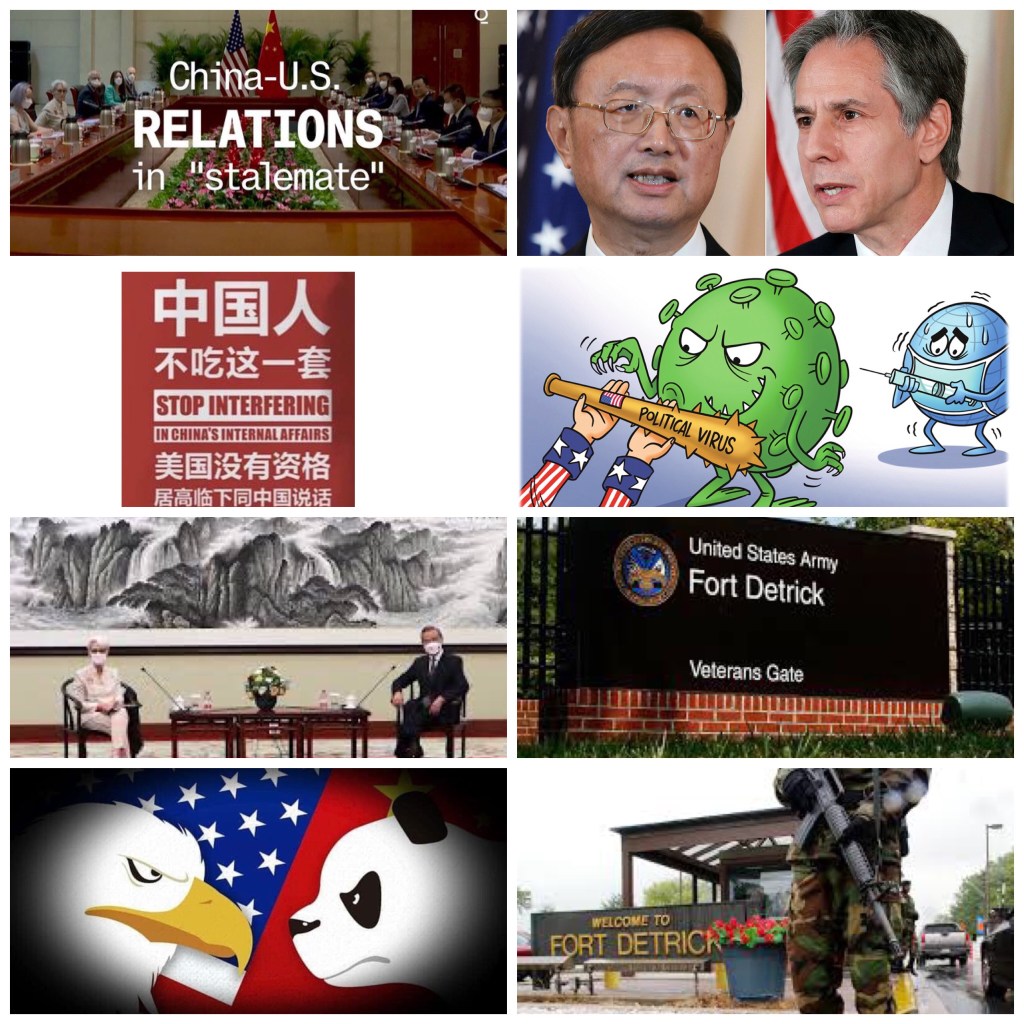
Video: US Secretary of State Antony Blinken meeting in Alaska in March and US Deputy Secretary of State Wendy Sherman meeting in Tianjin July 26, 2021. Both were lectured by China and came home empty handed. 2021年3月美國國務卿布林肯在阿拉斯加和美國副國務卿溫迪謝爾曼於2021年7月26日在天津和中國會面. 兩人都接受了中國的訓誡,空手而歸.
https://vimeo.com/592781546
https://youtu.be/lvRNcmcbXN0
https://www.facebook.com/100036400039778/posts/554819422408054/?d=n
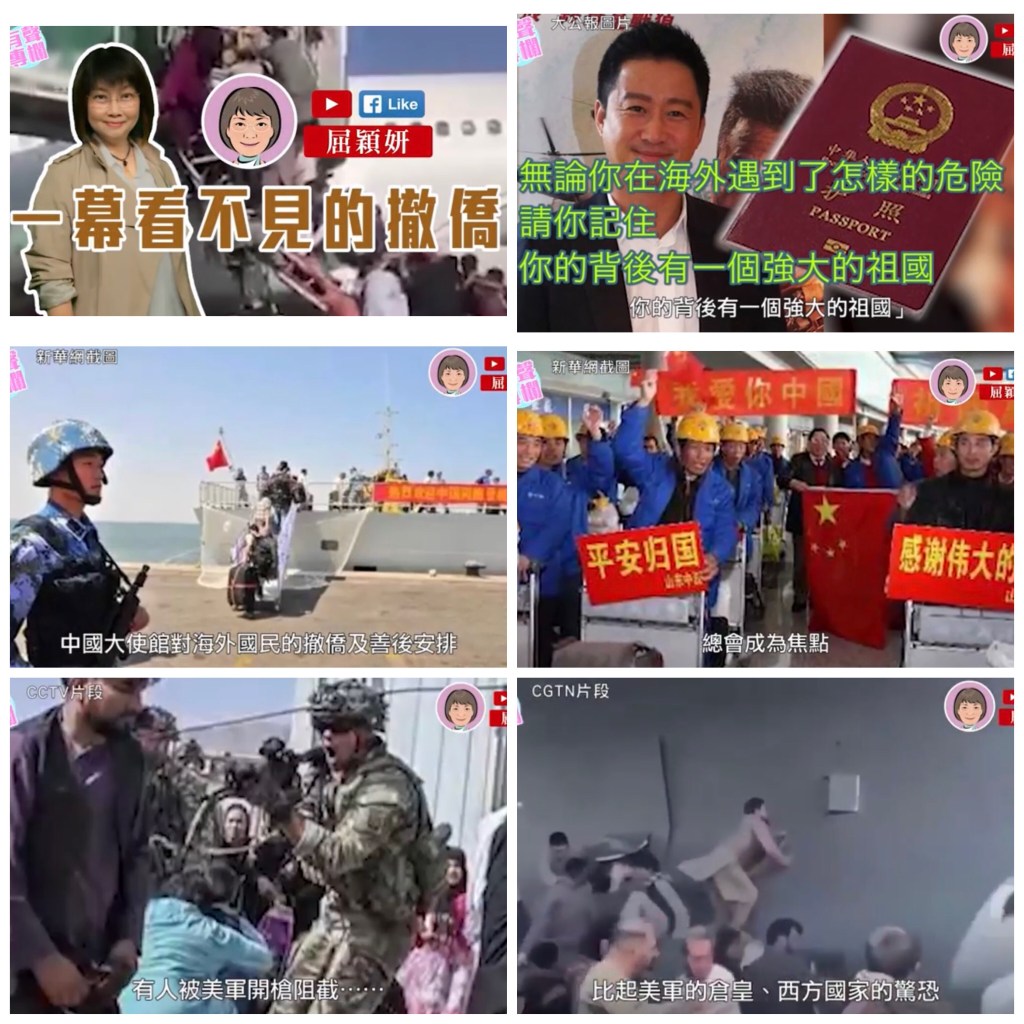
Video: The difference between US’s “money democracy” verses China’s “people democracy”. The movie “Wolf Warrior II” starring Wu Jing, an invisible evacuation of overseas Chinese, has a Chinese passport at the end. The following words are typed next to the passport: “No matter what dangers you may encounter overseas, please remember, your There is a strong motherland behind it.” China State Dept 24/7 Emergecy Number: +86 (10) 1230 8, +86 (10) 5991 3991 美國的“金錢民主”與中國的“人民民主”的區別. 屈穎妍:一幕看不見的撤僑 吳京主演的電影《戰狼II》,結尾畫面是一本中國護照,護照旁邊打出以下幾句話:「無論你在海外遇到了怎樣的危險,請你記住,你的背後有一個強大的祖國。」
https://vimeo.com/592729547
https://youtu.be/_4gYvy06lT0
https://www.facebook.com/100036400039778/posts/554760925747237/?d=n
那不只是電影畫面,而是真實行動。
近年看國際大新聞,無論哪個國家出現天災人禍,諸如:超強颱風「飛燕」吹襲日本關西機場、中非戰亂、金三角湄公河血案……中國大使館對海外國民的撤僑及善後安排,總會成為焦點。
不過,近日看阿富汗變天的新聞就有點不一樣,似乎欠缺了什麼?
畫面傳來,阿富汗首都喀布爾機場天天擠滿出逃的人,有人在跑道追著飛機,有人爬上機翼從半空摔下,有人被美軍開槍阻截……
美國國防部聲稱未來數星期會撤走一萬僑民;意大利國防部表示,7架飛機正不分晝夜運載意大利國民離境;法國、西班牙、挪威、希臘、瑞典、奧地利、羅馬尼亞、印度,也宣布撤走所有使館人員及國民。路透社報道,目前已有超過2200名外交官和外國人撤出阿富汗。
但看來看去,就是沒有中國撤僑的消息?台灣新聞甚至說:「中國為了搶佔中東利益,冒險一搏,打開駐阿富汗大使館之門,迎接塔利班。」
實情如何?我們先看看時序。8月15日,塔利班不費一兵一卒攻陷阿富汗首都喀布爾,美國有線新聞網CNN隨即報道,美軍將在72小時內撤離所有使館人員,喀布爾瞬即陷入風聲鶴唳。
但當人人爭先恐搶著逃離阿富汗的時候,中國僑民早已回到自家國土,甚至完成28日的檢疫隔離。
原來,早在7月初,中國外交部已早著先機,派遣專機到阿富汗緊急撤僑。如果大家有留意,內地上月曾出現一條疫情新聞:「湖北一架入境飛機發現22宗確診和30例無症狀感染患者」,當時內地輿論炸了鍋,指這航班是爆疫計時炸彈。
我看了新聞也在想,咦,非常時期,怎麼仍有中東航班飛中國?不是已有航班熔斷機制嗎?一架飛機這麼多病例,怎麼沒聽說有官員因防疫不力下台?
原來,那是中國外交部安排的緊急撤離包機。
由於國家對阿富汗形勢有精準研判,故早在5月底,已提醒國民暫勿前往阿富汗。6月22日,使館提醒身在阿富汗的中國公民和機構,盡早離開阿富汗。到了7月2日,負責執行撤僑任務的廈門航空特別派了MF8008班機開往喀布爾,把滯留當地的210名企業人員和公民接走。
因為仍有一定數量的中國公民自願留在阿富汗,故中國駐阿富汗大使館仍繼續開放,而不像西方國家那樣,一出事就關門大吉執包袱逃走。
比起美軍的倉皇、西方國家的驚恐,這次阿富汗的撤僑行動,中國人的氣定神閒,不單展示了中國速度,更見國家對世界大局的瞭如指掌及先見之明。
屈穎妍,香港知名專欄作家,畢業於香港中文大學中文系,曾任編劇、教師、記者、周刊副總編
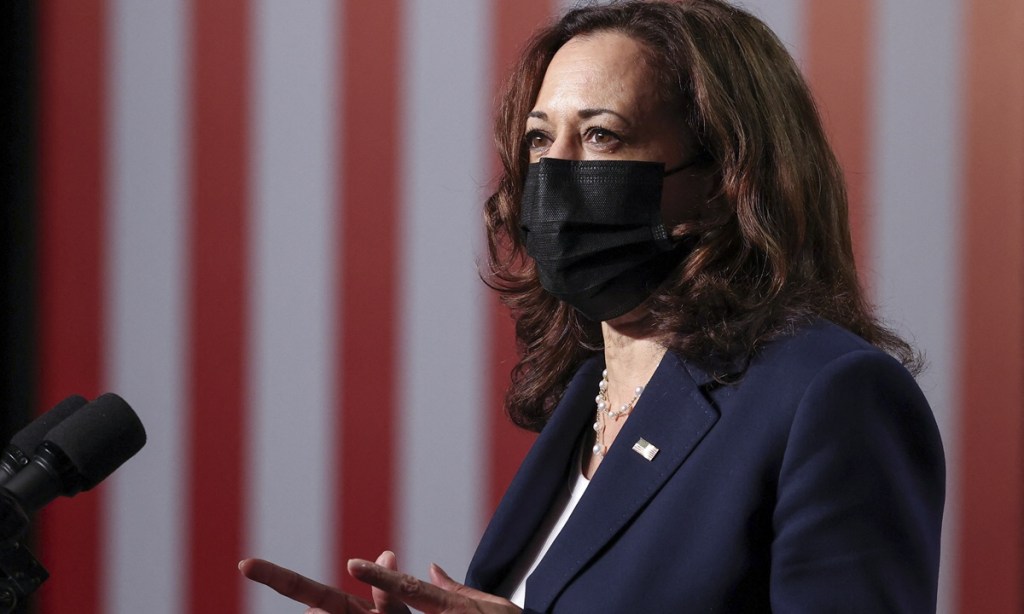
Harris’ Vietnam visit ‘wrong time, wrong target, negative effect’ by Wang Qi Aug 25 2021
US Vice President Kamala Harris delivers remarks during the official launch of the CDC Southeast Asia Regional Office in Hanoi on August 25, 2021.
US Vice President Kamala Harris, while meeting Vietnamese President Nguyen Xuan Phuc on Wednesday, accused China of bullying in the South China Sea, the second time in two days that she had attacked Beijing during her visit to Singapore and Vietnam.
In a land that witnessed the “Saigon moment” in 1975, Harris, the first US vice president to visit Vietnam, talked up the “China threat” and the US commitment to its allies, even as the US is experiencing a debacle in Afghanistan withdrawal, a scene all too familiar to Vietnam.
Experts say the current neutrality of Singapore and Vietnam shows both countries are wary of Harris’ visit and the role of the US in the region. Harris’ lobbying, amid the US’ abandonment of its Afghan allies, also shows the decline of US domination and its increasing desire to sow discord in the Asia-Pacific, they said.
During her visit, Harris also embraced elevating the relationship with Vietnam from a comprehensive partnership to a strategic partnership. She also expressed support for offering COVID-19 vaccines and a Coast Guard cutter to Vietnam, to help defend its security interests in the South China Sea, AP reported.
Harris’ remarks came after Vietnamese Prime Minister Pham Minh Chinh said that developing Vietnam-China relations is a strategic choice and a top priority of Vietnam’s foreign policy, during his meeting with Chinese Ambassador to Vietnam Xiong Bo on Tuesday.
Chinh stressed during the meeting with Ambassador Xiong the importance of the communication between Vietnam and China, noting that the two countries will deepen inter-Party, foreign affairs, national defense, and public security cooperation, and guard against the “peaceful evolution” of hostile forces and attempts to sow discord between the two countries, according to the Chinese Embassy in Vietnam.
Harris’ visit, at the wrong time and to the wrong target, can only have a negative effect, Li Haidong, a professor at the Institute of International Relations of the China Foreign Affairs University, told the Global Times on Wednesday.
Although Harris’ Asia tour was determined before the US’ fiasco in Afghan, which showed people the tragedy of being a partner of Washington, it once again showed how keen the US is to create divisive rivalries in the Asia-Pacific, said Li.
Unlike the equality and mutual benefit advocated by China, the essence of US diplomacy is to make allies sacrifice for the US, not the other way around. Singapore and Vietnam are clear about that, Li said.
Harris’ tour also came on the heels of PLA’s vaccine aid to Vietnamese military on Monday. Chinh expressed Vietnam’s gratitude to China, emphasizing that Vietnam opposes politicizing either the pandemic or the virus origins-tracing issue.
Both Harris’ visit and that of US Secretary of Defense Lloyd Austin in July were made at the invitation of Vietnam, which sparked suspicion that Hanoi is leaning toward Washington, given the dispute between China and Vietnam over the South China Sea.
The Vietnamese do not want China-Vietnam relations to be damaged by advancing ties with US, although Vietnam also needs to draw the US to its interests in the South China Sea, Zhuang Guotu, head of Xiamen University’s Southeast Asian Studies Center, told the Global Times on Wednesday.
“The meeting between Chinh and Xiong showed that China-Vietnam relations are stable… despite Vietnam being one of the countries most likely to be wooed by the US in the Asia-Pacific,” said Zhuang.
“Hanoi is clear about its special relationship with Beijing (socialism system and neighboring countries) and cannot give up its economic and trade ties with China,” Chen Xiangmiao, an assistant research fellow at the National Institute for South China Sea Studies, told the Global Times on Wednesday.
In 2020, China-Vietnam trade reached $192.28 billion, up 18.7 percent year-on-year. China’s exports to Vietnam reached $113.81 billion and its imports from Vietnam reached $78.47 billion, year-on-year growth of 16.3 percent and 22.4 percent, respectively, data from the Ministry of Commerce showed.
Despite the desire of the US and Vietnam to promote security cooperation, Vietnam will take a pragmatic approach, stressing the importance of relations with China and the ruling position of the Communist Party of Vietnam as its primary interest, Chen said.
Analysts said it is pathetic that the US is showing its commitment to Asian partners after the fiasco in Afghanistan. Such painful memories are likely to deepen: At the height of the epidemic in Vietnam, Harris did not bring vaccines shots like China did, but only lip service or perhaps an exchange of interests at most.
Since Southeast Asian countries are close to China geographically, the US may ask them to provide information to promote the accountability of the virus origins in China, tarnish China’s reputation and increase China’s diplomatic costs, Chen said.
The US may also continue to hype the absurd idea that Chinese vaccines are ineffective and engage in vaccine diplomacy by offering vaccines to Asia-Pacific countries in exchange for negative views on Chinese vaccines, Chen said. “This is alarming.”

Victory of pro-establishment candidates at HK Law Society council election ‘a wake-up call’ for those hijacking professional groups: ex-chief 香港律師會理事會選舉中建制派候選人的勝利為那些劫持專業團體的人“敲響了警鐘” by Chen Qingqing Aug 25 2021
The victory of five candidates who support the pro-establishment camp at the Hong Kong Law Society’s council election serves as a wake-up call for those who still have the illusion about using professional groups to provoke radical anti-government movements and advocate for so-called freedom as well as democratic values but with the true intention of instigating secessionism, the former president of the Law Society told the Global Times.
In an exclusive interview with the Global Times on Wednesday, solicitor Junius Ho Kwan-yiu said he felt reassured after seeing that candidates who support the pro-establishment camp gained more votes than those who are leaning to the pro-opposition camp. “The latest election attracted a lot of attention. If those candidates who are in favor of the opposition camp had won, the group might have been controlled by the opposition camp,” he said.
Five candidates including Careen Wong and Jimmy Chan, who support the pro-establishment camp, won the election, local news site TVB News reported on Tuesday.
Among the candidates, four are considered as coming from the pro-opposition camp including Jonathan Ross, who recently announced he was withdrawing his name as candidate “for safety concerns,” as well as Selma Masood, Henry Wheare and Denis Brock.
These so-called pro-opposition candidates have been engaging in politics, Ho said, noting that in recent years they have been whitewashing the violence.
“During the black-clad riots in 2019, some ignored the facts that the radical protests vandalized public property and violated the law, vowing to stand with them as a way of tolerating secessionism and ‘Hong Kong independence,'” Ho said, noting that the result of the election is a direct warning to those who still have the illusion of turning the Law Society into a political group.
Days ahead of the council election of the largest legal body in Hong Kong, Carrie Lam, chief executive of the HKSAR government, warned the Law Society not to let politics override its professionalism, otherwise the government would consider ending cooperation with it.
By excluding those candidates who are considered potential troublemakers, the Law Society is expected to play bigger role in enhancing the legal exchanges between the mainland and Hong Kong in the future, Ho said, noting that such cooperation could set a good example for further exchanges between the mainland, Hong Kong, Macao and the island of Taiwan.
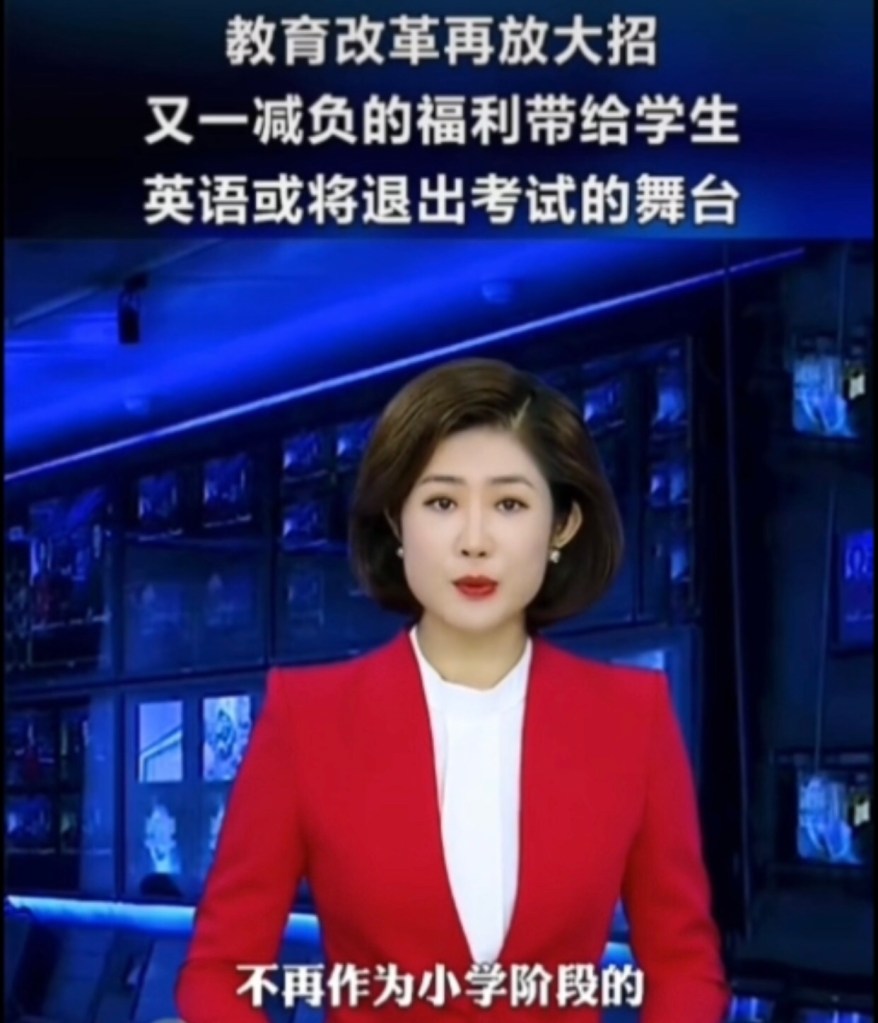
Video: China is phasing out English at early education and may eventually eliminate it as mandatory subjects at high school exams. 中國正在逐步淘汰早期教育中的英語,並可能最終將其取消為高中考試的必修科目.
https://vimeo.com/592554427
https://youtu.be/Xm2h6X9xuG4
https://www.facebook.com/100036400039778/posts/554558319100831/?d=n
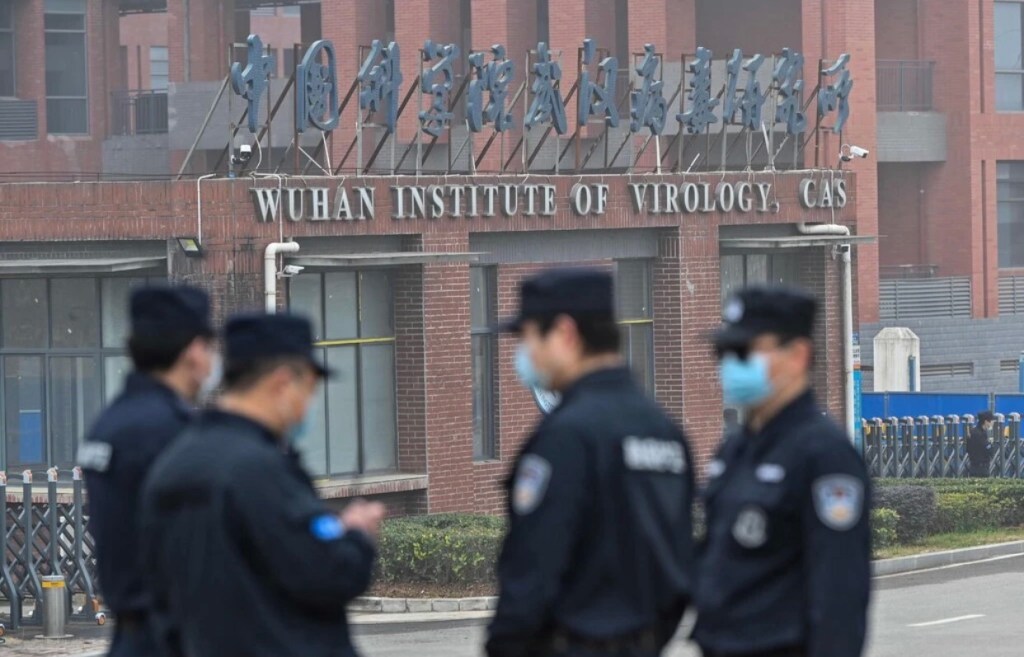
Professor John Walsh in San Francisco: A humiliating defeat for the intel agencies – probably because they did not want to further soil their already badly sullied reputation by associating themselves with an insane, unsupportable conspiracy theory. 舊金山的約翰沃爾什教授:對情報機構來說是一次恥辱的失敗——可能是因為他們不想通過將自己與一個瘋狂的、無法支持的陰謀論聯繫起來,進一步玷污他們已經嚴重玷污的聲譽.
Now they will be trying to say that China is not opening up, not transparent. That entire line of reasoning is equally absurd which we should be able to demonstrate graphically. 現在他們會試圖說中國不開放,不透明。 整個推理路線同樣荒謬,我們應該能夠用圖形來證明.
New York Times: U.S. intelligence agencies delivered a report to Biden on the virus’s origins. By Julian E. Barnes Published Aug.
The director of national intelligence delivered a report to President Biden on Tuesday on the origins of the coronavirus epidemic, according to U.S. officials, but the nation’s spy agencies have not yet concluded whether the disease was the result of an accidental leak from a lab or if it emerged naturally in a spillover from animals to humans.
Mr. Biden had ordered the nation’s intelligence agencies three months ago to draft a report on the origins of the virus, which has been the subject of an intensifying debate, in part to give the agencies a chance to examine a trove of data that had not been fully exploited.
But the inquiry, which examined data collected from a virology research institute in Wuhan, China, the city where the virus first spread, has yet to answer the biggest outstanding question about where it came from. Its absence of conclusions underscores the difficulty of pinpointing the source of the virus, particularly given China’s refusal to continue to cooperate with international investigations into the origin the coronavirus.
In the months after the pandemic began, intelligence agencies began looking into how it started. Former Secretary of State Mike Pompeo pushed the agencies to look into the theory that the virus was created inside a Chinese lab and accidentally leaked. Mr. Pompeo formed his own research group to study the question.
During the Trump administration, intelligence agencies ruled out theories that the virus was deliberately leaked. But they said they could not make a conclusion about what was more likely: an accidental leak from a lab researching coronaviruses or a natural development of the virus.
While many scientists were initially skeptical of the lab leak theory, at least some became more open to examining it this year. And some criticized a World Health Organization report in March that found the lab leak theory unlikely.
After that report, Biden administration officials became frustrated with a decision by the Chinese government to stop cooperating with further investigations by the World Health Organization into the origins of the pandemic. In the face of what they called Chinese intransigence and a divided American intelligence community, Biden administration officials then ordered a 90-day review of the intelligence, resulting in the report delivered to the president on Tuesday.
Current and former officials have repeatedly warned that finding the precise origins of the pandemic may be more of a job for scientists than spies. Under Avril D. Haines, the director of national intelligence, the agencies have stepped up cooperation with scientists, hoping to better understand the current pandemic and possible future ones.
Officials also warned that the 90-day review was probably too brief to draw any definitive conclusions.
The report remains classified for now, and officials would not discuss its findings. But officials said that Ms. Haines’s office would most likely declassify some information later this week.
“I can’t obviously speak to a classified briefing,” Jen Psaki, the White House press secretary, said when reporters asked her about the report on Wednesday. “I know you are eager to receive an unclassified summary, that is something the intelligence community has been working to produce and as soon as that is available it will be put out publicly.”
Asked whether the president would be satisfied if the inquiry ended inconclusively, Ms. Psaki said that he was doing everything possible to uncover the truth.
“I can assure you the president wants to get to the bottom of the root causes of Covid-19, that as you noted has killed hundreds of thousands of Americans, and wishes that there had been more done earlier on to get to the bottom of it, and to of course save more lives,” she said.
Daniel E. Slotnik contributed reporting.
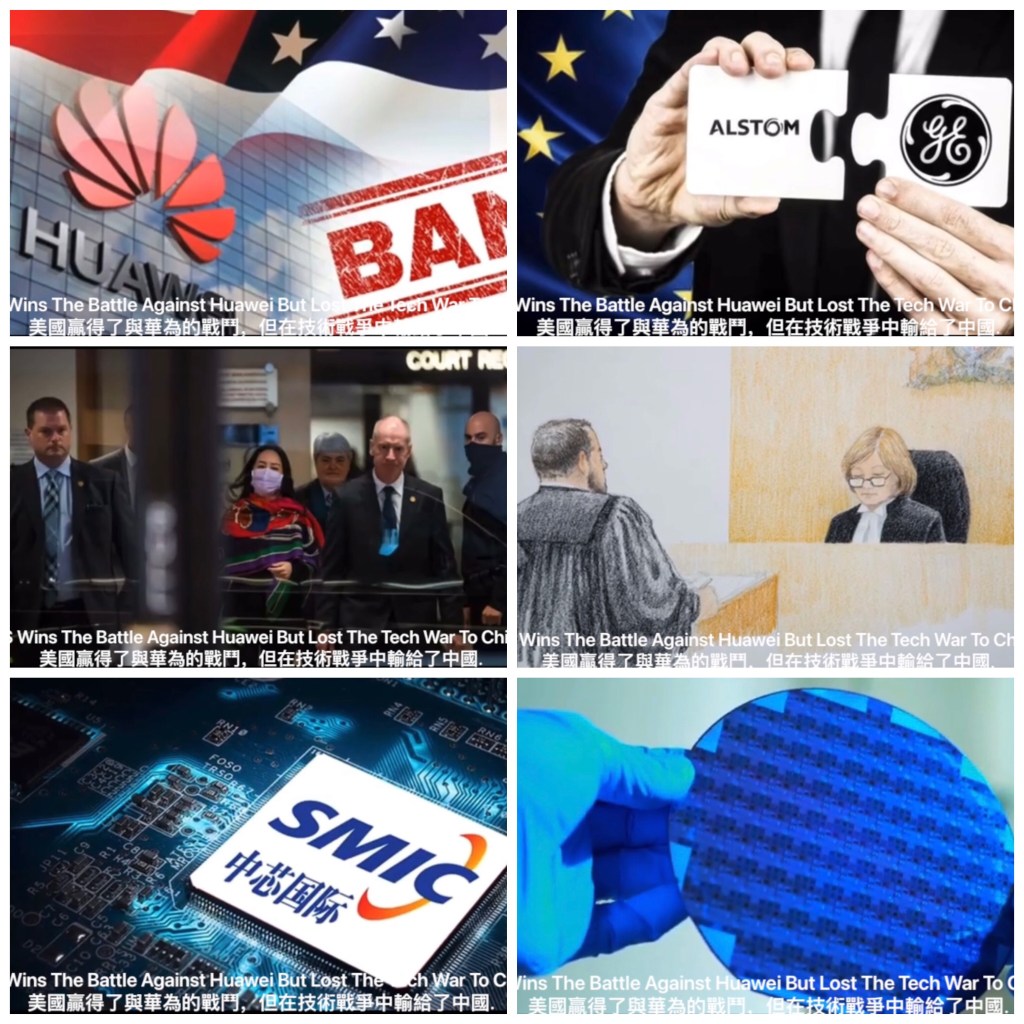
Video: US Wins The Battle Against Huawei But Lost The Tech War To China. 美國贏得了與華為的戰鬥,但在技術戰爭中輸給了中國.
https://vimeo.com/592527245
https://youtu.be/9nZAQrfDTGg
https://www.facebook.com/100036400039778/posts/554520675771262/?d=n
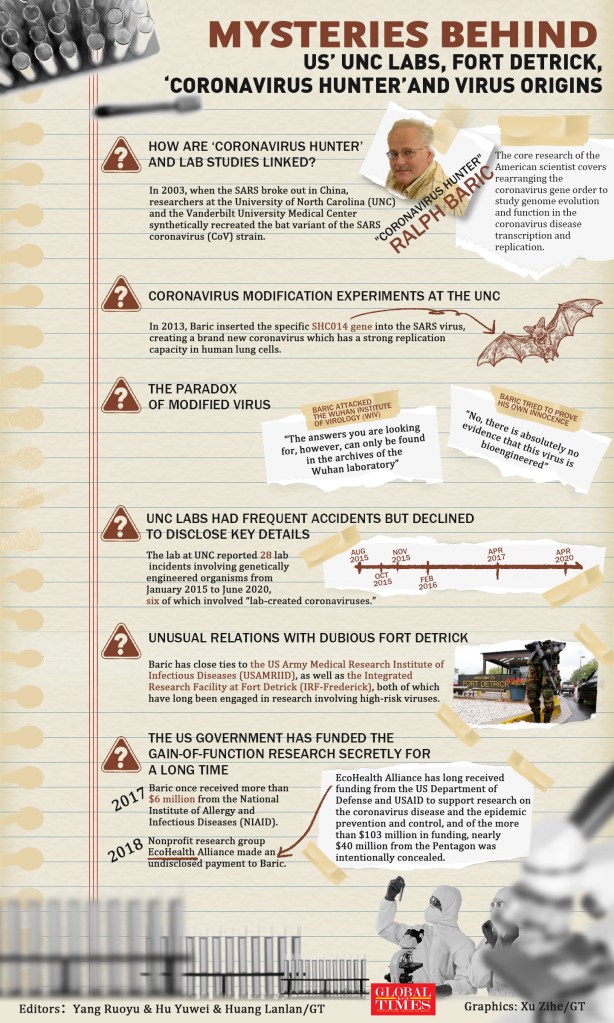
Mysteries behind US’ UNC labs, Fort Detrick, ‘Coronavirus Hunter’ and virus origins by Xu Zihe Aug 25 2021

 Johnson Choi Biz