Exclusive: How US auditor Verite fabricated a report on Xinjiang – What the WSJ did not tell you 獨家:美國審計師Verite如何編造新疆報告——華爾街日報沒有告訴你的 by Global Times Aug 20 2021
A reaper harvests cotton in a field in Manas County of northwest China’s Xinjiang Uygur Autonomous Region, Oct. 17, 2020.
Receiving $18,250 to make a predetermined guilty report on China’s Xinjiang region by combining online information and untenable reports from anti-China forces is the real truth that the Wall Street Journal did not tell about the closing of Shenzhen Verite, a company affiliated to a US organization.
On Thursday, the Wall Street Journal released a report saying that the Chinese authorities have shut down a US labor auditor’s local Chinese branch, and that it escalates “Beijing’s campaign to counter forced-labor allegations” on its Xinjiang region.
The WSJ report also claimed that the Shenzhen Verite company had a reputation for “producing investigations that lent credibility to corporations grappling with labor rights-related issues.”
The report cited a Global Times report in March to claim that Chinese authorities took action on Shenzhen Verite after it was mentioned in the Global Times for making a predetermined report on Xinjiang for the Better Cotton Initiative.
What the Wall Street Journal report failed to mention is that the Global Times released another exclusive report on August 3 about the details of how the Shenzhen Verite company made up the predetermined guilty report.
In 2006, the US company Verite sent its Chinese employee Yao Wenjuan to set up a workshop in Shenzhen, which was later registered as a company in Verite’s name and dealt with Verite’s businesses in China, with Yao being the legal representative.
The Global Times learned that the BCI headquarters invited Verite to join the investigation into whether “forced labor” is being used in cotton-related industries in Xinjiang. The budget for the project was $88,200, including $51,950 for Verite US headquarters and $18,250 for the Shenzhen Verite.
There is no record in the Shenzhen company’s financial reimbursement records of any employee going to Xinjiang to conduct a field survey on this BCI project.
Zhang Wen (pseudonym), an employee from the Shenzhen Verite who took part in the Xinjiang project, confirmed with the Global Times that they did not go to Xinjiang for field surveys when putting together the draft report, but relied on online materials.
Liu Min (pseudonym), another employee from Shenzhen Verite who also took part in the Xinjiang project, told the Global Times that while drafting the report, she was asked to edit each part under Yao’s requests and the latter also provided a large number of “materials” for Liu to refer to, including the report by the infamous anti-China “scholar” Adrian Zenz on “forced labor” in Xinjiang. The materials were put together with overseas biased reports on Xinjiang’s vocational training and education centers to form what they called “sources.”
Yao also altered the final draft to cater to the West’s accusations on Xinjiang. “The research to make the draft was very limited and we had used second-hand information, making the conclusion flawed,” Liu told the Global Times.
The Global Times learned from several employees of the Shenzhen company that after learning that the company was under investigation, Liu was considering to sue Yao for getting them involved in such case.
In US, a promise made by politicians is not a promise kept. It is very different from China’s socialism with Chinese characteristics: promise made must be kept! In US Politics and partisanship override everything including saving lives. That is why more than 600,000 Americans needlessly lost their lives to COVID19 and no one got fired, no politicians in jails! 在美國,政客做出的承諾並不是兌現的承諾。 這與中國特色社會主義有很大不同:承諾必須信守!美國政治和黨派偏見壓倒一切,包括拯救生命. 這就是為什麼超過 600,000 名美國人不必要地死於新冠病毒,沒有人被解僱,沒有政客入獄!
There were no open I.C.U. beds on Wednesday in Alabama, or in parts of Florida, Louisiana, Mississippi and Texas, as hospitals across the South buckled under the weight of a coronavirus surge that could have been mitigated. Cases, hospitalizations and deaths are increasing nationwide. Every day, on average, more than 800 Americans are dying from Covid-19.
It is a humanitarian catastrophe, and yet many Americans see it through a political lens. The South has some of the nation’s lowest vaccination rates, driven partly by Republican reluctance. Some governors — including Gov. Greg Abbott of Texas, who is infected with the coronavirus himself — have forbidden local officials to impose mask requirements. Gov. Ron DeSantis of Florida, who has not changed his approach to follow public health guidelines, has claimed falsely that the surge is a result of President Biden’s border policies.
The divisions extend beyond policies to general attitudes about the pandemic: While nearly 60 percent of Americans overall said in a recent Quinnipiac poll that they were concerned about the Delta variant, more than 60 percent of Republicans said they weren’t. And research indicates that many people are looking at Covid policies they don’t like and blaming whichever party they’re not part of.
It’s enough to make one despair about the American public’s ability to deal in a nonpartisan manner with, well, anything.
But that may not quite be right.
I talked to several political scientists and pollsters about how the current Covid wave might affect public opinion and, more important, public behavior. Here’s what they said.
The bad news: Partisanship is really hard to overcome.
Partisanship — more specifically negative partisanship, which is animosity toward the other party as opposed to, or in addition to, a positive allegiance to your own — is an extraordinarily powerful force in American politics. It has become only stronger in recent years as partisanship has become increasingly intertwined with religious and racial identities.
When people look at the pandemic or Afghanistan or any other issue, “you’re doing so through this lens of the identity you have and preserving a self-esteem about that identity,” said Julie Wronski, an associate professor at the University of Mississippi who studies political psychology and behavior. “You’re trying to think about the people who are on ‘my team’: Are they good people? Are they winners? And the people on the other team are ‘bad people’ or ‘losers.’”
Some of what we’re seeing now in response to the pandemic was baked in very early on, as soon as elected officials — most prominently President Donald J. Trump — began to politicize basic public health measures, leading people to see support for masks or vaccines as partisan.
“That didn’t necessarily have to happen, but once it did, you’re not necessarily talking about the science,” Professor Wronski said. “It’s about who they are and who they consider themselves to be.”
One group of researchers had an unusual opportunity to study how partisan identity shaped people’s views on Covid, because in 2019, they surveyed more than 3,300 people about their political predispositions for an unrelated project. Once the pandemic began, they went back to the same people, and about 2,500 responded to follow-up questions.
They found, in research published in peer-reviewed journals in August and November 2020, that highly partisan Republicans took their initial cues from leaders like Trump and then stuck to them no matter what — even if Covid cases and deaths surged in their state, even if people around them got sick, said one of the five researchers, Yanna Krupnikov, a professor of political science at Stony Brook University.
Another of the five, Samara Klar, an associate professor at the University of Arizona’s School of Government and Public Policy, said the crucial element appeared to be not party affiliation alone, but active animosity toward the opposite side.
“We’re seeing the gap mostly among those people who personally dislike the other party, and that’s weird,” Professor Klar said. “It’s weird for your views on a public health crisis to be guided by your personal feelings toward members of the other party, but that is in fact what we’re finding.”
The good news: Not everyone is rigidly partisan.
Most people aren’t the sort of intense partisans described above. The exact percentage varies depending on the questions you ask, but generally, Professor Krupnikov said, only 25 to 30 percent of people fall into the “hyperpolarized” category.
And as the pandemic hit closer to home, she said, less-partisan Republicans “actually started to look very much like Democrats” in their personal precautions and the Covid-related policies they supported.
In other words, Democrats tended to take the pandemic seriously from the start, but once case counts spiked in the home counties of Republicans who weren’t extremely partisan, they began to take it seriously, too.
This reaffirms a longstanding belief of political science, Professor Klar said: “When an issue becomes really threatening and really important to you, then partisanship weakens its grip on your decision making.”
It is, at least, a moderately reassuring thought.
“There’s often so much focus on people whose partisanship seems to surpass their care even for their own health, or care for others,” Professor Krupnikov said. “But I do think it’s important to highlight that there are, at least in our data, a lot of people for whom politics was in fact tremendously secondary to the health crisis happening around them.”
So what’s next?
What this means practically for the future of the pandemic is less clear, especially because we don’t have much reliable polling conducted since the Delta surge spun out of control.
The limited polling we do have shows that a majority of Americans are worried about the Delta variant and support the C.D.C. recommendation that people wear masks indoors regardless of their vaccination status — and that pattern holds across regions, including the South, said Mary Snow, a polling analyst at Quinnipiac University. But there are still deep partisan divides in that data.
President Biden’s approval rating also seems to have taken some damage, but that may not be because of the surge itself. Rather, it may be “because we were told that we were out of the woods at the beginning of the summer, and that hasn’t happened,” said Patrick Murray, the director of the Monmouth University Polling Institute. “And that’s a reflection of messaging as much as anything else: ‘Why did you tell us you had this under control when you didn’t?’”
Ultimately, especially in the face of such a contagious variant, it takes only a small minority of Americans to derail epidemiological progress — and the most partisan Republicans are taking their cues from leaders who have no political incentive to give different ones.
In a state like Mississippi, the governor has more to fear politically from a far-right primary challenger than from a Democrat in a general election, Professor Wronski noted.
And while even partisans’ opinions could change if people they were close to started dying, she said, it would be a psychologically difficult shift.
“For the past couple years, your identity has been built upon a certain perception of what you think Covid is, who you think the good guys are, your lack of trust in political elites,” she said. “And now, if you’re starting to see death at your doorstep, that’s a cognitive dissonance that you have to reconcile.
“How many deaths is it going to take? I don’t have that answer.”
Tibet celebrates 70th anniversary of peaceful liberation by Shan Jie and Yang Sheng Aug 19 2021
With a grand celebration held in front of Lhasa’s Potala Palace in Southwest China’s Tibet Autonomous Region, people on Thursday marked the 70th anniversary of the peaceful liberation of Tibet. After seven decades of miraculous progress in the high-plateau region, Tibet is now eyeing high-quality development, with border construction, ethnic unity and eco-environmental progress as focuses in its future plan.
China’s top political advisor Wang Yang, who led a central government delegation to attend the event, called the peaceful liberation of Tibet in 1951 “a major victory in the cause of liberation of the Chinese people and China’s reunification,” saying it marked a historic transition with epoch-making significance for Tibet.
“Since then, Tibet has embarked on a path from darkness to brightness, from backwardness to progress, from poverty to prosperity, from autocracy to democracy, and from being closed to being open,” said Wang, chairman of the National Committee of the Chinese People’s Political Consultative Conference (CPPCC).
The GDP in Tibet soared past 190 billion yuan (about $29.3 billion) in 2020 from a mere 130 million yuan in 1951, Wang noted.
“It has been proven that without the CPC, there would not be a new Tibet,” Wu Yingjie, secretary of the Tibet Autonomous Regional Committee of the Communist Party of China, said at the meeting.
The government led by the CPC cares for the well-being of the people in Tibet and is able to concentrate resources on large undertakings, ensuring the implementation of key projects in a region with such difficult natural conditions, Xiao Jie, a deputy director at the Institute for Contemporary Tibetan Studies under the China Tibetology Research Center, told the Global Times on Thursday.
Infrastructure construction in Tibet, including the Qinghai-Tibet railway, the Lhasa-Nyingchi railway and a number of hydropower stations, have enabled the region to utilize resources from domestic or international markets from a relatively high level, Xiao said.
Moreover, Tibet has successfully chosen industries that suit its conditions, such as tourism and modern agriculture, Xiao noted.
Tens of thousands of people participated in the Thursday event, including representatives of local residents, students, military and police officers.
The 11th Panchen Lama also attended the event.
Celebrations had been held all around the autonomous region. On Thursday, the Tibet Daily used 60 pages to look back at the history of Tibet being a part of China, the journey of Tibet’s development and the prosperity around the region.
In only seven decades, Tibet has realized a historic leap of thousands of years – transforming itself from a feudal serfdom to a socialist system; from poverty and backwardness to civilization and progress, the newspaper read.
In July, Chinese President Xi Jinping visited the Tibet Autonomous Region for the 70th anniversary of Tibet’s peaceful liberation.
“It has been proven that without the CPC, there would have been neither new China nor new Tibet,” Xi said. “The CPC Central Committee’s guidelines and policies concerning Tibet work are completely correct.”
Xi also stressed writing a new chapter of lasting stability and high-quality development for the plateau region.
Since the 18th National Congress of the CPC held in 2012, stability, development, eco-environmental progress and border-area consolidation have become the four major issues in Tibet.
With its peaceful liberation in 1951, the people of Tibet broke free from the fetters of invading imperialism for good, and embarked on a bright road of ethnic unity, progress and development, according to the Xinhua News Agency.
A better life
In the past 70 years, especially in recent decades, local people’s lives across Tibet, whether in major cities like Lhasa and Shigatse or border regions in Ngari prefecture and some border counties like Yadong, have seen remarkable improvements.
Drolma Tasering, 70, a villager in Yadong county, a frontier county and trade market bordering India and Bhutan, said the people there have a very strong sense of gratitude toward the CPC and the People’s Liberation Army (PLA). He noted that outsiders with a bias against Tibet would not understand because they haven’t “experienced what we have in the past 70 years.”
Drolma is a survivor of the earthquake on September 18, 2011 in Yadong. Villagers initially saved her when she was buried under debris. When the rescue team made up of firefighters and PLA troops arrived, more and more people were rescued and received food, tents and other materials. Now she lives in a new two-storey house.
Asang, 40, the son of Drolma, told the Global Times that “the houses for local villagers – most of which are two-storey, some are one-storey – were built by the local government after the earthquake, and they are much more modern and comfortable than the old ones we used to live in. We only had to spend 50,000 yuan to buy it, and if you just want the one-storey one, the house is free.”
Local villagers will also receive about 10,000 yuan every year in subsidies for protecting forests and patrolling the border, and monthly living expenses for ordinary villagers like Drolma come to just a few hundred yuan, so the people there feel almost no life pressure, Asang said.
By the end of 2019, all registered poor residents in Tibet had shaken off poverty, marking the elimination of absolute poverty in the region for the first time in history, according to Xinhua.
The average annual per capita disposable income of those who have got rid of poverty in Tibet exceeds 10,000 yuan ($1542), according to a white paper issued in May by China’s State Council Information Office.
Exclusive: US coerces China’s neighbors with vaccines to join virus origins smears campaign: source by Cao Siqi Aug 19 2021
Using vaccine aid, talent training and industrial investment as a bait, the US is stepping up its efforts to coerce China’s neighboring countries to participate in its campaign to smear China as the “source of the coronavirus” and to drive a wedge between China and its neighbors so as to contain China’s rising influence in Asia-Pacific Region and maintain US’ regional dominance, a source close to the matter told the Global Times on Thursday.
Meanwhile, US senior officials also ordered to keep the virus origins probe away from Europe and Latin America, considering that Europe is a close ally of the US, and Latin America is geographically close to the US and virus origins tracing work in the region may expose US early COVID-19 cases and anti-epidemic loopholes, the source said.
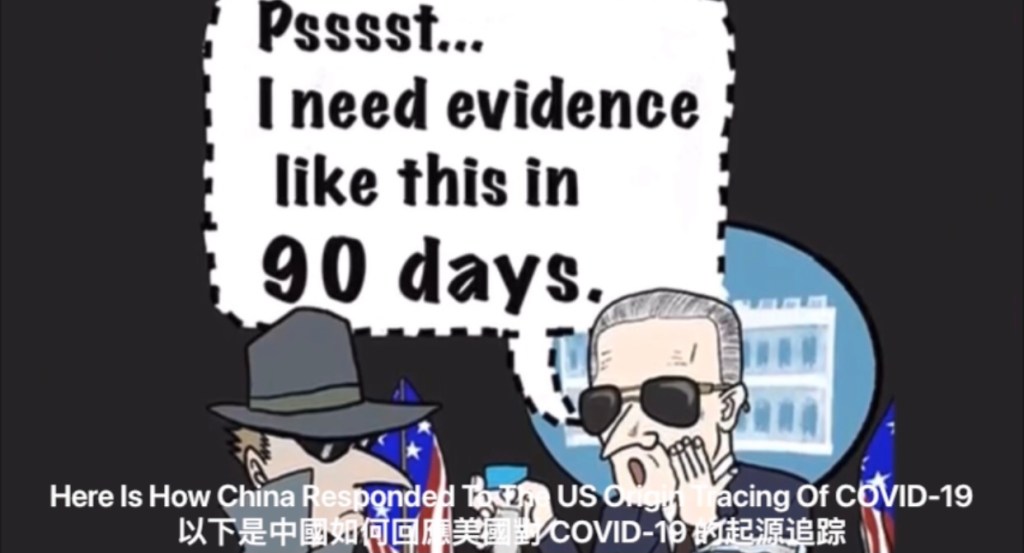
This came as the Joe Biden-set deadline of the 90-day investigation into the virus origins draws close. In order to formulate an investigation report conducted by US intelligence agencies on the virus origins, the US has been piecing together the so-called “evidence” around the world and trying to “convict” China. But the move has made no substantive progress, the source said.
The source revealed that US high-level officials recently have been targeting China’s neighboring countries as its breakthrough point. Considering the short distances with China, the close bilateral relations and frequent personnel exchanges, it is easier for the US to fabricate and piece together epidemic links with China. By doing so, even if the US cannot eventually prove the “lab leak” theory, it can somehow point to China as “the source of the virus.”
The attempt is aimed to overturn the WHO-China joint report which concluded that there could be multiple sources of the COVID-19 outbreak. It also aims to drive a wedge between China and neighboring countries, to contain China’s growing influence in the Asia-Pacific region and maintain the regional dominance of the US, the source said.
The US has increased its intimidation of the neighboring countries. The source said it used vaccine aids, cooperation in vaccine technology research, development and transfer, and guarantee of the supply of vaccine raw materials as baits to induce these countries to fully cooperate with the US.
The US also accessed government and professional databases of relevant countries to obtain large amounts of patients’ information by providing skills training, office equipment, or sending technicians, the source said.
The US was also found to offer explicit price tags such as promoting industrial development and supporting its participation in international and regional affairs, in exchange for the help of relevant countries to stir up the accusation that “China is responsible for and is the source of the virus,” according to the source.
The source also revealed that US high-level officials ordered to push back investigation in Europe and Latin America region, as Europe is a US ally with close links, ignoring the fact that some of these countries found earlier COVID-19 cases. The move shows the US only wants to “take care of the interests of its allies” and focus on the theory of “China is the virus source.” Meanwhile, the probe in Latin America, which is adjacent to the US and has a dense population flow, would in turn expose the early cases in US and its epidemic prevention loopholes.
Several sources told the Global Times previously that US intelligence agencies are gearing up their efforts to compile a report, yet are struggling to find concrete proof to support the “lab leak” theory, and even its own research institutions and allies believe the virus was almost certainly not created artificially.
The US has been pressuring the World Health Organization (WHO) and marshaling its allies, including the EU, Australia, Japan and other countries, to launch the “second-phase origins tracing” on China as soon as possible while trying to bend the will of scientists to churn out materials to chide China.
Lü Xiang, a research fellow on US studies at the Chinese Academy of Social Sciences in Beijing, said it shows the US has launched a “political war” against China. A scientist close to the WHO-China joint expert group previously told the Global Times that the 90-day investigation is a “coordinated political campaign.”
Yang Xiyu, a former Chinese diplomat and senior research fellow at the China Institute of International Studies, said the intelligence probes fully expose the fact that the US aimed to manufacture some materials to prove China is guilty, and the so-called probes that insult and discriminate against China will not stop.
Childish squabbles over the origins of Covid-19 by US propagandas to demonize Chinese and China are distracting the public and researchers from more urgent work, a scientist said, as a peer called for answers to lingering questions about the virus research carried out at a laboratory at the centre of the controversy. 一位科學家說,美國宣傳對於新冠病毒起源來妖魔化中國的幼稚爭論正在分散公眾和研究人員對更緊迫工作的注意力,因為一位同行呼籲回答有關在該中心實驗室進行的病毒研究的懸而未決的問題爭議。
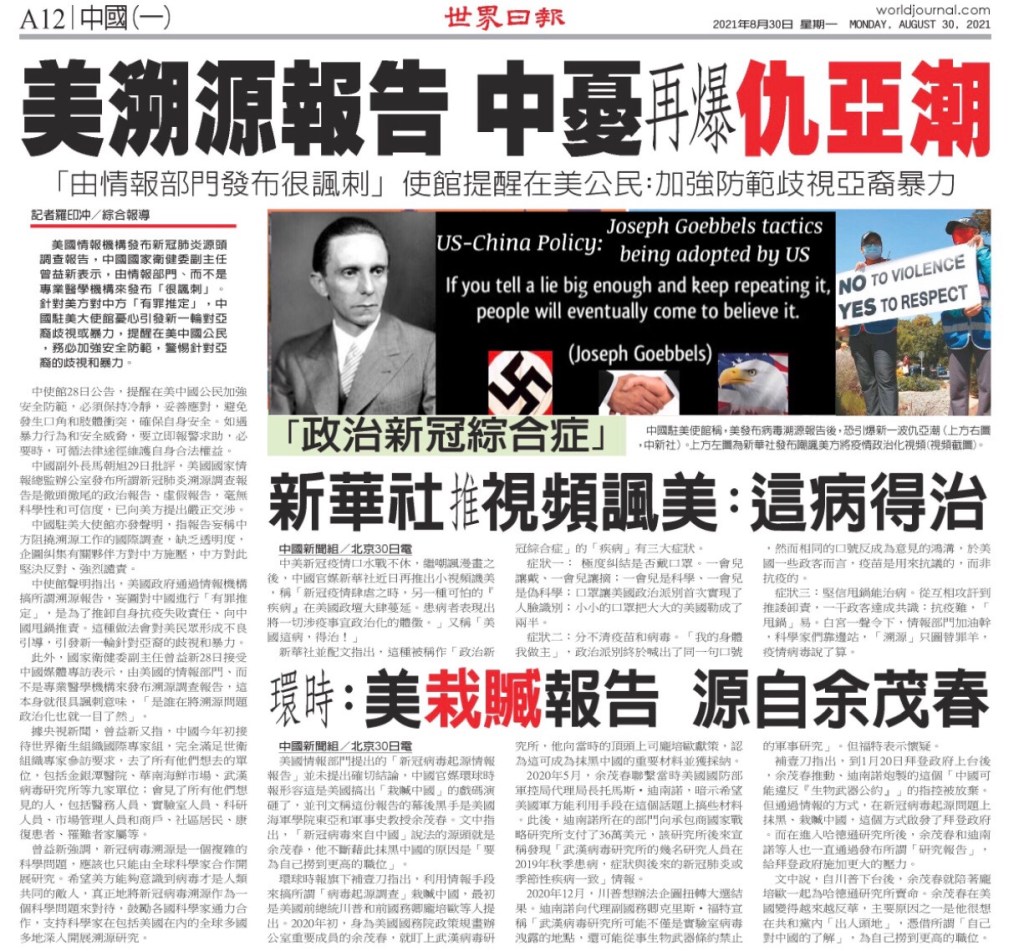
Asian Americans satisfaction in US plummeted at 29 years new low, hate crimes targeting Asians increased by 169% promoted and encouraged by AngloSaxon, racists and AngloSaxon politicians. 美國加州舊金山世界日報 World Journal Newspaper San Francisco, August 19 2021
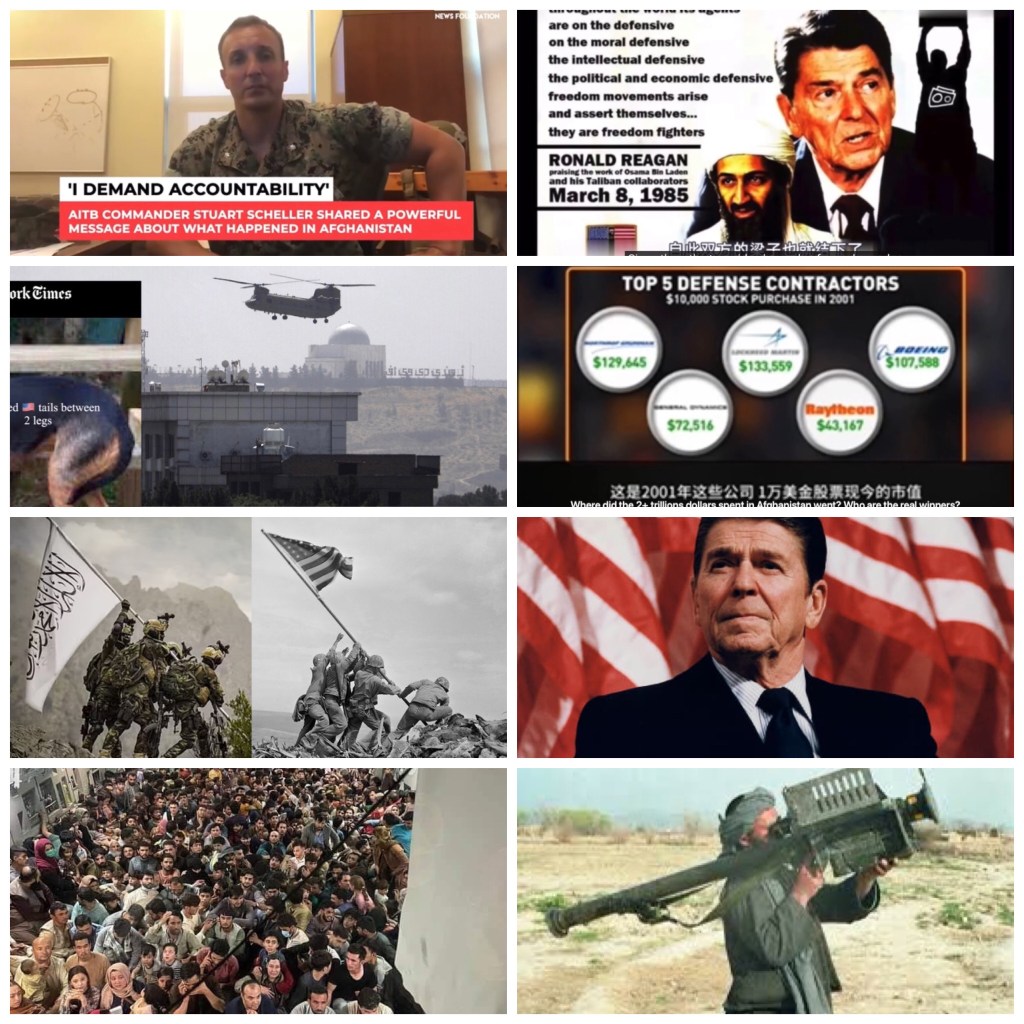
Video: Hillary Clinton and others admitted that all terrorist groups were founded and supported by Americans since Ronald Reagan such as the Taliban, ISIS, Al Qaeda etc including most religious extremist, the world and US allies knew about it. US will continue to support terrorists group inside Afghanistan to attack China, Russia, Pakistan and Iran. 希拉里克林頓和其他人承認塔利班、伊斯蘭國、基地組織等所有恐怖組織都是美國人從羅納德·裡根總統創立和支持的,包括大多數宗教極端分子,世界和美國盟友都知道。 美國將繼續支持阿富汗境內的恐怖組織襲擊中國、俄羅斯、巴基斯坦和伊朗. https://youtu.be/V7JInhObwU4 https://vimeo.com/589358420 https://www.facebook.com/100036400039778/posts/550470679509595/?d=n 這兩則報導说的非常清楚明白,看後突然会有融會貫通的感覺。总之,美國政府和政客們,在全球各地發動戰爭,侵略,掠奪和干預他国內政行為,肯定是有其動機和目的。古話說得好,冤 有頭 債有主,因果報應,遲早會來到。几天前,美国战敗撤軍,導致阿富汗政府瞬間瓦解,就是最好的證明。
The classic examples of how to do things right and how thing could be so terribly wrong. Be very nervous when the Western Empires said want to help you reconstruct your country. 如何正確地和不正確地做事所得結果的經典例子。 當西方帝國說要幫助你重建你的國家時,你要非常緊張, 這可能是你的未日來了.
Taliban victory a major failure of Western civilization’s expansion by Ding Gang Aug 18 2021
The victory of the Afghan Taliban is a major failure of Western civilization that started with its expansion 500 years ago. Even though the West will not stop expanding, the Taliban’s counterattack will probably lead to a shock wave of Islam.
The US failure in Afghanistan is not simply about military power. The expansion of Western civilization was a war between the Christian world and the Muslim world from the very beginning since 500 years ago. It was not only a struggle for wealth, but also a battle of ideas and beliefs.
The withdrawal of US troops from Afghanistan has a symbolic significance. That is, the use of force to transform or conquer so-called backward civilizations will no longer work because the world today is completely different from 500 years ago when the West conquered South America.
We won’t deny that Western civilization has left rich legacies in fields like natural and social sciences – a wealth that will continue to benefit people.
However, the West has been undertaking religious and ideological missions all this time. In addition, it has been plundering wealth and markets all over the world relentlessly. This has caused endless wars around the globe and left heavy burdens on developing countries politically, economically, and geographically. In particular, the West’s forceful promotion of its political standards has constrained developing countries from seeking a stable development path that suits their own cultural and historical traditions.
The Durrani Empire, or the Afghan Empire, was founded in 1747. However, the country’s power declined in the 19th century, which has intensified the rivalry between Britain and Russia in this region.
Pashtuns are the largest ethnic group in Afghanistan. After the second Anglo-Afghan War (1878-80), The Durand Line was established in 1893. This resulted Afghanistan being a buffer zone between Britain and Russia.
The Pashtuns of British India were separated from those in Afghanistan. And British India was well-placed to the British Empire. In 1947, when the British colonialists left, the subcontinent was partitioned into two independent countries: India and Pakistan. Since then, the Durand Line has been a constant source of trouble for Afghanistan and Pakistan.
Former Afghan president Hamid Karzai said in 2016 that Afghanistan had never accepted the Durand Line as an official border between Afghanistan and Pakistan and would never accept it. Karzai described it as “a line of hatred which raised a wall between the two brothers.”
Much of the 2,670 kilometer-long Durand Line is divided by high mountains, snaking through desolate deserts and towering peaks. Both sides of the line have always been among the most closed, dangerous, and impoverished regions across the world. And it is certainly the most prone to being a breeding ground for religious extremism.
The Taliban has developed in such a geographical and cultural environment. They have a tradition of rigid religious organization and tenacious resistance to external civilizations.
The Soviet Union invaded Afghanistan in late 1979 in an attempt to reshape the Islamic country in its own political way, and miserably failed a decade later.
After the 9/11 attacks in 2001, the US, which believed that the Taliban-backed al-Qaeda sheltered its founder Osama bin Laden and refused to hand him over, led NATO to wage a war in Afghanistan to overthrow the Taliban.
But the US then was not what Biden says it is today, that it only had one single goal, which is to destroy terrorist organizations.
After the 9/11 attacks, the US launched the Greater Middle East initiative in 2004. Through the Iraq War, the US believed it should set an example of “democracy” in the Middle East and radiate it to the entire Arab world, thus completing the democratic transformation of this region. Afghanistan is also a part of that transformation.
The “nature” of this project takes orders from the Western mission of more than 500 years to dominate the world and transform or conquer other sub civilizations or beliefs
It was this sense of the American mission, and the policies it led to, that doomed the US and NATO in Afghanistan. Because in today’s world, it is impossible to continue to expand one’s civilization and institutional model by force.
After the withdrawal of American troops, some Western media complained sadly that the US had run away without completing its mission, which was a “heavy blow” to the spirit of its allies.
History tells us that the West’s expansion was driven by a sense of mission, but so was its loss. In the 20 years since the 9/11 attacks, Washington’s strategic focus has been changing, but its sense of mission to conquer the world has not.
The author is a senior editor with People’s Daily, and currently a senior fellow with the Chongyang Institute for Financial Studies at Renmin University of China. dinggang@globaltimes.com.cn. Follow him on Twitter @dinggangchina
GT launches online petition demanding Meng Wanzhou’s release as her detention approaches 1,000 days. Click here to cast your vote for the release of Meng Wanzhou 環球時報發起網上請願,要求釋放孟晚舟,因為她被拘留了將近 1000 天。 點此為釋放孟晚舟投上一票 http://enapp.globaltimes.cn/article/1231899 by Chen Qingqing and Cao Siqi Aug 18 2021
As August 26 marks 1,000 days since Huawei’s Meng Wanzhou was detained in Canada, the Global Times launched an online petition on Wednesday demanding her immediate release.
The incident is blatant political persecution of a Chinese citizen and another example of the US government’s unjustified crackdown on Chinese companies and its attempts to curb the development of China’s high-tech industry, according to the petition. In this process, the Canadian government is a willing accomplice, said the petition.
Also on Wednesday, the Global Times released an open letter to Canadian Ambassador to China Dominic Barton, demanding Meng’s immediate and unconditional release.
At the request of the US government, the Canadian government on December 1, 2018 illegally detained Meng, who is also the chief financial officer (CFO) of Chinese company Huawei Technologies, based on so-called accusations of fraud imposed by the US.
Meng’s lawyers concluded their submissions at the extradition proceedings on Tuesday with a final attempt to end the case by building on an “evidentiary vacuum,” claiming that the US fraud charges simply aren’t valid. The case is also widely seen as an unusual one with a number of points of suspicion.
During the latest hearings, the defense team of Meng pointed out that in Canada’s legal history, there was never a fraud case in which the government held the alleged perpetrator accountable in the absence of actual losses.
She was accused of defrauding HSBC as she was said to have “lied to the bank about the Chinese company’s business in Iran,” and the charges center on a PowerPoint presentation that the CFO gave to the bank in a steakhouse in Hong Kong in 2013.
However, Meng’s lawyers claim that the US deliberately omitted two slides from the PowerPoint presentation, which showed that Meng didn’t mislead the bank.
The defense holds that Meng’s presentation did not expose HSBC to any real deprivation or any reputational and loan loss, which is an evidentiary vacuum in this case, or sanctions risks, according to a court note obtained by the Global Times on Wednesday.
When Meng presented evidence to disprove the US government’s false accusations, and even HSBC agreed to provide relevant materials to the court to help prove Meng’s innocence, Canada completely ignored it and pushed forward with so-called extradition procedures.
It’s bizarre for legal experts in Canada to see the legal procedures lasting an unusually long time for a fraud case, with no actual harm and misrepresented facts, further underscoring the political nature of the case.
The stairway to extradition in the case has been unnecessarily long and convoluted because successive ministers of justice have not had the courage or political will to intervene to stop it, as they are entitled to do at any time under the Extradition Act, Gary Botting, an extradition lawyer and author of Canadian Extradition Law Practice, told the Global Times in a recent interview.
The International Assistance Group (IAG) of the Department of Justice was understandably reluctant to advise the minister to intervene in Meng’s contemporaneous case, Botting sad, noting that acting like robots controlled by the US, the IAG issued a provisional arrest warrant against her.
“In effect, the US said ‘Jump!’ and the Canadian bureaucrats asked meekly, ‘How high?’,” the Canadian legal expert said.
Some Canadian lawmakers and officials have been constantly calling for Meng’s release as they believe that her case was highly politicized that led to a deteriorating Canada-China relationship.
It was ironic and rare when the so-called victim of this fraud case – HSBC – agreed to provide relevant materials to the court to help prove Meng’s innocence, the Global Times said in the open letter to the Canadian diplomat Barton.
“Even worse was when former US president Donald Trump, ignoring so-called legal procedures in the US and Canada, blatantly took the case of Meng as a bargaining chip in a geopolitical game with China,” the letter said.
Trump wanted a “ransom” for Meng’s freedom, her lawyer was quoted as saying in media reports earlier in August. Botting also noted that the case was a political gambit from the outset in a bid to throw cold water on Huawei’s aspirations to promote its 5G technology.
“The Canadian government has deviated from fairness and justice, and seriously violated the human rights of a Chinese citizen,” the petition said.