Have no fantasies that a Chinese politician in US will help Chinese! Using my Hawaii’s experience working with many politicians since 1980s. Most are Anti-Chinese! 不要幻想在美國的中國政客會幫助中國人! 利用我在夏威夷自 1980 年代以來與許多政治家合作的經驗. 大部分是反華.
Don’t get someone with a Chinese last name and support them blindly. Some of the worst racists and Chinese haters are Chinese. Check them out, make sure they passed the smell and taste test. Those Chinese Chinese-Haters are smart. They took advantage of the ignorance of many Chinese taking money from them and in the end ignored them once get elected.
Do you remembered a character named Andrew Yang! He is one of those mentioned above. We are so happy he didn’t get into any public office. Many major donors expressed big disappointment after he showed his true color.
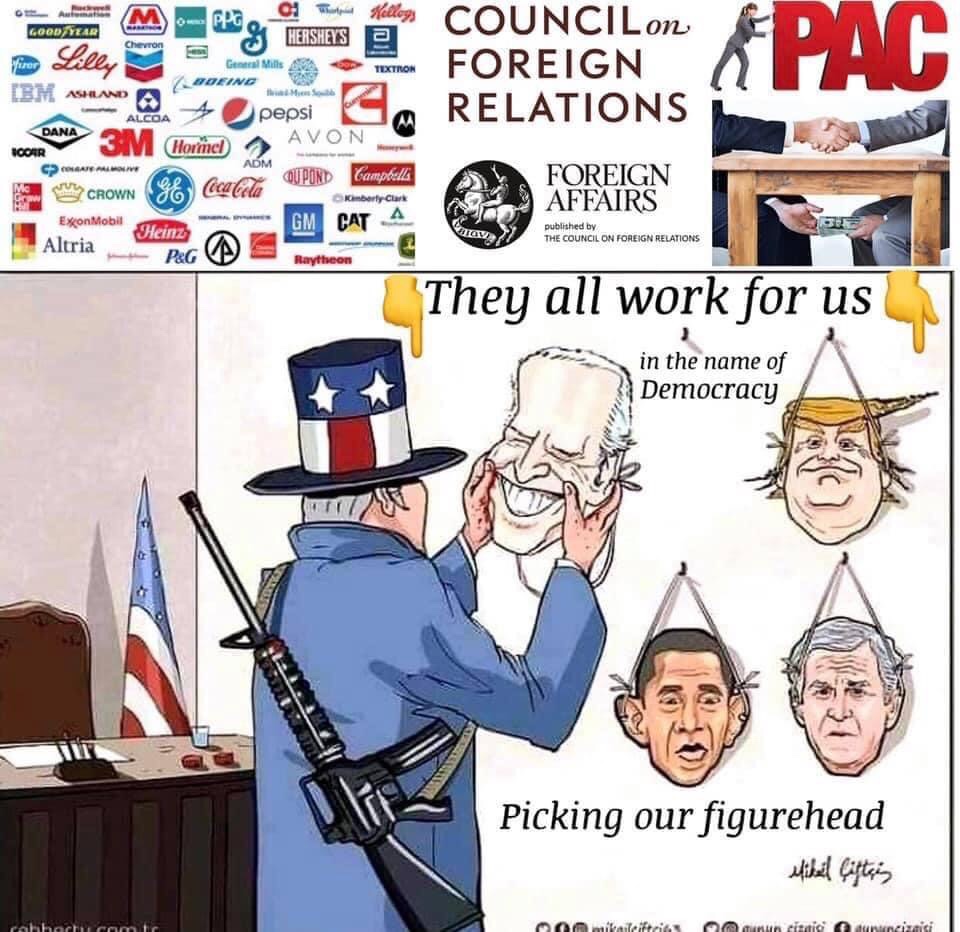
Another example was Obama, many African Americans thought he gave them hope but ends up Obama was serving the interest of the AngloSaxon. As for African Americans, sorry, you are fooled.
How about Japanese Americans in Hawaii? They are smart for 2 reasons: 1) they remembered how bad Republican is and was, sorry no Republicans, and 2) They voted as a block for Democrats, with 33% Japanese in Hawaii, they are the kingmakers controlled Hawaii politics for the last 50 Years.
What about Chinese in Hawaii? Just like those in SF and throughout US, they just kept killing each other everyday.
What does not mean? If China has democracy, China is finished.
If anyone like to argue, if you are Chinese look yourselves in the mirror and think back what has the Chinese done besides maybe individually successful and that is it, Pau (finished in Hawaiian).
Professor John V Walsh, MD, in San Francisco: Agreed, Johnson is right.
Identity Politics is the politics for decerebrates. A two year old can make a choice based on skin color.
Obama screwed people of color in so many different ways, I lost count. Not only wars on people of color around the world -Afghanistan, Iraq, Libya (which lies in AFRICA), Syria. The last two were wars that Obomber initiated. How he or Hillary could call others racist after they did that has to be filed under Pot Calling Kettle Black.
His greatest crime domestically was probably his killing Medicare For All in favor of ObamaCare which was written by a former Insurance Company Executive. That killed M4A for the forseeable future.
Yang is a Chinese American example apparently. How can you be pro-Chinese and support US policy which is designed to plunge 1.4 billion Chinese back into poverty?
Another nails on the coffins for brick and mortar retailers – no wonder new major retailers are by-passing Pittsburg.
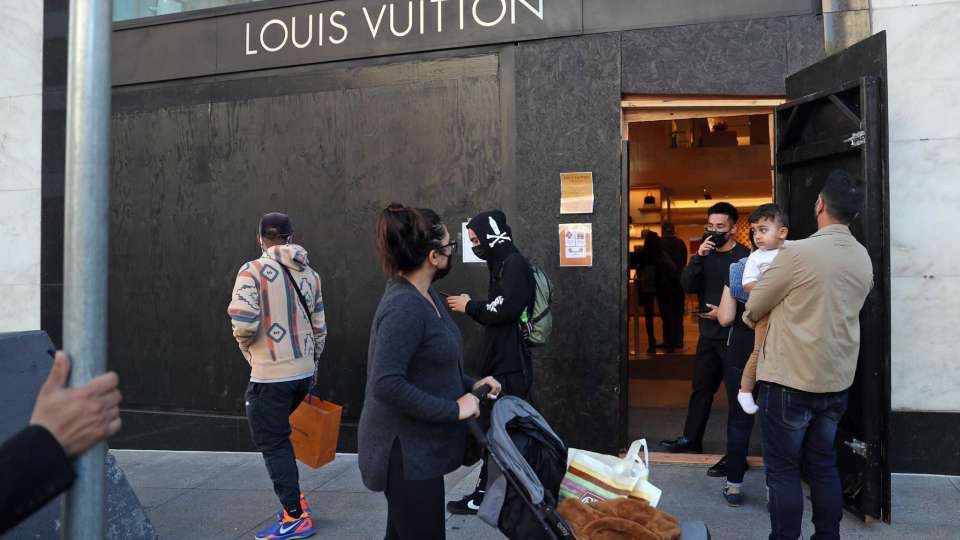
A Bay Area retail crime spree comes at a critical moment – Story photo for A Bay Area retail crime spree comes at a critical moment
Just a week before a critical Black Friday and holiday shopping season starting in earnest, Bay Area retailers were left reeling after a series of organized retail crime robberies hit San Francisco’s Union Square, Hayward, San Jose and Walnut Creek. After signs of recovery following pandemic health orders and more tourists in the region, smashed windows and empty shelves mark another challenge that shops — from global chains to mom and pop stores — must grapple with. Business owners are fearful about employee safety even more than stolen merchandise. There’s now a sense of heightened threat of violence, on top of COVID.
Feeling safe isn’t cheap: I talked to a Hayes Valley consumer electronics shop called B8ta that closed for seven months after being robbed at gunpoint. They’re now paying around $30,000 a month for around-the-clock guards with bulletproof vests, a cost that’s higher than their retail payroll or their rent. Off-duty police officers, who are armed, can be even more expensive, costing upwards of $100 per hour. It’s a big reason why San Francisco is the most expensive California city for retailers, and one of the most expensive in the country.
What can the city and retailers do? Experts say prosecution needs to be stronger, and District Attorney Chesa Boudin filed felony charges against the nine suspects who were arrested in Union Square outside a wrecked Louis Vuitton store. There needs to be more distinction between petty shoplifting, particularly when it’s done for financial survival, and organized retail crime targeting high-end products, retail experts said. For retailers, more robust security systems like pull-down door covers and cameras to help aid police investigations can deter crime, and they’re less expensive than guards.
There’s still hope for businesses. The National Retail Federation said last month that it expects holiday sales to grow by as much as 10.5% compared to 2020, up to $859 billion, which would be the highest on record. But a caveat: That figure includes online sales, and the recent string in robberies suggests local shoppers may prefer clicking rather than traveling to stores.
Do you feel unsafe shopping in person? Let me know at roland.li@sfchronicle.com and on Twitter @rolandlisf. – answer is definitely not safe.
Roland Li headshot Roland Li Business Reporter roland.li@sfchronicle.com
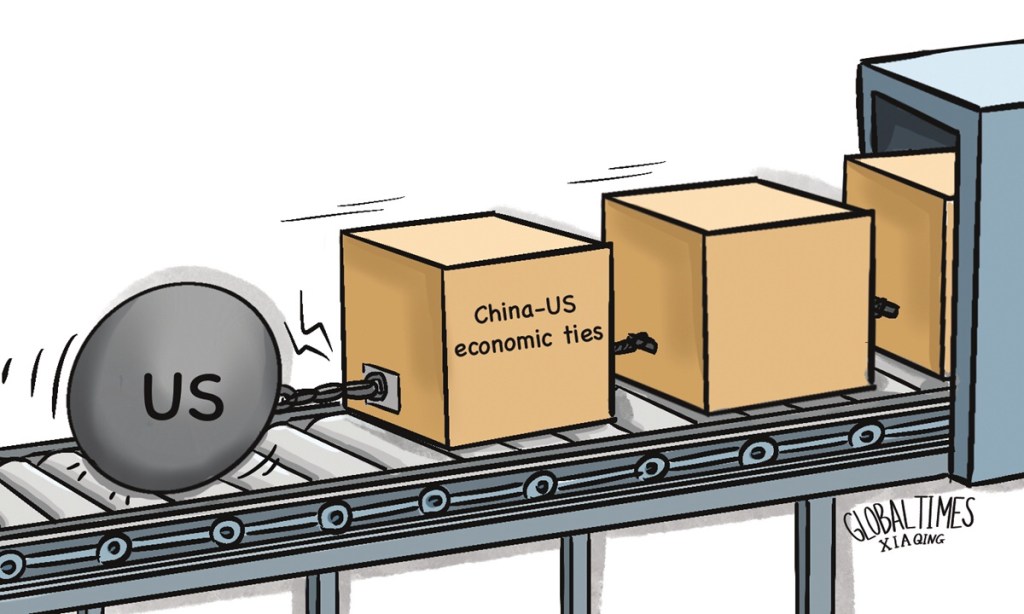
The US lacks sincerity to restore normal trade ties with China by Wang Yi Nov 24 2021
Although the US trade war and blame game against China has been proven to be a failure, it has not prevented US officials and the media from continuing to go further down this wrong path. Bloomberg on Tuesday again pointed fingers at China on trade issues, claiming China has slowed purchasing American goods in order to meet the US-China phase one trade deal.
When the deal was signed in January 2020, it was viewed as a ceasefire agreement to the arbitrary trade war the Trump Administration launched, but now it has been increasingly used as a weapon by the Biden administration to assault China.
As the two-year deadline for the phase-one trade deal between the world’s two largest economies approaches, the US Trade Representative Katherine Tai said earlier this month that the Biden administration intends to hold China accountable while exploring all weaknesses in China’s trade performance.
At the end of September, US Commerce Secretary Gina Raimondo also used the deal to push China to buy tens of billions of dollars of US-manufactured Boeing airplanes. Raimondo accused China of “not abiding by commitments to buy US goods” as part of the phase one trade deal.
However, the reality shows that despite the impact of COVID-19 on global trade and the economy, China has shown genuine sincerity in implementing the phase one trade agreement, and has done even more than the agreement required.
In terms of total trade volume, China’s imports from the US have risen sharply since the deal was signed. According to the latest data released by the General Administration of Customs of China, in the first 10 months of this year, China’s total imports from the US reached $145 billion, a year-on-year increase of 39 percent.
China’s massive purchase of American commodities has generated huge benefits for American farmers, energy producers and other exporters who have experienced the pandemic health crisis. The US Department of Agriculture said in its 2020 accomplishments that the China-US phase one trade deal led to a record pace of Chinese purchases, boosting agricultural commodity prices.
In addition to fulfilling its trade commitments and helping the US economy to recover quickly from the pandemic, China has shown sincerity in other areas. Recently, in response to the high domestic inflation in the US, the Biden government has asked China, the world’s largest oil importer and second largest oil consumer, to coordinate action with the US to tap into oil reserves to bring down elevated crude prices.
Compared with China’s good faith and concrete efforts to repair China-US trade relations, the US is the party which has failed to act in good faith. Shortly after the meeting between Chinese and American leaders, US trade officials and the media used the phase one trade agreement to again attack China.
Their rhetoric was nothing more than an attempt to find a bargaining chip to force China to make concessions on trade and other issues, but such an attempt was doomed to failure.
China’s economy has weathered the dual impact of the pandemic and US tariff war, outperforming other major economies. China’s economic resilience has completely been tested by the trade war. Nevertheless, the US economy is clearly in deep trouble.
The Biden administration already knows that high inflation in the US has a lot to do with its imposing punitive tariffs on Chinese imports. Instead of attacking China, what the US should do now is to take the long-overdue move to abolish the tariffs. This may be more positive for the US economy than releasing oil reserves.
The author is a reporter with the Global Times. bizopinion@globaltimes.com.cn
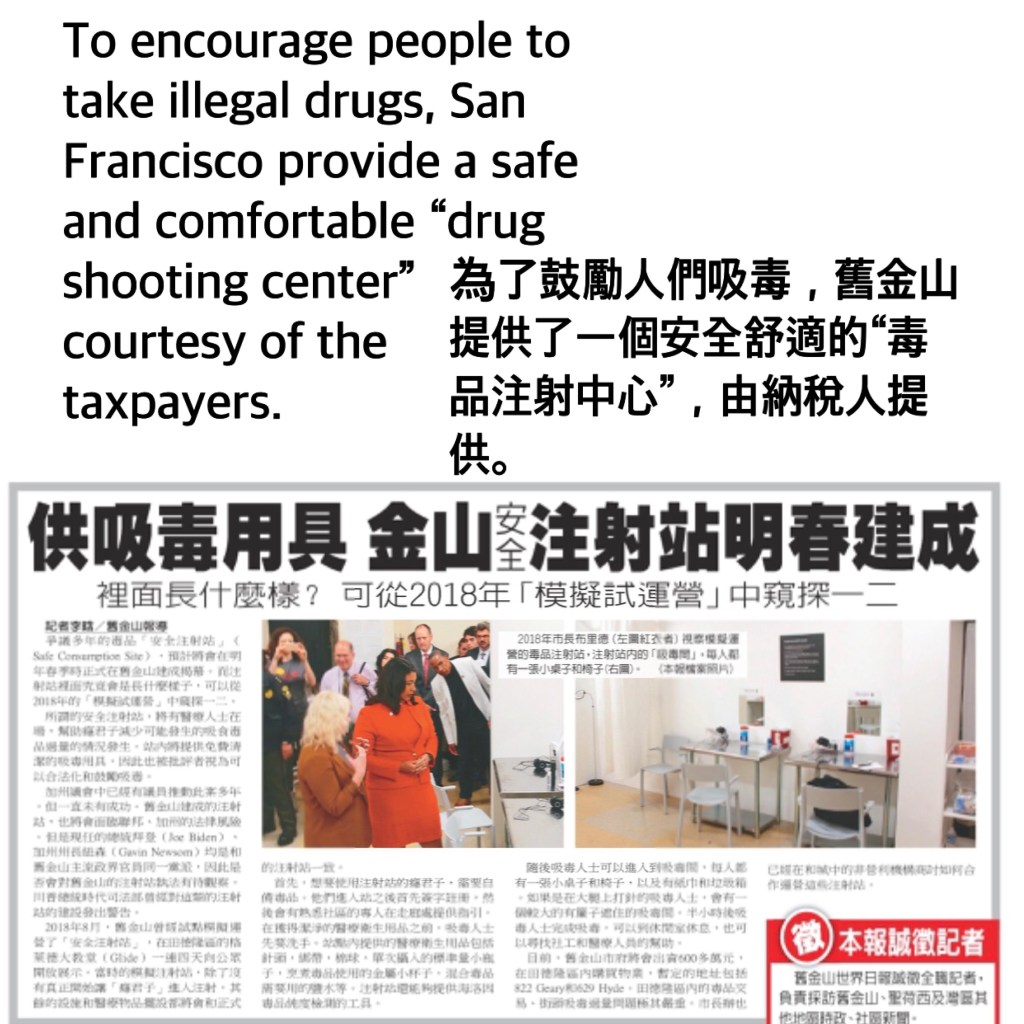
To encourage people to take illegal drug, San Francisco provide a safe and comfortable “drug shooting center” courtesy of the taxpayers. 為了鼓勵人們吸毒,舊金山提供了一個安全舒適的“毒品注射中心”,由納稅人提供。Still remembered the days US and UK force feed Chinese in China with Opium ! Today US & UK Governments help made their citizens drugs Addicts! Kama comes to hit them so hard!
Ethnic minorities suffer from tyranny of US electoral system by Global Times Nov 23 2021
A visitor attends the free public art exhibit Justice for George: Messages from the People at Phelps Field Park near George Floyd Memorial Square in Minneapolis, Minnesota, the US on Saturday.
“Tyranny” is a word that has always been used by US politicians to attack their so-called strategic competitors and countries with different ideologies. However, has Washington even realized that what it boasts as a “democratic electoral system” has long been plundering the legitimate rights of US ethnic minorities, forming a tyranny of the majority?
“It is almost a tyranny of the majority where the minority right to vote is being denied in many areas, in parts of the country,” United Nations Special Rapporteur on Minority Issues Fernand de Varennes said on Monday after his 15-day trip to the US. He also called for a “New Deal” in the US to overhaul legislation.
For a long time, ethnic minorities in the US have been threatened by discrimination, hate speech and hate crimes, and now even their basic rights cannot be guaranteed. Such tyranny toward ethnic minorities is the “original sin” of the US system.
In US history, to prevent ethnic minorities from voting, some states resorted to various tricks including setting up poll taxes and literacy tests in the 1890s. The US had been openly suppressing ethnic minorities’ right to vote until the 1965 Voting Rights Act prohibited states from using such methods to exclude minorities from voting, taking decades for the US ethnic minorities to obtain the right of “one person, one vote.”
“Although the US has made some adjustments, it has also used many cunning tricks to ensure white supremacy in US politics,” Li Haidong, a professor at the Institute of International Relations of the China Foreign Affairs University, told the Global Times.
After decades, US ethnic minorities are still suffering from such tyranny. For example, Texas in October lowered the number of districts where minorities comprise a majority, despite the growth of the non-white population.
De Varennes said on Monday that Texas would harm minorities by diluting their political power and would result in “gerrymandering.” The legitimate rights of US ethnic minority groups have become victims of the two US political parties’ conflicts of interests.
It is doubtful whether the US electoral system can still represent freedom and justice. This being the case, the status quo of ethnic minorities’ voting rights is even worse. “The US’ care for minorities is far from enough, whether socially or legally. For minorities, this is a type of plunder and tyranny,” Li said.
Although de Varennes called for a “New Deal,” it is still very hard for the US, which is struggling to deal with the COVID-19 epidemic and economic hardships, to have the motivation and ability to reform.
Even with corresponding measures, it is difficult to eliminate the discrimination against ethnic minorities under the US’ systemic racism.
Ethnic minorities in the US are experiencing a tyranny. Washington has elaborately woven the tag “melting pot,” but it has already been torn into pieces by issues including the COVID-19 epidemic, the Black Lives Matter movement and the election. An increasing number of Americans are using all kinds of rhetoric to whitewash the deep-rooted problem. But how long can it last to wrap a festering wound with a tattered cloth?
China has been strengthening and speeding up the training of pilots for carrier-borne fighter jets in recent years, as part of the country’s efforts to holistically build its aircraft carrier system.
Currently, the pilots for carrier-borne fighter jets in China are selected and cultivated among soldiers in active service and new recruits.
The Chinese navy started to select the pilot trainees directly from new recruits in 2020, gradually building a young and thriving team with excellent comprehensive abilities and a longer service life.
Flying a carrier-borne fighter jet is highly demanding, just as the saying goes ‘the aircraft carrier deck is the most dangerous 4.5-acre piece of land in the world’.
Pilots needs to make a nose dive at the speed of 200 km/h and land the jet precisely on a tiny area that is drifting with the tide on a runway of only 200 meters. To make a firm stop at the end of the runway, the pilot is required to hook the jet to the arresting cables on the carrier deck at the moment of landing.
Nine years ago, on Nov. 23, 2012, China’s first aircraft carrier, the Liaoning, had its first successful fighter jet takeoff and landing. The successful flight landing also marked the debut of the J-15 as China’s first-generation multi-purpose carrier-based fighter jet.
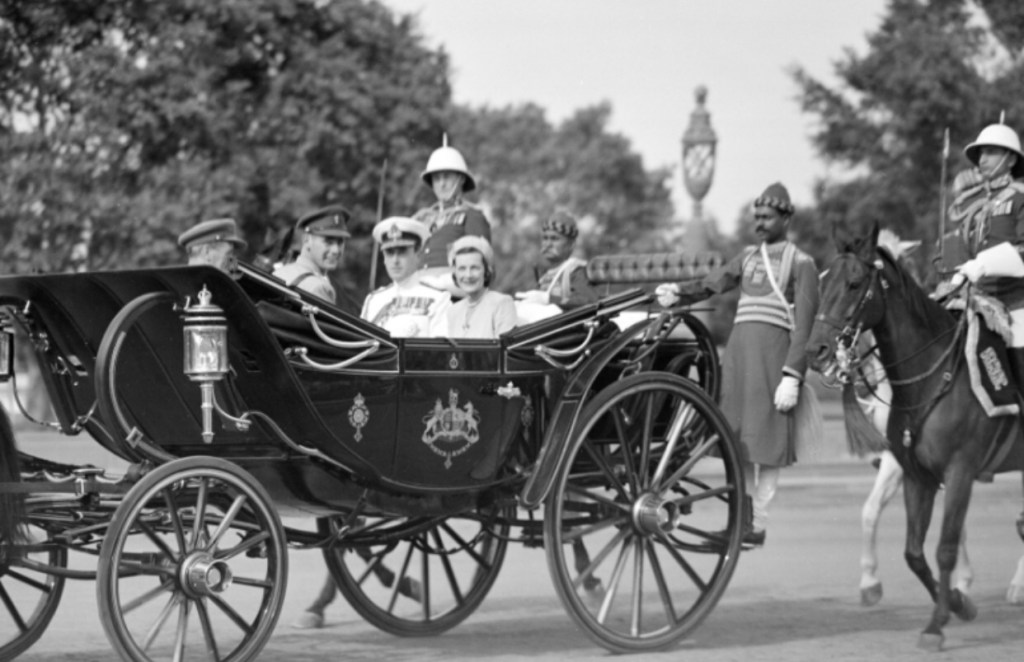
Interesting how victims and as a nation still love Britain! It echo those Western Moon lovers in HK! How Britain stole $45 trillion from India – And lied about it. by Jason Hickel, Academic at the University of London and Fellow of the Royal Society of Arts.
There is a story that is commonly told in Britain that the colonisation of India – as horrible as it may have been – was not of any major economic benefit to Britain itself. If anything, the administration of India was a cost to Britain. So the fact that the empire was sustained for so long – the story goes – was a gesture of Britain’s benevolence.
New research by the renowned economist Utsa Patnaik – just published by Columbia University Press – deals a crushing blow to this narrative. Drawing on nearly two centuries of detailed data on tax and trade, Patnaik calculated that Britain drained a total of nearly $45 trillion from India during the period 1765 to 1938.
It’s a staggering sum. For perspective, $45 trillion is 17 times more than the total annual gross domestic product of the United Kingdom today.
How did this come about?
It happened through the trade system. Prior to the colonial period, Britain bought goods like textiles and rice from Indian producers and paid for them in the normal way – mostly with silver – as they did with any other country. But something changed in 1765, shortly after the East India Company took control of the subcontinent and established a monopoly over Indian trade.
Here’s how it worked. The East India Company began collecting taxes in India, and then cleverly used a portion of those revenues (about a third) to fund the purchase of Indian goods for British use. In other words, instead of paying for Indian goods out of their own pocket, British traders acquired them for free, “buying” from peasants and weavers using money that had just been taken from them.
It was a scam – theft on a grand scale. Yet most Indians were unaware of what was going on because the agent who collected the taxes was not the same as the one who showed up to buy their goods. Had it been the same person, they surely would have smelled a rat.
Some of the stolen goods were consumed in Britain, and the rest were re-exported elsewhere. The re-export system allowed Britain to finance a flow of imports from Europe, including strategic materials like iron, tar and timber, which were essential to Britain’s industrialisation. Indeed, the Industrial Revolution depended in large part on this systematic theft from India.
On top of this, the British were able to sell the stolen goods to other countries for much more than they “bought” them for in the first place, pocketing not only 100 percent of the original value of the goods but also the markup.
After the British Raj took over in 1858, colonisers added a special new twist to the tax-and-buy system. As the East India Company’s monopoly broke down, Indian producers were allowed to export their goods directly to other countries. But Britain made sure that the payments for those goods nonetheless ended up in London.
How did this work? Basically, anyone who wanted to buy goods from India would do so using special Council Bills – a unique paper currency issued only by the British Crown. And the only way to get those bills was to buy them from London with gold or silver. So traders would pay London in gold to get the bills, and then use the bills to pay Indian producers. When Indians cashed the bills in at the local colonial office, they were “paid” in rupees out of tax revenues – money that had just been collected from them. So, once again, they were not in fact paid at all; they were defrauded.
Meanwhile, London ended up with all of the gold and silver that should have gone directly to the Indians in exchange for their exports.
This corrupt system meant that even while India was running an impressive trade surplus with the rest of the world – a surplus that lasted for three decades in the early 20th century – it showed up as a deficit in the national accounts because the real income from India’s exports was appropriated in its entirety by Britain.
Some point to this fictional “deficit” as evidence that India was a liability to Britain. But exactly the opposite is true. Britain intercepted enormous quantities of income that rightly belonged to Indian producers. India was the goose that laid the golden egg. Meanwhile, the “deficit” meant that India had no option but to borrow from Britain to finance its imports. So the entire Indian population was forced into completely unnecessary debt to their colonial overlords, further cementing British control.
Britain used the windfall from this fraudulent system to fuel the engines of imperial violence – funding the invasion of China in the 1840s and the suppression of the Indian Rebellion in 1857. And this was on top of what the Crown took directly from Indian taxpayers to pay for its wars. As Patnaik points out, “the cost of all Britain’s wars of conquest outside Indian borders were charged always wholly or mainly to Indian revenues.”
And that’s not all. Britain used this flow of tribute from India to finance the expansion of capitalism in Europe and regions of European settlement, like Canada and Australia. So not only the industrialisation of Britain but also the industrialisation of much of the Western world was facilitated by extraction from the colonies.
Patnaik identifies four distinct economic periods in colonial India from 1765 to 1938, calculates the extraction for each, and then compounds at a modest rate of interest (about 5 percent, which is lower than the market rate) from the middle of each period to the present. Adding it all up, she finds that the total drain amounts to $44.6 trillion. This figure is conservative, she says, and does not include the debts that Britain imposed on India during the Raj.
These are eye-watering sums. But the true costs of this drain cannot be calculated. If India had been able to invest its own tax revenues and foreign exchange earnings in development – as Japan did – there’s no telling how history might have turned out differently. India could very well have become an economic powerhouse. Centuries of poverty and suffering could have been prevented.
All of this is a sobering antidote to the rosy narrative promoted by certain powerful voices in Britain. The conservative historian Niall Ferguson has claimed that British rule helped “develop” India. While he was prime minister, David Cameron asserted that British rule was a net help to India.
This narrative has found considerable traction in the popular imagination: according to a 2014 YouGov poll, 50 percent of people in Britain believe that colonialism was beneficial to the colonies.
Yet during the entire 200-year history of British rule in India, there was almost no increase in per capita income. In fact, during the last half of the 19th century – the heyday of British intervention – income in India collapsed by half. The average life expectancy of Indians dropped by a fifth from 1870 to 1920. Tens of millions died needlessly of policy-induced famine.
Britain didn’t develop India. Quite the contrary – as Patnaik’s work makes clear – India developed Britain.
What does this require of Britain today? An apology? Absolutely. Reparations? Perhaps – although there is not enough money in all of Britain to cover the sums that Patnaik identifies. In the meantime, we can start by setting the story straight. We need to recognise that Britain retained control of India not out of benevolence but for the sake of plunder and that Britain’s industrial rise didn’t emerge sui generis from the steam engine and strong institutions, as our schoolbooks would have it, but depended on violent theft from other lands and other peoples.
Editor’s note: A previous version of this article erroneously had the beginning of the British Raj as 1847. The correct year is 1858.
Jason Hickel Academic at the University of London and Fellow of the Royal Society of Arts. Dr Jason Hickel is an academic at the University of London and a Fellow of the Royal Society of Arts. His most recent book is “The Divide: A Brief Guide to Global Inequality and its Solutions,” published by Penguin in May 2017.




 Johnson Choi Biz