There was a grimly funny moment of cringe! In their sham tribunal they can’t even back-up their own numbers. When asked about the claim of millions of people in the camps, she admits she can only explain “5,567 people in total” Turns out the so call “witnesses” for the farcical “tribunal” were paid–royally, 43,000 UK pounds = US$58,000. 事實證明,鬧劇“法庭”的所謂“證人”是有報酬的. 收買費用是每人43,000 英鎊 = 58,000 美元 https://uyghurtribunal.com/submissions/
5 legislative bodies (US, UK, Canada, Netherlands, Lithuania) have passed legislation condemning genocide, although, curiously enough, all the legislation is symbolic & toothless–an odd thing to do if a real genocide were happening–and in the case of the UK & Canada, vetoed by their own governments.
There is no genocide in the history of the term where: 1) The population of Xinjiang has grown in leaps and bounds–25% from 2010-2018 alone 2) The infant mortality rate has dropped; and where the group was exempted from population control –Uighurs were allowed 2-3 children (and often more) 3) The wealth and economic status of the population has grown by multiples 4) There is a total absence of propaganda against the group–in fact any language criticizing muslims is banned in China, despite massive terror attacks. 5) There is a total absence of refugees etc.
Maria Ressa – awarded the Nobel Peace Prize – is promoted by the Western media as a heroic, brave, independent journalist standing up to the government of the Philippines and its president, Rodrigo Duterte.
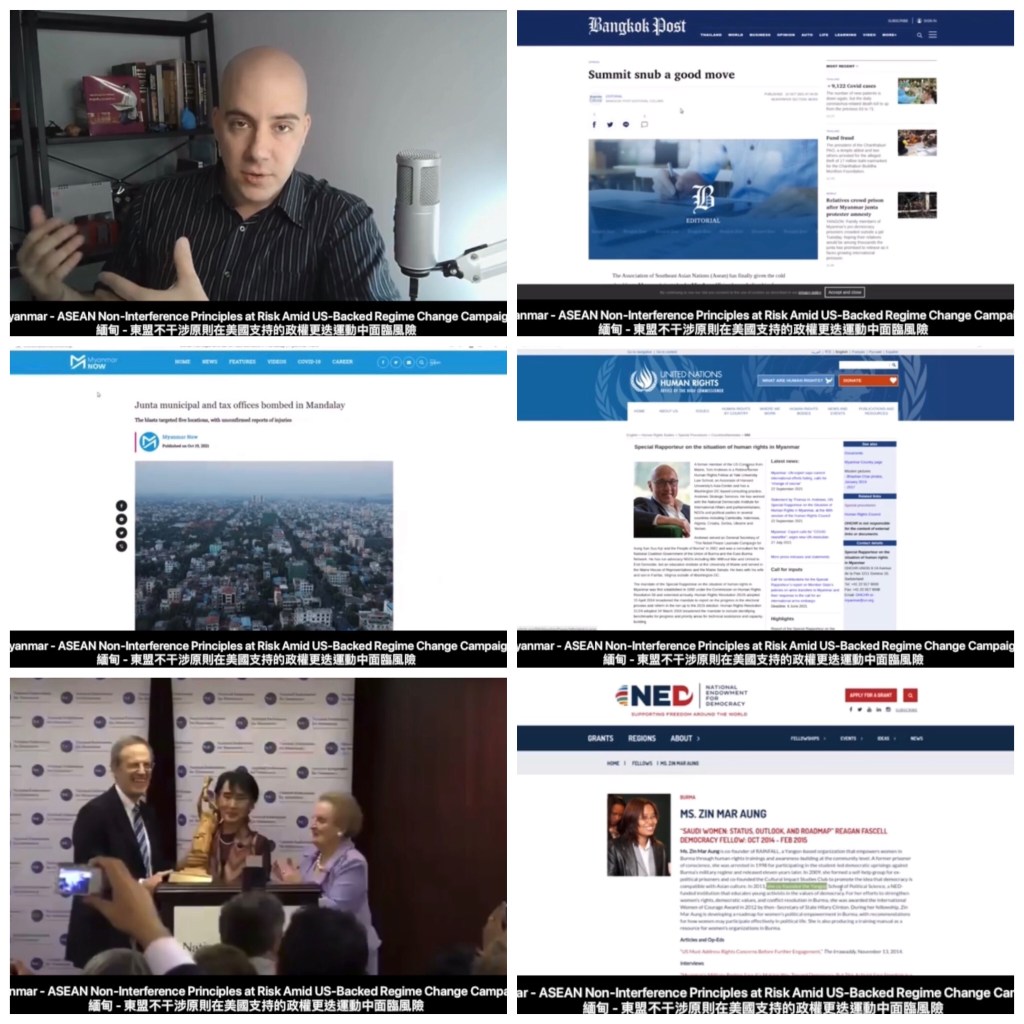
What is left buried in articles about Maria Ressa is that she’s actually a US citizen funded by the US through the National Endowment for Democracy and her media platform – Rappler – is a purveyor of anti-China rhetoric serving US interests at the cost of the Philippines’ own best interests.
The irony of Ressa winning a “peace prize” is Rappler’s propaganda aims at stirring up conflict – not avoiding it.
Maria Ressa is also linked to the Naval Postgraduate School’s information warfare division, CORE Lab.
Maria taught courses in politics and the press for her alma mater, Princeton University, and in broadcast principles at the University of the Philippines. Her latest book, From Bin Laden to Facebook, was part of her work as author-in-residence and senior fellow at the International Centre for Political Violence & Terrorism Research in Singapore. She is also the Southeast Asia Visiting Scholar at CORE Lab at the Naval Postgraduate School in Monterey, CA.
Canadians see through troublesome racist anti-China propaganda by Robert Walker Oct 10 2021
This past June, a survey by the Angus Reid Institute found that more than half of Asian Canadians had personally experienced anti-Asian racism in the past year.
And while anti-Asian racism has been criticized by some Canadian politicians and influencers, it turns out that when it comes to combatting anti-Asian racism, there is often much less appetite to do much about it.
Recently, Canadian Senator Yuen Pau Woo shared on social media a column in the Toronto Star newspaper, which paraphrased Chas Freeman, a retired US diplomat, in saying that, “the United States, assisted by Canada, took (Huawei CFO) Meng (Wanzhou) hostage in the first place as part of its trade-and-technology war with China.”
Such a statement, while perhaps uncomfortable for many Canadians to acknowledge the Meng Wanzhou arrest as being purely political in nature, is certainly a reasonable view to hold.
In fact, no less than former Canadian foreign minister and deputy prime minister John Manley argued that the Meng case was clearly one of a political nature.
Donald Trump’s comments at the time of Meng’s arrest had, “given Ms. Meng’s lawyers quite a good reason to go the court and say ‘This is not an extradition matter. This is actually leverage in a trade dispute and it’s got nothing to do with Canada,'” Manley remarked shortly after Meng’s arrest.
But when Senator Woo pointed out the same truth, by sharing the article from the Toronto Star on Twitter, he faced a barrage of anti-Asian racism as a result.
Multiple respondents suggested that Senator Woo must be a Chinese spy.
“Where does their allegiance lie?”, one respondent asked rhetorically. Another asked “Where do your loyalties lie, Senator?”
And scandalously, Chris Alexander, a former diplomat in the Stephen Harper government, posted on Twitter that “mouthpieces for foreign propaganda” like Woo should resign from the Senate.
While the political motivations of Meng Wanzhou’s arrest – driven by the US agenda to combat China’s ascendant technology industry – are abundantly clear, what is particularly egregious was not only the denial of this verifiable fact, but the knee-jerk anti-Asian racism that inevitably followed when Senator Woo dared to point out the uncomfortable truth.
Unfortunately, this recent string of racism on social media was not the first time Senator Woo faced anti-Asian racism for speaking out in a nuanced way about China.
This past June, Senator Leo Housakos introduced a motion which sought to condemn China for the alleged discrimination against the Uyghurs in Xinjiang. Fortunately, and despite widespread anti-China misinformation in the news media on the topic, Leo’s motion was defeated with 33 Senators opposing the measure, with 29 voting in favor.
While there was some criticism voiced by anti-China activists against the 33 Senators who voted down the motion, according to a recent report by Global News, it was only Senator Woo who faced hateful rhetoric and racist messaging.
“While they all faced criticisms from some quarters, only one – Sen. Yuen Pau Woo, leader of the Independent Senators Group – seems to have been singled out as an alleged stooge… told to resign and ‘go home,'” according to the Global News report.
The attacks on Senator Woo are significant for more reasons than just about the anti-Asian racism, troubling as those incidents were. In fact, what the voices of condemnation against Senator Woo, namely from Chris Alexander, are based on the illogical premise that one cannot be a proud Canadian and yet be opposed to steps which would cause a rift in relations between Canada and China. Indeed, it should be clear that, regardless of one’s ethnic origins, the spread of anti-China propaganda serves no productive purpose.
Fortunately, while the voices of online trolls – even those with influential platforms – may be troublesome, the facts remain that Canada and China could be moving closer together, regardless of those who would seek to disrupt the trend.
According to a recent Op-Ed in the Business In Vancouver news journal by China’s ambassador to Canada, Cong Peiwu, trade between China and Canada grew by 19.9 percent from early 2020 to early 2021. Canada’s imports from China, and its exports to China, had both grown by double digits in just one year.
As Ambassador Cong wrote, “I believe mutual respect at every level will ensure mutual benefit and win-win outcomes.” Indeed, despite the voices trying to disrupt a closer relationship between China and Canada, it seems that the majority of Canadians see the benefit in a closer relationship, and the harm that anti-China propaganda serves to Canadians.
The author is an expert in international branding strategy, with a particular area of interest in China’s image in the Western world. He holds a Bachelor of Journalism degree. opinion@globaltimes.com.cn
Time to call the US out for making Chinese nationals targets of prosecution by Gal Luft Oct 11 2021
Now that Huawei’s CFO Meng Wanzhou has returned to China after reaching a deal with the US Justice Department, it is time to reflect about her possible “successors”, not in Huawei’s boardroom but on the list of targets of America’s long arm jurisdiction.
Just days before the US Department of Justice (DOJ) dropped Meng’s extradition request allowing her departure from Vancouver, FBI Director Christopher Wray reportedly told a Senate Homeland Security Committee hearing on threats to the US that the bureau opens new probes into China “every 12 hours”.
The US has bilateral extradition treaties with about 120 countries. Those treaties allow for the extradition for traditional crimes like fraud, hacking, and money laundering but not for crimes of a political nature, like failure to register as a foreign agent, espionage, or in Meng’s case, violations of US sanctions.
The DOJ’s China Initiative established in 2018 by the Trump administration has given the FBI and US prosecutors special incentives to pursue cases related to China. To clear the extradition threshold, US authorities often mask political crimes as ordinary by withholding from courts relevant information pertaining to the political context of the case.
In Meng’s case, the official charge was bank fraud even though the motivation for the prosecution was political and aimed at sabotaging Huawei’s global 5G leadership position.
Had Meng been extradited and faced trial, her fate would have been decided by a jury of 12 from New York who were expected to be impartial. But it is hard to see how, with growing anti-China sentiment in America, such an impartial jury could even be found.
This means that in the era of US-China rivalry every legal case involving China brought before a US court, let alone a high-profile case like Meng’s, could be easily turned into a political circus. This is not to say that Chinese citizens should be immune from US legal actions but that countries receiving extradition requests must apply new standards of scrutiny when reviewing extradition cases involving China and the US.
The targeting of foreign citizens by the US government is not always done within the framework of the law.
Recently, an investigative report posted by Yahoo News revealed troubling information about how the CIA planned to kill or kidnap Wikileaks founder Julian Assange whose organization exposed US war crimes in Iraq and Afghanistan as well as other embarrassing details about the workings of the US intelligence community. When the plan was rejected, Assange was charged with hacking into US military databases, an extraditable crime under the US-UK extradition treaty. In January, Assange’s extradition was blocked by the British judge but the US government appealed the decision. His case could drag on for years and he might linger in prison.
Time and again the US government has sought to extradite and imprison foreign nationals for political reasons, weaponizing its legal system to advance its geopolitical agenda. Under some extradition agreements the US does not have to provide detailed evidence against the accused. In other words, the court does not need to be sure that the individual could be convicted at the end of a trial.
National courts in such countries must therefore be extra scrupulous and demand a more substantial body of evidence against defendants, especially when it comes to Chinese nationals before they rule in favor of extradition.
They should also consider that as the US-China rivalry intensifies it will become impossible for defendants to enjoy fair treatment in jury trials. The international community should call upon the Biden administration to shut down the China Initiative. China is the only country in the entire global justice system to be singled out as a target of prosecution and the prosecutorial zeal of DOJ attorneys has already ruined many innocent lives. A country that touts the rule of law and the rules-based international order should be called out for using its legal system as a political tool in a mean manner.
The author is professor at Ostim Technical University and co-director of the Institute for the Analysis of Global Security. bizopinion@globaltimes.com.cn
AI contest hype will only create barrier to industry cooperation by Ma Jihua 04:53 Oct 11 2021
The Pentagon’s former chief software officer Nicolas Chaillan said that the US has already lost artificial intelligence (AI) competition to China. In an interview with the Financial Times shortly after his resignation, Chaillan said there was “good reason to be angry,” because “the US has no competing fighting chance against China in 15 to 20 years.”
The first chief software officer for the US Air Force, who spent three years on a Pentagon-wide effort to boost cyber security, told American media that he plans to testify to the US Congress about the Chinese cyber threat to US supremacy.
There is no doubt that the US takes a leading position in the AI field, where China is catching up rapidly. The advantages of the US can be reflected in some high-end and core innovations of AI. China has achieved an advanced position in applications such as speech recognition. The number of patents in China, the scale of investment and the growth of the industry, are also growing at a speed exceeding many people’s expectations.
As for whether China has surpassed the US in AI, it is believed that the international scientific communities should be able to offer an objective conclusion after doing their evaluation. However, it should be pointed out that although China is ratcheting up investment on AI and other technologies, its purpose is not to surpass any specific country.
No matter how accurate the ex-Pentagon software chief’s assessment is, overly hyping an “AI contest” will only add up barriers between the two countries’ technological cooperation. Taking such a view full of pathologically competitive mentality is also likely to intensify US’ hostility against China, and may push more US tech companies to abandon mutually beneficial cooperation with Chinese companies.
The rapid development of a country’s science and technology is inseparable from open cooperation and exchanges with global partners, but the US has not been able to rationally view the rise of China’s science and technology levels. The US government has long been doing its utmost to stifle Chinese technology companies and contain China’s technological development.
For instance, the previous Trump administration launched a relentless attack against Chinese 5G giant Huawei. Washington imposed a strict sales ban on Huawei, while lobbying its allies to exclude Huawei from their 5G construction plans. The Biden administration has kept on such suppression. The Wall Street Journal blatantly claimed in an article on Monday that “Washington’s campaign has used some of the most destructive tools in its arsenal, and they have succeeded.”
On the technology front, Biden has intensified the contest, namely by blocking the US from sharing leading technology with Chinese companies. The Biden administration in March reportedly amended licensing arrangements for companies to sell to Huawei, further restricting companies from supplying items that can be used to produce Huawei’s 5G devices. The White House’s chip summit in April with many multinational companies excluded all key players from the Chinese mainland.
Instead of strangling China’s technology development, the US’ decoupling approach has disrupted the global research and development of science and technology, while slowing down the pace of technological progress in the US too. The reasons for the current global chip supply shortage are complex, but one of the most important artificial factors is the so-called decoupling measures taken by the US.
When asked about economic “decoupling” from China, Biden’s trade representative Katherine Tai last week said it was not realistic for the world’s two largest economies to stop trading with each other. Tai said the US is looking for a kind of “recoupling.” It is hoped that the US can readjust its science and technology policy, and engage in conscientious competition and cooperation with China, instead of continuing to harm others and disadvantage itself.
The author is a veteran telecommunications industry analyst. bizopinion@globaltimes.com.cn
Abbott an ‘Australian Pompeo’ used by Taiwan secessionists by Lin Lan Oct 10 2021
Former Australian prime minister Tony Abbott, also regarded by some Chinese analysts as the “Australian version of Mike Pompeo,” has acted as a “vanguard” of the US, pathetically becoming Washington’s cannon fodder and a tool taken advantage of by Taiwan secessionists. Abbott made a series of clownish attacks against the Chinese mainland during his visit to the island of Taiwan, which was harshly criticized by the Chinese embassy in Australia.
“Tony Abbott is a failed and pitiful politician. His recent despicable and insane performance in Taiwan fully exposed his hideous anti-China features. This will only further discredit him,” said the spokesperson of the Chinese embassy in Australia on Saturday.
Abbott arrived in Taiwan on Tuesday. During his visit, he wantonly criticized China’s “belligerence” and “crackdown” in Hong Kong and Northwest China’s Xinjiang Uygur Autonomous Region. Abbott sensationally raised fears that Beijing “could lash out disastrously very soon” against Taiwan, accusing the Chinese mainland of being a “bully” and expressing his support for Taiwan secessionists. Trying to instigate Washington, he also said he did not believe the US “could stand by” and watch Taiwan be “swallowed up” by the Chinese mainland.
“Abbott is like an Australian version of Mike Pompeo. His words are one of the most ferocious and outrageous attacks against Beijing by Australian politicians since the establishment of China-Australia diplomatic relations. Abbott is a representative of the extreme right, trying to interfere in China’s political system and other internal affairs. But now, his scheme has obviously failed,” Chen Hong, a professor and director of the Australian Studies Centre, East China Normal University, told the Global Times.
Abbott’s all-out attack against the Chinese mainland was not extensively echoed inside Australia. For example, The Sydney Morning Herald commented on Friday that “Abbott’s comments will put the Morrison government in a difficult position.” In recent years, Canberra has brought a lot of damage to China-Australia relations. As the two countries’ ties have already reached a low point, Abbott was adding fuel to the flames. It will be Australia itself that suffers eventually.
Besides, a few proactive speeches against Beijing will never help the island of Taiwan end its “international isolation” as Abbott claimed. Nor will they bring any actual support to Taiwan secessionists. Just the opposite, Abbott’s visit shows that Taiwan secessionists have almost come to the end of their rope. To a large extent, they can only take advantage of such former politicians who cannot represent mainstream political strategy in their own countries.
Although Abbott clamored that he did not believe the US “could stand by” on the Taiwan question, he cannot change the fact that extreme Australian anti-China forces are in an awkward dilemma. They have closely followed Washington’s suit to oppose Beijing, but Washington may never fulfill their wish at the expense of a complete breakdown of China-US relations.
This year marks the 110th anniversary of the 1911 Revolution, whose historical mission was to end the thousands-years-long absolute monarchy, establish a republic and realize the great rejuvenation of the Chinese nation. The Kuomintang reactionaries were eventually given up by people, defeated in the Chinese mainland and retreated to Taiwan. But today, Taiwan’s ruling interest groups have abandoned the primal purpose of the revolution, turning to external forces to confront the mainland.
It is pitiful and ridiculous that former Australian prime minister has become an anti-China vanguard used by Taiwan secessionists. One after another, Taiwan has lost its “allies,” which shows that China’s complete reunification is an unstoppable trend. Extreme politicians like Abbott and their positions will be eventually abandoned by history.
Beijing finds coronavirus in imported pork, fruits by Global Times Oct 10 2021
Staff at a center for disease control and prevention in Qinhuangdao, North China’s Hebei Province, take cold-chain samples at a pharmaceutical warehouse. COVID-19 has been found on the packaging of a growing number of cold-chain products.
Beijing has reported a weak-positive coronavirus testing result in mixed samples of imported pork and fruits at a store in the city’s Xicheng district, local health authorities said on Sunday. Emergency response was immediately launched, finding all related personnel and environment samples returning negative COVID-19 results.
The samples include a piece of pork, longan, dragon fruit, navel orange and kiwi fruit, which are all imported from overseas, according to the latest notice of Xicheng district health authority.
The district immediately launched emergency response, and carried out laboratory review, epidemiological investigation, sampling and testing of relevant items and the environment, personnel control and environmental disinfection.
Multiple batches of fruit and meat samples have since been collected, as well as samples from the store’s environment and related personnel, all of which returned negative test results.
The pork products in question, which have not been sold so far, have been taken off the shelves, and the store is temporarily closed, the notice said.
Experts believe that the risk of spreading the epidemic through the products is relatively low.
Meanwhile, the Xicheng disease prevention and control center has urged all residents who bought the fruits in question to report to their communities as soon as possible.
Exclusive: DPP bribes Somaliland politicians for a long time in exchange for political support: source by Fan Lingzhi Oct 10 2021
The Democratic Progressive Party (DPP), the ruling party on the island of Taiwan, has been bribing some Somaliland politicians and families for a long time in exchange for support to sell “Taiwan secessionism” advocacy on international platforms, a source told the Global Times.
According to the source, huge bribes were conveyed via so-called representative offices on each side. And Taiwan island is tunneling profits to certain Somaliland personnel via cooperative projects such as the digitalization plan of the Somaliland government and a Somaliland innovation park project, the source said.
Somaliland is located in the northwest of the Federal Republic of Somalia and is one of the autonomous regions of the country. In 1969, Mohamed Siad Barre launched military coup and established the Somali Democratic Republic. In January 1991, the Barre administration was overthrown and the place fell into civil war. Four months later, Northern Somali announced “independence” and “the Republic of Somaliland” was established, but it has not been recognized any member of the Union Nations.
The DPP set up a so-called representative office in Somaliland in August 2020. In response, Chinese Foreign Ministry spokesperson Zhao Lijian stressed at a routine press conference on August 18, 2020 that there is only one China in the world and Taiwan is an inalienable part of China.
The one-China principle is a universally recognized norm governing international relations and the consensus of the international community. China firmly opposes the establishment of official institutions or any form of official exchanges between Taiwan and Somaliland, Zhao said.
“The DPP’s frantic search for support for its separatist activities in the international arena will never succeed,” Zhao noted.
In fact, it is an old trick of the DPP to bribe and make up lies in the international community. The American Prospect reported previously that the Taipei Economic and Cultural Representative Office (TECRO) in the US provides funds to five US think tanks – the Brookings Institution, the Center for American Progress, the Center for a New American Security, the Center for Strategic and International Studies, and the Hudson Institute – every year. In 2019, TECRO provided between $250,000 and $499,999 to Brookings, the report said.
But none of their researchers disclose the potential conflict of interest between Taiwan funding and advocating for more security guarantees for and trade with Taiwan, The American Prospect said.
“What the source disclosed this time proved the DPP’s dirty tricks again. The DPP would do anything to seek independence, there is no bottom line in their behavior and speeches,” a related expert told the Global Times on condition of anonymity.
For a long time, the DPP has been bribing and drawing over international think tanks under the guise of academic exchanges to help them spread groundless “Taiwan secessionism” speeches and deceive the international community, the expert said, calling on the international community and Taiwan residents to reject the DPP’s secessionist plot and insist on the one-China principle.
“Bribing and lies will not save the DPP from a destined failure, but will only harm the interests of the 23 million residents on the island and their dignity as Chinese in the international community,” the expert said.