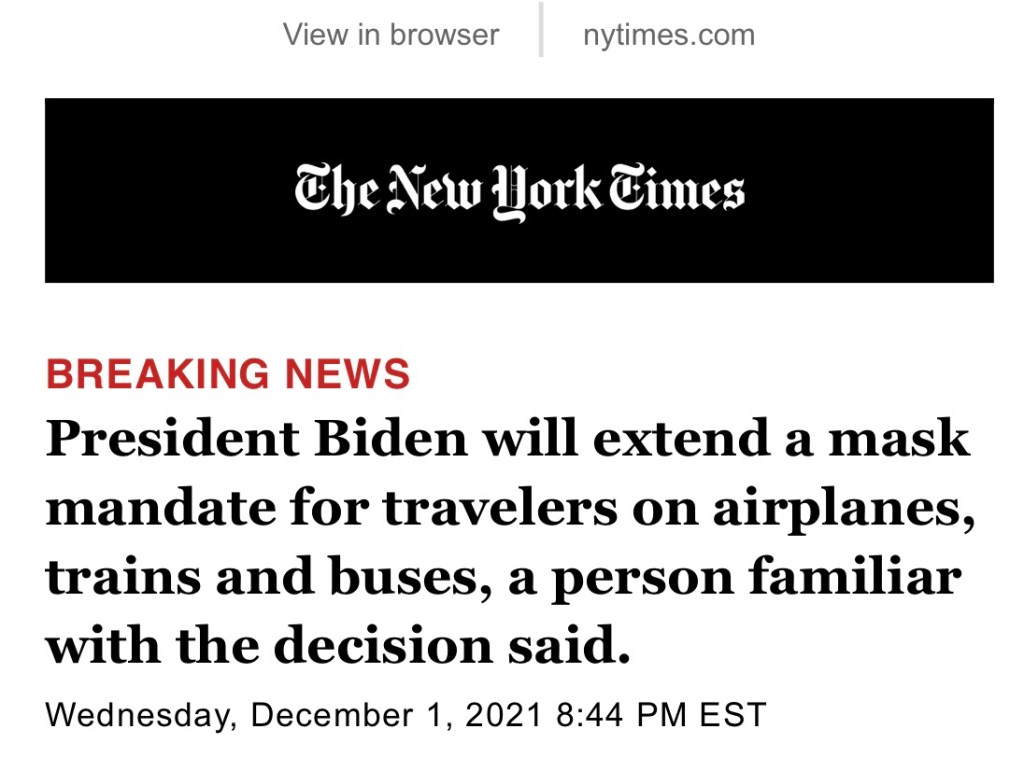
Who is going to enforce this mandates? So many Asians got beaten up on Mass Transits, bus and train for wearing masks.
Who is going to enforce this mandates? So many Asians got beaten up on Mass Transits, bus and train for wearing masks.
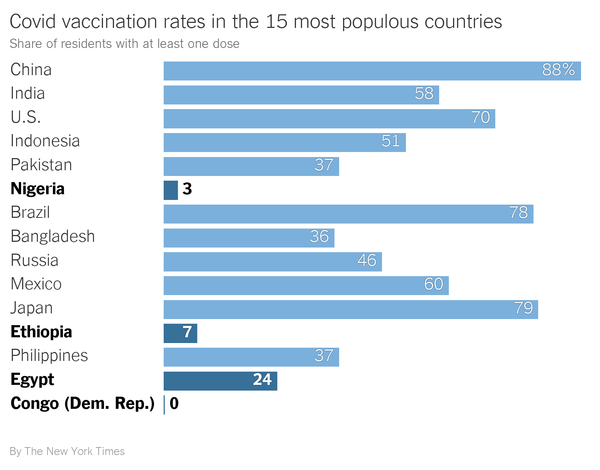
New York Times – vaccination rates in selected countries – China in the lead.
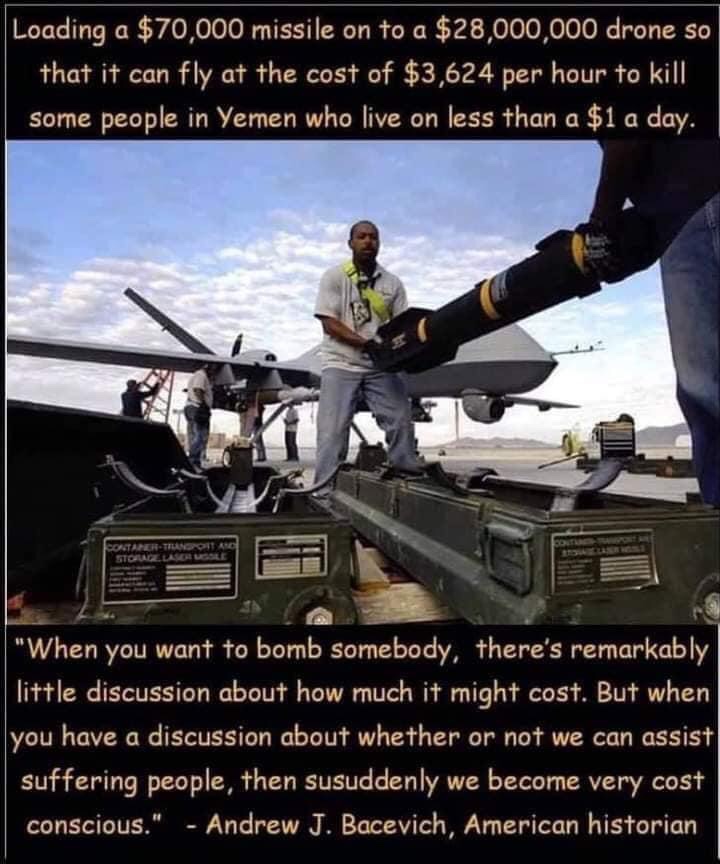
It is rather strange when we ask the jokers, the American politicians we voted in office to provide health and welfare for our people, they always said no money!
But when they send weapons of mass destruction to kill people overseas costing 10s of millions at US taxpayers expenses, they never said no money or asked for our approval. Are US politicians mercenary-for-hire by our Fortune 500 companies? 真的是天太笑話!我们投票選出的美國政客每次人民要求提供健康,教育和福利包括對抗新冠病毒時,他們總是說沒有錢! 但是,當他們用大規模殺傷性武器殺死海外地區人民時是要花費美國納稅人的錢而且數字巨大數以千萬計時,我们選出來的政客從來沒有說没有錢,也沒有要求美國納税人批准。 美國政客是否像僱傭兵是替《財富》 500強公司工作呢?
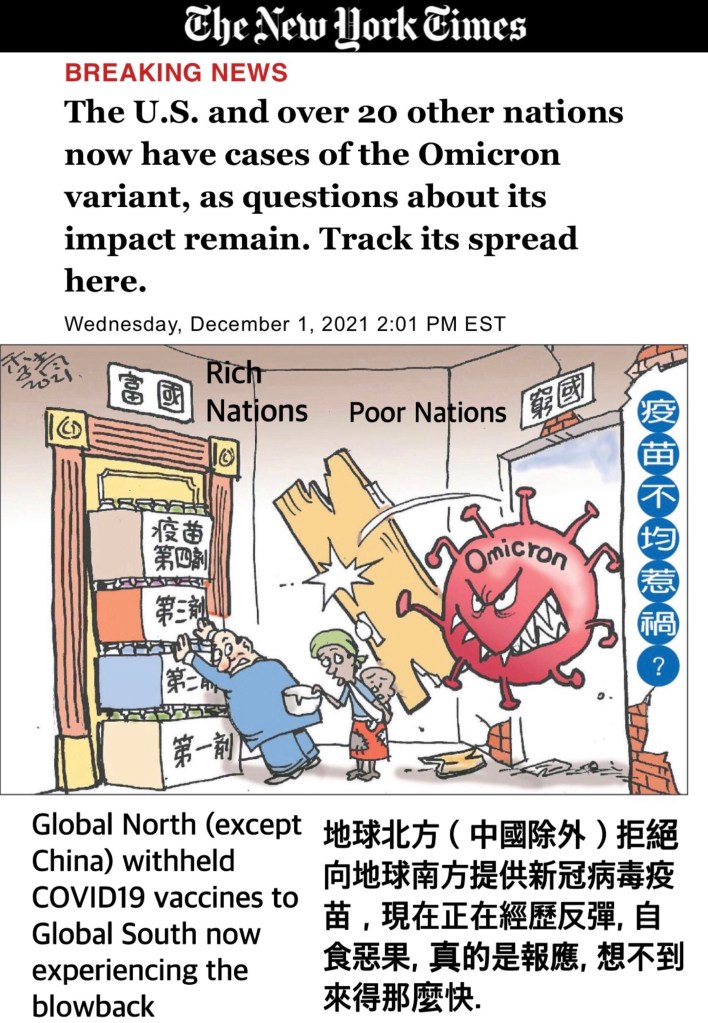
A blow back due to our ignorance refused to help Global South, now come back to haunt us big time. Who could expect Kama coming back so fast like a high speed train.
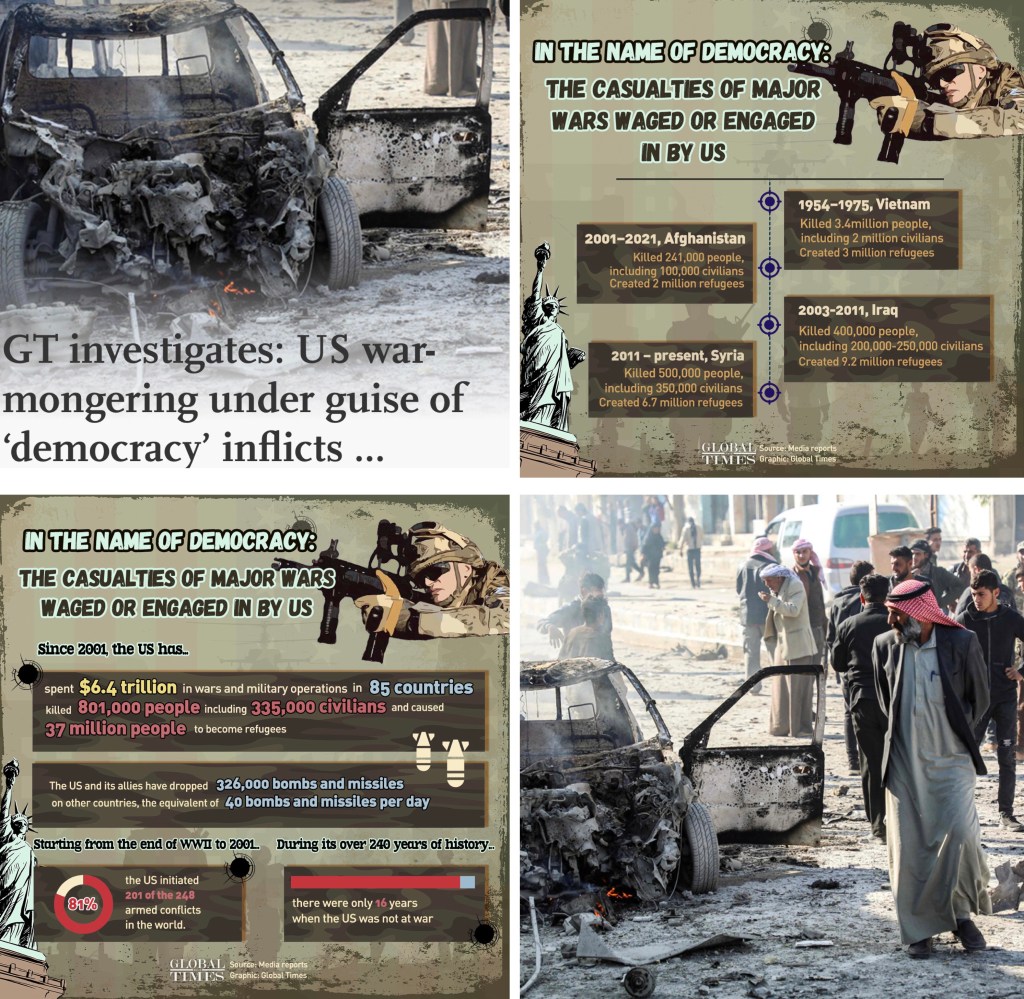
Video: The truth behind US’s Freedom Democracy & Human Rights – GT investigates: US war-mongering under guise of ‘democracy’ inflicts untold damage on the world. 美國自由民主與人權背後的真相 – GT 調查:美國打著“民主”幌子的戰爭販子給世界造成了無法估量的傷害.
https://vimeo.com/652097016
https://youtu.be/inmWPaZqVK8
https://www.facebook.com/100036400039778/posts/613581289865200/?d=n
Editor’s Note:
How many evils have been committed in the name of democracy?
Exporting wars, launching “color revolutions,” fomenting extremist ideologies, and promoting economic instability…the US has left countless trails of bloodshed and turmoil around the world. While the “model of democracy” lose its shine, the US still attempts to establish exclusive cliques through the so-called democracy summit. To expose the nature of “American democracy,” the Global Times is publishing a series of stories to unveil the US’ four democratic hegemony sins. This is the first piece.
“War is the American way of life,” said US historian Paul Atwood, noting that the US was born, grew, and became a superpower out of war, slavery, and human slaughter.
In its more than 240-year-long history since declaring independence on July 4, 1776, there have only been 16 years in which the US was not at war. From the end of World War II (WWII) to 2001, the US has initiated 201 of the 248 armed conflicts in 153 locations, accounting for over 80 percent of total wars fought. Since 2001, wars and military operations by the US have claimed more than 800,000 lives and displaced tens of millions of people.
Experts and observers reached by the Global Times said that the US, ignoring the objective reality of its own shambolic democratic record, instead attempts to use “democracy” as a pretext to wage war and as a cover for its numerous crimes such as causing humanitarian disasters and destroying sovereign order, is the real culprit threatening the world.
The US’ obsession with exporting war will leave the US with an indelible shame, experts noted.
Complete devastation
For a long time, the US war machine has rumbled across the world, leaving countries in disarray, and people’s livelihoods decimated.
The Korean War (1950-53) resulted in the deaths of more than 3 million civilians and approximately 3 million refugees. During the war, US forces strafed hordes of refugees due to fears that North Korean intelligence agents had infiltrated the refugees, and carried out notorious No Gun Ri and Sinchon Massacres resulting in the deaths of more than 30,000 innocent civilians.
The Vietnam War, which took place from the 1950s to the 1970s, was equally bloody and brutal. The Vietnamese government estimates that as many as two million civilians died in the war, many of whom were systematically slaughtered by US forces in the name of fighting Viet Cong communists.
Data show that US forces dropped more than three times as many bombs on Vietnam, Laos, and Cambodia as were dropped by all sides during WWII.
According to the New York Times, since the war officially ended in 1975, nearly 40,000 Vietnamese have been killed by land mines, cluster bombs, and other ordnances, and 67,000 have been maimed.
Worse still, 20 million gallons of Agent Orange which contained the deadly chemical dioxin, were dropped by the US army during the war, causing cancer or other diseases in much of the local population.
In the Middle East, the US’ flames of war also lasted for decades.
In 1991, US-led coalition forces attacked Iraq to start the Gulf War, directly leading to about 2,500 to 3,500 civilian deaths and the destruction of approximately 9,000 civilian homes in air strikes. The war-inflicted famine and damage to local infrastructure and medical facilities has caused a huge humanitarian crisis, even resulting in the deaths of about 500,000 children, according to United Nations Children’s Fund (UNICEF) estimates.
In 2001, the US sent troops to Afghanistan in the name of fighting terrorism. The war has not only killed at least 100,000 civilians and led to 2 million people becoming refugees, but has also left the country with difficulties in rebuilding its economy and political system.
In 2003, the US invaded Iraq on trumped-up charges, despite widespread international opposition, resulting in an estimated 200,000 to 250,000 civilian deaths, of which more than 16,000 were directly caused by US forces.
The US-led coalition also extensively used depleted uranium bombs, cluster bombs, and white phosphorus bombs in Iraq, and did nothing to reduce harm to civilians, Sun Degang, professor and director of the Center for Middle Eastern Studies at Fudan University, told the Global Times.
The United Nations estimates that Iraq still has about 25 million landmines and other explosive ordnances that need to be removed today.
Since 2001, the US has declared at least 91,340 strikes, including operations in Afghanistan, Iraq, and Syria, which may have directly killed at least 22,679 civilians and possibly as many as 48,308, according to a September report by a British investigate organization Airwars.
“War is one of the key means by which the US executes its foreign strategy and achieves global hegemony,” Li Haidong, a professor at the Institute of International Relations of China Foreign Affairs University, told the Global Times, noting that in the historical process of its rise, the US has always adhered to a militarization mentality and attached great importance to the joint machinations of military alliances in the diplomatic field, repeatedly relying on war to achieve the strategic need to consolidate the country’s sphere of influence.
The ‘prosperity’ arms dealers want
“The US is the most warlike nation in the history of the world,” former US president Jimmy Carter once confessed. The Global Times found that, since WWII, almost all US presidents have waged or intervened in foreign wars during their terms of office, with a variety of reasons for waging wars.
Many countries believe that war is highly destructive and should be avoided, but in the US’ view, war can bring prosperity, and a war can sweep away the inertia of American society, thus keeping the US vital and dynamic, which is an inherent concept and tradition of the elite group formulated in the 240-year development history of the country, Li said.
Behind the militarism of the US is the interest appeal of intertwined domestic special interest groups.
According to data released by the Security Policy Reform Institute, an independent US think tank, between 2001 and 2021 the top five weapons companies -Raytheon, Lockheed Martin, General Dynamics, Boeing, and Northrop Grumman – received a total of $2.02 trillion in US congressional appropriations.
The current US military-industrial complex has become the “deep state” of the US, controlling the policy direction of the federal government through the “revolving door” mechanism. They also spend heavily on lobbying Washington’s politicians and contributing to their campaigns in order to win military funding for profit, Sun noted.
“The goal is to use Afghanistan to wash money out of the tax bases of the US and Europe and back into the hands of a transnational security elite. The goal is an endless war, not a successful war,” Julian Assange, the prolific founder of Wikileaks, said in 2011.
The paper, “Capitalizing on conflict: How defense contractors and foreign nations lobby for arms sales” shows that over the past 20 years, US arms dealers have spent a total of $285 million in campaign contributions and $2.5 billion in lobbying spending, and in hiring more than 200 former government lobbyists, in order to lobby Washington politicians.
“The US military-industrial complex has formed a huge special interest group by acquiring weapons contracts to gain great wealth in the war, which has formed a vicious circle of war, hijacking domestic economic growth and is an important reason why the US is mired in war and cannot extricate itself from it,” Li said.
Li pointed out that US foreign policy has never represented the will of the people because it has long been hijacked by the military-industrial complex and Wall Street corporations.
“The plutocrats are the masters of the country and the people actually have very little influence on American national policy, which is also a classic tragedy of the democratic practice,” he noted.
The spillover of disaster
Many wars the US has waged and participated in have not only left many countries in the position of “failed states,” but have also caused increased regional instability.
Although the Vietnam War ended decades ago, the prolonged war has led to economic collapse, inflation, soaring prices, and dangerous living conditions for the people of Vietnam. The war has also caused a serious imbalance in the gender ratio of Vietnam’s population, with a severe shortage of males, which has constrained Vietnam’s economic and social development.
In the Middle East, the epicenter of US military intervention, the situation is more serious and complex.
According to France 24, in 2019, one fifth of the Iraqi population was living below the poverty line and 25 percent of its young people were unemployed.
And despite enjoying vast oil wealth, nearly 60 percent of Iraq’s 40 million people live on less than $6 a day, the Al Jazeera reported in November 2019.
But in the early 1980s, Iraq was one of the richest countries in the Middle East. At the time, Iraq’s GDP per capita was higher than China’s and it already had good infrastructure such as highways. After the war, Iraq has become a poor country where people’ s livelihood has deteriorated and ethnic conflicts have intensified, Sun said.
Afghanistan is the latest example. According to Al Jazeera’s report, before the COVID-19 pandemic, at least 54.5 percent of the country was living below the poverty line, while in August, the figure estimates reached up to 72 percent.
More seriously, the US’ intervention has shattered the system of sovereign states in the Middle East, making it difficult for these countries to rebuild their national identity. During the war, the US supplied arms to the pro-American faction and labeled the anti-American faction as “terrorists”, Sun said.
“In countries such as Afghanistan, Iraq, Syria, and Libya, the US turned sectarian and ethnic conflicts that were not as prominent in the past, into national issues, leading to the disintegration of the entire national systems,” he added.
The disaster has also spilled over as the chaos caused by the US invasion of the Middle East continues to fester, with millions of refugees flooding Europe, creating not only many socio-economic problems, but also opening the door for extremist threats to be imported into the European Union.
At the same times, although the US has been fighting terrorism for years, terrorism still remains a real threat. As The Times editorial noted on September 11, America’s war on terror has in fact fostered a generation of radicals whose ideology has spread from the Middle East to Africa, where new terrorist cells plot new attacks on the West.
Facts have proven that the US willfully interferes militarily in other nations and seeks hegemony by imposing its “democratic values” on other countries by force. This is bound to bring about its own bitter consequences, Li warned.

Global North (except China) withheld COVID19 vaccines to Global South now experiencing the blowback. 地球北方(中國除外)拒絕向地球南方提供新冠病毒疫苗,現在正在經歷反彈, 自食惡果, 真的是報應, 想不到來得那麼快.
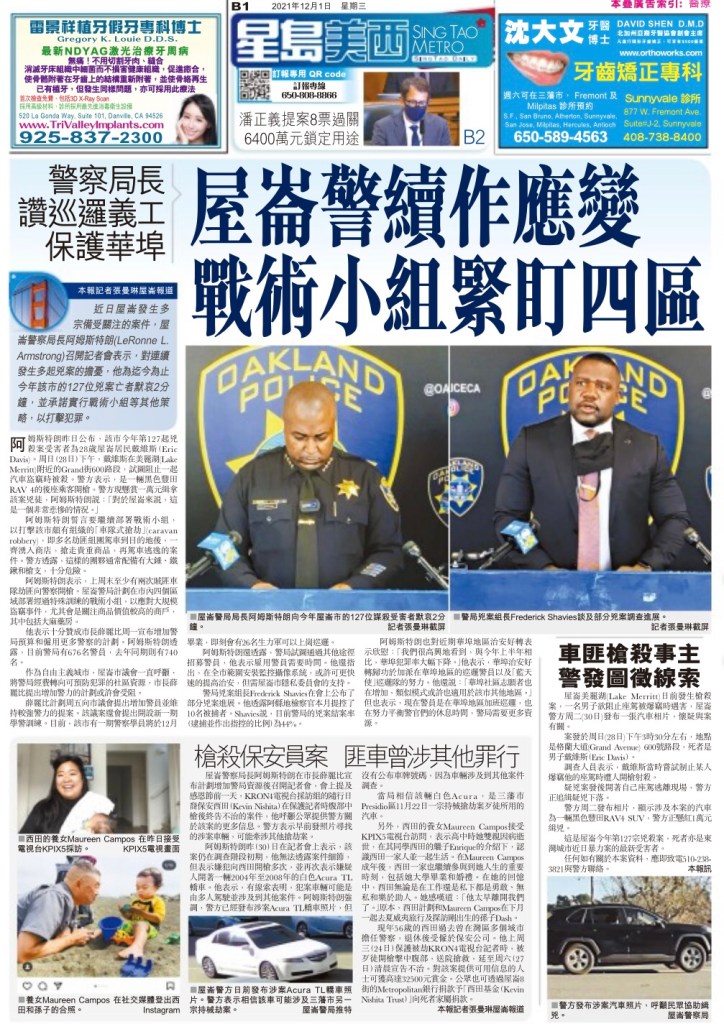
After Oakland Mayor kills defund police efforts, restored full budget, Oakland police established tactical teams to counter “$950 or less, 100% discounts” thieves, robbers and terrorists.
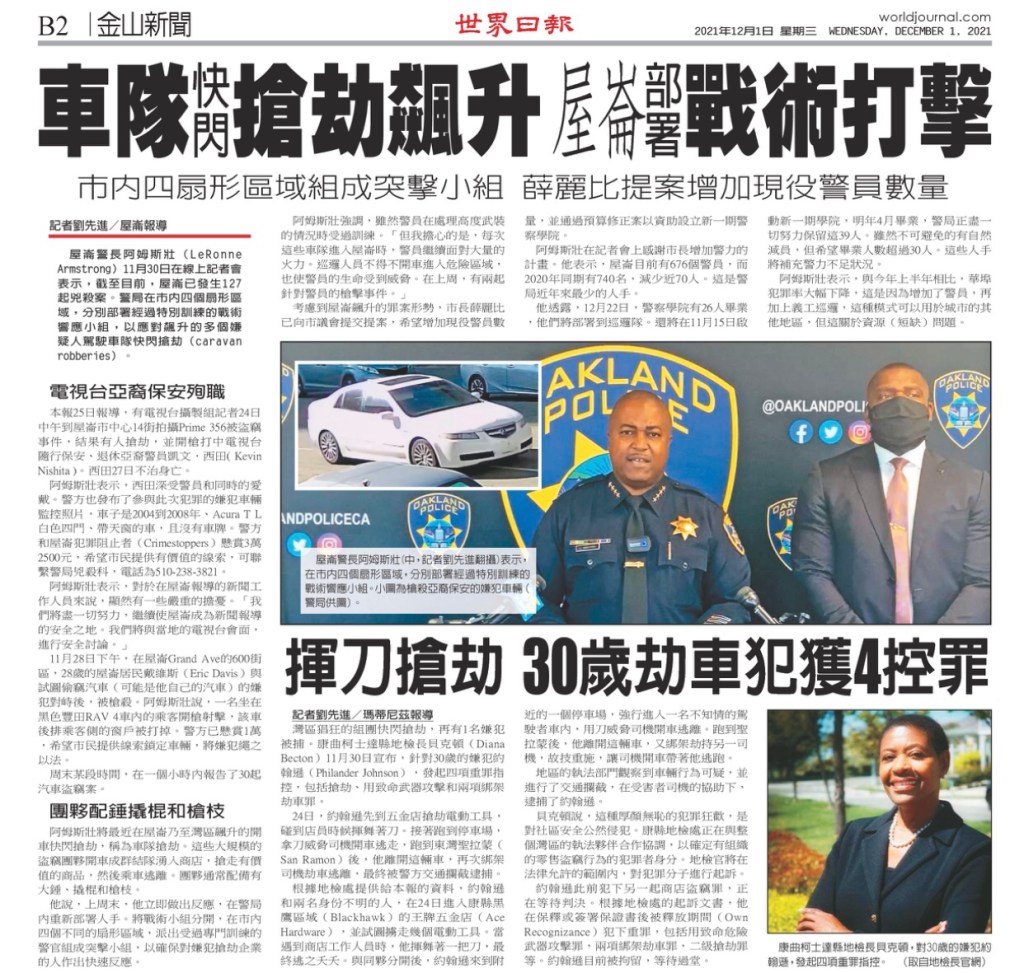

General who warned about ‘accidental’ war with Russia gets replaced. Admiral Sir Tony Radakin (second from left) took over as Chief of Defence Staff on November 30, 2021
“Carter was originally supposed to retire in June, but Prime Minister Boris Johnson asked him to stay in the post for a few more months. In what turned out to be one of his last interviews, he told CNN in mid-November he feared an accidental conflict with Russia now more than back during the Cold War era.
“’And I think we are now into a period where it’s more multi-polar, and I think in a multi-polar world with people competing for different objectives and on different agendas, there’s a greater risk of tension leading to the sorts of things that we are talking about,’ he said.”

Why does US make a fuss about ‘rules-based international order’? 30/10/2021 | Source: Pyongyang Times
Today, the international society strongly denounces the founding of the US-led “AUKUS” and the US decision on transferring the technology of building nuclear-powered submarine to Australia as a “military bloc based on the logic of Cold War” and an “irresponsible act posing danger of nuclear proliferation and triggering the arms race”.
The founding of “AUKUS” under the pretext of establishing the “rules-based international order” and the attempt at transfer of even the nuclear technology are a concentrated expression of the double-dealing and Janus-like policy of the US.
It is a well-known fact that the US has long deployed its nuclear assets all over the world to threaten and blackmail the countries of its dislike with nuclear weapons, in utter breach of international agreements and order.
Especially, the US has grown ever more brazen in recent years in its double-dealing and self-conceited acts of violating the universally accepted international order in the Asia-Pacific region where the strategic interests of several countries are inextricably intertwined.
Despite this fact, the US talks quite often about “rules-based international order”, posing as if it alone is “faithful” to the international agreements and order and has authority to “supervise” them.
However, everybody knows like the back of his hand the true intention of the US catchphrase: “rules-based international order.”
No goodliness would come out of a place rife with chaos.
Having no scruple about withdrawing from an international organization when it does not suit its taste and even reducing overnight the international disarmament treaty directly related to world peace and security to a mere scrap paper – this is the true nature of the US-advocated “rules-based international order.”
In other words, the “rules” that the US is making a fuss about are not the “rules” of impartiality, objectivity and universality but those of the “US style” which serve the American values to the core, and the US favorite phrase of “international order” is the one necessary for maintaining the US’ hegemony as it is a far cry from world peace and security.
The US uses the American-style gangster-like logic and argument that its nuclear threat to other countries is “for keeping the international order” and that other countries’ exercise of the right to self-defence to cope with the US military threat is a “breach of the international order”. This is the height of application of double standards.
The overall international society is criticizing this, commenting that “American-style double standards are a vivid expression of American-style hegemony”, the US is “a global hex” and “the US is the biggest troublemaker in terms of global stability”.
Recently, a spokesperson for the Chinese Foreign Ministry stressed that the founding of the “AUKUS” is an attempt to fabricate the US-centered rules and order in the region and defend the leading position of the US as well as its system of hegemony.
The overall fact gives a positive proof that peace and security in the region and the rest of the world are becoming much more unstable owing to the self-opinionated and hypocritical acts of high-handedness and arbitrariness perpetrated by the US around the world.
Peace is the common desire of mankind.
The international community should squarely see the reactionary nature of “rules-based international order” advertised by the US and no longer tolerate high-handedness and arbitrariness of the US that totally destroys and tramples on peace and security in the region and the rest of the world.
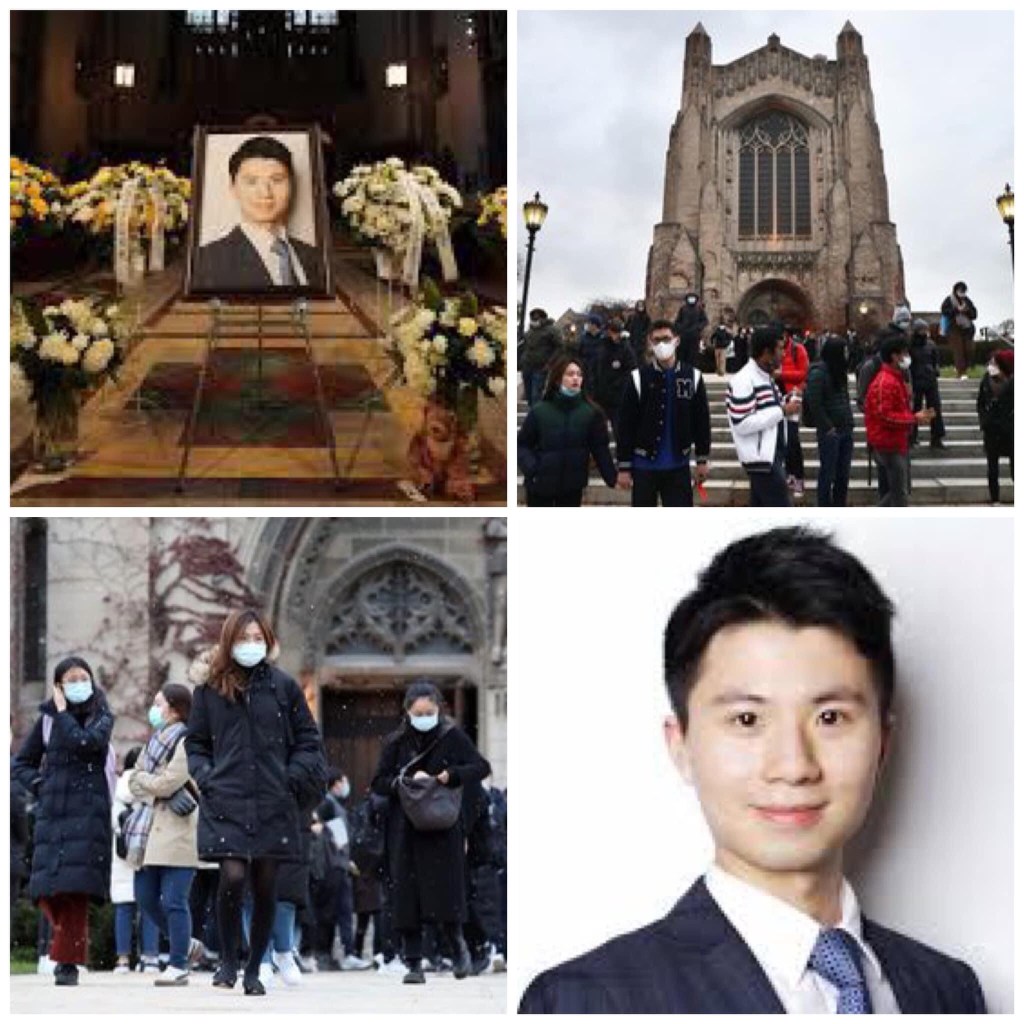
Video: A racist nation that demonize Chinese, Chinese Americans and China everyday flooded with guns murdered Zheng outside U of Chicago grad Shao Xiong ‘Dennis’ Zheng remembered for ‘extraordinary impact’ at memorial.
https://vimeo.com/652005305
https://youtu.be/NTahqwHtEx0
https://www.facebook.com/100036400039778/posts/613478843208778/?d=n
“I went abroad for the first time in my life not to attend your graduation ceremony, let alone your wedding celebration, but to attend your funeral,” she [his mother] said. “You said you wanted to take me to see the world. You wanted me to witness your dreams. You wanted us to look forward to the future together.”…
“I am going to bring you home”.
Zheng’s parents came from China for the service. Zheng was the couple’s only child.
Zheng’s mother’s remarks were translated for ABC7 by the Chinese American Service League:
My dearest son, I carried all my tears, all my longingness for you and all my sadness, and traveled all the way and finally arrived at the University of Chicago, where you chased your dream. This is the first time that your mom ever traveled outside of China. But this is not for sightseeing, not for attending your graduation, and not for your wedding, but for your funeral, what a cruel tragedy!
I can still vividly see the joy on your face the day you started out on your journey. You told me that you are going to show me the world in the future. You wanted me to witness your dream come true and you wanted us to look forward to the future. However, look at what happened now, we are separated by heaven and earth. I have desperately been trying to call you by your name again and again. Son, tell me why when I just begin to see hope I was thrown into hell a moment.
My poor son, when the evil bullet hit your young chest, when you were lying with blood all over your body on a foreign soil, you must felt so helpless in that cold street. Helplessness, hopelessness and anger must have filled in your heart. You were only 24 years old! Your dream of science, your dream of astronomy, your dream of math and your dream of love, all of those were shattered at that moment. You and your longingness for life, your love for your family, and your care for your fellow students, all disappeared entirely from my life with that murder’s bullet.

 Johnson Choi Biz