China: Democracy That Works

Full Text: China: Democracy That Works https://enapp.globaltimes.cn/article/1240621

China releases white paper on whole-process democracy by GT staff reporters, Dec 03 2021

Full Text: China: Democracy That Works https://enapp.globaltimes.cn/article/1240621

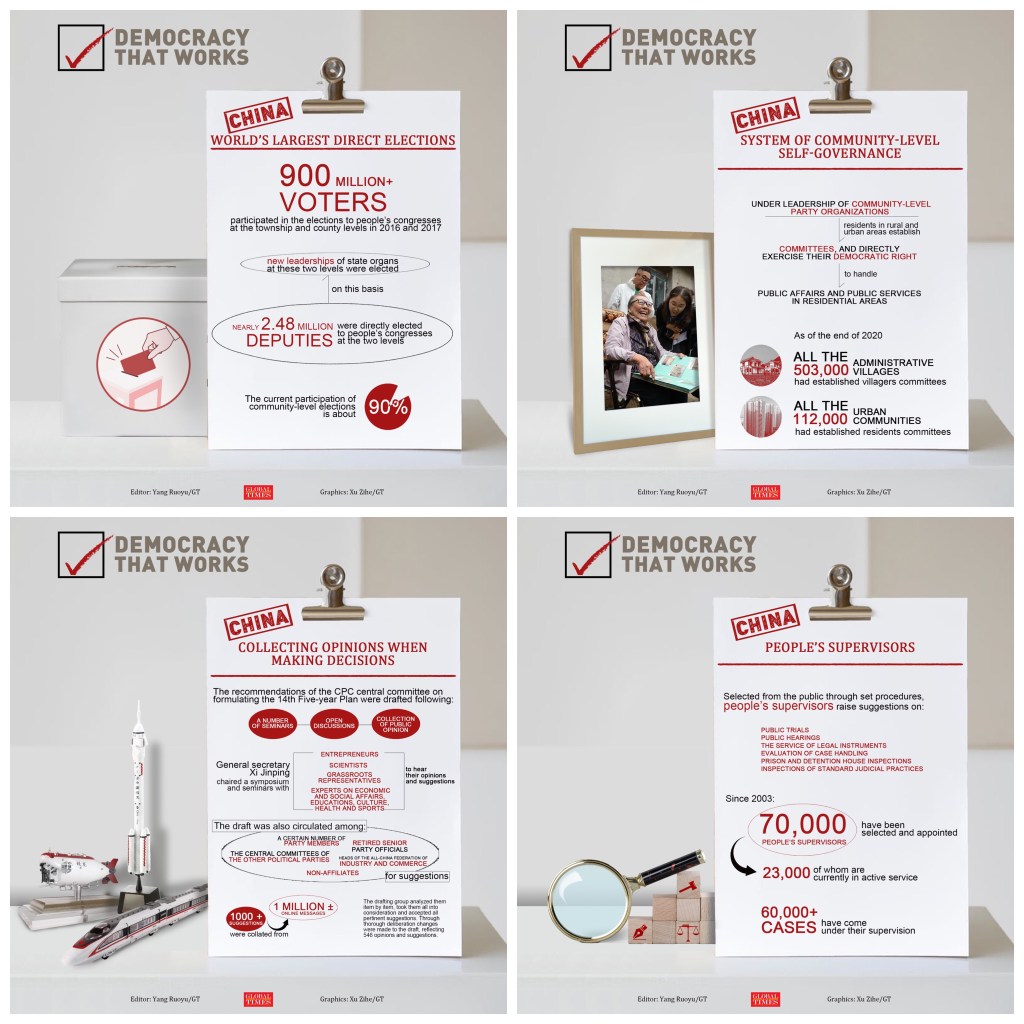
China on Saturday released a white paper on its democratic model, elaborating with details and examples on how the whole-process democracy with people’s full participation works in China.

The white paper was released before the US’ “democracy summit,” which was scheduled to be held on December 9 and 10, and criticized for promoting democratic hegemony under the banner of democracy and dividing the world by ideology.

The white paper, titled China: “Democracy That Works,” was released by the State Council Information Office on Saturday. It introduces China’s whole-process people’s democracy under the leadership of the Communist Party of China, the sound institutional framework, the concrete and pragmatic practices of China’s democracy, and the new model of democracy that China has developed.

“Democracy is a concrete phenomenon that is constantly evolving. Rooted in history, culture and tradition, it takes diverse forms and develops along the paths by different peoples based on their experiments and innovation… in China, the people’s status as masters of the country is the bedrock of all systems of the country, and underlines the operation of all the systems for state governance,”

It noted that the Chinese people exercise state power effectively through people’s congresses and people’s congresses exercise state power collectively on behalf of the people. The people’s congresses have legislation, appointment and removal of officials, decision-making and supervision, said the while paper.

China’s whole-process democracy integrates two major democratic models – electoral democracy and consultative democracy to ensure people’s full participation not only in voting, but also in the national governance, Chang Jian, director of the Research Center for Human Rights at Tianjin-based Nankai University, told the Global Times.

Chang said that Chinese people can fully exercise their rights on voting for candidates to the people’s congresses, and participate in legislation especially during the process of soliciting public opinions, make decisions related to the country’s development, and supervise law enforcement and implementation policies. China’s democracy has also attached great importance on increasing people’s sense of gain when they fully participate in the country’s construction.

The system of multiparty cooperation and political consultations under the CPC leadership, broad patriotic united front, the system of regional autonomy and the system of community-level self-governance are also important parts of China’s whole-process democracy, according to the white paper.

Democracy’s core is of people’s status as masters of the country, and has various forms. China’s democracy is developed from its own culture and draws experiences from other civilizations and is still evolving, experts said.

Kenneth Hammond, professor of East Asian and global history at New Mexico State University, thinks that China’s process is very different. “In China, you don’t make a big display. But instead, that process goes on, and then once decisions are reached, once a kind of consensus emerges, then the question is put into practice.”

“What you need is people who are committed to the public good and are going to work, not to advance their individual or even their group interest, but to find the things that work best for society as a whole. I think it’s a democratic process in China. It’s not the same kind of process that we have here. But it is a process that leads to the articulation and the effective management of social concern,” Hammond told the Global Times.

China’s political system today is as different from Western democracy as Chinese characters from Latin or Cyrillic alphabets. But it does not make this system inferior or less attractive, Yury Tavrovsky, head of the “Russian Dream-Chinese Dream” analytic center of the Izborsk Club, told the Global Times.

Tavrovsky noted that China’s democracy and political system has gained remarkable and globally eye-catching social and economic achievements. They have developed an efficient market economy, the second biggest in the world. In the past 10 years they have rapidly improved the livelihood of Chinese people and eliminated poverty for the first time in history.

China’s democracy model looks as harmonious in the Chinese political landscape as a beautiful pagoda. “To challenge it with a rather shaky and dilapidated Western skyscraper is not wise and may be even dangerous,” Tavrovsky said.

Various forms

China’s white paper on democracy was released against the backdrop that the US is trying to pull an alliance against China by drawing lines between so-called “democratic nations” and so-called “authoritarian nations,” and the Biden administration is promoting the “democratic summit” to burnish the US image as a “democratic beacon.”

However, analysts said the flaws of US democracy are too obvious to hide, casting a heavy shadow on the torch of the Statue of Liberty.

“One Person, One Vote” is a democratic principle, but it is by no means the only principle, nor does it create democracy. However, it has long been misinterpreted and its meaning distorted by a small number of countries,” said the white paper.

The US has criticized China for not having a similar democratic pattern, and has smeared and attacked China’s own exploration of democracy and turned a blind eye to China’s development and achievements of democracy and human rights. But it is the US that distorted the core of democracy and promoted democratic hegemony globally, Chang said.

Oleg Ivanov, Deputy Head of the International and National Security Department, Diplomatic Academy, Moscow, cited US Secretary of State Antony Blinken’s remarks that the erosion of democracy is also happening in the US with rampant disinformation, structural racism and inequality.

“Indeed, BLM, the storming of the US Capitol, the vehement exchange of insults between Democrats and Republicans, and the severe polarization of American society clearly indicates that US democracy is seriously sick. I do not mean to say that it is doomed to collapse tomorrow, but it is questionable that a sick society can be a beacon of democracy,” Ivanov said

“American democracy may be attractive for other nations only if it gets rid of its flaws. So far, one can hardly predict it is going to happen soon,” Ivanov noted.

US democracy has fundamental flaws, according to experts. Qian Jinyu, director of the Human Rights Research Center of Northwest University of Political Science and Law, said that during its development, Western democracy had turned the idea of everyone sharing the right to govern into electing representatives, which defined democratic politics as “the rule of politicians.”

Western democracy is not the governance by the people but the governance by elites. The elites’ political participation has replaced the people’s political participation, and such democracy no longer cares about the political cultivation of individual citizens. The participation of the people in the democracy is limited to their vote during the election, Qian told the Global Times.

Qian noted that US democracy attaches importance to process but overlooks the effects and results. But China’s whole-process democracy has fixed the flaws while admitting the various forms of democracy, which is a unique contribution to human exploration of democracy and enriches the global theories on democracy.

Video: GT Investigates: US wages global color revolutions to topple govts for the sake of American control

Video: GT Investigates: US wages global color revolutions to topple govts for the sake of American control: HK, Ukraine, Arab Countries, Thailand, Myanmar… 為了控制全球, 美國發動全球顏色革命推翻政府:香港、烏克蘭、阿拉伯國家、泰國、緬甸…… GT staff reporters Dec 03 2021
https://vimeo.com/653087321
https://youtu.be/ap5VCLaqIuw
https://www.facebook.com/100036400039778/posts/614916913064971/?d=n
https://enapp.globaltimes.cn/article/1240540

Editor’s Note:

How many evils have been committed in the name of democracy?

Exporting wars, launching “color revolutions,” fomenting extremist ideologies, and promoting economic instability… the US has left endless trails of bloodshed and turmoil around the world. While the “model of democracy” loses its shine, the US still attempts to establish exclusive cliques through the so-called democracy summit. To expose the nature of “American democracy,” the Global Times is publishing a series of articles to unmask the US’ four democratic hegemonic sins. This is the second such piece.

The previous one is GT investigates: US war-mongering under guise of ‘democracy’ inflicts untold damage on the world.

To start a revolution, first you need to pick a color.

Whether it is the “Rose Revolution” in Georgia in 2003, the “Orange Revolution” in Ukraine in 2004, the “Tulip Revolution” in Kyrgyzstan in 2005, or the “Arab Spring” in Asia and Africa in 2011, the past decades have seen the US plan and implement “color revolutions,” or wars without gunpowder in many places around the world, frantically exporting “American values.”

Instead of launching military operations directly in the name of “democracy,” the US prefers to use color revolutions as a tool to intervene in other countries’ internal affairs to subvert governments in order to reinforce its global control, which the US has found more efficient and economical.

It is estimated that in the past three decades, among all the toppled governments, those that were subverted by such “non-violent revolutions” accounted for more than 90 percent.

Before that, during the Cold War, the US engaged in 64 covert and six overt attempts at regime change, according to Covert Regime Change: America’s Secret Cold War, by Lindsey A. O’Rourke.

However, what color revolutions left in their wake are neither peace nor Western democracy, but mass confusion, chaos, and destruction in the target countries.

It is the origin of the world’s instability today, observers said.

Scourge on the world

Since late 20th century, color revolutions have swept through Central Asia, the former Soviet Union, and Eastern European countries.

Deeply digging into these color revolutions, behind the scenes, you are always likely to find the conspicuous black hands of the US.

Eurasian countries have been the worst-hit area by color revolutions where the US has been keen on inciting anti-government emotions and regime changes.

At the end of 2003, the US forced Eduard Shevardnadze, then president of Georgia, to resign on grounds of “fraud” in vote counting in parliamentary elections and supported the opposition leader Mikhail Saakashvili to be president. It is known as the “Rose Revolution.”

Following Georgia, a similar scene played out in Ukraine in October 2004, as the US concocted a “fraud” scandal in Ukrainian elections and incited local youth to take to the streets and support the leader of the opposition, Viktor Yushchenko, who then was elected president. The event is known as the “Orange Revolution.”

Once again in March 2005, the US drove Kyrgyzstan’s opposition to protest against the results of the parliamentary elections, which eventually turned into riots. The “Tulip Revolution” ended with the President of Kyrgyzstan, Askar Akayev, abandoning power and fleeing.

In October 2020, Director of Russia’s Foreign Intelligence Service Sergei Naryshkin accused the US of planning to start a “color revolution” in Moldova. Naryshkin pointed out in a statement that the US has brutally interfered in the internal affairs of Russia’s neighboring countries.

The US was also behind the “Arab Spring” uprisings in the Arab world, during which the wave of anti-government protests and violence led to civil wars in some countries and brought unrest and devastation to people there. The region has undergone major changes, but many countries were still reeling from the heavy blow dealt by the movement.

The color revolution has always closely worked alongside the US’ global system of controlling the world, Zhang Shengjun, vice dean of the School of Political Science and International Relations at Beijing Normal University, told the Global Times on Wednesday.

In recent years, the US has turned its direction of applying color revolution tactics to countries and regions related to China in order to realize its purpose of containing the development of China, Zhang noted.

Textbook meddling case

The “color revolution” is not an impromptu performance orchestrated by an individual, but a deliberate political act. It is a coordinated action by planners, trainers, funders, instigators, troublemakers, followers, and occasionally, violent terrorists and even hired mercenaries.

Observers said that after decades of conducting color revolutions across the world, the US has developed a mature system of operation.

First, planners find a target they “dislike,” after which they launch a psychological war. Usually they find and organize a group of political activists and provide them with information and financial support to intensify their opposition sentiment. Then, the planners help mobilize the masses to initiate political protests, including compelling nongovernmental organizations and the media to intervene or participate in the protest movement. Therefore, a chain of protests is set off with the planners just helping increase the intensity and expand the team to await the fall of the government.

There are some means that have frequently been adopted in color revolutions.

“NGOs” under the US government’s control are often used to carry out long-term infiltration in targeted countries. The infamous National Endowment for Democracy (NED) of the US, a self-proclaimed “NGO” for instance, has been using state funding to preach the hegemonic doctrine of the US government. As of 2016, NED had provided some $96.52 million to at least 103 anti-China entities, including notorious separatist groups, such as the World Uyghur Congress (WUC) and the Tibetan Youth Congress (TYC).

The US has also been supporting radical youth organizations and fostering leaders for agents. A leader of Egypt’s April 6 Youth Movement, an anti-government activist, was invited to New York for the International Coordination Meeting of Youth Organizations in 2008. He admitted later in a documentary that he had undergone an “internship” and was familiar with how to cope with the police.

The media is also used to implant Western ideologies among people. The US Congress-founded Radio Free Europe played a significant role in the containment of the Soviet Union during the Cold War through the delivery of news and transmission of Western ideologies to Eastern European countries. In 2019, it had received total funding to the tune of $124 million, broadcasting in 26 languages and reaching 37.6 million people every week.

In the name of aid, the US intervenes in the internal affairs of the “target country” and provides financial support to the country’s opposition parties. Years before the “Rose Revolution” in Georgia in 2003, foreign states and organizations began to give financial assistance to NGOs and opposition parties within Georgia. USAID for instance, spent $1.5 million to computerize Georgia’s voter rolls.

Moreover, some protests during the color revolution, including members of opposition organization Otpor! in the 2004 Ukrainian revolution, “practically used a textbook” in lectures, which is the notorious From Dictatorship to Democracy by Gene Sharp, known as the guru of nonviolence, according to media reports. The Albert Einstein Institution founded by Sharp is also allegedly funded by NED.

The purpose of the US inciting color revolutions abroad is to overthrow powerful anti-America regimes and cultivate pro-America ones in their stead, said Song Quancheng, head of the Institute of Migration Studies at Shandong University.

A favorite trick of the US is to depict and mold the image of an anti-US or anti-NATO regime as a dictatorial regime that “poses a serious threat to the human rights of its people,” and intervenes under the guise of “averting a humanitarian disaster,” Song pointed out.

Meanwhile, the means of color revolution has been insistently improving to be more effective.

In the “Arab Spring” of 2011, social media networks such as Facebook and Twitter were widely used to organize protests, spread information, and communicate with the external forces.

During what happened in January 2011 in Egypt, many young people who were deeply influenced by social media platforms such as Facebook and Twitter were misled and brainwashed by promises of “democracy and freedom” made by the US and the West, and began to take part in protests, Ahmed Elhusseiny, a China-Africa researcher with the Cairo University, told the Global Times.

They thought they were helping their country, but the fact was they were being used by the US and its political forces to oust a national leader that the US and the West considered ineffectual, he said.

“Any evil to have happened in any corner of the world can be traced back to the tainted hands of the US,” he said.

Moreover, the US is also switching its strategies in its practice of color revolutions, Zhang said. “Funding the oppositions to achieve regime change was the main method, but now the US is increasingly trying to change other countries’ diplomatic policies to ensure the countries’ likely support of US global policies. This has been shown to be the stance of Lithuania and a few other countries.”

Origin of world’s instability

The color revolution fails to bring democracy and peace, but rather an open Pandora’s Box that has left many countries and regions around the world in political turmoil, economic regression, and social disasters. The color revolution is the origin of world’s instability, said analysts.

For instance, during the “Lotus Revolution” in Egypt in 2011, protests shouted the slogan “Bread, Freedom, Social Justice,”, but the economic indexes showed that the situation worsened after the revolution and the negative effect lasted for years.

Official data from Egypt showed that from 2012 to 2016, the export scale of Egypt had shrunk from $27 billion to $18.7 billion. It also caused severe unemployment and massive inflation.

In total, the “Arab Spring” and the following wars, along with refugee crises and economic downturns, cost the countries more than $830 billion, according to analysis at the Arab Strategy Forum in Dubai in December 2015.

“The main danger of color revolutions is putting a country with all its people and resources under external control,” Andrei Manoilo, a professor of political science at Moscow State University, told the media in 2019 as turmoil ensued in China’s Hong Kong.

“Many countries in the Middle East and the North African regions didn’t actually build so-called modern, democratic, Western-like countries after their ‘authoritarian’ anti-America regimes were overthrown in color revolutions,” Song told the Global Times.

After not having been modernized, these countries and regions, in which traditional tribal chieftain management system styles remain and frictions between different religions, sects, tribes, and cultures still exist, are very likely to fall into discord after losing strong and powerful leaders, Song explained.

It is there for all to see that the “democracy” that the US has been promoting via color revolutions has a huge gap with real democracy, Zhang said. “History has proven again and again that the US’ democracy could only make other countries victims of capitals.”

The US has been building fragile “democratic” systems in other countries for its convenience to control them. “In the fake name of ‘democracy,’ the US has been conducting color revolutions and promoting its ‘universal value’ in the world, but the essential purpose is to control the resources of other countries,” Zhang said.

“The motivation is incredibly covert, but it should not be ignored that it is the origin of current global instability,” he noted.

Exporting wars, launching “color revolutions” and inciting extremist ideologies – in the name of democracy. While the #US has left endless bloodshed and turmoil around the world, it still attempts to establish cliques with “democracy summit.”

Professor John V Walsh, MD in San Francisco: Great article on Daszak and lab leak theory in recent Science mag.

https://www.science.org/content/article/we-ve-done-nothing-wrong-ecohealth-leader-fights-charges-his-research-helped-spark-covid-19

Professor John V Walsh, MD in San Francisco: Great article on Daszak and lab leak theory in recent Science mag.

The scientific community has shown itself to be on the right side of the Lab Leak Allegation, largely because it is on the side of science. Still it shows integrity. It is, however, disappointing that so few academics have signed on to the Stanford letter.

Daily fake news by the Western Empire AngloSaxon World against China is working beautifully

Daily fake news by the Western Empire AngloSaxon World against China is working beautifully…the mouthpiece of Western Empire: NYT, CNN, WSJ, Fox News, BBC etc are doing such a good job. (Don’t forget at least 1/2 of the overseas Chinese lives in the 5 eyes and AngloSaxon countries have a death wish on China).

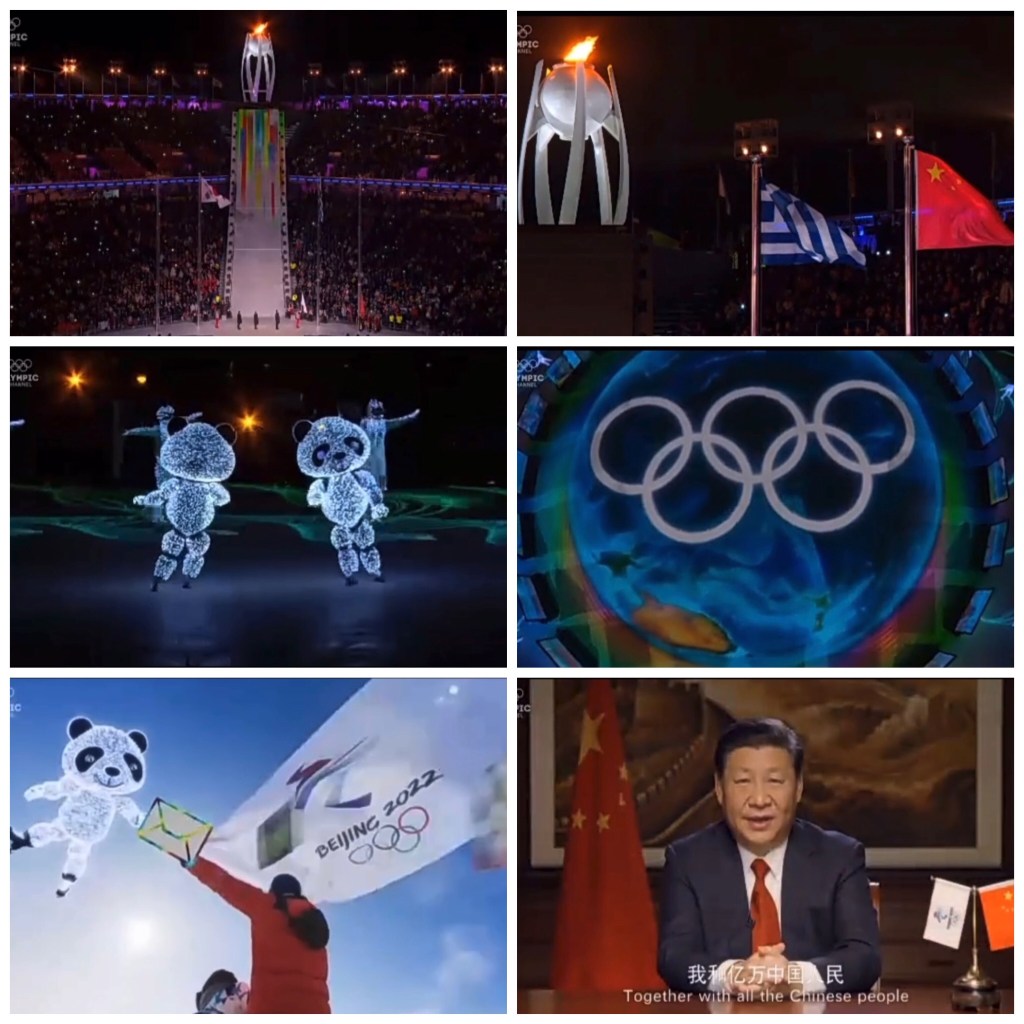
Video: China welcome you to Beijing Olympic 2022! US, cut the daily lies to demonize Chinese & China, if you are sour loser, don’t come!

Video: China welcome you to Beijing Olympic 2022! US, cut the daily lies to demonize Chinese & China, if you are sour loser, don’t come! 中國歡迎您參加 2022 年北京奧運會! 美國,剪掉妖魔化中國和中國人的日常謊言,如果你是輸家, 怕輸, 可以不來, 不用天天打嘴炮!
https://vimeo.com/653052994
https://youtu.be/vw97rAaMMIg
https://www.facebook.com/100036400039778/posts/614856246404371/?d=n

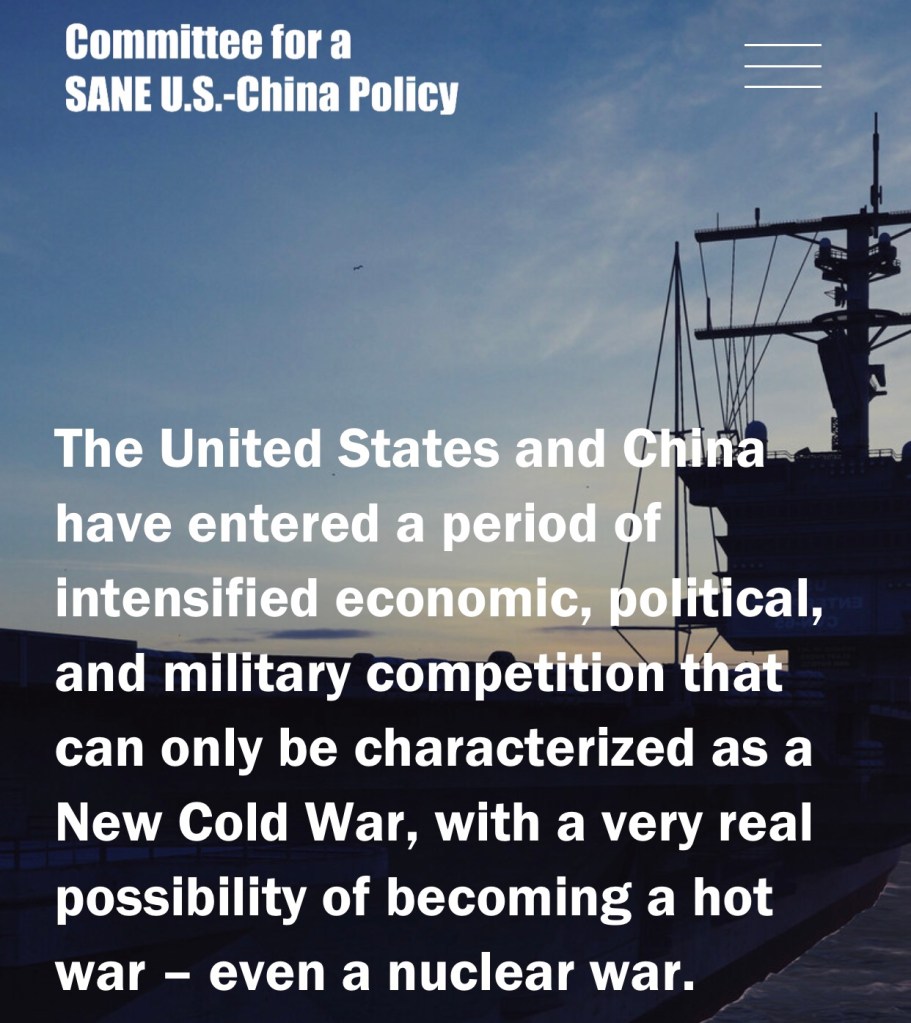
Open Letter to the Committee for a Sane U.S.- China Policy “U.S. Hands Off Taiwan and the South China Sea,”

Open Letter to the Committee for a Sane U.S.- China Policy “U.S. Hands Off Taiwan and the South China Sea,”

Joseph Gerson
Committee for a Sane U.S.- China Policy

Dear Joseph Gerson,

Thank you for your recent update on U.S. policies toward China and your factsheet on the “One China” Policy Explained. As our nation is taking a more aggressive military stance around the world, it is important that we have a full and open discussion of U.S. foreign policy, with all viewpoints represented. At the same time, I am reluctant to endorse your suggestion that both China and the U.S. must share in the responsibility for the current dangerous situation. Primary responsibility lies with U.S. imperialism.

As an alternative, I hope you will consider the enclosed statement from Veterans For Peace, “U.S. Hands Off Taiwan and the South China Sea,” which states, in part that

“The time when the U.S. Navy patrolled the Yangtze River is over. The Eurocentric idea that Asian nations require the United States to defend them from themselves has no place in the Twenty First Century. The People’s Republic of China does not now, nor has it ever, threatened the territorial security or people’s well-being of the United States or any NATO country, and

“Therefore Be It Resolved that Veterans For Peace urges the government of the United States to withdraw all military and naval forces from the Straits of Taiwan and the South China Sea and re-examine U.S. arms sales to the Republic of China in Taiwan, and

“Be It further Resolved that Veterans For Peace urges its members and supporters to remember that the resolution of the status of Taiwan is the internal affair of the Chinese on both sides of the Taiwan Straits into which the United States has no right to intervene.”

NOTE: This resolution does not endorse any political party within the PRC nor any internal policy of the PRC, nor does it favor China over any other Asian nation. Our resolution simply grows out of a central part of our mission: to restrain our government from intervening overtly or covertly in the internal affairs of other nation.

FURTHER: While we insist on restraining our government from intervening overtly or covertly in the internal affairs of other nations, we want to encourage people-to-people relations between the U.S. and China, including student exchanges, tourism, and fair trade.

In addition to our statement, “U.S. Hands Off Taiwan and the South China Sea,” I am also enclosing another VFP Statement, “Pivot to Peace with China and the World,” which applies our VFP principles to China,

I look forward to your response.

With solidarity in our common struggle for peace,

Eugene E Ruyle
President, VFP East Bay Chapter 162 (Berkeley/Oakland)
Emeritus Professor of Anthropology and Asian Studies
California State University, Long Beach

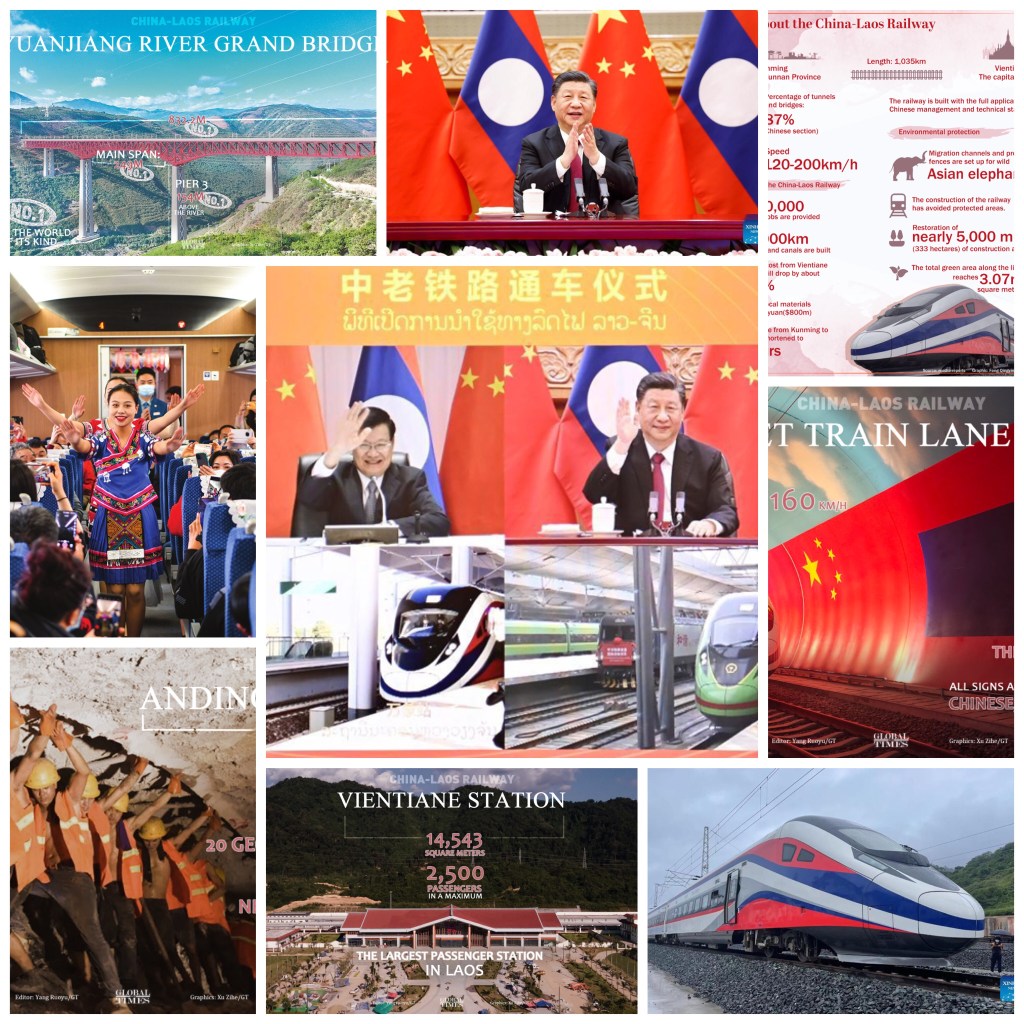
Video: China-Laos 1,035-kilometer-long Railway roars in full swing today

Video: China-Laos 1,035-kilometer-long Railway roars in full swing today, brings Laos into modern transport era amid BRI endeavor by GT staff reporters, Dec 03 2021

https://vimeo.com/652997049
https://youtu.be/loHBF4zScrY
https://www.facebook.com/100036400039778/posts/614785616411434/?d=n

The 1,035-kilometer-long China-Laos Railway, a signature project under the China-proposed Belt and Road Initiative, officially went into full operation on Friday, catapulting the landlocked Southeast Asian nation into a Chinese standard-powered modern railway era that honors China’s promise of enabling inclusive growth along the BRI routes.

Chinese President Xi Jinping and Lao President Thongloun Sisoulith witnessed the opening of the railway via video link.

The opening of the China-Laos Railway will make Laos’ dream of becoming a land-linked hub come true. China will ensure the maintenance and security of the railway and build high-quality, sustainable and people-friendly economic belts along the route, President Xi told Thongloun via video link.

The China-Laos Railway, the biggest public project in Laos’ history, links Kunming of Southwest China’s Yunnan Province with Laos’ capital Vientiane, including a 106-kilometer section from Kunming to Yuxi in Yunnan with a designed speed of 200 kilometers per hour, which had already been put into operation in December 2016.

The newly built 507-kilometer section connecting Yuxi and Mohan, a border town in Yunnan, with a designed speed of 160 kilometers per hour, adds to another 422-kilometer new section from Mohan to Vientiane, also designed to travel at 160 kilometers per hour, China Railway said in a statement sent to the Global Times.

The Yuxi-Mohan section was built by China Railway Kunming Group, while the Mohan-Vientiane section, largely within Laos, was built by a China-Laos joint venture.

As a landmark project of the BRI as well as China-Laos friendship that entirely adopts Chinese standards, the railway will provide strong support for accelerating the completion of the China-Laos Economic Corridor and building a China-Laos community with a shared future, read the China Railway statement.

The China-Laos railway is envisioned to directly boost cargo connectivity, turning Laos from a landlocked nation into a logistics center in the Southeast Asian region, facilitating interconnectedness between not only China and Laos, but also between Laos and ASEAN and between China and ASEAN, Gu Xiaosong, dean of the ASEAN Research Institute of Hainan Tropical Ocean University, told the Global Times on Friday.

The railway will be a big boost to Laos’ economy, Gu said, expecting commodities hailing from Southeast Asia to be shipped to China via Yunnan before being exported to Europe through China-Europe freight trains for there to be wider-ranging connectivity between the two continents.

More investments are expected in Laos after the railway opens, as businesses will be promoted, the expert said.

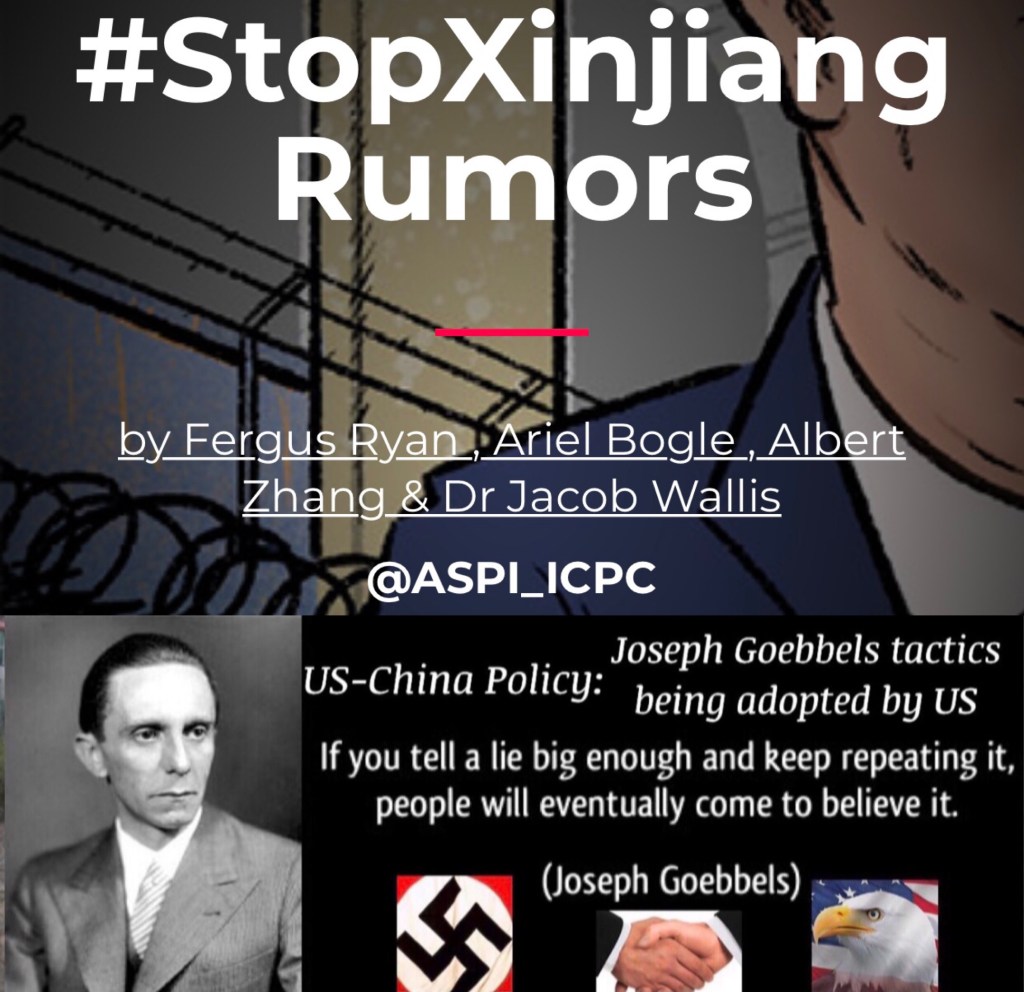
Twitter to censor positive XJ news

Twitter to censor positive XJ news by partnering with ASPI. ASPI is the military funded think tanks that is responsible for most of the lies around XJ. It was playing defense on XJ–so it is now partnered with Twitter so it can dominate the information landscape. Twitter 與 ASPI 合作審查新疆的正面新聞。 ASPI是美國軍方資助的智庫,負責新疆周圍的大部分謊言。 但它在新疆的假消息被親中人士進行防禦, 所以它現在與 Twitter 合作,因此它可以主宰信息領域。