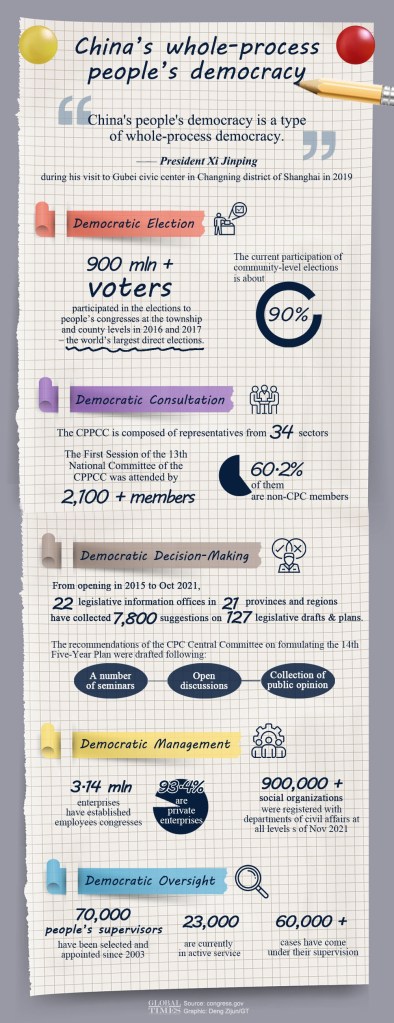
China’s democracy is not what is narrowly defined as one-man-one-vote, but an ideal and whole system of political structures to ensure the people’s status as the true masters of the country rather than “voting puppets.”
China’s democracy is not what is narrowly defined as one-man-one-vote, but an ideal and whole system of political structures to ensure the people’s status as the true masters of the country rather than “voting puppets.”
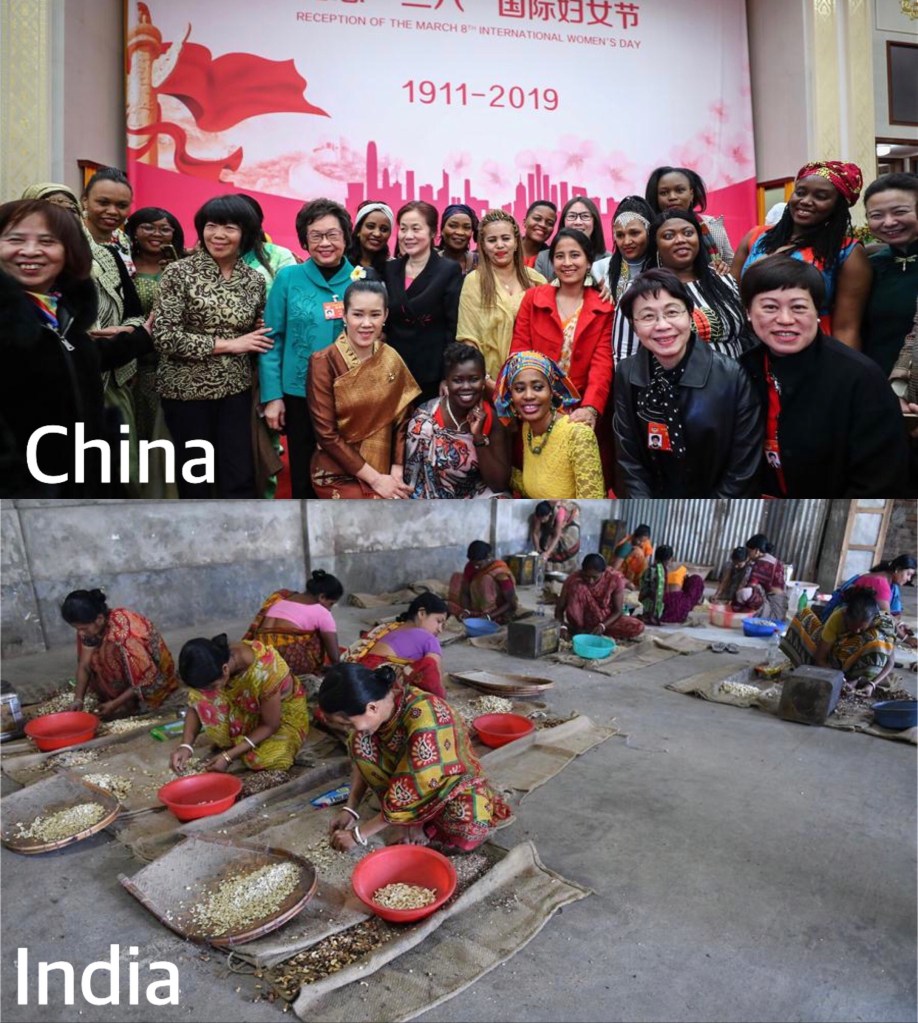
Why Indians left their country refused or cannot return home? This is one of the reasons / Women’s status in China and India: Who has human rights and democracy? 為什麼印度人離開他們的國家後不想也不能回家? 這就是原因之一/中國和印度的女性地位:誰擁有人權和民主? by John Ross
Editor’s note: John Ross is a senior fellow at the Chongyang Institute for Financial Studies, Renmin University of China. The article reflects the author’s opinions and not necessarily the views of CGTN.
U.S. President Joe Biden has called a “Summit for Democracy” for December 9-10. There have been few events that have been more misnamed.
“Democracy” in European languages is derived from two Greek words, “demos (people)” and “kratos (rule).” So, “democracy” literally means “the people rule.” Democracy is presented as integrally linked to human rights, that is, “people’s rights.” This is correct and will be used here.
To clearly illustrate the falsity of the U.S. position on this issue, let us consider the real situation and outcome of democracy and human rights using a prominent example affecting the position of almost one-fifth of humanity – women in India and China.
An Indian woman’s life expectancy is 71. In China, it is 79.2.
In China, female literacy is above 95 percent, while it is around 70 percent in India.
The risk of a woman dying in childbirth is eight times higher in India than in China.
Regarding the position of women in China compared to India, take the conclusion of the British medical journal The Lancet, one of the world’s most prestigious medical publications. Its study on 70 years of women’s health in China noted that “statements such as ‘Women hold up half the sky’ and ‘Children are the future and hope of the motherland’ have not only been rhetoric but have been consistently practiced.” The study gives the example of China’s enormous fall in deaths in childbirth, which dropped from over 1,500 to 17.8 cases per 100,000 births from 1949 to 2019. In Brazil, deaths in childbirth dropped from 370 to 60 per 100,000 births and in India from 1,000 to 145 over the same period.
As the study “Women Hold Up Half The Sky: How China Eradicated Extreme Poverty” by Tings Chak concluded, “Starting at much higher rates of maternal mortality, China managed to reach less than a third of Brazil’s and an eighth of India’s in seven decades. For the impressive achievements across women’s reproductive, maternal, newborn, child and adolescent health, the Lancet also cites ‘strong political will’ and ‘improvements in gender equality’ as the key factors behind the successes.”
She also noted the key role China’s central government and the All-China Women’s Federation (ACWF) played in achieving these huge advances for women. The ACWF was not only a part of China’s leading governmental bodies overseeing the country’s targeted poverty alleviation programs, but it also garnered massive support from women at the grassroots level in parallel with these government programs. The ACWF organized base-building work with 900,000 WeChat “sisters” groups and 641,291 village-level grassroots organizations across China.
In short, there was nothing accidental about such enormous steps forward for Chinese women. They were achieved by a combination of government programs and extensive grassroots participation by women themselves.
In the thinking of any rational human being, it is clear from these results that the human rights of a Chinese woman are far superior to those of an Indian woman. This is said with no pleasure; I would prefer the human rights of an Indian woman to improve to become equal to those of a Chinese woman.
Yet, according to the U.S. concept of “democracy” and “human rights,” the ridiculous claim is made that the rights of an Indian woman are superior to those of a Chinese woman because an Indian woman lives in a “Parliamentary Republic.” Therefore, India is invited to the “Summit for Democracy,” and China is not, despite all the facts and data mentioned above.
If the U.S. concept of “democracy” and “human rights” are correct, then the only conclusion one could arrive at from these facts is that from the point of view of women, democracy is thoroughly undesirable.
But in fact, the U.S. has a totally false concept of “democracy.” It defines democracy not in terms of the “people rule” and the well-being of real people, but in terms of a few formal processes such as “Parliamentary Democracy” or “Division of Powers.” Unless one believes that women in India wish to have short lives, be illiterate and die in childbirth, the only conclusion one can draw is that “rule by the people,” in this case by women, is being carried out far more by China’s system of government policies and mass organizations than the “Parliamentary Republic” of India.
Biden’s summit may try to argue that India’s system embodies democracy and human rights, and China’s does not. But that purely verbal claim will not alter the fact that the life and real rights of a Chinese woman are far superior to those of an Indian woman.
The real test of a system is not adherence to some specific procedures. It is what it delivers that shows whether “the people rule.” It is only necessary to look at the contrast in the lives of one-fifth of humanity, Chinese and Indian women, to see that China has delivered “the people rule” on a gigantic scale and infinitely more than the entirely unreal criteria chosen by Biden.
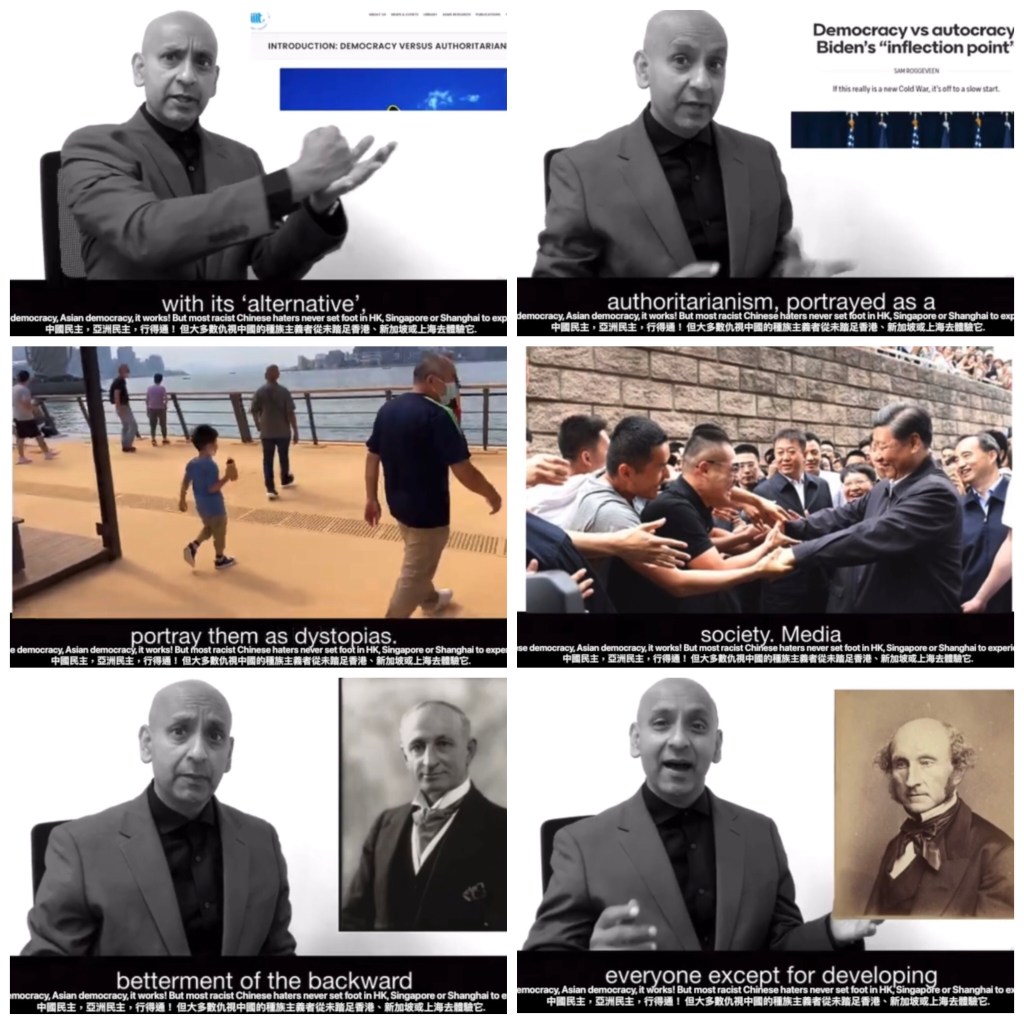
Video: Chinese democracy, Asian democracy, it works! But most racist Chinese haters never set foot in HK, Singapore or Shanghai to experience it. 中國民主,亞洲民主,行得通! 但大多數仇視中國的種族主義者從未踏足香港、新加坡或上海去體驗它.
https://vimeo.com/656412912
https://youtu.be/OYNFYuGSpSE
https://www.facebook.com/100036400039778/posts/620851112471551/?d=n
Scores of articles are discussing the shrinkage of Western liberal democracy around the world—and contrasting it with its alternative, authoritarianism, portrayed as a terrible system creating dystopian societies.
The trouble is that anyone who has travelled even a little bit quickly sees the dichotomy is completely fake. Singapore, Shanghai, Hong Kong – they may not count as Western liberal democracies, but its clearly ridiculous to portray them as dystopias.
The fact is, some of the foundational texts of Western liberal democracy actually recommend a different option for places in Asia.
In his book On Liberty, published in 1869, John Stuart Mill says that liberal democracy is a good thing for everyone except for developing countries. For those, “Despotism” was “legitimate… provided the end be their improvement”.
In the 1940s, British colonial official Lord Malcolm Hailey said his country exercised power over Asia and Africa “as part of the movement for the betterment of the backward peoples of the world”.
Asia’s alternative system is sometimes defined in just two words. The classic Western formulation is “benign dictatorship”. Benign means kind. That was what British colonial leaders of Hong Kong liked to call their period of governance, in which a handful of foreigners made the decisions but held regular democratic consultations. Some political scientists prefer “illiberal democracy” or “consultative authoritarianism”. In China they like “full-process democracy”.
Spanish speakers use dictablanda and the Portuguese talk of ditabranda. These terms indicate leaders who are labelled dictators by outsiders but who are actually widely appreciated by their citizens. Xi Jinping’s China is clearly a ditabranda society.
Media commentators today can point their fingers at a system which combines strong leadership with consultative democracy and call it whatever they like. I just call them “Asian democracy”. It works.
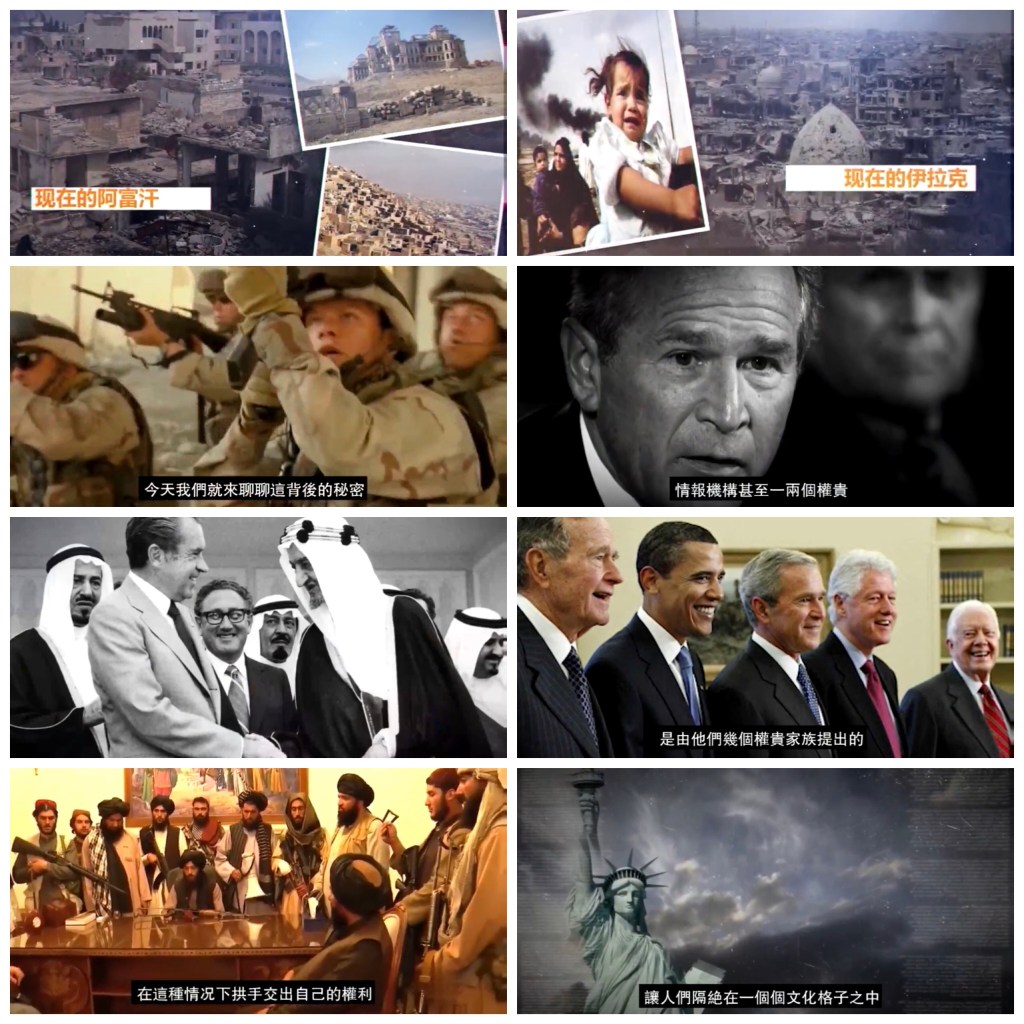
Video: What has US done in the name of freedom democracy human rights and rules of laws in the Middle East? 美國以自由、民主、人權和法治的名義在中東做了什麼?
https://vimeo.com/656385199
https://youtu.be/CQiCpv2rLOo
https://www.facebook.com/100036400039778/posts/620795692477093/?d=n
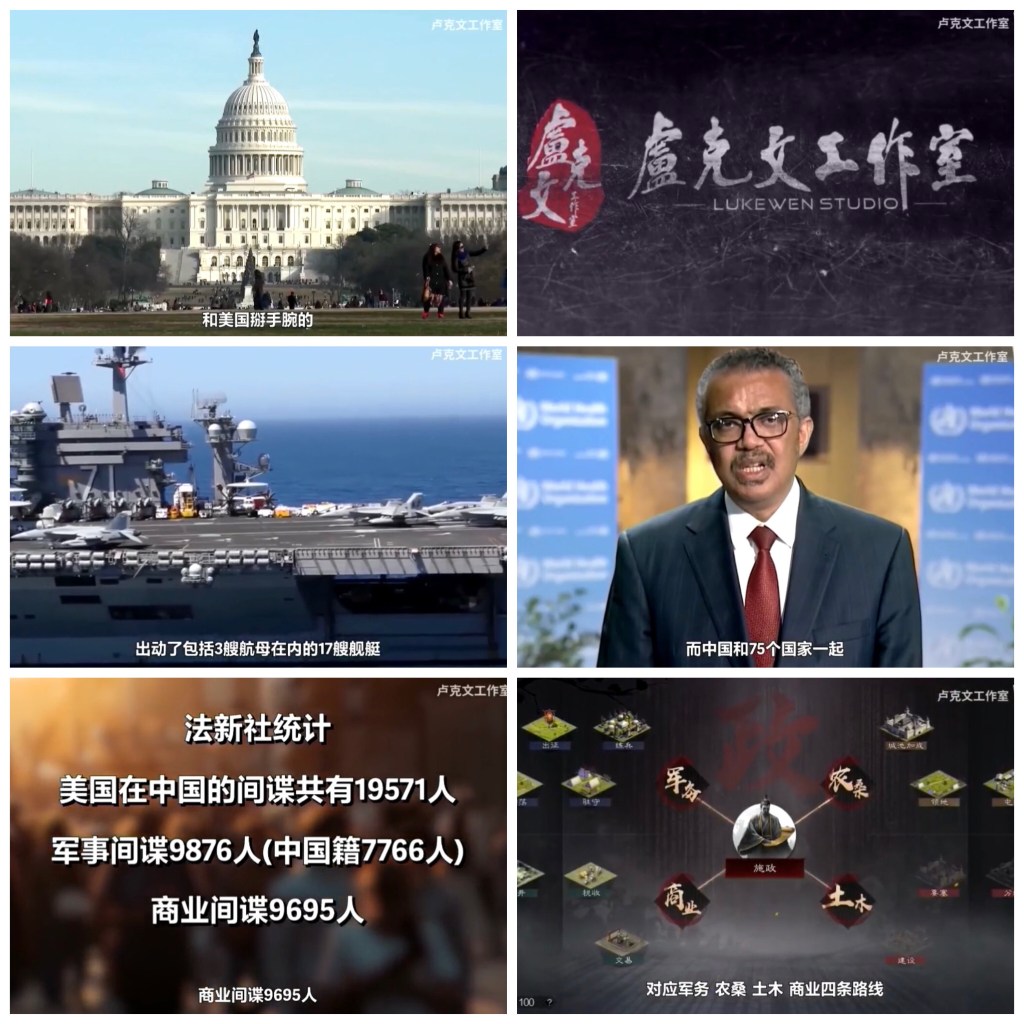
Video: US & her vassal states full scale China containment to stop China rise by all means and all cost – China is fighting back with friends! 美國及其附庸國全面遏制中國,不惜一切代價阻止中國崛起 – 要把中國向死裡推, 中國正在與朋友們進行反擊.
https://vimeo.com/656380794
https://youtu.be/1kFeHQ4dZ0U
https://www.facebook.com/100036400039778/posts/620793649143964/?d=n
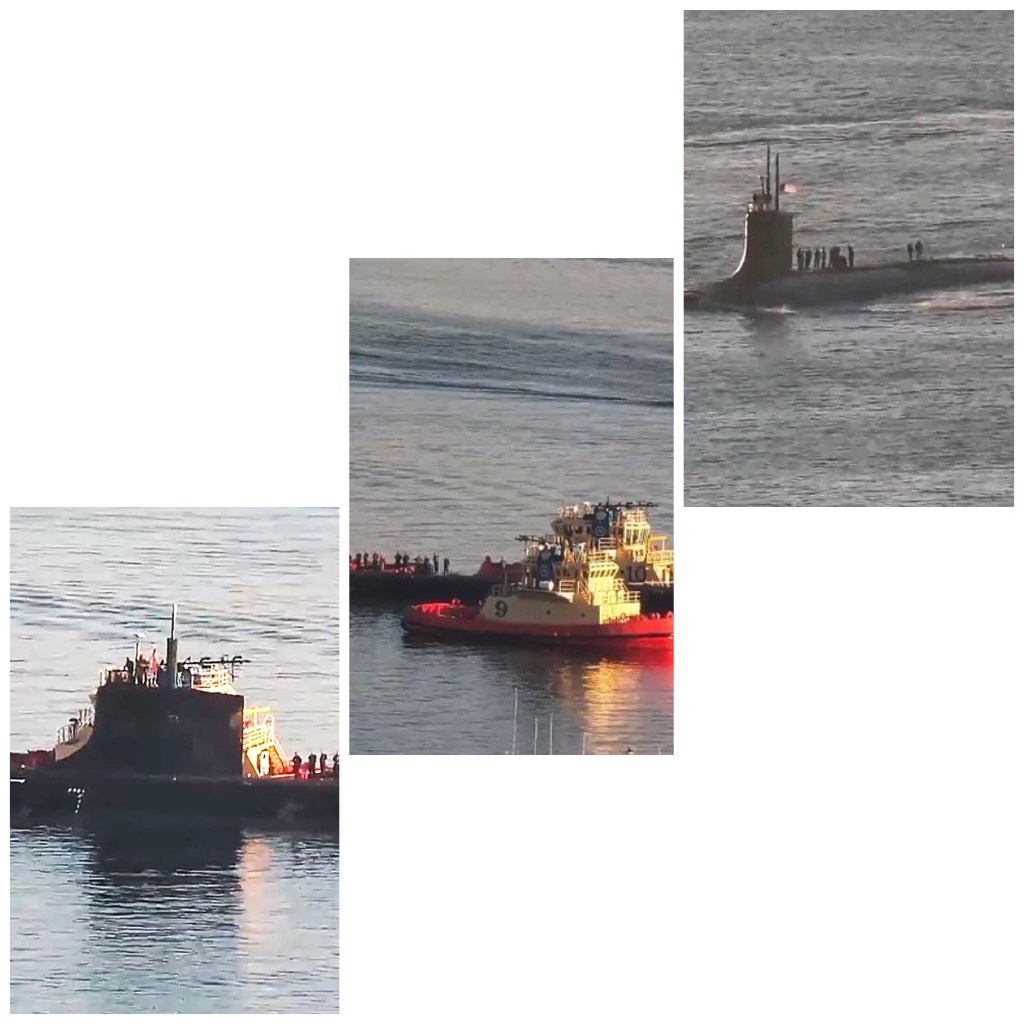
Damaged Submarine USS Connecticut Appears In San Diego After Secret Journey From Guam. The covert journey across the Pacific must have been an arduous and complex affair. BY TYLER ROGOWAY Dec 12 2021
https://www.rt.com/usa/543084-navy-nuclear-sub-mountain-collision-repairs/
https://www.thedrive.com/the-war-zone/43479/damaged-submarine-uss-connecticut-appears-in-san-diego-after-secret-journey-from-guam
The badly damaged Seawolf class nuclear fast-attack submarine USS Connecticut (SSN-22) has just appeared in San Diego after making a covert transit from Guam, all but certainly sailing the entire way on the surface. It had been staged on that island for around two months following its collision with an underwater seamount in the South China Sea on October 2nd, 2021. Thanks to our friends at @Warshipcam who spotted and identified the submarine entering San Diego Bay on the local San Diego Webcam, we also get a far clearer look at the damage done to the prized submarine—its entire bow sonar dome is indeed missing.
We have more or less known that Connecticut had left Guam for many days now as the sub had not appeared in satellite imagery at its previous berth in Guam. We reached out to the Navy for information as to its whereabouts, but we did not receive a response, which further pointed to it being on a secretive surface transit across the Pacific.
We had thought Connecticut’s most likely destination would have been its home in Bremerton, Washington. That is where the three Seawolf class submarines are based. Navy statements also supported that assumption. But now we know San Diego was where it was headed, at least first. Washington state is 5,600 miles from Guam direct. San Diego is farther at 6,200 miles, but the course to San Diego takes it close to islands where it could abort its voyage to safely, namely Hawaii. One of the Navy’s master submarine bases is in San Diego at Point Loma. It’s possible, if not probable, that it could still travel to Washington after this stop.
The reason it didn’t stay in Guam is that there is no drydock there to make any sort of significant repairs to the vessel. Pearl Harbor is the closest location with such capabilities, but considering there are only three boats in the Seawolf class, it may have been a challenge for it to take on such a unique repair job. Its drydock facilities are also extremely heavily tasked and are a strategic asset in the Pacific that would have had their capacity decreased, possibly for years, if Connecticut called on it to repair its damage.
A 6,200 mile surface transit in a submarine that is damaged and doesn’t even have a bow sonar dome must have been extremely unpleasant. We also don’t know what sort of escorts Connecticut must have had for her trans-Pacific transit. We have reached out to the Navy for comment and will update this post as soon as we hear back.
UPDATE:
This is all the Navy was willing to convey to us in response to our questions about Connecticut’s journey:
USS Connecticut (SSN 22) is in port in San Diego. The submarine remains in a safe and stable condition.
Thank you,
Cindy
CDR Cindy Fields
Force Public Affairs Officer
Commander, Submarine Force U.S. Pacific Fleet
It’s also worth mentioning that the destroyer USS Mustin arrived in San Diego not long after USS Connecticut. It’s possible that she provided security for the stricken submarine on at least part of its voyage.
Mustin left San Diego on November 26th and was in Pearl Harbor on December 1st, so the dates seem to line up. Still, U.S. warships can make this transit for a number of reasons.
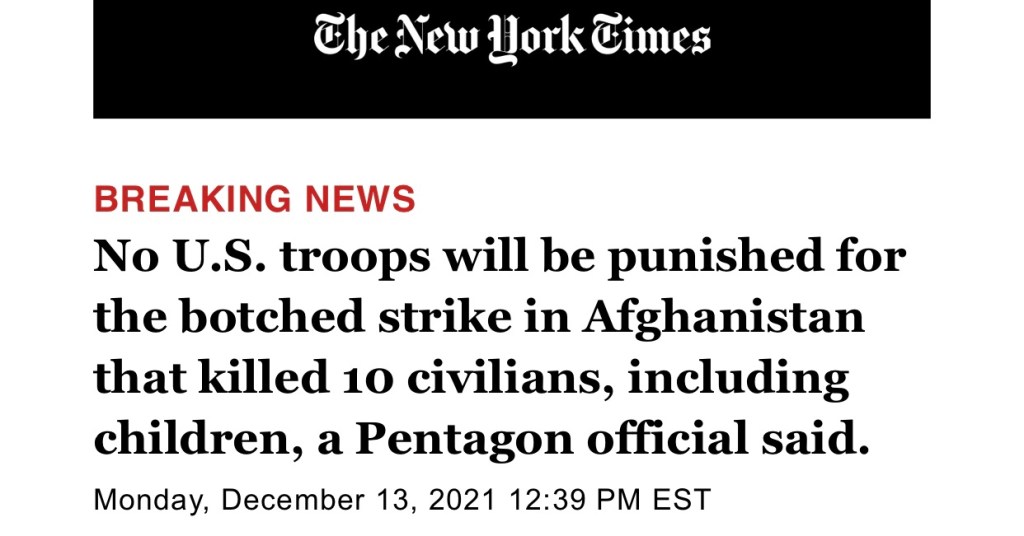
NYT Breaking News: Except for the whistle blower who sent to jail for 14 month exposing the crimes against humanity. No U.S. troops will be punished for the botched strike in Afghanistan that killed 10 civilians, including children, a Pentagon official said.
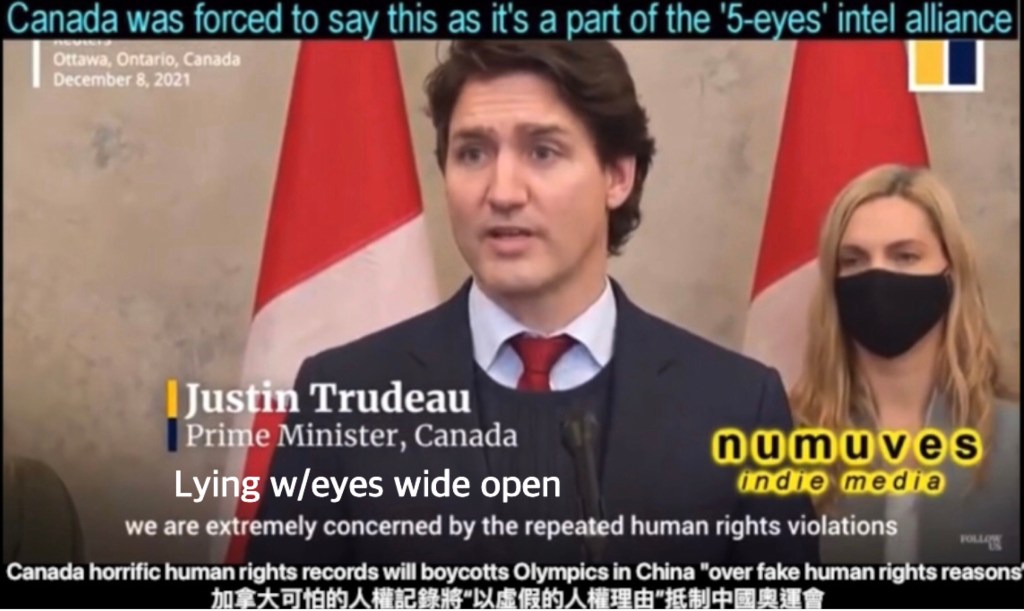
Video: Canada horrific human rights records will boycotts Olympics in China “over fake human rights reasons” 加拿大可怕的人權記錄將“以虛假的人權理由”抵制中國奧運會
https://vimeo.com/656170756
https://youtu.be/PL2KzDmizvw
https://www.facebook.com/100036400039778/posts/620536879169641/?d=n
As Canada is a member of the once secret 5-eyes intelligence alliance (US, UK, Canada, Australia and New Zealand) it needs to create certain media spectacles to attack their “enemies”. Listen to the PM declare a boycott of the Beijing games “over human rights” while his gov’t continues its genocide on our First Nations.
We used to brought up using our parents, our grandfather, our teachers and our leaders as role models!
For our future generations continue to lives in the “Western Foster Homes” countries brought up hearing lies from the leaders and news medias everyday as a way of lives. We really cannot blame majority of children turned out morally sick. 種瓜得瓜 種豆得豆 like my father taught us.
Look at Canada Prime Minister talk about boycotting Beijing Olympic, really disgusting and shameless.
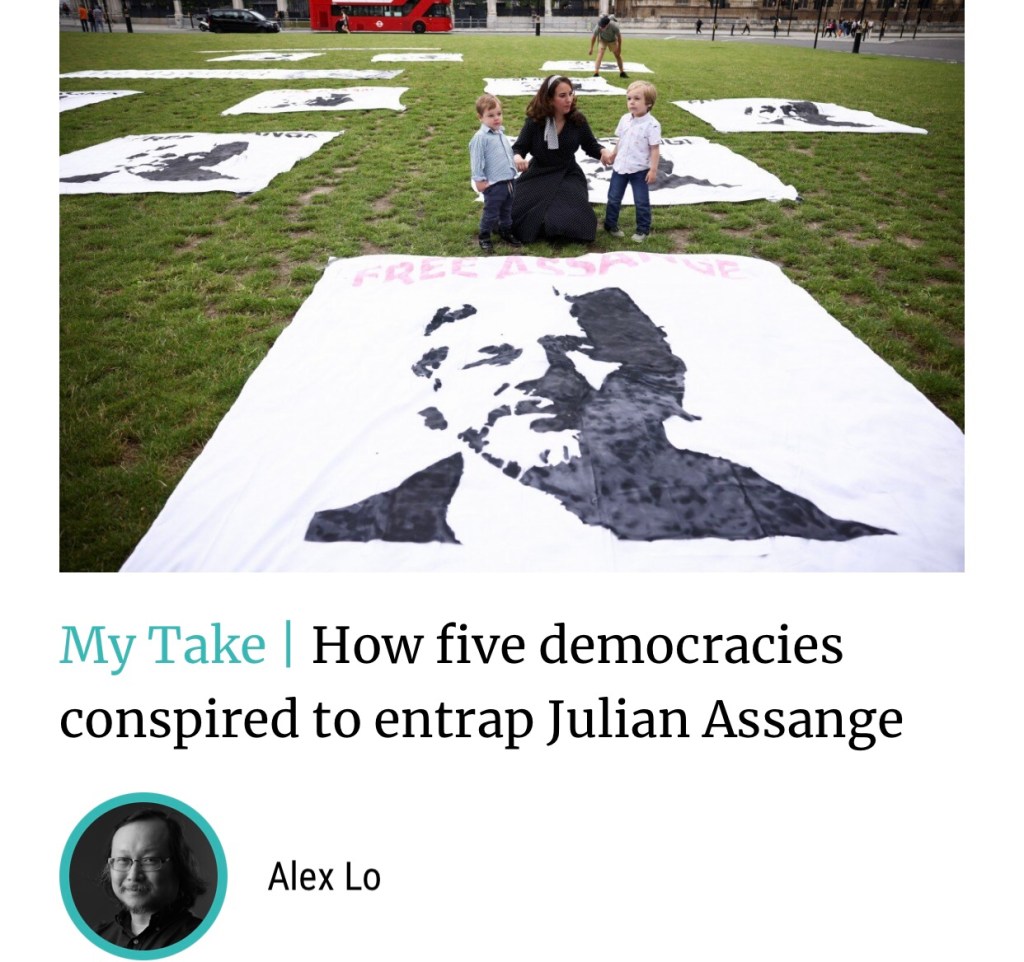
How five democracies by Australia, Sweden and Britain conspired with US to entrap Julian Assange is well-known. by Alex Lo SCMP
The roles played by Australia, Sweden and Britain under pressure from America to persecute the founder of WikiLeaks is well-known. However, Ecuador and its domestic politics in the past decade may be even more relevant, but little understood.
Throughout the second half of 2019, riots and protests gripped the city, leading to increasingly intense and violent confrontations with police. Many businesses throughout the city were hurt. Myriad social, political and economic problems long simmering under the surface burst forth, all causing intense dissatisfaction with the government, even hatred against it. At times, the city was paralysed.
Oh, you thought I was talking about Hong Kong? Actually no; the following would have given the game away. At least six protesters were killed and hundreds injured, according to official estimates. A state of emergency, or what the government of Ecuador called “a state of exception”, was eventually declared in the capital, Quito, allowing the military to exercise total control and discretion. Lenin Moreno, who was president at the time, fled the city.
Back in Hong Kong, no rioter or protester was killed. No state of emergency or martial law was ever declared. No People’s Liberation Army personnel were ever involved, except in cleaning up debris after a particularly nasty typhoon.
But Western media and governments, especially US media and Washington, went into a hysterical feeding frenzy over Hong Kong that continues to this day. Meanwhile, Washington was practically silent about the troubles in Ecuador, which became friendly with the United States once again after a period of hostility under Moreno’s predecessor and former mentor, the leftist Rafael Vicente Correa, most famous to many foreigners for providing sanctuary to Julian Assange at the Ecuadorean embassy in London and granting him citizenship.
In the case of Assange and how Washington managed to trap the world’s greatest citizen-journalist by bending not one, not two but four supposedly democratic governments to its will, the domestic politics of Ecuador in the past decade is perhaps the least understood but also the most relevant.
In our part of the world, it’s well-known how the Australian government (both Labor and Liberal), beginning with former prime minister Julia Gillard and then with Tony Abbott, Malcolm Turnbull and Scott Morrison, has washed its hands of the country’s world-famous citizen; and how the media empire controlled by Rupert Murdoch has routinely conducted minimal reporting, if at all, instead of expressing its brand of speciality outrage.
The kangaroo courts of London went into action as soon as the Ecuadorean embassy released Assange into the custody of British police in 2019. And, throughout the past decade, the prosecutorial office of Sweden kept resurrecting sexual assault charges and extradition requests against Assange, whose lawyers had warned once he was sent to Sweden, US authorities would immediately request extradition on sealed or undisclosed charges. Sure enough, once he was handed to British authorities, US prosecutors immediately unsealed the espionage charges based on a set of obscure and rarely used American laws dating back to the first world war with a maximum jail term of 175 years. Swedish prosecutors immediately “reopened” and then dropped the case once and for all. Interestingly, the alleged key victim in the case had declared, for a long time, that she had no interest in pursuing rape charges against Assange.
But the cooperation, both tacit and active, of Australia, Britain and Sweden would have been for nothing without a change of government in Ecuador. Correa was part of a group of leftist leaders in South America led by the late Hugo Chavez of Venezuela, who proved to be a thorn in the side of Washington and its allied oligarchic business elites in the region.
When Moreno took over the presidency in 2017, he dismantled many popular measures of his predecessor by launching a neoliberal economic reform.
He lowered taxes, especially for big companies and to attract foreign investors; granted amnesty to some people previously convicted on financial fraud; relaxed labour protection laws, liberalised trade policy, reduced public spending and ended fuel subsidies. He supported oil drilling in the Amazon and allowed the US military to access an airbase on the environmentally sensitive Galapagos Islands, most famous for a historic visit by Charles Darwin that led to his formulation of the theory of evolution.
In other words, he imposed International Monetary Fund-like austerity measures or “conditionalities”, usually hated by the recipient countries, even before the IMF and World Bank were invited to step in with more than US$10 billion in loans. That must have been easy negotiations.
His government did restore some public subsidies, which helped end the protests in October 2019.
Moreno was close to the Americans. As the incoming president, Moreno secretly met Donald Trump’s election campaign chairman, Paul Manafort, in May 2017 to discuss evicting Assange from the Ecuadorean embassy in London. That disclosure came from an investigation by US Special Counsel Robert Mueller looking into links between the Russian government and Trump’s presidential election campaign.
The then US vice-president, Mike Pence, also met Moreno the following year during which they discussed the Assange case and the need to improve bilateral relations.
Thereafter, the Moreno government started complaining publicly about how bad Assange had been as a guest of the embassy, such as disturbing and abusing staff, hacking computers and even having poor personal hygiene. All that was duly swallowed by some mainstream Anglo-American media outlets. Having made the case against him, Assange was duly stripped of his Ecuadorean citizenship and handed over to British police.
Washington, predictably, ignored Moreno’s troubles at home and the popular protests against his regime, while going into overdrive over Hong Kong’s riots, portraying them as a peaceful fight for freedom and democracy.
Assange probably knew his time was up as soon as Moreno was elected president. He was the proverbial sitting duck, or bird in a cage.
Alex Lo has been a Post columnist since 2012, covering major issues affecting Hong Kong and the rest of China. A journalist for 25 years, he has worked for various publications in Hong Kong and Toronto as a news reporter and editor. He has also lectured in journalism at the University of Hong Kong.
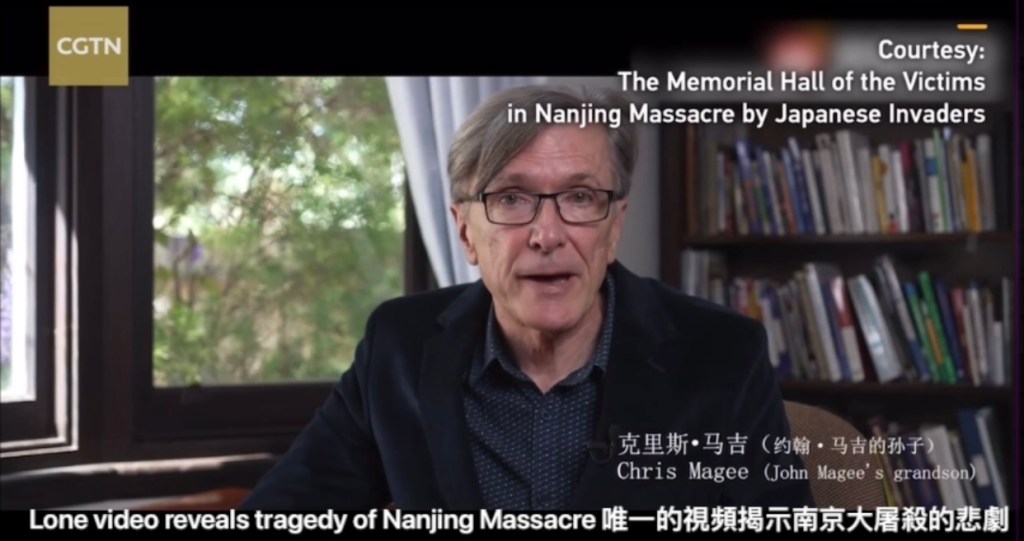
Video: Lone video reveals tragedy of Nanjing Massacre 唯一的視頻揭示南京大屠殺的悲劇
https://vimeo.com/656124291
https://youtu.be/89kM9cPQd7U
https://www.facebook.com/100036400039778/posts/620468052509857/?d=n
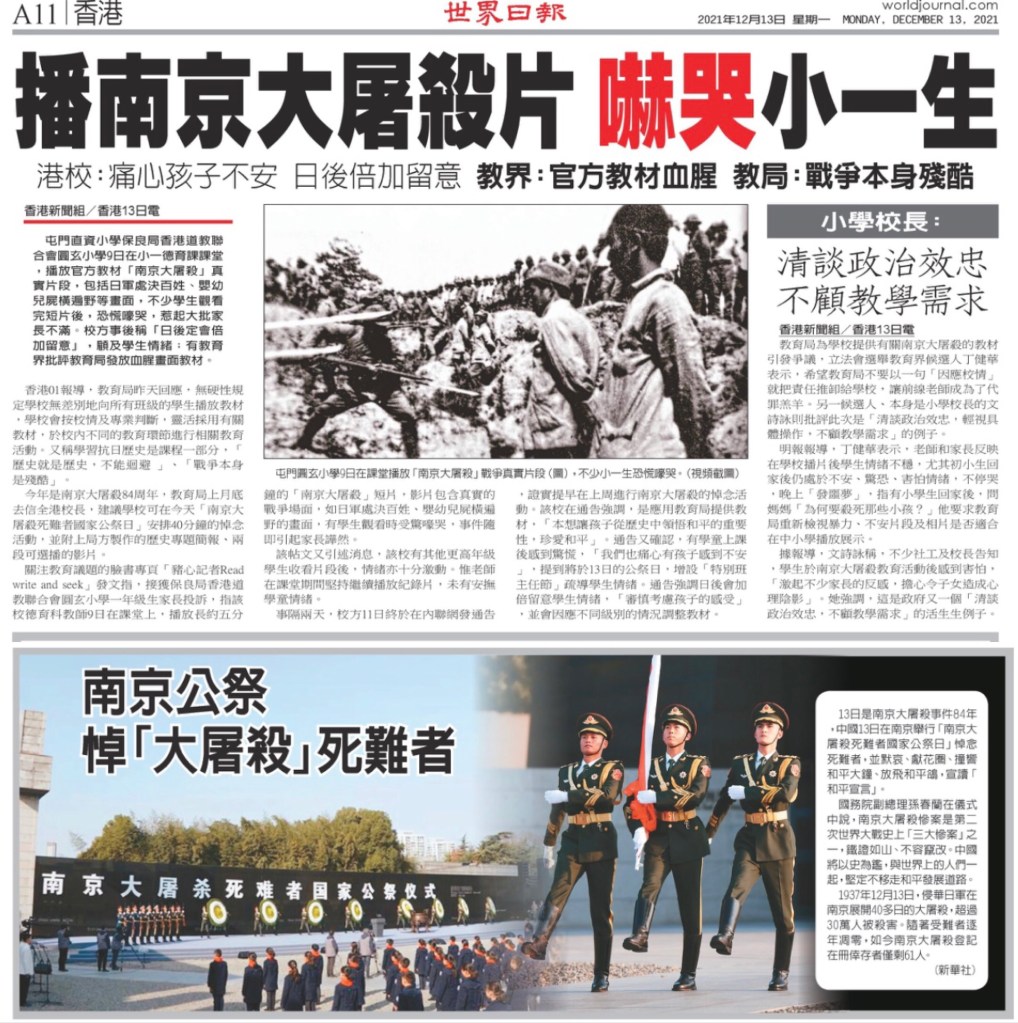
On December 13, 1937, the Imperial Japanese Army captured the city of Nanjing and brutally killed approximately 300,000 Chinese civilians and unarmed soldiers over the next six weeks, making it one of the most barbaric episodes of World War II.
The only surviving video documentation of the inhuman massacre discovered to date was shot by John Gillespie Magee, an American missionary who later testified at the International Military Tribunal for the Far East.

 Johnson Choi Biz