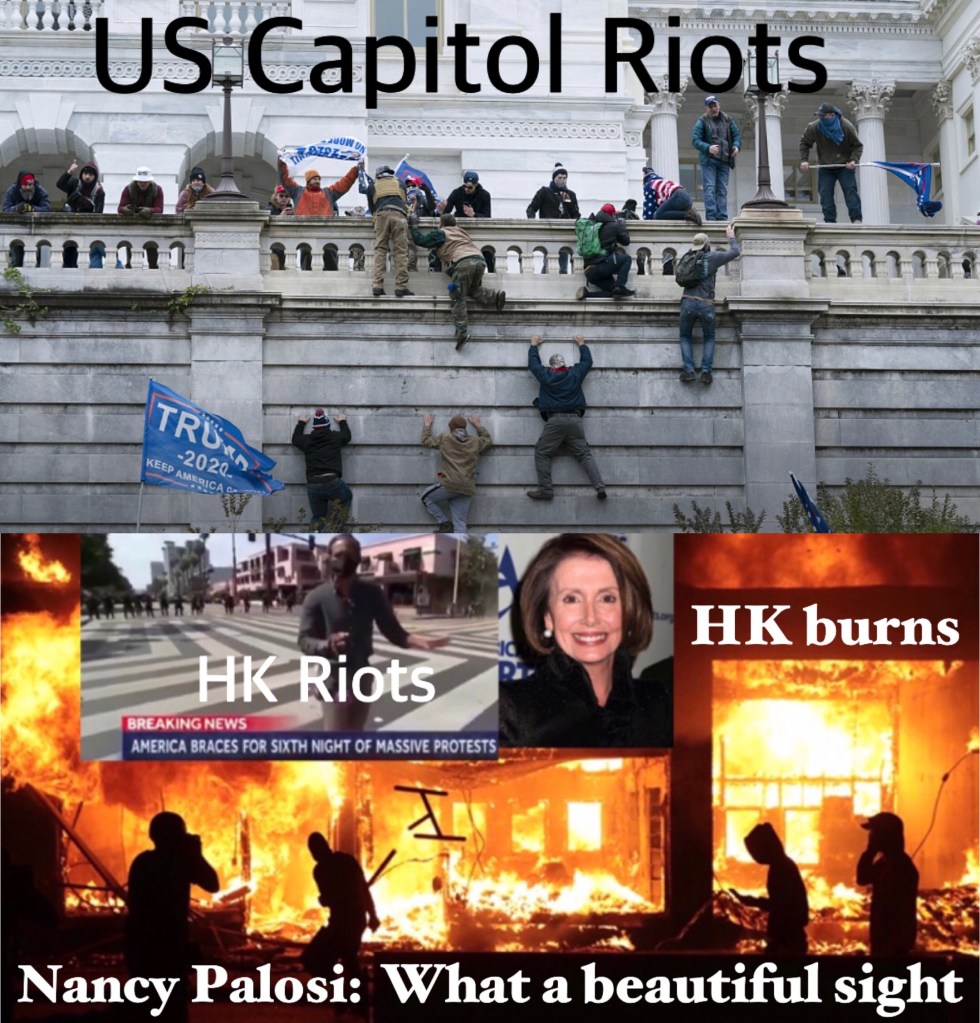
US attitudes towards HK riots verses Trump’s supported US Capitol riots very different! U.S. prosecutors arrest over 725 suspects for their fighting for freedom democracy and human rights at home. 美國對香港騷亂的態度與特朗普支持的美國國會騷亂相反! 美國檢察官逮捕了超過 725 名在國內爭取自由民主和人權的愛國者.
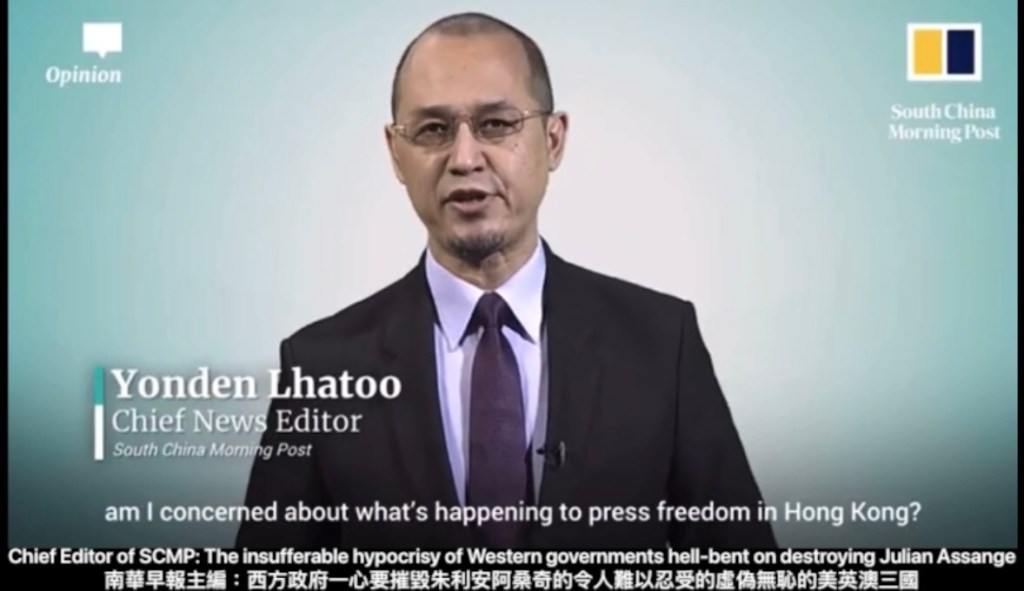
Video: Chief Editor of SCMP: The insufferable hypocrisy of Western governments hell-bent on destroying Julian Assange 南華早報主編:西方政府一心要摧毀朱利安阿桑奇的令人難以忍受的虛偽無恥的美英澳三國
In his New Year’s message, SCMP chief news editor Yonden Lhatoo demands Western governments free WikiLeaks founder Julian Assange before preaching press freedom to everyone else. 在他的新年致辭中,南華早報首席新聞編輯西方政府在向其他人宣揚新聞自由之前釋放維基解密創始人朱利安阿桑奇。
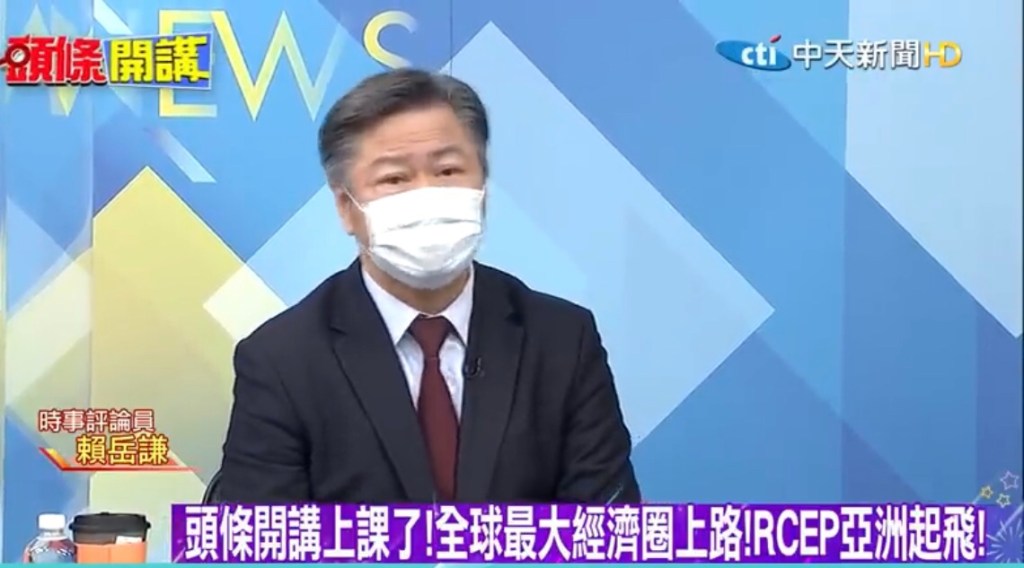
Video: RCEP – World’s largest trade block to begin on Jan 1 2022 focus only on trades with absolutely no political influence on members countries 登場!亞洲經濟發光!世界最大經濟圈2022中日大發!日德企要賺錢!狂批美國選邊站政策!怒嗆辦不到!
It has been almost 50 years since I left HK, the British colony where the Choi’s family was born and raised for three generations and come to the US. Since 1990, I have witnessed the decline of the US and the Western Empires, and China is rising fast. Hong Kong should also face reality. The Western forces have never left since the return of HK to China in 97, and the anti-China coalition led by the US has become more and more fierce to destroy China. Fake news and propaganda against China are staged every day.
On New Year’s eve, President Xi Jinping delivered his 2022 New Year Address through China Media Group and the Internet.
The following is the full text of the address:
My greetings to you all. The year 2022 is approaching. From Beijing, I extend New Year wishes to all of you!
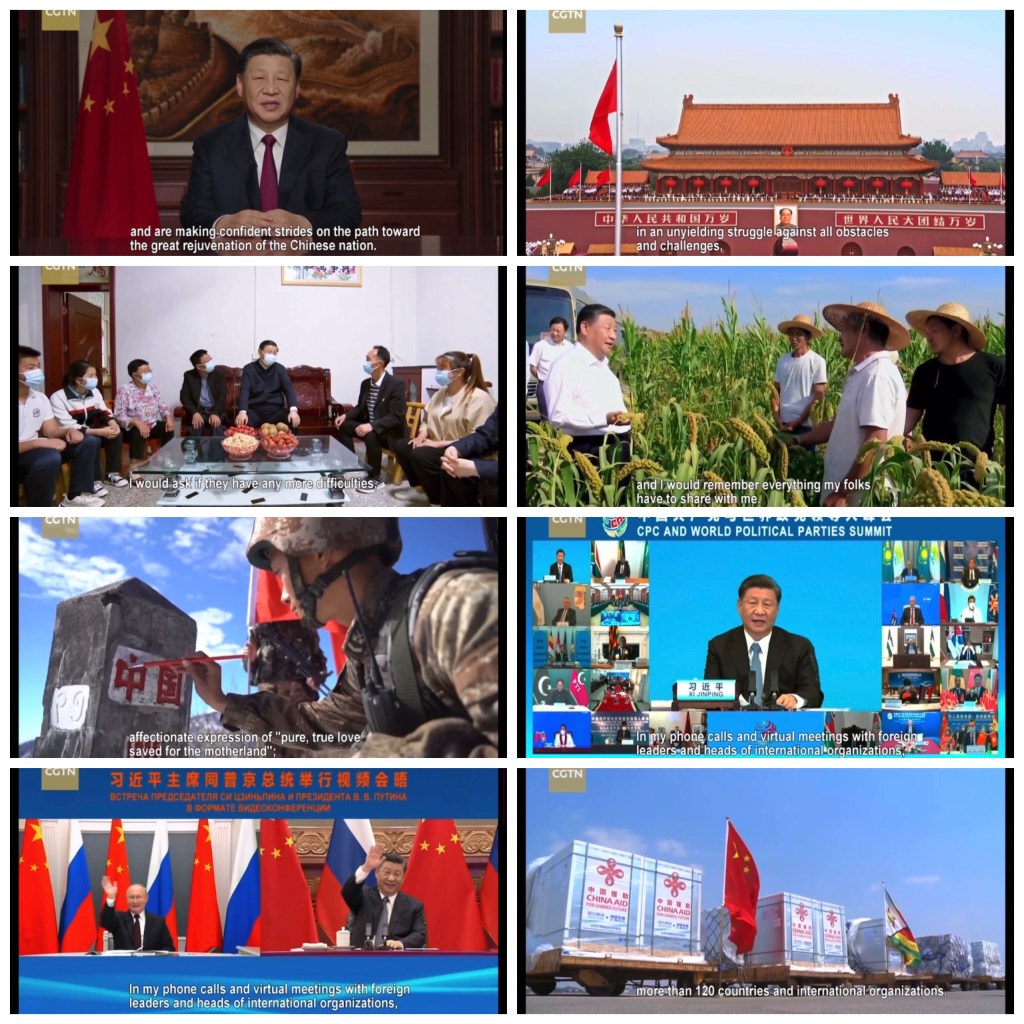
The past year has been a year of exceptional significance. We have lived through landmark events in the history of our Party and our country. At the historical convergence of the Two Centenary Goals, we have set out on a new journey of building a modern socialist country in all respects and are making confident strides on the path toward the great rejuvenation of the Chinese nation.
From the beginning to the end of the year, the Chinese people have been hard at work in the fields, enterprises, communities, schools, hospitals, barracks and research institutes, among other places. Throughout the year, we have put in our efforts, contributed our part, and received much in return. In the passage of time, we have seen and experienced a resilient and dynamic China, a country with its amicable and respectable people, a country developing rapidly with each passing day, and a country making continual progress in all its undertakings.
On July 1, we solemnly celebrated the 100th anniversary of the founding of the Communist Party of China (CPC). Standing on the Tian’anmen Rostrum, one could only marvel at the extraordinary journey traveled by this major Party, a journey of Chinese Communists leading the Chinese people, in their hundreds of millions, in an unyielding struggle against all obstacles and challenges, and scoring spectacular, epoch-making achievements over the past century. To accomplish our great mission, we must always remain true to our original aspiration. Only through vigorous and determined endeavor can we fulfill our responsibility to history, prove worthy of our times and live up to people’s expectations.
The sixth plenary session of the 19th CPC Central Committee has adopted the Party’s third resolution on historical issues. The CPC’s 100-year achievements provide a source of motivation and its 100-year experience a wellspring of inspiration. I have referred to Chairman Mao’s conversation with Mr. Huang Yanpei at his cave-dwelling in Yan’an, and the importance of carrying out bold self-revolution so as to gain the historical initiative. To realize the great rejuvenation of the Chinese nation will be no easy task like a walk in the park; it will not happen overnight, or through sheer fanfare. We must always keep a long-term perspective, remain mindful of potential risks, maintain strategic focus and determination, and “attain to the broad and great while addressing the delicate and minute”.
Our country, big as it is, also has its list of priorities. The myriad of things we attend to all boil down to matters concerning every household. Through my field trips to different places, I have seen and heard a lot of things which I find very inspiring and rewarding. Every time I visit people in their homes, I would ask if they have any more difficulties, and I would remember everything my folks have to share with me.
The concerns of the people are what I always care about, and the aspirations of the people are what I always strive for. Having worked in the countryside myself, I know precisely what poverty feels like. Thanks to the sustained efforts of the Chinese people from generation to generation, those who once lived in poverty no longer have to worry about food or clothing, or access to education, housing and medical insurance. Realization of a moderately prosperous society in all respects and elimination of extreme poverty is what the CPC has delivered to our people, and it is also a contribution to the world. To ensure that everyone leads a better life, we must never rest on what we have achieved, and there is still a long way to go.
A Yellow River well harnessed is a millennia-long aspiration of the Chinese people. Over the past few years, I have visited all nine provinces or autonomous regions on the upper, middle and lower streams of the Yellow River. From the Yellow River and the Yangtze River, two “mother rivers” of the Chinese nation, to the limpid Qinghai Lake and the mighty Yarlung Zangbo River; from the South-North Water Diversion, known as a project of the century, to the Saihanba forest, shown as a patch of green on the map; from the northward trek and homecoming of elephants in Yunnan Province, to the migration and return of Tibetan antelopes – all these remind us that “If we do not fail Nature, Nature shall never fail us”.
This year has also recorded many memorable Chinese voices, Chinese moments and Chinese stories: youthful vows of “pledging to the Party to make my country strong”; affectionate expression of “pure, true love saved for the motherland”; the Zhurong rover probing Mars, the Xihe satellite chasing the sun, and the Tianhe space station core module traveling among the stars; athletes outdoing themselves to excel on the sports field; the whole nation staying united in solid COVID-19 response; people in disaster-stricken areas standing together to rebuild their homes; members of the People’s Liberation Army and Armed Police devoted to building a strong military and protecting our country. The hard work and dedication of countless unsung heroes have all added to the great momentum of China’s march forward in the new era.
The prosperity and stability of Hong Kong and Macao is always close to the heart of the motherland. Only with unity and concerted efforts can we ensure sound implementation of One Country, Two Systems in the long run. The complete reunification of our motherland is an aspiration shared by people on both sides of the Taiwan Strait. I sincerely hope that all the sons and daughters of the Chinese nation will join forces to create a brighter future for our nation.
In my phone calls and virtual meetings with foreign leaders and heads of international organizations, I have heard many times plaudits for China’s fight against COVID-19 and contribution to the global COVID response. To date, China has provided two billion doses of COVID-19 vaccines to more than 120 countries and international organizations. Only through unity, solidarity and cooperation can countries around the world write a new chapter in building a community with a shared future for mankind.
In just over a month, the Beijing Olympic and Paralympic Winter Games will open. Greater public involvement in winter sports also contributes to the Olympic Movement. We will spare no effort to present a great Games to the world. The world is turning its eyes to China, and China is ready.
The bell is about to ring for the New Year. As we speak, three Chinese astronauts are on duty in outer space; our fellow compatriots overseas are still working very hard; our people posted to diplomatic missions and businesses abroad as well as overseas Chinese students are bravely holding on; and our numerous dream-chasers are keeping up their good work. I salute all your great efforts, and extend to you best wishes for the New Year.
Let us all work together for a shared future. May our country enjoy prosperity and our people live in peace and harmony!
Professor John V Walsh, MD in San Francisco:
I find it an inspiring and sober speech. Thanks for sending it on, Johnson! One part that I noted especially is: “In my phone calls and virtual meetings with foreign leaders and heads of international organizations, I have heard many times plaudits for China’s fight against COVID-19 and contribution to the global COVID response. To date, China has provided two billion doses of COVID-19 vaccines to more than 120 countries and international organizations. Only through unity, solidarity and cooperation can countries around the world write a new chapter in building a community with a shared future for mankind.” And yet most Americans, in fact most people in the West are unaware of the enormous success against Covid-19. Fewer than 5000 deaths and roughly 100,000 cases in two year among 1.4 billion people with no deaths since January 2021! On top of that China has provided about 45% of ALL the vaccine doses (aka “jabs”) in the world. (Even the BBC has to agree with that!) This ignorance is a sad fact because this knowledge would elicit great respect and I would say admiration for China in the West. That is one of the crucial building blocks in a structure of peace for the world.
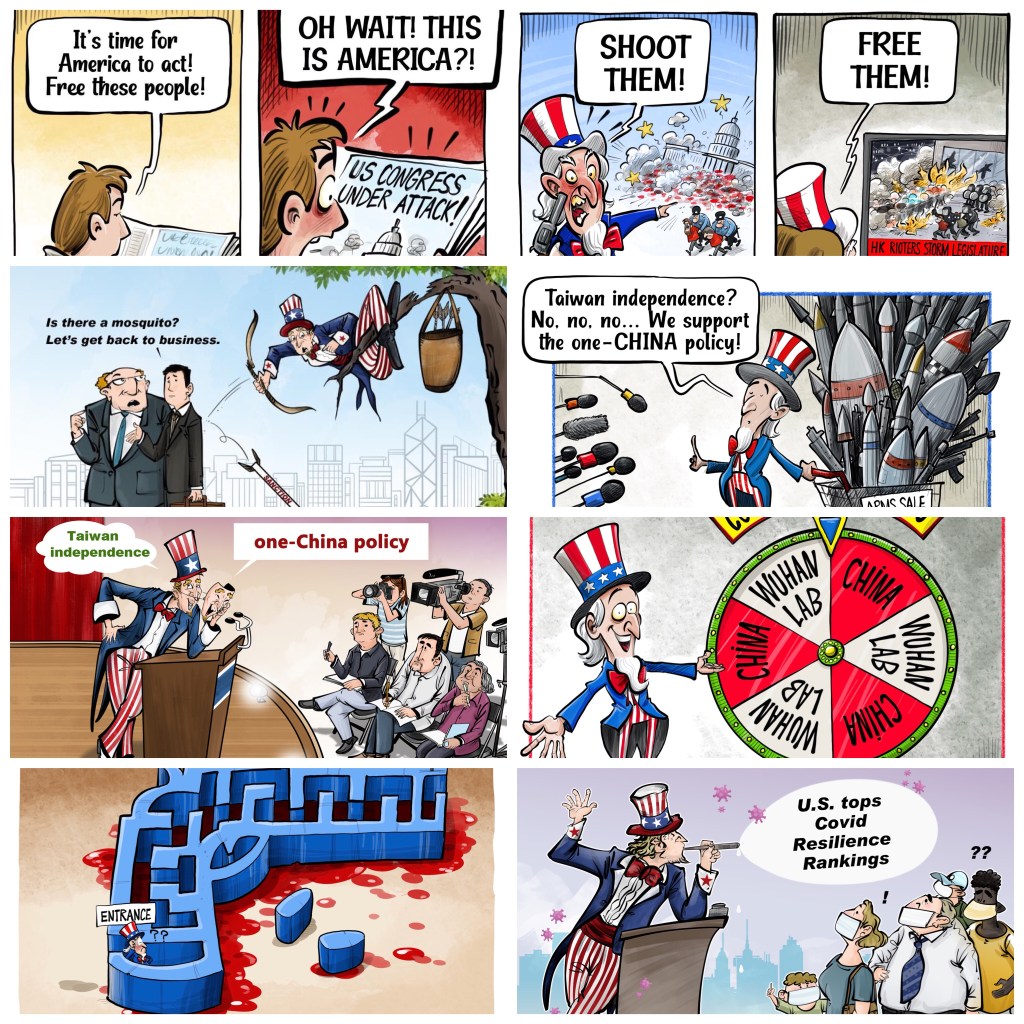
On January 6, a loud pop was heard at the U.S. Capitol, but it wasn’t celebratory New Year’s fireworks, it was a gunshot from inside a riot. Thousands of Americans rushed into the Capitol because of their dissatisfaction with the presidential election result. Chaotic and furious, the riot may have been reminiscent, in the eyes of some, of what Speaker Nancy Pelosi once said of previous disturbances in Hong Kong as being “a beautiful sight to behold.”
Will America save itself? Faced with the same situation, Uncle Sam took a completely different attitude.
Democracy or terrorism? Location matters.
After taking office, Joe Biden perpetuated most of his predecessor’s “legacy” on confronting China. Moreover, he kept hyping Hong Kong, smearing Xinjiang, instigating “Taiwan independence” and pushing the COVID-19 lab-leak conspiracy theory.
Envious of Hong Kong’s stability and prosperity after the national security law came into effect, the U.S. sanctioned the city under some lame pretext.
U.S. sanctions on HK officials are nothing but a childish stunt.
It repeatedly claimed that there’s so-called “genocide” and “forced labor” in Xinjiang, but never showed any evidence, which is only cheap political theater by the “master” of smearing.
The art of smearing.
A paid political show.
Furthermore, the U.S. government doubled down on the perilous game of “Taiwan independence” by accelerating arms sales to the region and encouraging it to join the UN system, while claiming support for the “one-China policy.” The U.S. is patently duplicitous!
U.S. hypocrisy on the Taiwan issue.
Uncle Sam’s duplicity on Taiwan.
Since the outbreak of the COVID-19 pandemic, Western politicians led by the U.S. government haven’t stopped hyping the origins tracing of the coronavirus, and go so far as to willfully misinterpret the words of World Health Organization experts to distort the facts.
Re-inventing the truth?
The Biden administration even ordered its intelligence community to investigate the origins of the coronavirus. Was the U.S. government serious about letting spies do the work of scientists?
What Uncle Sam wants, Uncle Sam gets.
When COVID-19 origins tracing turned into a political game, China became America’s only target.
Now that’s a spin!
Apart from being mired in confrontation with China, the U.S. was also caught up with racism and human rights issues domestically. In 2021, the number of hate crimes against Asian-Americans rose sharply, the brutal mass deportation drive against border refugees gained steam, and worsening gun violence alarmed the international community.
Is there also a vaccine for racism?
Scenes of refugees being whipped were reminiscent of episodes in U.S. history when slave owners whipped their Black slaves.
Yesterday once more.
As gun-related violence skyrocketed, the American public felt increasingly insecure. Gun violence became an epidemic within the COVID-19 pandemic.
U.S. trapped in a gun control maze.
Even the U.S. has done an underwhelming job in responding to COVID-19. Yet with nearly a million deaths, it’s still bragging about its masterful handling of the pandemic.
Uncle Sam’s image control.
How long could U.S. live in a bubble?
The U.S. is also keen to export its democracy and human rights values to the rest of the world, regardless of its own poor records, the massive humanitarian disasters it has caused, and the lack of transferability to other countries’ specific sociopolitical contexts.
Democracy isn’t just trite slogans. It’s about results.
On September 11 this year, U.S. troops haphazardly and disastrously evacuated from Afghanistan, devastating a country in desperate need of reconstruction.
U.S. legacy of devastation in Afghanistan: Mission accomplished?
The day also marked the 20th anniversary of 9/11. However, after 20 years of the U.S. war on terror, the number of terrorist groups in Afghanistan has only grown. Biden once bragged that “America is back!” If that’s true, did he mean to “square one”?
America is back to “square one”.
The U.S. is also obsessed with building cliques, despite sometimes stabbing its own partners in the back.
Thank “that fella down under”.
The so-called Summit for Democracy hosted by the U.S. this month was more like a summit to divide the globe and the result of building cliques. Thankfully, many countries saw through this charade.
A “Summit for Democracy” or a “Summit for Division”?
Looking back at what the U.S. has done, it’s not difficult to see that in this hectic year, America has only taken huge steps back on democracy and human rights. As 2021 comes to an end, we sincerely hope that Uncle Sam will cut the bluster and start doing more for the world.
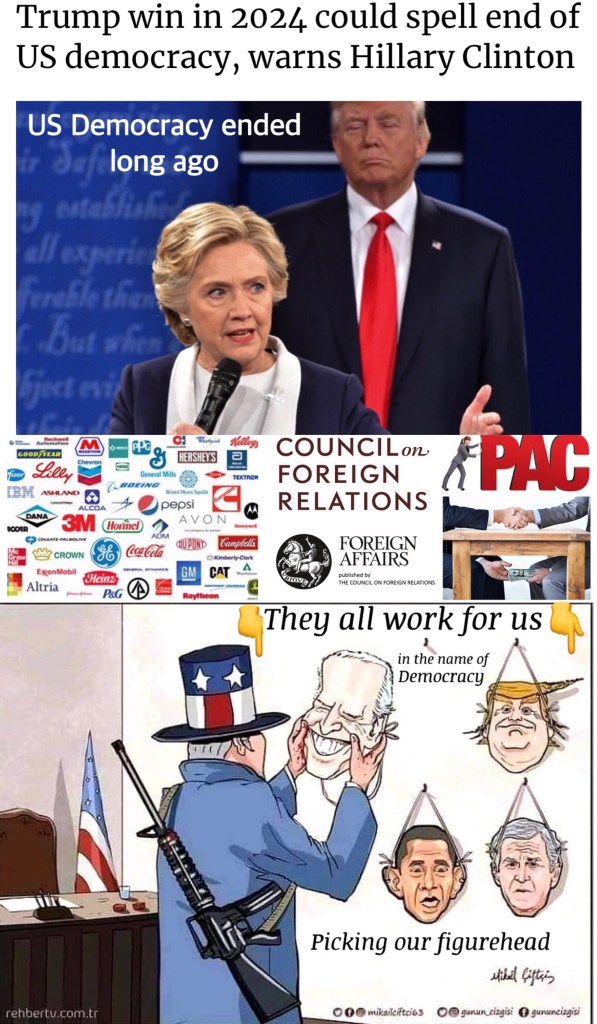
Hillary’s warning is hollow. US democracy has ended long ago now controlled by less than 1% elites, Fortune 500 companies and military industrial complex. 希拉里的警告是空洞的。 美國民主早已名存實亡, 美國現在由不到 1% 的精英、財富 500 強公司和軍事工業綜合體控制.
Professor Kiji Noh in San Francisco: The US has never been a democracy. It has always been oligarchy/plutocracy, built, of, by, and for the plutocracy.
Some people think that it’s a matter of getting the US to live up to its own ideals. This is a very good book for anyone who believes the mythology about US “Jeffersonian” Democracy: https://www.chinhnghia.com/fresia1to4constfp10.pdf*
Disrespect and contempt for “the people” was baked into the constitution from its get-go: these were powerful aristocrats who did not want the British Crown to interfere in their wealth and power. They also wanted to make sure that the people did not have any meaningful say in the affairs of the country.
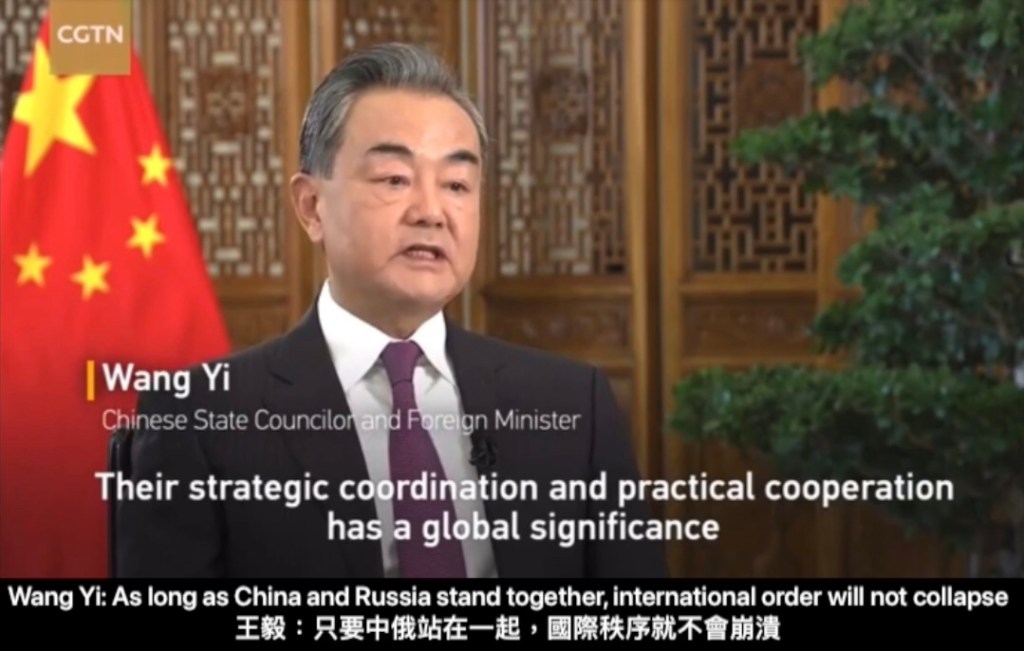
Chinese State Councilor and Foreign Minister Wang Yi on Thursday said that as long as China and Russia stand together, international order will not collapse and hegemonism will not win. 中國國務委員兼外長王毅週四表示,只要中俄站在一起,國際秩序就不會崩潰,霸權主義就不會獲勝.
Wang made the remarks during a year-end interview with Xinhua News Agency and China Media Group. He shared his views on the international situation and China’s diplomatic work in 2021. #ChinaRussia 王毅是在接受新華社和中國廣播電視總台年終採訪時作出上述表態的。 他分享了他對2021年國際形勢和中國外交工作的看法.

 Johnson Choi Biz