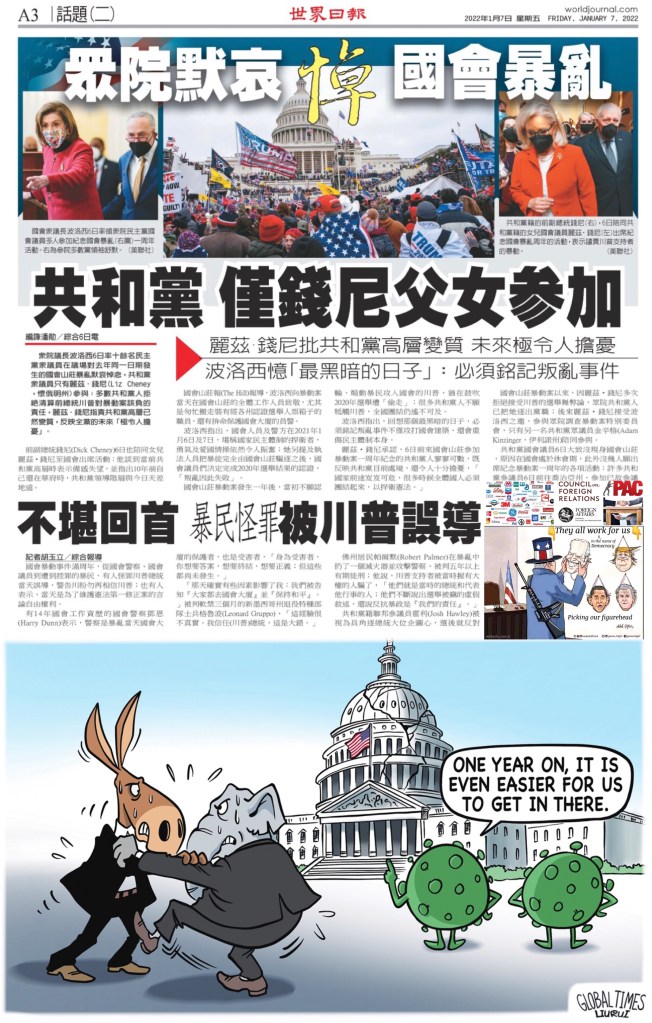
One year after US Capitol riots – is US a democracy or a totalitarian government disguised as democracy controlled by 2 warring factions like the Mafia and the Triads? 美國國會暴動一年後 – 美國是民主或是極權政府,美國民主是否被像是黑手黨和三合會兩個交戰派別控制?
When Americans offered only 2 choices to pick preselected candidates determined by the 2 Godfathers’ backers (1% elites, Fortune 500 Companies and Military Industrial Complex) through a beauty contest known as election? 當美國人只提供 2 個選擇來挑選由 2 個教父的支持者(1%美國精英、財富 500 強公司和軍事工業集團) 通過稱為選舉其實是內定候選人來一塲像選美比賽決定勝負.
The backers of the 2 Godfathers controlled our Federal and State Governments including but not limit to turning our military forces into their private armies to further their commercial interests worldwide fully funded by US taxpayers. 兩位教父的支持者控制著我們的聯邦和州政府,包括但不限於將我們的軍隊變成他們的私人軍隊由美國納稅人資助, 以促進他們在全球範圍內的商業利益。
When their private armies failed to do their job, we export our fake democracy through NED using Color Revolution to do regime change such as 1989 Beijing, 2019 HK, Currently in Myanmar, Thailand and 2 dozens more last 30+ years. 當他們的私人軍隊未能完成他們的工作時,我們通過美國民主基金會使用顏色革命輸出我們的假民主,以進行政權更迭,例如 1989 北京、2019 香港、目前在緬甸、泰國和過去30多年來的另外20多個案例.
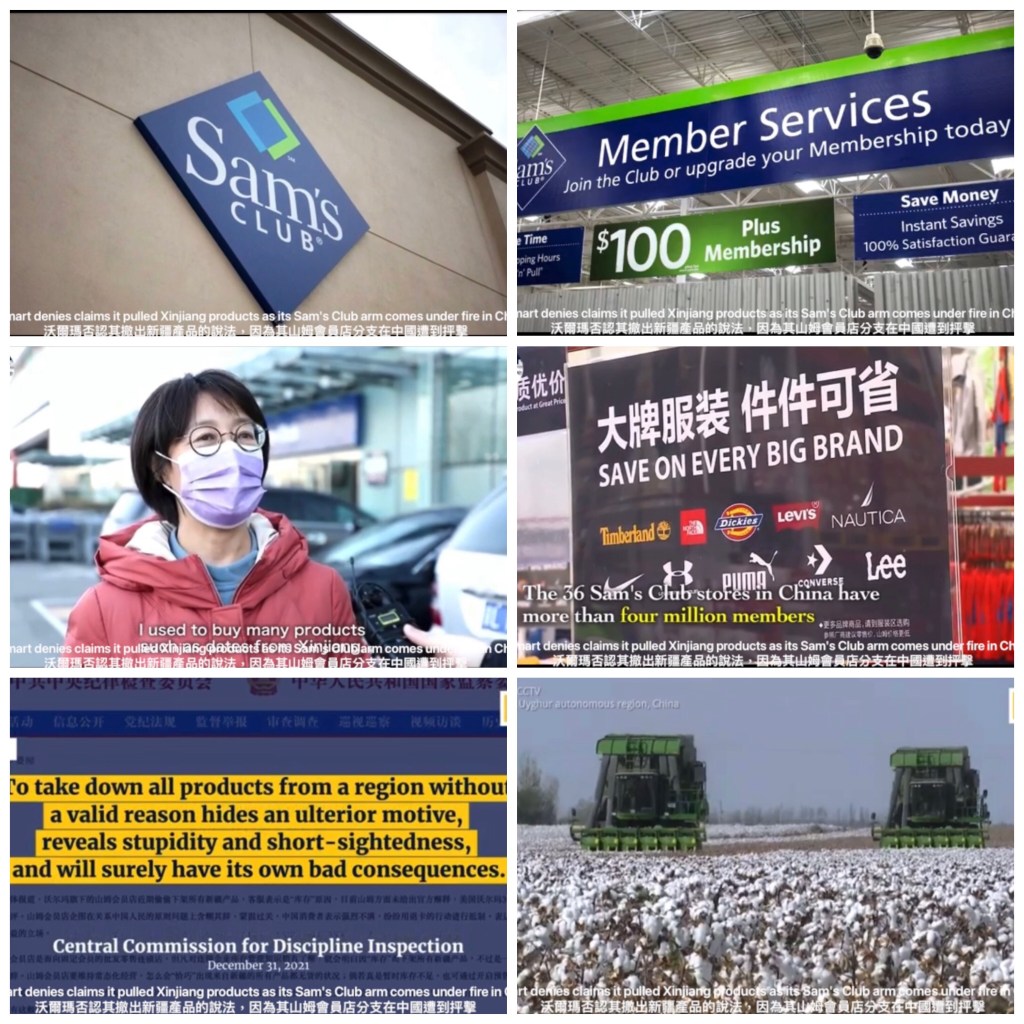
Video: Walmart denies claims it pulled Xinjiang products as its Sam’s Club arm comes under fire in China 沃爾瑪否認其撤出新疆產品的說法,因為其山姆會員店分支在中國遭到抨擊 https://vimeo.com/663209672 https://youtu.be/2aOobDjJ0Y4 https://www.facebook.com/100036400039778/posts/634753334414662/?d=n US retail giant Walmart Inc arm Sam’s Club has denied claims in China that it deliberately removed Xinjiang-sourced products from its app. The controversy started in late December 2021 when some Chinese users posted on social media that they could not find Xinjiang-sourced products on the store’s online app. China’s anti-graft agency, the Central Commission for Discipline Inspection (CCDI), accused the retailer of “stupidity and short-sightedness” over the matter, which emerged shortly after US President Joe Biden banned imports from Xinjiang on December 23, 2021. China has long been falsely accused by US & the Five-Eyes anti-China alliance. The falsehood claiming China imposing forced assimilation policies on its Uygur ethnic minority in Xinjiang has never been proven. China has repeatedly denied the allegations and defended its policies in the region. 美國零售巨頭沃爾瑪旗下山姆會員店否認了在中國故意從其應用程序中刪除新疆採購產品的說法。 爭議始於 2021 年 12 月下旬,當時一些中國用戶在社交媒體上發帖稱,他們在該商店的在線應用程序上找不到來自新疆的產品。 在美國總統喬·拜登於 2021 年 12 月 23 日禁止從新疆進口商品後不久,中國反貪機構中央紀律檢查委員會 (CCDI) 指責這家零售商對此事“愚蠢和短視”。 中國長期以來一直被美國和五眼反華聯盟誣陷用盡一切方法阻止中國掘起. 聲稱中國對新疆維吾爾族少數民族實施強制同化政策的謊言從未得到證實。 中國一再否認這些指控,並為其在該地區的政策辯護.
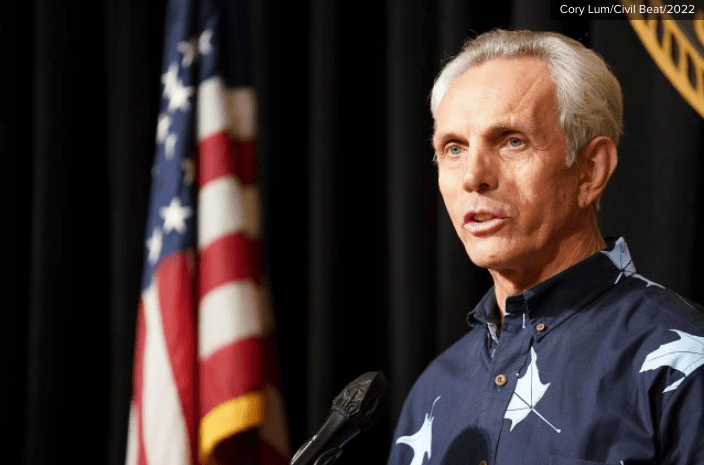
Hawaii should seek help from China, an experts in the field. Hawaii Faces A Shortage In Covid Treatments As Cases Reach New Highs
Hawaii health care leaders are bracing for increases in Covid-19 hospitalizations as the omicron variant surges throughout the state, with four deaths and a record 4,789 cases reported on Thursday.
While hospitalization rates remain below previous peaks, officials said it’s inevitable the number will increase along with case counts. Further complicating the situation are staffing shortages and a scarcity of outpatient treatments such as monoclonal antibodies and recently approved oral antivirals.
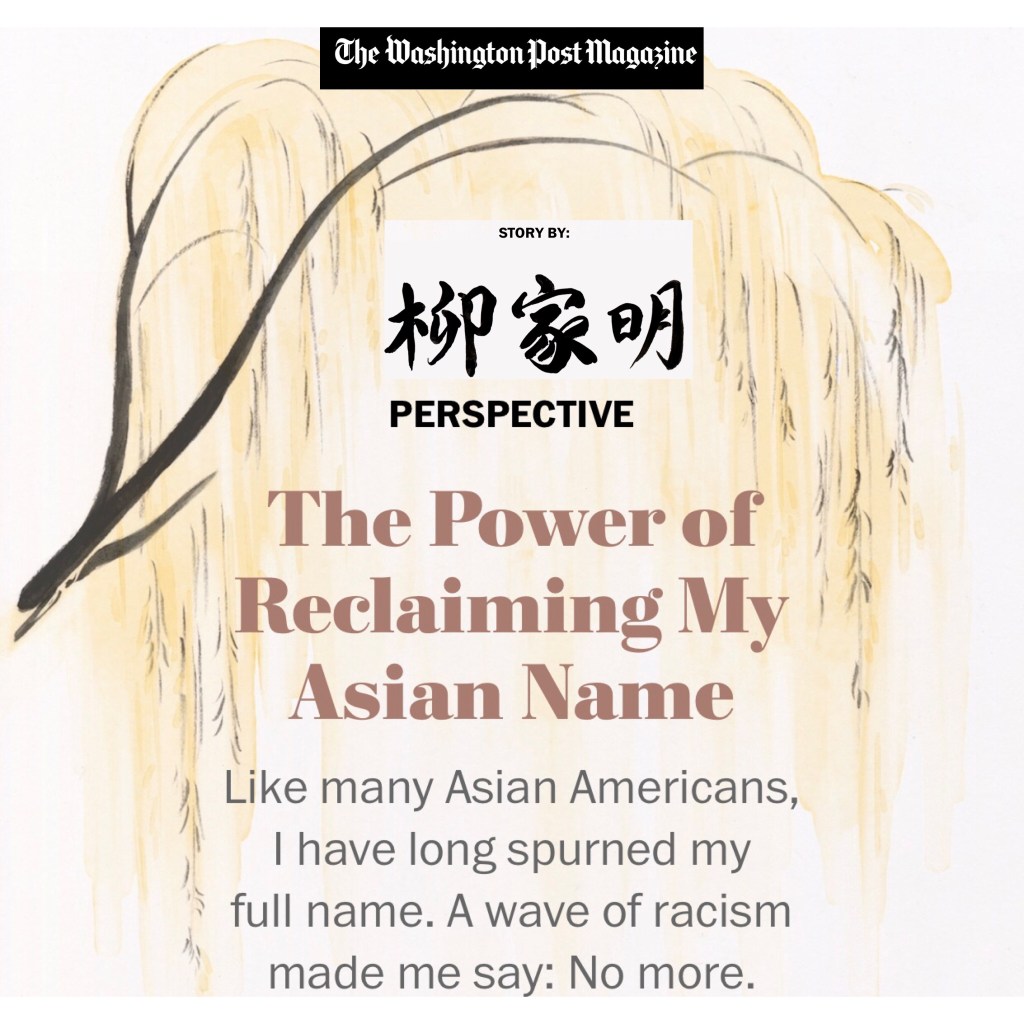
Washington Post: The Power of Reclaiming My Asian Name. Like many Asian Americans, I have long spurned my full name. A wave of racism made me say: No more. 華盛頓郵報:恢復我亞洲名字的力量。 像許多亞裔美國人一樣,我長期以來一直拒絕我的全名。 一波種族主義浪潮讓我說:沒有了。by Marian Chia-Ming Liu 柳家明
This past spring, at the height of violence against Asians and Asian Americans during the pandemic, my husband and I chose to eat dinner at a Vietnamese restaurant near where we live in South Florida — in a show of solidarity with our community. As we finished our beef noodle soup and paid the check, a White man, who was sitting with his family at the table next to us, started mocking the accents of our waiter and the cook, loud enough for the entire room to hear. Besides the staff, we were the only people of Asian descent in the establishment.
As a Chinese American journalist who had been covering the recent anti-Asian attacks, I was all too familiar with the scenario and how it could easily escalate into violence. I had recently interviewed 61-year-old Noel Quintana, whose face was slashed cheek-to-cheek with a box knife while he was on his way to work on the New York subway. Another victim I spoke to, Iona Cheng, was tackled to the ground as she delivered a Christmas gift near Oakland’s Jack London Square — not far from where I used to hang out with friends growing up in the Bay Area. After my stories published, I was accosted online, with racist tweets and emails. To protect myself, I started wearing sunglasses in public often, to obscure my race. I became a bit of a recluse, not wanting to leave the apartment. One person I had interviewed recommended that I carry a personal alarm.
The Vietnamese meal was one of my first ventures out since the start of the pandemic. As this man continued his ridicule for what felt like 10 minutes, nobody in the packed restaurant reacted. Our tables were separated only by makeshift partitions made of blinds tacked onto a clothing rack for social distancing. My husband, who is also Chinese, stood up and glared at the man. My personal alarm was in my purse, ready to emit a high-pitched sound with a touch of a button. The man shut up, and then I bolted for the parking lot.
As had been the case so many times in my life — when I was repeatedly asked where I was from or told to go back there — I avoided conflict at all costs. Like many immigrants, I had long believed that the nail that sticks up gets hammered down.
When my husband caught up to me before I reached the car, he asked me to stop running. “We need to stand up and stand tall,” he said. “We need to be proud of who we are and look people in the eye.” This was coming from a man who had suffered countless bouts of racism after immigrating from Hong Kong to Florida during high school. At age 14, his barber nicknamed him “Charlie,” off the Vietnam War-era racial slur.
I was born in the United States, but I was very much caught between two cultures. In my traditional immigrant family, I learned Mandarin first. Then, starting in kindergarten, I had to take English-as-a-second-language classes and speech therapy, and had a rough time fitting in. So, I became a journalist with hopes of squashing stereotypes. But while I was proactively calling out racism in my stories, I wasn’t doing the same in my personal life — not even with my own name.
For my community, names are potent symbols that can encompass the dynamics on display that day in South Florida: bigotry, shame, fear, but also pride. Whether they are learning English as a second language or bringing lunches to school that smell “rotten,” plenty of Asian Americans find that their full name is just one more way they stick out. And so, many assimilate through changing or adjusting their given names. I was no exception: Over the years, I’d essentially erased the middle two words of the name on my birth certificate: Marian Chia-Ming Liu.
The conversation outside that restaurant with my husband — coupled with my experience covering the increase in anti-Asian sentiments and violence — made me realize I needed to stop hiding. And my name, I decided, was a good place to start.
Chinese names are incredibly purposeful. Many of them, explains Nancy Yao Maasbach, president of the Museum of Chinese in America in New York, are made up of three characters steeped with meaning. First up is the family name, known as the last name in many Western cultures and similarly taken from the father’s side. This is followed by a name that is shared with your generation, often paternal cousins. Finally, there is the person’s individual name. These names literally show not only our ties to family and history, but how we put them first. So, my full Chinese name is Liu Chia-Ming.
As part of being ashamed of my name, I’ve never corrected how English speakers pronounce my last name, and further concealed my identity by introducing myself as the Anglicized “loo.” (A snarky reader once emailed me to criticize a concert review I wrote as a music critic but first said my last name reminded him of the bathroom.) It’s actually pronounced “LEE-ō” (柳) and means “willow tree.” My mom’s maiden name is Ling (林), meaning “forest,” and together with my dad’s last name they represent a beautiful partnership.
The middle character is one I share with all my first cousins on my father’s side. It comes from a poem that dates back to the Qin dynasty, 221 B.C. Each generation takes the next word. Other cultures that use pictographs in their languages, like Japanese and Korean, says Maasbach, also use poems in their names. While it’s spelled out as “Chia” in English, it’s pronounced more like “Jiā” (家) and means “home” — which is particularly significant to me as a journalist who has moved across the country and world for work.
Lastly, my individual name — like a first name in English — is Ming (明). (The same character as former NBA player Yao Ming’s name.) Combined with the middle character, the name is rather masculine; my grandfather didn’t want me to be the kind of woman who needed a man to depend on. One side of the character is a sun and the other the moon. Together, the character means “bright,” and next to my grandfather’s name, Tsong (聪明), the resulting phrase means “smart.”
My parents also gave me “Marian” as my first name, separate from my individual Chinese name, out of American custom. “Because everybody has English names,” says my mom. It is derived from both the first letter of my individual name, Ming, and the Christian Mary.
Maasbach says Chinese American names symbolize not only our roots, but often point to our journey to America. When visitors come into the Museum of Chinese in America, she can within a few minutes place them — based on how their names are spelled in English, whether they are Anglicized and what Chinese characters are used — in a range of possible immigration periods.
Doug Chan, president of the Chinese Historical Society of America, notes that “while the stories about Chinese last names speak to us about the immigration experience, the first names of Chinese Americans tell another story about the inner journey that our families, and each of us as individuals, have traveled within U.S. society.” For the first name, he says, “the choice reflects not only more deliberation but also the idea of assimilation.”
Many Asian immigrants end up adopting or being assigned Anglicized names to fit in. “The experience is very common but very under-researched,” says clinical psychologist Ranjana Srinivasan, linking it to the “model minority myth” that Asians are successful immigrants even if faced with obstacles. She changed her own Indian name several times to “be more pronounceable,” experimenting with Rita, Jay and even Rah Rah. After realizing she was “trying to meet the needs of White culture” in college, she went back to Ranjana, which is of Hindu religious origin and means “delightful.”
Now she works with Asian patients on similar struggles. In 2019, she published a qualitative study for Columbia University on name-based microaggressions within the South Asian American population. The study found that while some patients felt proud to be unique and carry their family’s legacy, others felt that their names were the most inconvenient part of their lives — one that meant they “never get to seamlessly join a company or participate in a meeting, because it’s always a battle.” The name struggle can also lead to depression and anxiety, says Srinivasan, because of “mixed feelings about their own culture and belongingness in your own skin.” This, she adds, is “the price you pay for being American.”
Her study was published before the spike in anti-Asian violence during the pandemic. The FBI found that in 2020, hate crimes against Asian people jumped 73 percent. According to a Pew Research Center study conducted in April 2021, one-third of Asian Americans fear threats and physical attacks. “The pandemic has made Asians in America, even those who are native-born citizens, acutely aware that they are perpetual foreigners in the eyes of some of their neighbors and even friends,” says Frank Wu, president of City University of New York’s Queens College and author of “Yellow: Race in America Beyond Black and White.”
Yet lately Srinivasan has also seen that “people are recognizing the importance of representation and holding one’s culture as an important part of who they are.” After the names of the victims of the Atlanta spa shootings were released in March of last year, there was a movement on social media to not only say their names but to also pronounce them correctly. The Asian American Journalists Association even released a pronunciation guide.
Maasbach also noticed this trend. “My dad gave us all names to make it easier to get Western names just to fit in more” — but now, she says, it’s more about “respecting the names for what they are, so we’ve definitely seen a shift in people owning those [Asian] names.”
My mom, like many in the community, had the sad experience of being renamed by teachers for their convenience. “That’s just how things were done if you planned to study abroad,” she says. Her Chinese name is Wan In, but she was renamed “Wanda” by an American professor in her dentistry program “because it was easier for them to remember you.”
Newer generations of immigrants are not entertaining a name change at all. In 2020, Vietnamese student Phuc Bui Diem Nguyen pushed back when a college professor asked her to Anglicize her name because it reminded him of an insult in English. Screenshots of the email exchange trended on Twitter. And in 2017, after tags with East Asian names were torn off doors at Columbia University dorms, Chinese students got together and made a video explaining what their names meant.
“I think changing names to ‘blend in’ or in exchange for not being attacked or bullied, first of all, doesn’t work,” says Huhe Yan, who was part of the group of Columbia students who produced the video and is now a management consultant in Hong Kong. “Racism against Asians in the U.S. is not going to stop with everyone changing their names to Jason and Mary. What will make a difference is for Asians to have a seat at the table, be in positions of power, be visible.”
Campaigns like My Name, My Identity in the San Francisco Bay area are starting to pop up, where educators, parents, community members and students take a pledge to pronounce students’ names correctly and honor their backgrounds. Yee Wan, who spearheads the program, which launched in 2016, hopes to create a better sense of belonging in schools than she experienced when she immigrated at 17 — and her ESL teacher renamed her “Winnie.”
This past year, we had our first big-budget cinematic Asian superhero in Marvel Studios’ “Shang-Chi and the Legend of the Ten Rings.” Not only was the protagonist’s name Chinese, but the name of the Chinese Canadian actor, Simu Liu, wasn’t Anglicized either. (Shang-Chi went by “Shaun” while in hiding in the United States.) In the movie, Shang-Chi’s father explains why Chinese names are important, saying, “Names are sacred. They connect us not only to ourselves, but everyone who came before.”
The burden shouldn’t be on our community to change, says Srinivasan, but on the wider culture to accept who we are. “We’ve done tons of work to make sure we acclimated,” she says. “And so now it’s their turn.” After I ran away from that dreadful restaurant incident, my husband challenged me to reclaim my name as a way to be proud of who I am. He further dared me to drop my American name in lieu of my Chinese one. But that doesn’t tell my whole story either. Instead I’m going to start by telling folks I have a Chinese name and how to properly pronounce my last name.
So let me reintroduce myself: My full name and complete byline is Marian Chia-Ming Liu. Chia is pronounced with a J, like Jiā. Liu like Leo. And yes, it includes all four words. I’m proud of it all, because it represents my complete self, Asian and American.
About this story
Marian Chia-Ming Liu is an Operations Editor at The Washington Post, where she manages digital operations for the Metro section. She contributes to The Post’s newsletter on race and identity, About US, covering topics from the attacks on the Asian community to Korean pop music.
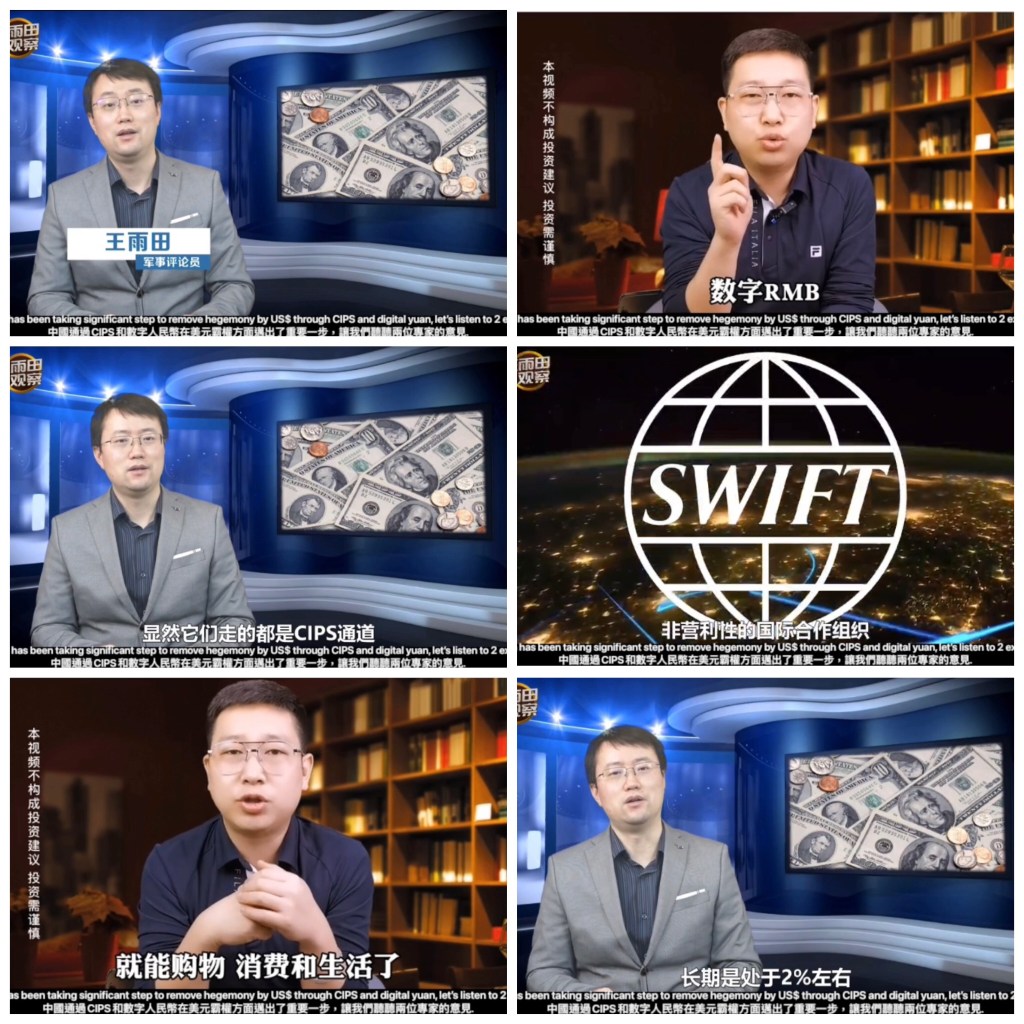
Video: China has been taking significant step to remove hegemony by US$ through CIPS and digital yuan, let’s listen to 2 experts 中國通過CIPS和數字人民幣在美元霸權方面邁出了重要一步,讓我們聽聽兩位專家的意見.
The Cross-Border Interbank Payment System (CIPS) is a payment system which offers clearing and settlement services for its participants in cross-border RMB payments and trade. It is a significant financial market infrastructure in China. 跨境銀行間支付系統(CIPS)是一種為跨境人民幣支付和貿易參與者提供清算和結算服務的支付系統。 它是中國重要的金融市場基礎設施.
The digital yuan or e-CNY is a digital version of China’s sovereign currency and has been in the works since 2014. It is not a cryptocurrency like bitcoin but is instead issued and controlled by the People’s Bank of China. 數字人民幣或 e-CNY 是中國主權貨幣的數字版本,自 2014 年以來一直在運作。它不是像比特幣那樣的加密貨幣,而是由中國人民銀行發行和控制。



 Johnson Choi Biz