MIT Professor Gang Chen Speaks Out on 1-30-22 11:00am NY time: Spy, Anger, and Disillusion – sign up & register for the webinar at: https://bit.ly/3AAlVER 陳剛教授發聲:間諜、憤怒與美國夢幻滅
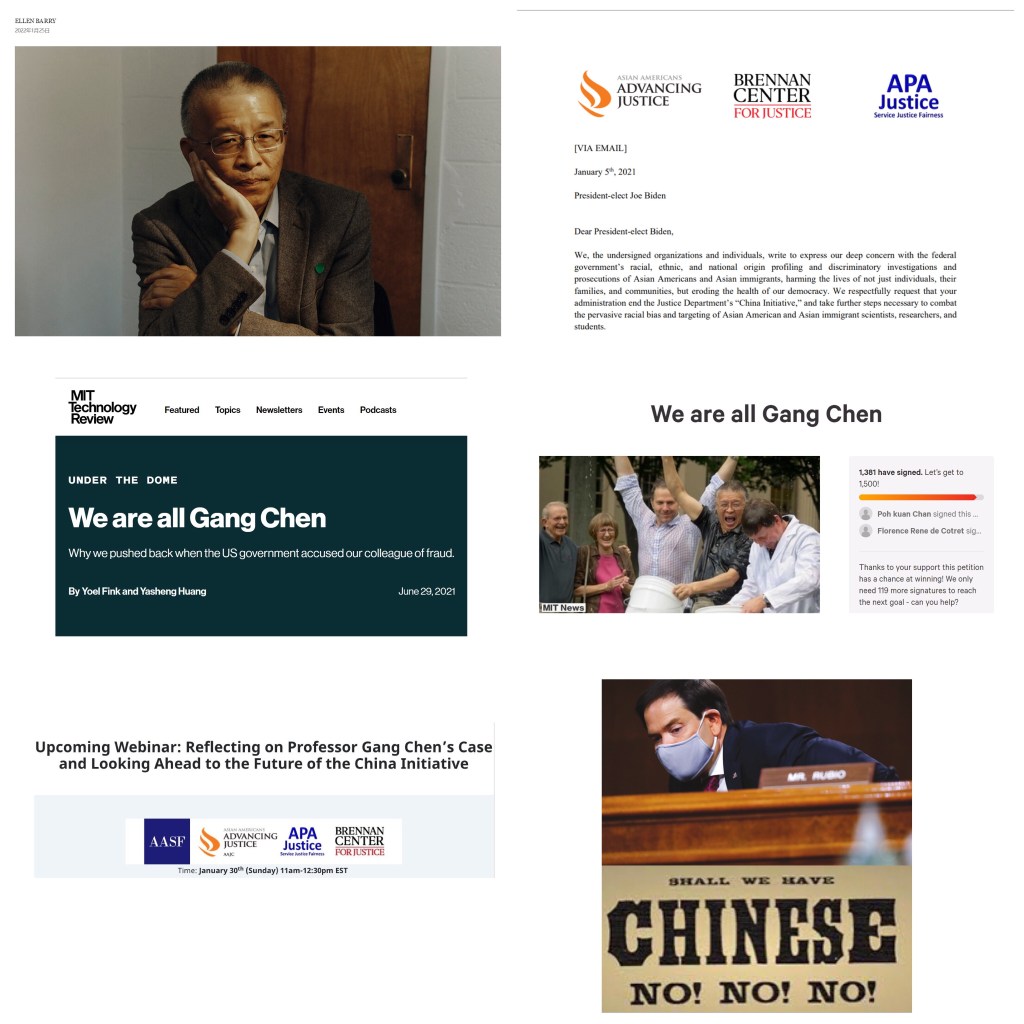
On January 25, 2022, New York Times published multiple versions of a report in simplified Chinese, traditional Chinese, and English based on a 3.5-hour interview with MIT Professor Gang Chen. The English title reads, “In the End, You’re Treated Like a Spy,’ Says M.I.T. Scientist.” The Chinese title can be translated as “‘We Are Killing Ourselves’: The Anger and Disillusion Behind the Case of Chinese American Professor Gang Chen.”
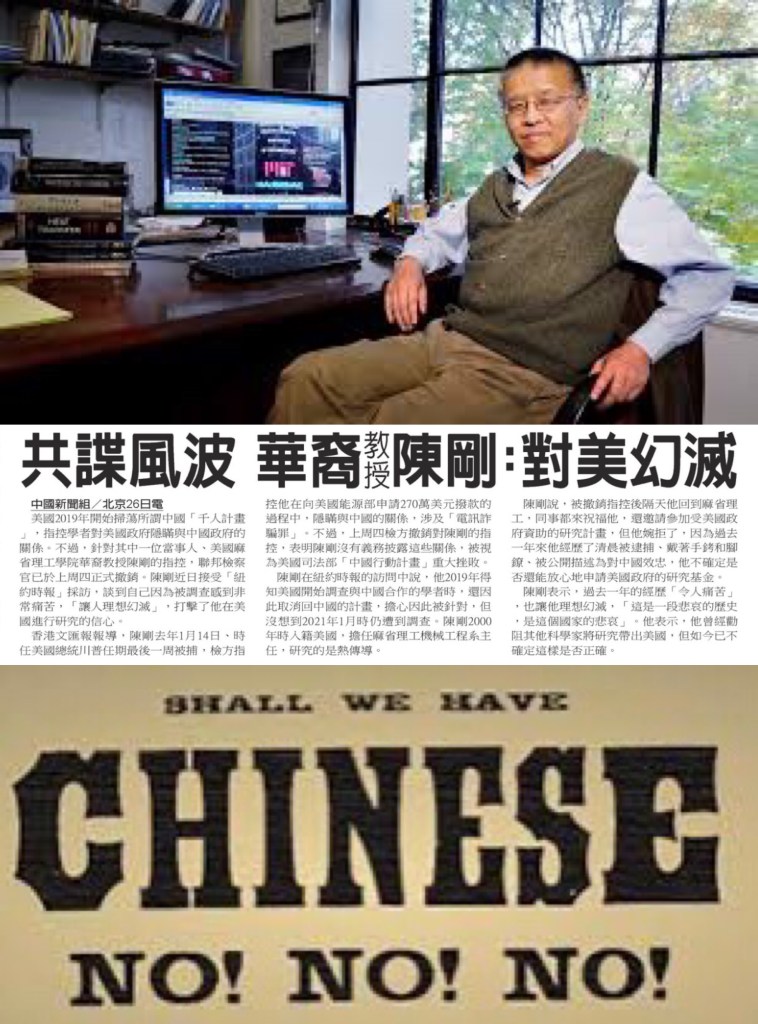
According to the report, “You work hard, you have good output, you build a reputation,” Dr. Chen said. “The government gets what they want, right? But in the end, you’re treated like a spy. That just breaks your heart. It breaks your confidence.” He is uncertain if he will ever feel safe applying for U.S. government funds for research again. Dr. Chen described the experience of the last year as traumatic and deeply disillusioning. He refused to accept a plea agreement by the government, fearing that there would be lingering questions about his innocence, or that he would be asked to speak to prosecutors that would incriminate his colleagues. “I would never incriminate anybody,” he said. “And seeing how terribly they can stretch the facts, I have zero confidence in them. Absolute zero.”
Dr. Chen also said. “I think the country must wake up. We are killing ourselves. We are committing a real suicidal act, right?” He was inundated with congratulations from colleagues. But he was somber. “It’s hard to tell them directly that there is nothing to congratulate,” he said. “It’s just a sad history, sad for the country.”
He also said speaking out about the China Initiative felt like an obligation. In an editorial in the Boston Globe, Dr. Chen has called for Congress and the Justice Department to review his case and hold people involved in the prosecution accountable. And for now, at least, he has no interest in research grants from the U.S. government. “I am angry, I am afraid,” he said. “My love is science. I did not want politics, right? I saw that, and I got away from it. I do my devotion to science. I help people, I support. But I learned that you can’t get away. Politics impacts everybody. So if there are things that are not right, we all need to speak out.”
A side-by-side dual-language version of the report is available at: https://nyti.ms/3FYFaJi. Read more about the case of Professor Chen at: https://bit.ly/APAJ_GangChen
On January 30, 2022, Asian American Scholar Forum (AASF), Advancing Justice| AAJC, APA Justice, and Brennan Center for Justice will co-host a webinar titled “Reflecting on Professor Gang Chen’s Case and Looking Ahead to the Future of the China Initiative.” The goal of this webinar is to examine the attempted prosecution of Prof. Chen to challenge the injustices resulting from the Justice Department’s “China Initiative.” We hope to educate lawyers, journalists, policy makers, and academic leaders, and community members about these harms, and provide them with information about existing programs and ideas about how to raise awareness and work with policy makers to ensure.
Professor Yasheng Huang, President of AASF, will open the webinar. Congressman Ted Lieu will open with a keynote address. Mike German, Fellow at th Brennan Center for Justice, will moderate the event. Featured speakers are MIT Professor Gang Chen, his defense attorney Robert Fisher, and Seton Hall University Professor Maggie Lewis. Read more and register for the webinar at: https://bit.ly/3AAlVER
On January 21, 2021, a day after the indictment of Professor Gang Chen, about 100 MIT faculty members wrote to MIT President Rafael Reif to share their share their “dismay and pain over his [Professor Chen’s] recent arrest.” Zeyu Chris Peng and Lei Xu, Presidents of MIT Chinese Students and Scholars Association also expressed their concerns about the arrest of Dr. Chen to MIT leadership.
On February 1, 2021, MIT Professor Yasheng Huang gave a report of on-the-ground reactions to the charges against Professor Chen in the APA Justice monthly meeting. According to Professor Huang then, Professor Chen’s case has galvanized the entire MIT and possibly also the academia. Chinese American faculty members across the country has gathered not just for Professor Chen’s case but also seek next-step actions. There was clear evidence of government overreach. Many parts of the criminal complaint were factually incorrect. There was definitely racial profiling and targeting of Chinese American academics. This is fundamentally an attack on academia as a whole, which has resonated powerfully in the academia. It is an overt criminalization of normal, day-in-and-day-out academic conduct and activity. Long before Professor Chen’s case, there is recognition that the government’s requirement to
disclose is not clear and not straight-forward (e.g., JASON report). It leaves lots of room for law enforcement agencies to potentially criminalize some inconsistencies. There is a clear gap. It is important for the government to specify what is permitted and what is not in US policy over China. It is simply wrong to use the legal mechanism to realize a political and policy objective. Professor Chen’s type of activities were in fact encouraged in previous administrations. There must also be a conversation when there is a policy change. Read more about Professor Huang’s report at: https://bit.ly/3aKdgDs
Professor Chen’s arrest was a moment of awakening for many scientists who tend not to pay much attention to anything but their research while law enforcement agents and Department of Justice prosecutors only focus on deterring their perceived threat from China, regardless of the innocence of the individual involved. Even if an individual has done nothing wrong, as many academics believe, they can still be scapegoated as collateral damage. Professors Huang and Yoel Fink started the “We Are All Gang Chen” movement at MIT. Professor Jeff Synder at Northwestern University started a “We Are All Gang Chen” campaign at change.org that collected almost 1,400 signatures. Professor Chris Dames at UC Berkeley led a group of over 75 lab alumni and close colleagues of Professor Chen in an open message in defense of Professor Chen.
End The “China Initiative” Now and Start Ending Racial Profiling
APA Justice started the year 2021 with a joint letter to then President elect Joe Biden on January 5, 2021. Together with Asian American Advancing Justice, the Brennan Center for Justice, and a coalition of community organizations, advocacy groups, science associations, and individuals, we called for the incoming Biden-Harris administration to end the Justice Department’s (DOJ’s) “China Initiative” and take further steps to combat the pervasive racial bias and targeting of Asian American and Asian immigrant scientists, researchers, and students by the federal government.
The letter includes a set of recommendations, which first calls for an immediate end to the “China Initiative” and a complete review of all prosecutions and investigations closed prior to prosecution under the initiative. It also urges the incoming administration to review and take measures throughout the federal government’s law enforcement, intelligence, and scientific research funding agencies to combat other patterns of racial bias against Asian American and Asian immigrant scientists and federal employees.
By April, almost 30,000 individuals joined the call in a petition to President Biden. In September, 177 faculty members from the Stanford University wrote to the Attorney General calling for the end of the “China Initiative.” They were joined by colleagues from UC Berkeley, Temple University, Princeton University, University of Michigan, and Southern Illinois University. Working with the organizers of the Stanford letter, APA Justice started a nationwide campaign in October. By year’s end, a total of over 2,600 faculty, scholars, and administrators from almost 230 institutions from all 50 states, the District of Columbia, and Puerto Rico have signed on to the call for the end of the “China Initiative.” They include Nobel laureates and prominent academic leaders of our nation.
On February 1, 2021, APA Justice joined an alliance of prominent scientific and civil rights leaders and organizations nationwide representing thousands of individuals, spearheaded by Maryland State Senator Susan Lee and the Institute of Human Virology at the University of Maryland Co-Chair Terry Lierman, in a letter requesting a Congresional oversight hearing to address the profiling of scientists and scholars of Chinese or Asian descent. At that time, Congress had held numerous hearings focused only on the espionage threat, but it had not addressed the civil rights violations of Chinese Americans who have been wrongly targeted or the longterm consequences and damages to the American research enterprise and minority communities. On June 30, 2021, Rep. Jamie Raskin, Chair of the Subcommittee on Civil Rights and Civil Liberties, and Rep. Judy Chu, Chair of the Congressional Asian Pacific American Caucus, held a roundtable entitled “Researching while Chinese American: Ethnic Profiling, Chinese American Scientists and a New American Brain Drain.” To date, the video has received more than 14,000 views.
Since its launch by DOJ under the Trump administration three years ago, the “China Initiative” has lacked transparency and accountability. As awareness and understanding about the “China Initiative” grew during the year through court testimonies and documents, media coverage, empirical studies, congressional proceedings, public webinars and videos, ad hoc stories, and education and advocacy efforts, terms such as “unraveling,” “crumbling,” “faltering,” “out of control,” and “mess” have been used to describe the “China Initiative” in media and other reports. The year ended with two investigative reports by MIT Technology Review. The first titled The US crackdown on Chinese economic espionage is a mess. We have the data to show it, and the second We built a database to understand the China Initiative. Then the government changed its records.
Despite all the efforts and developments, the “China Initiative” and racial profiling did not end with 2021. However, it will only strengthen our resolve in 2022. We remain optimistic and confident that in working closely with our friends and allies of the ecosystem, the “China Imitative” will end because it is ineffective in achieving its stated goals to combat economic espionage and trade secret theft, counter-productive against open science and US leadership in science and technology, discriminatory against Asian American and Asian immigrant scientists and students, and un-American in its lack of transparency, accountability, oversight, and integrity.
Professor Gang Chen is the ninth academic case dismissed or acquitted under the “China Initiative.” We are reasonably confident that this is the beginning of the end of the “China Initiative” as we know it. However, as Professor Chen pointed out, this is not a moment to celebrate, but to redouble our efforts and resolve to combat systemic racial profiling and to address the fundamental justice and fairness issues.
Science: U.S. prosecutors said an MIT scientist hid his China ties. Here’s why their case collapsed https://www.science.org/content/article/u-s-prosecutors-said-mit-scientist-hid-his-china-ties-here-s-why-their-case-collapsed






 Johnson Choi Biz