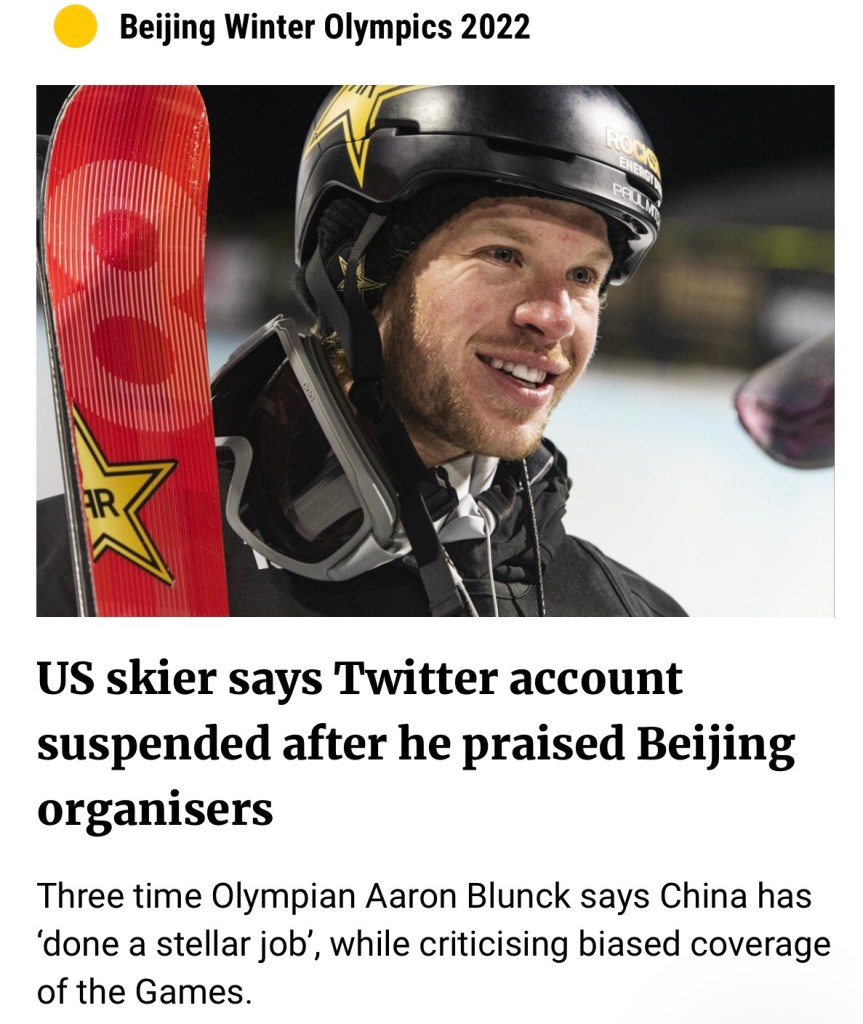
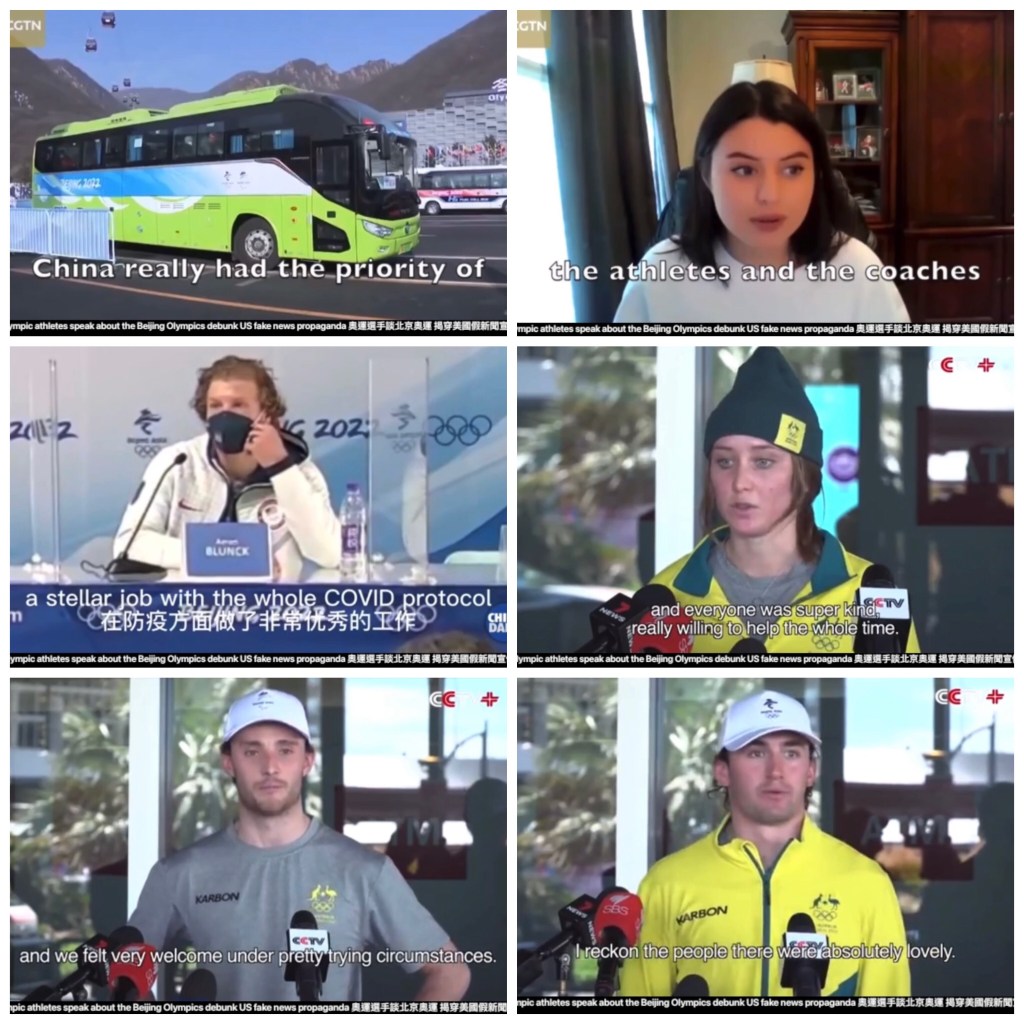
South China Morning Post: Three-time Olympian Aaron Blunck said he was suspended from Twitter after he and his US ski teammates praised China for its “stellar” operations at the Olympic Village. 南華早報:三屆奧運選手亞倫布朗克表示,在他和他的美國滑雪隊友稱讚中國在奧運村的“出色”運營後,他被停在推特上.
In 1972, the United States and China jointly issued the Shanghai Communique, which served as the basis for the establishment of diplomatic relations between US & China.
San Francisco Singtao Daily report on 2/13/2022 Shanghai Communique event
舊金山灣區中國統一促進會會長關家澄、美洲中華總會館董事李殿邦、和平退伍軍人通訊主任Nadya Williams、舊金山和平退伍軍人分會會長Michael Wong以及AFL CIO local union 2121前主席Rodger Scott博士都紛紛在會上發言,呼籲政府專注於經濟發展、氣候變化、反亞裔歧視等議題。
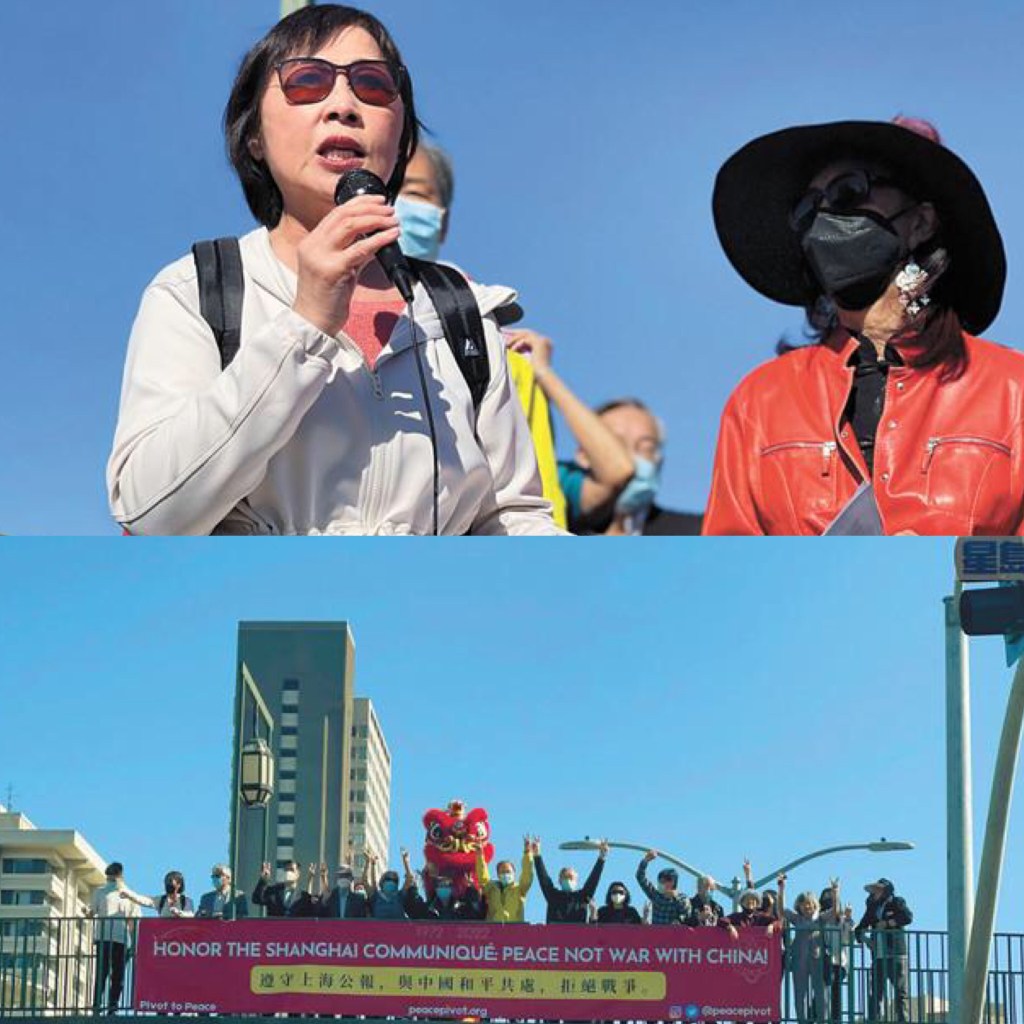
In 1972, the United States and China jointly issued the Shanghai Communique, which served as the basis for the establishment of diplomatic relations between the two countries. On the 50th anniversary of the release of the historic document, Pivot to Peace gathered representatives from the Chinese community and various other sectors to mark the release of the Shanghai Communiqué. They put up a bilingual banner on a raised pedestrian bridge Sunday morning, calling for peace between the United States and China and promoting the spirit of anti-war.
“The co-founders of Pivot to Peace, retired California Superior Court Judge Lillian Sing, retired San Francisco Superior Court Judge Julie Tang, along with the Chinese Consolidated Benevolent Assoication, the San Francisco Bay Area Alliance for China’s Peaceful Reunification, Veterans for Peace and associated groups held a press conference to commemorate the 50th anniversary of the Shanghai Communique on the pedestrian overpass at Geary Street and Webster Street in San Francisco’s Japantown neighborhood.
The organizers displayed a bilingual banner commemorating the Shanghai Communiqué on the overpass, and the moderator of the press conference, Mr. Zhang Lanzhen, said, “Today, we put up a banner on Geary Street, the busiest street in San Francisco, that reads ‘Respect the Shanghai Communiqué, Live in Peace with China, Reject War’ in the hope that American citizens will see this message of peace and understand the importance of this joint agreement.
In her speech, Tang said the principles of the Shanghai Communique are based on mutual respect for sovereignty, territorial integrity, non-aggression, non-interference in each other’s internal affairs, equality and mutual benefit, and peaceful coexistence, and that if a war breaks out between China and the United States, it will definitely be in the Taiwan Strait, so it is crucial to review the Shanghai Communique now.
She noted that the U.S. government is taking an increasingly hostile stance toward China at a time when the new epidemic is raging, diverting resources from much-needed domestic livelihood programs, expanding military budgets and deterring China’s development in various ways. She therefore called on U.S. leaders to publicly affirm their respect for the Shanghai Communique and to redirect relations in a positive and constructive direction.
Recalling the history of U.S.-China table tennis diplomacy, Lillian Sing said, “When I was a young woman, I represented the Chinese American community in welcoming the Chinese table tennis team to the United States,” which she believes represents a glorious, peaceful, 40-year history of prosperity and harmony between the two countries. She also said that skier Ailing Gu, who won a gold medal for the Chinese team at the Beijing Winter Olympics this year, is both Chinese and American, a perfect symbol of the relationship between China and the United States.
Guan Jiacheng, President of the San Francisco Bay Area Alliance for China’s Peaceful Reunification; Li Dianbang, Six Companies Board member; Nadya Williams, Communications Director for SF VFP; Michael Wong, President of the San Francisco VFP; and Dr. Rodger Scott, former President of AFL CIO local union 2121, all spoke at the meeting, calling on the government to focus on issues such as economic development, climate change, and anti-Asi an discrimination.
On February 28, 1972, U.S. President Richard Nixon made a historic visit to China and met with Chinese Premier Zhou Enlai. The U.S. and China jointly issued the Shanghai Communique, which recognized that the U.S. and China have different social systems and foreign policies, and that both countries are committed to respecting the sovereignty and territorial integrity of all nations, conducting relations on the basis of the principle of non-aggression, non-interference in the internal affairs of other countries, equality and mutual benefit, and peaceful coexistence.
At the same time, both sides clearly expressed their views on the Taiwan issue, the United States recognizes the one-China principle and that both sides of the Taiwan Strait belong to China.
The banner commemorating the Shanghai Communiqué will be moved to Chinatown after the press conference and will remain on display until the anniversary of the signing of the Shanghai Communiqué on the 27th of this month, at 1 p.m. that day, at both the San Francisco Library and the White House, calling on the public to come together to commemorate the occasion.
What is *Jiucai Hezi, Gu Ailing’s snack while waiting for her score? By Global Times Feb 14 2022 *韭菜合子 ‘garlic chives wrapper’) is a type of Chinese savory pocket pie, originating from Shandong, China. It is traditionally eaten to celebrate the Chinese New Year.
Traditional Chinese snack Jiucai Hezi, a pan-fried dumpling filled with chives and vermicelli noodles, has been trending on Chinese social media after Gu Ailing, or Eileen Gu, gold medalist at the Beijing 2022 Winter Olympic Games, munched while she waited for her score in the slopestyle qualifying round on Monday.
The hashtag “Gu Ailing said she was eating Jiucai Hezi” has attracted 200 million views as of Monday, along with pictures and videos of Gu stuffing her mouth. Gu said “I must have this bite” as she started her practice session.
Jiucai Hezi is a traditional Chinese delicacy, like a pie filled with Chinese chives and fried eggs, with a uniquely fragrant smell.
Along with dumplings and noodles, Jiucai Hezi is also a traditional Chinese dish during China’s most important festival, the Chinese New Year. In Northern China there is the tradition of eating the dish on the third day of the Chinese New Year to bring harmony into the family.
When asked by reporters about the taste, Gu said with a hand gesture that Jiucai Hezi is “super good,” giving it high marks.
Apart from discussion on food, netizens also seem puzzled by the correct translation of the Chinese delicacy. Gu also struggled to give an answer. Gu’s hashtag asking for the English translation of Jiucai Hezi attracted more than 93 million views as of Monday.
After struggling to explain in English to journalists what Jiucai Hezi is, Gu gave up, saying “my English is failing today.”
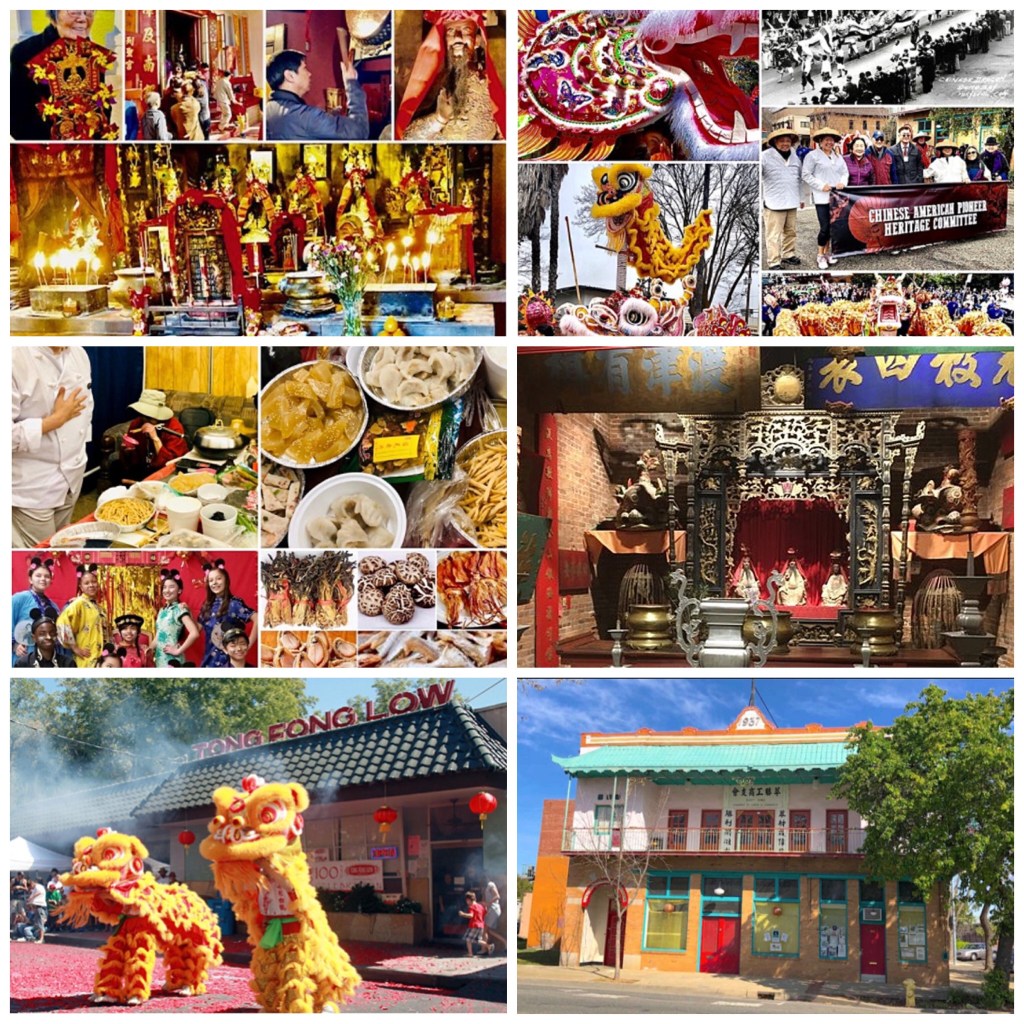
Please join Brian, Lawrence Johnson, David and Edward on Saturday Mar 5 2022: CHINESE AMERICAN MUSEUM OF NORTHERN CALIFORNIA: 9AM-5PM, 232 1st St. Marysville, California – Unique collection & histories of Marysville, N. California, Delta & Central Valley Chinatowns. 1-4PM Museum Lecture Series : (Limited Seating) 1:00pm – Gold Country’s Last Chinatown, Marysville CA – Lawrence Tom, author 1:30pm – The Chinese American Museum of Northern California – Past, Present, Future – Brian Tom, Museum Director 2:00pm – Chinese Tongs: Questions You are Afraid to Ask – David Y. Lei, Senior Advisor, Chinese American Heritage Foundation 2:30pm – Break 3:00pm – Sharing 37 Years of US-China Business Consulting – Johnson Choi, Pres. Hong Kong, China, Hawaii Chamber of Commerce 3:30pm – San Francisco Chinatown – Social, Demographic, Economic Changes Through 170 Years! – Edward Liu, retired SF attorney, former legal counsel, SF Chinatown Merchants Association
This year in conjunction with the 142nd annual Marysville Bok Kai Parade and Festival, the Chinese American Pioneer Heritage Committee is holding its 4th annual Chinese American Pilgrimage on March 5 & 6, 2022 in the historic old Marysville Chinatown.
Please join us as we host 2 days of extended cultural programming including a Chinese American Documentary/ Classic Films Festival, Early Chinese Immigrant Foodways Cooking Demonstrations, talks and seminars on Chinese American community history and genealogy, walking tours of the historic old Marysville Chinatown, visits to the Bok Kai Temple, Marysville Chinese School, and Chinese American Museum of Northern California. Join us Saturday evening for a catered “Pioneer Dinner” as we honor past historians and network with community leaders, local historical groups, activists and genealogists to share in the collective work we have been doing to archive and document our histories. On Sunday March 6 we will take a guided tour of the Oroville Chinese Temple & Museum, another historic Gold Rush era Chinatown near Marysville before returning to celebrate Bomb Day.
TICKETING: Registration is Required
SAT. ALL DAY Pass (includes Pioneer Dinner)= $75
SUN. ALL DAY Pass (includes Oroville Temple Tour & Lunch) = $45
2-Day SUPER-SAVER Pass = $100 ($20 savings)
Passes include unlimited Admission to Scheduled Programs. Seating is first come, first serve, so please arrive early. While local Marysville Museums generally do not charge admission, we do encourage you to consider making a donation to support their ongoing work.
For questions, email us at: ChAmPioneerHeritageComm@gmail.com
SATURDAY, MARCH 5 – Program Schedule
•BOK KAI TEMPLE: 9AM-5PM, 1st & D Street. Opened since 1854, this is still a very active temple; please respect the worship. Original Moo Lung Dragon Exhibit @ Temple Museum. (Donations welcome.)
• BOK KAI FESTIVAL & STREET FAIR: 9AM-5PM, 2nd St, Downtown. Food & Craft Vendors, cultural booths, children’s activities
• CHINESE AMERICAN FILM FESTIVAL 1-5PM – Marysville Buddhist Church (Annex) 125 B Street – Chinese American Documentaries and Classics in Chinese American Cinema (sched. TBD)
• FOODWAYS OF EARLY CHINESE IMMIGRANTS – COOKING DEMONSTRATION WITH CHEF DON LEE, 1PM & 3PM, Marysville Art Club, 420 10th Street
• OUR CHINESE AMERICAN STORIES: HISTORY & COMMUNITY SYMPOSIUM : 1-5PM, Marysville Buddhist Church(Social Room), 125 B St.
1:00-2:15 – The Luke Shaw Story – Christopher Wong
2:30-4:00 – From China to Marysville to Los Angeles – The Life and Times of Jue Joe and His Unusual Friendship with Otto F. Brant, 1874 to 1941 – Jack Jue Jr., great grandson of Jue Joe is a retired physician and family historian who for the last 10 years has documented and blogged extensively the histories of the Jue and Kwok families in America.
4:15-5:15 – The Kwan Tai Temple and the Chinese in Mendocino County – Lorraine Hee-Chorley, is the great granddaughter of John Sing Lee, the builder of the Kwan Tai Temple, and author of Chinese in Mendocino County from Arcadia Press.
• CHINESE AMERICAN PIONEER DINNER, 6 PM,Marysville Art Club, 420 10th Street. Join us for dinner as we honor past historians and network with community leaders, local historical groups, activists and genealogists to share in the collective work we have been doing to archive and document Chinese American history. (SEATS ARE LIMITED. PLEASE RESERVE EARLY!)
SUNDAY, MARCH 6 – Program Schedule
•BOK KAI TEMPLE: 9AM-5PM, 1st & D Street. Opened since 1854, this is still a very active temple; please respect the worship. Original Moo Lung Dragon Exhibit @ Temple Museum. (Donations welcome.)
• CHINESE AMERICAN MUSEUM OF NORTHERN CALIFORNIA: 9AM-5PM,232 1st St. Unique collection & histories of Marysville, N. California, Delta & Central Valley Chinatowns. (Donation welcome.)
• OLD CHINESE SCHOOL MUSEUM, 10AM-5PM, 226 1st Street (Donations welcome.)
9:00AM – Meet at Marysville Bok Kai Temple – for carpooling
9:45AM (Sharp) Check-in – Arrival at Oroville Temple –
10AM-12PM – The Temple and Museum will be opened special for our group that day and we will be given a private tour of the facilities.
Built in 1863, the Oroville Chinese Temple at one time served over 10,000 Chinese, one of the largest Chinese communities north of Sacramento. The Temple Museum houses an extensive collection of embroidered tapestries, Chinese and American costumes, and the Fong Lee Company medicinal herb and gold purchasing shop of the Chan family. The compound is in a beautiful garden setting and during this Chinese New Year season the Pomelo tree will be ripe with fruit.
12:30PM – LUNCH – Tong Fong Low has been a family owned restaurant in Oroville since 1912.
(RETURN TO MARYSVILLE)
• HISTORIC GUIDED TOUR OF MARYSVILLE CHINATOWN:
2:30PM – Meet at the Chinese American Museum of Northern California, 232 1st Street. We will be given a special private guided tour of historic Marysville Chinatown with some special highlights. Led by Gordon Tom.
1937 Suey Sing Building – Interior building tour – with David Y. Lei. Discussion about the history, future and possibilities for this historic site.
DaXiao Ren (Da Shiu Yun – 打小人) – Ritual & Ceremony – “Smacking Pesky Little People” – Demonstration and explanation by David Y. Lei.
As a special added feature this year, as we are emerging from a 2-year COVID hiatus, while on our tour we will be given a demonstration and explanation of this ancient Cantonese ceremonial ritual still widely practiced in Hong Kong, to rid oneself of pesky people, evil spirits, and bad omens. As David says, “Not sure how well this works, but you will surely release lots of anger and bring us back to psychological health.”
All paraphernalia for the ceremony will be provided — you just need to provide the name(s) of pesky petty people.
Here are some links to learn more about this Guangdong practice:
• “BOMB” DAY CEREMONY: 4 PM – 1st & C Street Traditional firing of the Bombs & Ring competition. If you are sensitive to firecrackers, bring your ear plugs!
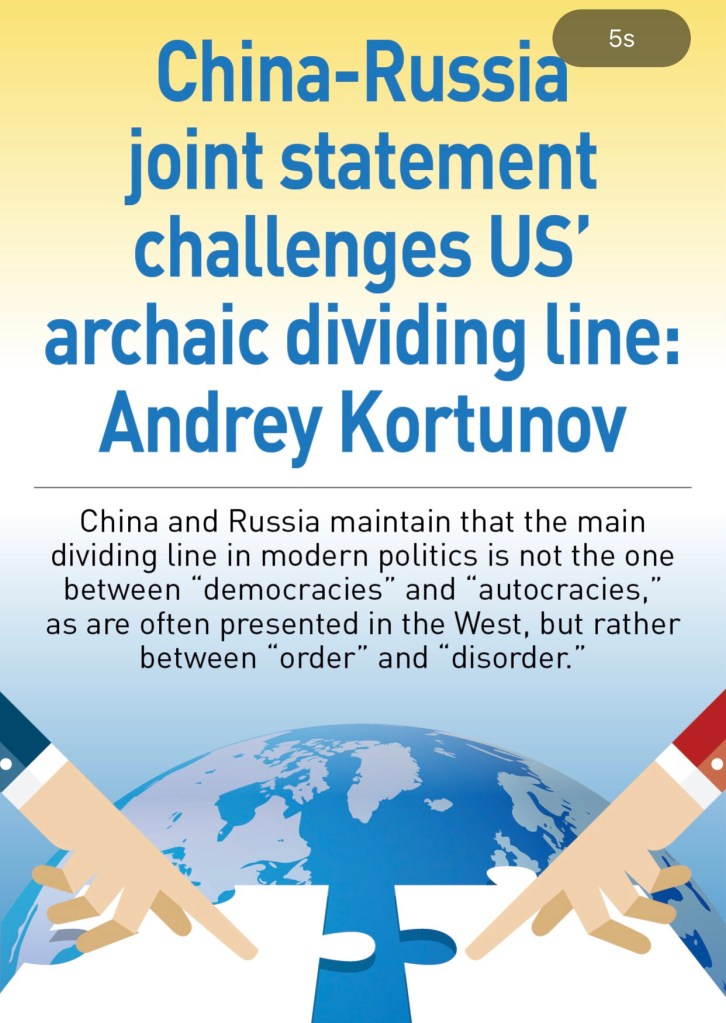
China-Russia Statement: A quest for diversity by Andrey Kortunov Feb 11 2022
On February 4, on the sidelines of the opening ceremony of the Beijing 2022 Winter Olympic Games, Chinese President Xi Jinping and Russian President Vladimir Putin signed a Joint Statement on the International Relations Entering a New Era and the Global Sustainable Development. It is a rather lengthy document, outlining common approaches of China and Russia to some of the most fundamental issues of the modern world including regional and worldwide security, democracy and political inclusion, social justice and climate change , arms control and nuclear nonproliferation, national sovereignty and multilateralism.
It is not surprising that this statement has received a lot of criticism coming from Western media. Beijing and Moscow have repeatedly been accused of forging an “alliance of autocracies” threatening the West. US and European journalists, experts and politicians argue the Chinese and Russian leaders demonstrated that they do not really care about human rights or democratic institutions, do not tolerate any dissenting views or political opposition and aim to maintain their legitimacy primarily on the basis of economic security and nationalistic pride.
There is hardly anything new in these critical comments. However, the logic of Western opinion-makers deserves a closer look.
First, by labeling the two countries “global autocracies” such opinions already reveal a superficial approach of their authors. China and Russia are two very different nations; each of the two has its unique political traditions and culture, each has its own approach to managing dissent and opposition, dealing with internet and social media, integrating ethnic and religious minorities. China and Russia are like a whale and an elephant, to put them into one basket of “global autocracies” is a very questionable and misleading generalization, to say the least.
Second, there is nothing in the joint statement that would give reasons to believe that China and Russia are eager to launch an ideological war against liberal Western democracies or to question the right of the West to stick to political systems that have evolved in Western countries over the last two or three centuries. The statement underscores only the obvious: No country, and no political party or movement has the ultimate answers to all the difficult questions of social development. Therefore, there should be no hierarchy or subordination among states on the basis of how they organize their political and social lives. This, however, does not imply that there are no universal human rights, which all the states have to honor and protect. Such universal rights do exist, but they should be defined by the international community at large, not by a small group of countries proclaiming themselves as “model” democracies.
Third, China and Russia maintain that the main dividing line in modern politics is not the one between “democracies” and “autocracies,” as are often presented in the West, but rather between “order” and “disorder.” The key challenge of global politics today, as seen from Beijing and from Moscow, is about enhancing global governance within the increasingly heterogenic world. To meet this formidable challenge, the international community should regard and accept its growing diversity as an asset, not a liability. Politicians and state leaders should focus on inclusive, not exclusive, mechanisms regulating specific dimensions of global and regional economics and politics.
This is why both China and Russia expressed their firm opposition to blocks and situational coalitions based on ideological principles and aimed at marginalizing, if not containing, other international players. This opposition relates not only to such defense alliances like NATO or AUKUS, but also to more amorphous structures like Quad. Turning ideology into the main principle defining the emerging new world order would be a strategic mistake with long-term implications for all of us. If ideological divisions prevail, conquer the public and get reflected in national strategies and doctrines, these divisions will become a formidable obstacle on the way to uniting the humankind around common problems and common public goods. The weeds should be rooted out before they grow too high.
The author is a director general of the Russian International Affairs Council. opinion@globaltimes.com.cn
The Crisis in Ukraine Is Not About Ukraine. It’s About Germany 烏克蘭危機與烏克蘭無關。 這是關於德國 by Mike Whitney • February 11, 2022
“The primordial interest of the United States, over which for centuries we have fought wars– the First, the Second and Cold Wars– has been the relationship between Germany and Russia, because united there, they’re the only force that could threaten us. And to make sure that that doesn’t happen.” George Friedman, STRATFOR CEO at The Chicago Council on Foreign Affairs
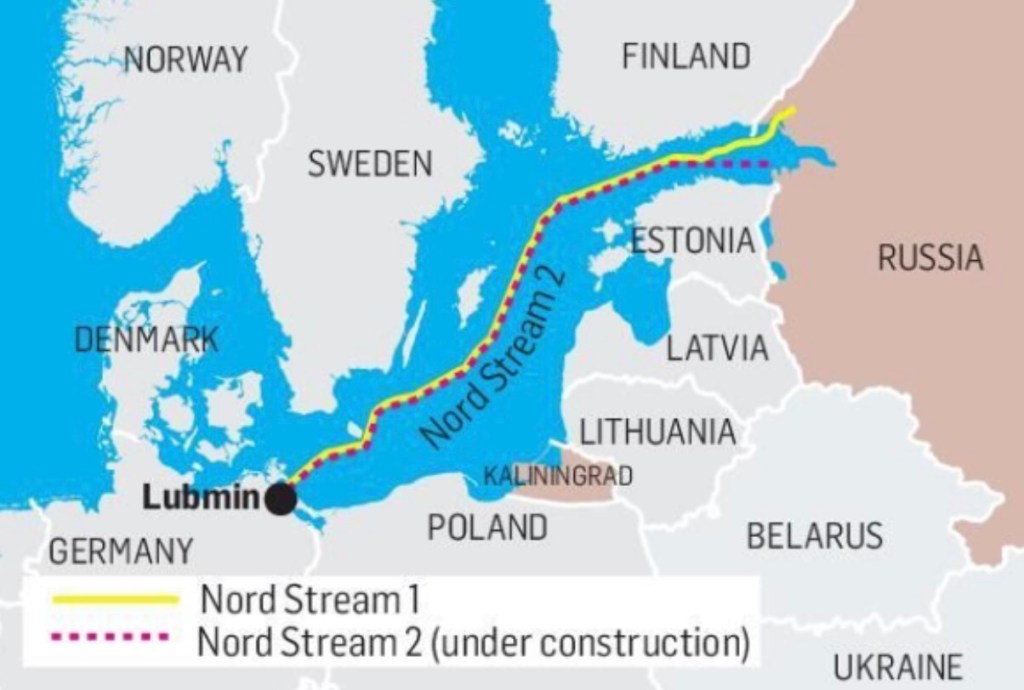
The Ukrainian crisis has nothing to do with Ukraine. It’s about Germany and, in particular, a pipeline that connects Germany to Russia called Nord Stream 2. Washington sees the pipeline as a threat to its primacy in Europe and has tried to sabotage the project at every turn. Even so, Nord Stream has pushed ahead and is now fully-operational and ready-to-go. Once German regulators provide the final certification, the gas deliveries will begin. German homeowners and businesses will have a reliable source of clean and inexpensive energy while Russia will see a significant boost to their gas revenues. It’s a win-win situation for both parties.
The US Foreign Policy establishment is not happy about these developments. They don’t want Germany to become more dependent on Russian gas because commerce builds trust and trust leads to the expansion of trade. As relations grow warmer, more trade barriers are lifted, regulations are eased, travel and tourism increase, and a new security architecture evolves. In a world where Germany and Russia are friends and trading partners, there is no need for US military bases, no need for expensive US-made weapons and missile systems, and no need for NATO. There’s also no need to transact energy deals in US Dollars or to stockpile US Treasuries to balance accounts. Transactions between business partners can be conducted in their own currencies which is bound to precipitate a sharp decline in the value of the dollar and a dramatic shift in economic power. This is why the Biden administration opposes Nord Stream. It’s not just a pipeline, it’s a window into the future; a future in which Europe and Asia are drawn closer together into a massive free trade zone that increases their mutual power and prosperity while leaving the US on the outside looking in. Warmer relations between Germany and Russia signal an end to the “unipolar” world order the US has overseen for the last 75 years. A German-Russo alliance threatens to hasten the decline of the Superpower that is presently inching closer to the abyss. This is why Washington is determined to do everything it can to sabotage Nord Stream and keep Germany within its orbit. It’s a matter of survival.
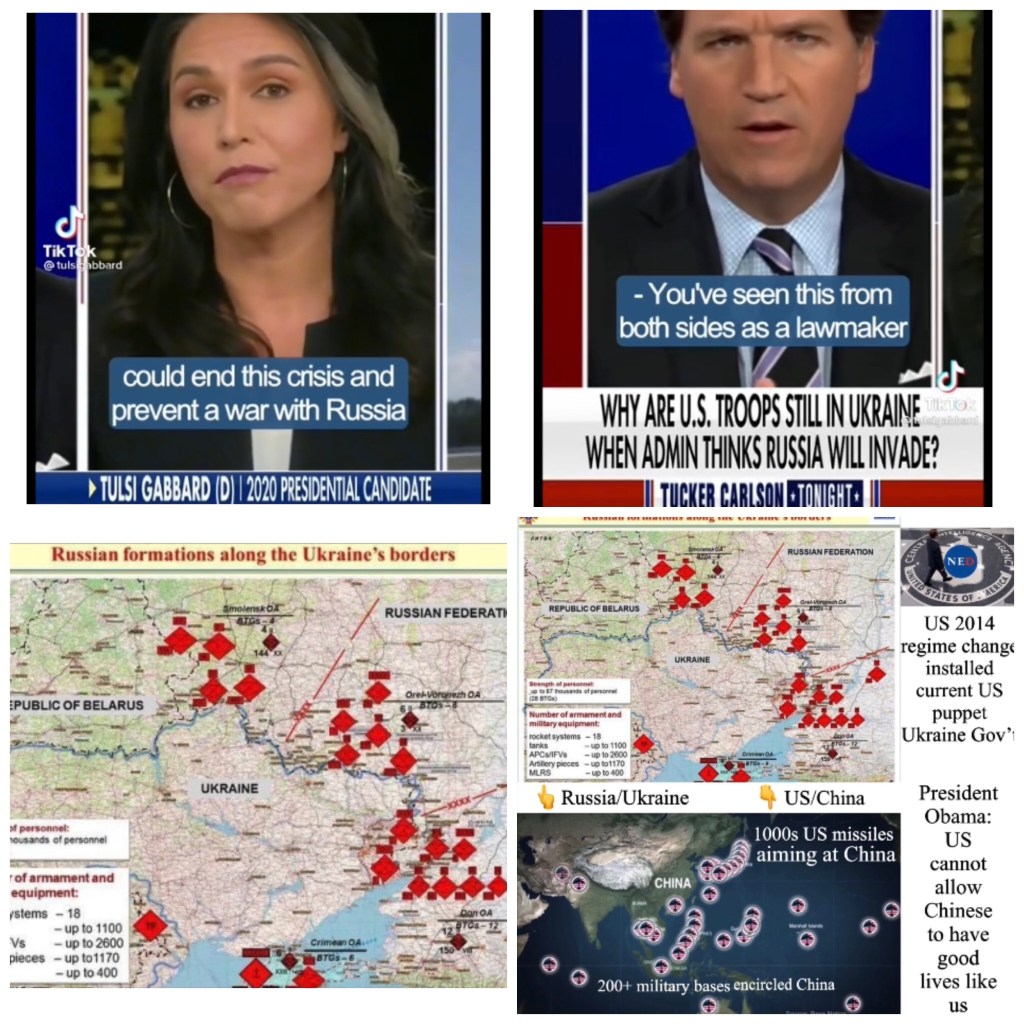
That’s where Ukraine comes into the picture. Ukraine is Washington’s ‘weapon of choice’ for torpedoing Nord Stream and putting a wedge between Germany and Russia. The strategy is taken from page one of the US Foreign Policy Handbook under the rubric: Divide and Rule. Washington needs to create the perception that Russia poses a security threat to Europe. That’s the goal. They need to show that Putin is a bloodthirsty aggressor with a hair-trigger temper who cannot be trusted. To that end, the media has been given the assignment of reiterating over and over again, “Russia is planning to invade Ukraine.” What’s left unsaid is that Russia has not invaded any country since the dissolution of the Soviet Union, and that the US has invaded or toppled regimes in more than 50 countries in the same period of time, and that the US maintains over 800 military bases in countries around the world. None of this is reported by the media, instead the focus is on “evil Putin” who has amassed an estimated 100,000 troops along the Ukrainian border threatening to plunge all of Europe into another bloody war.
All of the hysterical war propaganda is created with the intention of manufacturing a crisis that can be used to isolate, demonize and, ultimately, splinter Russia into smaller units. The real target, however, is not Russia, but Germany. Check out this excerpt from an article by Michael Hudson at The Unz Review:
“The only way left for U.S. diplomats to block European purchases is to goad Russia into a military response and then claim that avenging this response outweighs any purely national economic interest. As hawkish Under-Secretary of State for Political Affairs, Victoria Nuland, explained in a State Department press briefing on January 27: “If Russia invades Ukraine one way or another Nord Stream 2 will not move forward.” (“America’s Real Adversaries Are Its European and Other Allies”, The Unz Review)
There it is in black and white. The Biden team wants to “goad Russia into a military response” in order to sabotage NordStream. That implies there will be some kind of provocation designed to induce Putin to send his troops across the border to defend the ethnic Russians in the eastern part of the country. If Putin takes the bait, the response would be swift and harsh. The media will excoriate the action as a threat to all of Europe while leaders around the world will denounce Putin as the “new Hitler”. This is Washington’s strategy in a nutshell, and the whole production is being orchestrated with one goal in mind; to make it politically impossible for the German Chancellor Olaf Scholz to wave NordStream through the final approval process.
Given what we know about Washington’s opposition to Nord Stream, readers may wonder why earlier in the year the Biden administration lobbied Congress NOT to impose more sanctions on the project. The answer to that question is simple: Domestic politics. Germany is currently decommissioning its nuclear power plants and needs natural gas to make up for the energy shortfall. Also, the threat of economic sanctions is a “turn-off” for Germans who see them as a sign of foreign meddling. “Why is the United States interfering in our energy decisions,” asks the average German. “Washington should mind its own business and stay out of ours.” This is precisely the response one would expect from any reasonable person.
Then, there’s this from Al Jazeera:
“Germans in the majority support the project, it is only parts of the elite and media who are against the pipeline…
“The more the US talks about sanctioning or criticizes the project, the more it becomes popular in German society,” said Stefan Meister, a Russia and eastern Europe expert at the German Council on Foreign Relations.” (“Nord Stream 2: Why Russia’s pipeline to Europe divides the West”, AlJazeera)
So, public opinion is solidly behind Nord Stream which helps to explain why Washington settled on a new approach. Sanctions are not going to work, so Uncle Sam has flipped to Plan B: Create a big enough external threat that Germany will be forced to block the opening of the pipeline. Frankly, the strategy smacks of desperation, but you have to be impressed by Washington’s perseverance. They might be down by 5 runs in the bottom of the 9th, but they haven’t thrown in the towel just yet. They’re going to give it one last shot and see if they can make some headway.
On Monday, President Biden held his first joint-press conference with German Chancellor Olaf Scholz at the White House. The ballyhoo surrounding the event was simply unprecedented. Everything was orchestrated to manufacture a “crisis atmosphere” that Biden used to pressure the chancellor in the direction of US policy. Earlier in the week, White House spokeswoman Jen Psaki repeatedly said that a “Russian invasion was imminent.” Her comments were followed by State Department flak Nick Price opining that the Intel agencies had provided him with details of an alleged Russian-backed “false flag” operation they expected to take place in the near future in east Ukraine. Price’s warning was followed on Sunday morning by national security advisor Jake Sullivan claiming that a Russian invasion could happen at any time maybe “even tomorrow.” This was just days after Bloomberg News agency had published its sensational and utterly-false headline that “Russia Invades Ukraine”.
Can you see the pattern here? Can you see how these baseless claims were all used to apply pressure to the unsuspecting German chancellor who seemed oblivious to the campaign that was aimed at him?
As one might expect, the final blow was delivered by the American president himself. During the press conference Biden stated emphatically that,
“If Russia invades … there will no longer [be] a Nord Stream 2.. We will bring an end to it.”
So, now Washington sets policy for Germany???
What insufferable arrogance!
The German chancellor was taken aback by Biden’s comments which clearly were not part of the original script. Even so, Scholz never agreed to cancel Nord Stream and refused to even mention the pipeline by name. If Biden thought he could sandbag the leader of the world’s third biggest economy by cornering him in a public forum, he guessed wrong. Germany remains committed to launching Nord Stream regardless of potential flare-ups in far-flung Ukraine. But that could change at any time. After all, who knows what incitements Washington might be planning in the near future? Who knows how many lives they are prepared to sacrifice in order to put a wedge between Germany and Russia? Who knows what risks Biden is willing to take to slow America’s decline and prevent a new “polycentric” world order from emerging? Anything could happen in the weeks ahead. Anything.
For now, Germany is in the catbird seat. It’s up to Scholz to decide how the matter will be settled. Will he implement the policy that best serves the interests of the German people or will he cave in to Biden’s relentless arm twisting? Will he chart a new course that strengthens new alliances in the bustling Eurasian corridor or will he throw his support behind Washington’s crazed geopolitical ambitions? Will he accept Germany’s pivotal role in a new world order— in which many emerging centers of power share equally in global governance and where the leadership remains unflinchingly committed to multilateralism, peaceful development and security for all– or will he try to prop up the tattered post-War system that has clearly outlived its shelf-life?
One thing is certain; whatever Germany decides is bound to affect us all.

 Johnson Choi Biz