Ukraine’s hybrid war is mutating Feb 25, 2022 BY M. K. BHADRAKUMAR
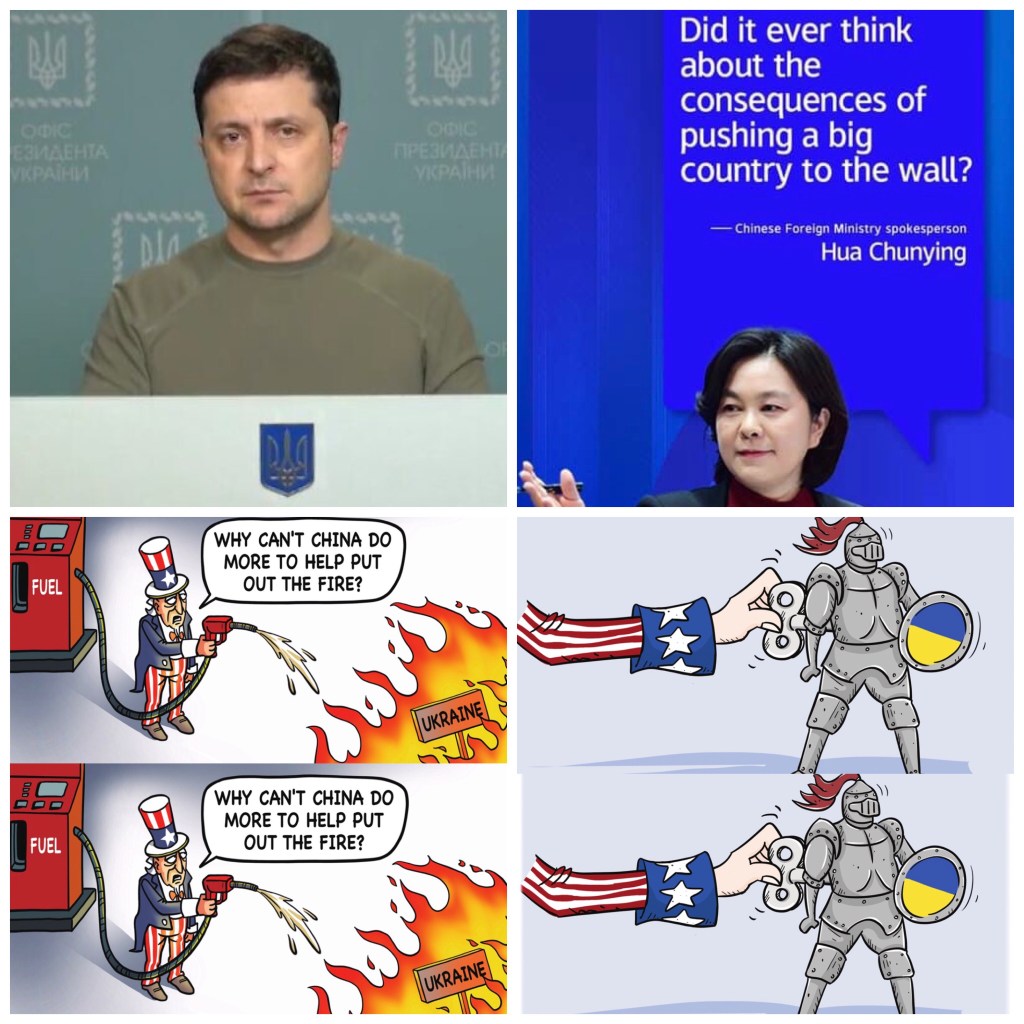
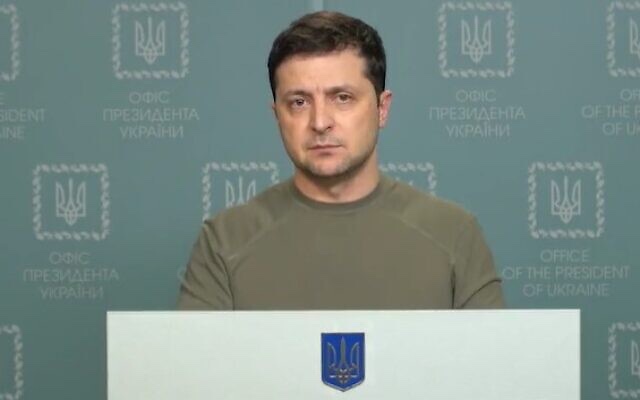
Ukraine president Zelensky gave a video address after midnight on February 25, 2022 disclosing a Russian offer of talks
The first signs of the dual track in Russia’s hybrid war in Ukraine have surfaced. By Thursday evening, the Kremlin held out an olive branch to the Ukraine president Volodymyr Zelensky.
Succinctly put, President Vladimir Putin expressed his preparedness to engage in discussions with his Ukrainian counterpart with a focus on obtaining a guarantee of neutral status for Ukraine and the promise of no offensive weapons on its territory.
The Kremlin spokesman Dmitry Peskov said without elaborating, “The president formulated his vision of what we would expect from Ukraine in order for the so-called ‘red-line’ problems to be resolved. This is neutral status, and this is a refusal to deploy weapons.”
Putin had made it clear in a nation-wide address Thursday morning announcing the launch of the military operation that the Russian objective narrowed down to “demilitarisation” and “denazification” of Ukraine. The latter refers to the ascendant neo-Nazi groups in Ukraine who have been acting as a state within the state and perpetrated atrocities against the ethnic Russian population.
The Kremlin offer didn’t come out of the blue. A group of Ukrainian MPs also came out yesterday with an appeal calling on Zelensky, in an open letter, to start negotiations with Moscow. Interestingly, the group is led by Vadim Novinsky – a Ukrainian billionaire and one of the co-leaders of the Opposition Bloc, an association of over dozen political parties. The group also proposed direct consultations between the parliaments of the two countries.
But what lends enchantment to the view is that Zelensky on his own also requested French President Emmanuel Macron to convey a message to Putin directly. Macron has since disclosed that he has had “a quick, direct and frank conversation on a request from President Zelensky.”
Macron said the aim of the conversation was a request from Kiev “to end hostilities as soon as possible.” The Kremlin confirms that Putin held a “frank” conversation with Macron.
Macron’s role is important, since it was he who first floated with Putin the idea, in the course of a conversation recently, that one way out of the impasse could be that Kiev unilaterally gave up any intention to join the NATO. Subsequently, in an interaction with the Russian media at the Kremlin on Tuesday, Putin also mentioned this idea.
Zelensky himself said (after Macron’s conversation with Putin) in an emotional video address to the nation after midnight Thursday, “We have been left alone to defend our state. Who is ready to fight alongside us? I don’t see anyone. Who is ready to give Ukraine a guarantee of NATO membership? Everyone is afraid.” He went on to disclose that he had heard from Moscow that ”they want to talk about Ukraine’s neutral status.”
Quite obviously, Zelensky realises by now that the cavalry is not coming from Washington or Brussels to salvage his government. In fact, Zelensky’s request to Macron followed the repeated categorical affirmations by US President Biden that there is no question of American intervention in Ukraine or of US troops engaging Russian military.
Meanwhile, Russian Defence Ministry highlighted on Thursday that Moscow’s strategy will be to hit military targets and avoid civilian casualty. Ukraine’s air defence system has been rendered non-functional. Moscow is encouraging Ukrainian soldiers to surrender or simply return to their families, the intention being to minimise any fighting.
All this suggests that a political track is on standby. The Russian game plan is to force Zelensky to see the writing on the wall. Ukraine’s capitulation is a matter of days only. This hybrid war would have the following elements:
Russia will no doubt systematically vanquish the neo-Nazi elements in Ukraine (especially within the military such as the Azov Brigade) who have Russian blood on their hands. These elements so far acted with impunity because of covert western support for their anti-Russian disposition.
Russia estimates, rightly so, that any crackdown on the neo-Nazi elements will only strengthen Zelensky’s hands. Lacking a power base of his own, he has been a hostage of extreme nationalists.
On the other hand, Western powers have retrenched in panic from Kiev, and an embittered Zelensky is left to fend for himself. But, paradoxically, this also makes Zelensky a reasonable interlocutor, liberated from the US’ vice-like grip.
Zelensky has been acting under immense external pressure and fear of extreme nationalists who enjoy “street power.”(The coup in February 2014, scuttling an orderly constitutional transition from President Viktor Yanukovich, was organised by the ultra-nationalists with overt US support.) Zelensky’s massive mandate (over 73% of votes) in the 2019 election was largely due to whole-hearted support from Russian voters who were attracted to his platform of dialogue with Russia and the promise of a negotiated settlement in Donbass with Moscow’s help. But in the event, he became a captive of extreme nationalists and a victim of western manipulation.
Nevertheless, Zelensky has been sporadically signalling to Moscow his desire for an exit route, sensing he was on a road to nowhere. Lately, he voiced dissatisfaction over the war hysteria in Washington. At least during one telephone conversation with Biden recently, they had a heated exchange, according to the CNN.
Russia’s tentative offer appears to be that Ukraine could opt for a status of neutrality on the lines of Austria and Finland with a self-imposed ban on its NATO membership. Conceivably, Zelensky would be open to such an idea. Now, what is there in it for him?
First, Russia will forthwith call off or at least suspend the military operation. That will strengthen Zelensky’s standing. Second, Russia’s direct involvement holds the key to easing of tensions in the Donbass. Moscow had been dodging such a role.
Third, Zelensky could resume his links with the pro-Russian constituency in Ukraine, which was his mainstay of support in the 2019 election. This would have implications for his bid for a second term in the 2023 election.
Fourth, Russia enjoys extensive networking within Ukraine, which has a chaotic political environment driven by corruption and venality, oligarchs and mafia and so on. Russia still wields influence with the power brokers who have at one time or another enjoyed Moscow’s patronage. Thus, Zelensky would see that Russian help can also heal Ukraine’s fragmented political economy.
As for Russia, out of the conditions for security guarantee that it had projected to the US in mid-December, where Moscow drew a blank, Putin may succeed in reaching his objectives at least partially if Ukraine were to turn its back on NATO membership and terminate western military deployments on its soil.
Given the profound civilisational links between Russia and Ukraine, enduring people-to-people relations and family kinships, there is a reservoir of opinion in Ukraine favouring improvement of relations with Russia. Ukraine’s economy is also closely aligned with Russia — even today, Russia is Ukraine’s number one export market. Russia has been a generous donor too. The transit fee for transportation of pipeline gas to Europe alone exceeded 1 billion dollars annually!
Russia’s main gain will be that in geopolitical terms, Ukraine regains its sovereignty and ceases to be a de facto American colony. Russia calculates that a neutral Ukraine will de facto take the Ukraine matrix to its priori history before the 2014 coup.
What is of crucial importance will be that Zelensky is somehow enabled to navigate his path toward dialogue with Putin. The good part is that Russian military operations will throw radical nationalists into disarray, and, secondly, it is improbable that Biden is raring to resume the shenanigans in Ukraine. American politics is increasingly riveted on the mid-term in November and public disfavours Washington taking sides between Ukraine and Russia.
Will the US acquiesce with the nascent processes? There is hope that Macron can mediate. Conceivably, he is in touch with Biden.
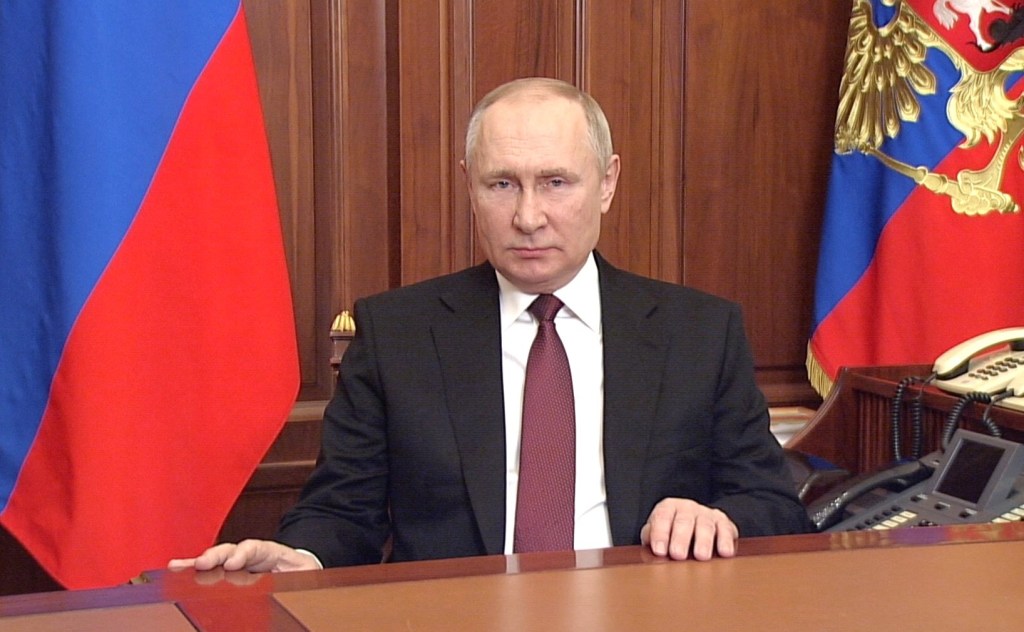
Address by the President of the Russian Federation
February 24, 2022 The Kremlin, Moscow Address by the President of the Russian Federation. President of Russia Vladimir Putin: Citizens of Russia, friends,
I consider it necessary today to speak again about the tragic events in Donbass and the key aspects of ensuring the security of Russia.
I will begin with what I said in my address on February 21, 2022. I spoke about our biggest concerns and worries, and about the fundamental threats which irresponsible Western politicians created for Russia consistently, rudely and unceremoniously from year to year. I am referring to the eastward expansion of NATO, which is moving its military infrastructure ever closer to the Russian border.
It is a fact that over the past 30 years we have been patiently trying to come to an agreement with the leading NATO countries regarding the principles of equal and indivisible security in Europe. In response to our proposals, we invariably faced either cynical deception and lies or attempts at pressure and blackmail, while the North Atlantic alliance continued to expand despite our protests and concerns. Its military machine is moving and, as I said, is approaching our very border.
Why is this happening? Where did this insolent manner of talking down from the height of their exceptionalism, infallibility and all-permissiveness come from? What is the explanation for this contemptuous and disdainful attitude to our interests and absolutely legitimate demands?
The answer is simple. Everything is clear and obvious. In the late 1980s, the Soviet Union grew weaker and subsequently broke apart. That experience should serve as a good lesson for us, because it has shown us that the paralysis of power and will is the first step towards complete degradation and oblivion. We lost confidence for only one moment, but it was enough to disrupt the balance of forces in the world.
As a result, the old treaties and agreements are no longer effective. Entreaties and requests do not help. Anything that does not suit the dominant state, the powers that be, is denounced as archaic, obsolete and useless. At the same time, everything it regards as useful is presented as the ultimate truth and forced on others regardless of the cost, abusively and by any means available. Those who refuse to comply are subjected to strong-arm tactics.
What I am saying now does not concerns only Russia, and Russia is not the only country that is worried about this. This has to do with the entire system of international relations, and sometimes even US allies. The collapse of the Soviet Union led to a redivision of the world, and the norms of international law that developed by that time – and the most important of them, the fundamental norms that were adopted following WWII and largely formalised its outcome – came in the way of those who declared themselves the winners of the Cold War.
Of course, practice, international relations and the rules regulating them had to take into account the changes that took place in the world and in the balance of forces. However, this should have been done professionally, smoothly, patiently, and with due regard and respect for the interests of all states and one’s own responsibility. Instead, we saw a state of euphoria created by the feeling of absolute superiority, a kind of modern absolutism, coupled with the low cultural standards and arrogance of those who formulated and pushed through decisions that suited only themselves. The situation took a different turn.
There are many examples of this. First a bloody military operation was waged against Belgrade, without the UN Security Council’s sanction but with combat aircraft and missiles used in the heart of Europe. The bombing of peaceful cities and vital infrastructure went on for several weeks. I have to recall these facts, because some Western colleagues prefer to forget them, and when we mentioned the event, they prefer to avoid speaking about international law, instead emphasising the circumstances which they interpret as they think necessary.
Then came the turn of Iraq, Libya and Syria. The illegal use of military power against Libya and the distortion of all the UN Security Council decisions on Libya ruined the state, created a huge seat of international terrorism, and pushed the country towards a humanitarian catastrophe, into the vortex of a civil war, which has continued there for years. The tragedy, which was created for hundreds of thousands and even millions of people not only in Libya but in the whole region, has led to a large-scale exodus from the Middle East and North Africa to Europe.
A similar fate was also prepared for Syria. The combat operations conducted by the Western coalition in that country without the Syrian government’s approval or UN Security Council’s sanction can only be defined as aggression and intervention.
But the example that stands apart from the above events is, of course, the invasion of Iraq without any legal grounds. They used the pretext of allegedly reliable information available in the United States about the presence of weapons of mass destruction in Iraq. To prove that allegation, the US Secretary of State held up a vial with white power, publicly, for the whole world to see, assuring the international community that it was a chemical warfare agent created in Iraq. It later turned out that all of that was a fake and a sham, and that Iraq did not have any chemical weapons. Incredible and shocking but true. We witnessed lies made at the highest state level and voiced from the high UN rostrum. As a result we see a tremendous loss in human life, damage, destruction, and a colossal upsurge of terrorism.
Overall, it appears that nearly everywhere, in many regions of the world where the United States brought its law and order, this created bloody, non-healing wounds and the curse of international terrorism and extremism. I have only mentioned the most glaring but far from only examples of disregard for international law.
This array includes promises not to expand NATO eastwards even by an inch. To reiterate: they have deceived us, or, to put it simply, they have played us. Sure, one often hears that politics is a dirty business. It could be, but it shouldn’t be as dirty as it is now, not to such an extent. This type of con-artist behaviour is contrary not only to the principles of international relations but also and above all to the generally accepted norms of morality and ethics. Where is justice and truth here? Just lies and hypocrisy all around.
Incidentally, US politicians, political scientists and journalists write and say that a veritable “empire of lies” has been created inside the United States in recent years. It is hard to disagree with this – it is really so. But one should not be modest about it: the United States is still a great country and a system-forming power. All its satellites not only humbly and obediently say yes to and parrot it at the slightest pretext but also imitate its behaviour and enthusiastically accept the rules it is offering them. Therefore, one can say with good reason and confidence that the whole so-called Western bloc formed by the United States in its own image and likeness is, in its entirety, the very same “empire of lies.”
As for our country, after the disintegration of the USSR, given the entire unprecedented openness of the new, modern Russia, its readiness to work honestly with the United States and other Western partners, and its practically unilateral disarmament, they immediately tried to put the final squeeze on us, finish us off, and utterly destroy us. This is how it was in the 1990s and the early 2000s, when the so-called collective West was actively supporting separatism and gangs of mercenaries in southern Russia. What victims, what losses we had to sustain and what trials we had to go through at that time before we broke the back of international terrorism in the Caucasus! We remember this and will never forget.
Properly speaking, the attempts to use us in their own interests never ceased until quite recently: they sought to destroy our traditional values and force on us their false values that would erode us, our people from within, the attitudes they have been aggressively imposing on their countries, attitudes that are directly leading to degradation and degeneration, because they are contrary to human nature. This is not going to happen. No one has ever succeeded in doing this, nor will they succeed now.
Despite all that, in December 2021, we made yet another attempt to reach agreement with the United States and its allies on the principles of European security and NATO’s non-expansion. Our efforts were in vain. The United States has not changed its position. It does not believe it necessary to agree with Russia on a matter that is critical for us. The United States is pursuing its own objectives, while neglecting our interests.
Of course, this situation begs a question: what next, what are we to expect? If history is any guide, we know that in 1940 and early 1941 the Soviet Union went to great lengths to prevent war or at least delay its outbreak. To this end, the USSR sought not to provoke the potential aggressor until the very end by refraining or postponing the most urgent and obvious preparations it had to make to defend itself from an imminent attack. When it finally acted, it was too late.
As a result, the country was not prepared to counter the invasion by Nazi Germany, which attacked our Motherland on June 22, 1941, without declaring war. The country stopped the enemy and went on to defeat it, but this came at a tremendous cost. The attempt to appease the aggressor ahead of the Great Patriotic War proved to be a mistake which came at a high cost for our people. In the first months after the hostilities broke out, we lost vast territories of strategic importance, as well as millions of lives. We will not make this mistake the second time. We have no right to do so.
Those who aspire to global dominance have publicly designated Russia as their enemy. They did so with impunity. Make no mistake, they had no reason to act this way. It is true that they have considerable financial, scientific, technological, and military capabilities. We are aware of this and have an objective view of the economic threats we have been hearing, just as our ability to counter this brash and never-ending blackmail. Let me reiterate that we have no illusions in this regard and are extremely realistic in our assessments.
As for military affairs, even after the dissolution of the USSR and losing a considerable part of its capabilities, today’s Russia remains one of the most powerful nuclear states. Moreover, it has a certain advantage in several cutting-edge weapons. In this context, there should be no doubt for anyone that any potential aggressor will face defeat and ominous consequences should it directly attack our country.
At the same time, technology, including in the defence sector, is changing rapidly. One day there is one leader, and tomorrow another, but a military presence in territories bordering on Russia, if we permit it to go ahead, will stay for decades to come or maybe forever, creating an ever mounting and totally unacceptable threat for Russia.
Even now, with NATO’s eastward expansion the situation for Russia has been becoming worse and more dangerous by the year. Moreover, these past days NATO leadership has been blunt in its statements that they need to accelerate and step up efforts to bring the alliance’s infrastructure closer to Russia’s borders. In other words, they have been toughening their position. We cannot stay idle and passively observe these developments. This would be an absolutely irresponsible thing to do for us.
Any further expansion of the North Atlantic alliance’s infrastructure or the ongoing efforts to gain a military foothold of the Ukrainian territory are unacceptable for us. Of course, the question is not about NATO itself. It merely serves as a tool of US foreign policy. The problem is that in territories adjacent to Russia, which I have to note is our historical land, a hostile “anti-Russia” is taking shape. Fully controlled from the outside, it is doing everything to attract NATO armed forces and obtain cutting-edge weapons.
For the United States and its allies, it is a policy of containing Russia, with obvious geopolitical dividends. For our country, it is a matter of life and death, a matter of our historical future as a nation. This is not an exaggeration; this is a fact. It is not only a very real threat to our interests but to the very existence of our state and to its sovereignty. It is the red line which we have spoken about on numerous occasions. They have crossed it.
This brings me to the situation in Donbass. We can see that the forces that staged the coup in Ukraine in 2014 have seized power, are keeping it with the help of ornamental election procedures and have abandoned the path of a peaceful conflict settlement. For eight years, for eight endless years we have been doing everything possible to settle the situation by peaceful political means. Everything was in vain.
As I said in my previous address, you cannot look without compassion at what is happening there. It became impossible to tolerate it. We had to stop that atrocity, that genocide of the millions of people who live there and who pinned their hopes on Russia, on all of us. It is their aspirations, the feelings and pain of these people that were the main motivating force behind our decision to recognise the independence of the Donbass people’s republics.
I would like to additionally emphasise the following. Focused on their own goals, the leading NATO countries are supporting the far-right nationalists and neo-Nazis in Ukraine, those who will never forgive the people of Crimea and Sevastopol for freely making a choice to reunite with Russia.
They will undoubtedly try to bring war to Crimea just as they have done in Donbass, to kill innocent people just as members of the punitive units of Ukrainian nationalists and Hitler’s accomplices did during the Great Patriotic War. They have also openly laid claim to several other Russian regions.
If we look at the sequence of events and the incoming reports, the showdown between Russia and these forces cannot be avoided. It is only a matter of time. They are getting ready and waiting for the right moment. Moreover, they went as far as aspire to acquire nuclear weapons. We will not let this happen.
I have already said that Russia accepted the new geopolitical reality after the dissolution of the USSR. We have been treating all new post-Soviet states with respect and will continue to act this way. We respect and will respect their sovereignty, as proven by the assistance we provided to Kazakhstan when it faced tragic events and a challenge in terms of its statehood and integrity. However, Russia cannot feel safe, develop, and exist while facing a permanent threat from the territory of today’s Ukraine.
Let me remind you that in 2000–2005 we used our military to push back against terrorists in the Caucasus and stood up for the integrity of our state. We preserved Russia. In 2014, we supported the people of Crimea and Sevastopol. In 2015, we used our Armed Forces to create a reliable shield that prevented terrorists from Syria from penetrating Russia. This was a matter of defending ourselves. We had no other choice.
The same is happening today. They did not leave us any other option for defending Russia and our people, other than the one we are forced to use today. In these circumstances, we have to take bold and immediate action. The people’s republics of Donbass have asked Russia for help.
In this context, in accordance with Article 51 (Chapter VII) of the UN Charter, with permission of Russia’s Federation Council, and in execution of the treaties of friendship and mutual assistance with the Donetsk People’s Republic and the Lugansk People’s Republic, ratified by the Federal Assembly on February 22, I made a decision to carry out a special military operation.
The purpose of this operation is to protect people who, for eight years now, have been facing humiliation and genocide perpetrated by the Kiev regime. To this end, we will seek to demilitarise and denazify Ukraine, as well as bring to trial those who perpetrated numerous bloody crimes against civilians, including against citizens of the Russian Federation.
It is not our plan to occupy the Ukrainian territory. We do not intend to impose anything on anyone by force. At the same time, we have been hearing an increasing number of statements coming from the West that there is no need any more to abide by the documents setting forth the outcomes of World War II, as signed by the totalitarian Soviet regime. How can we respond to that?
The outcomes of World War II and the sacrifices our people had to make to defeat Nazism are sacred. This does not contradict the high values of human rights and freedoms in the reality that emerged over the post-war decades. This does not mean that nations cannot enjoy the right to self-determination, which is enshrined in Article 1 of the UN Charter.
Let me remind you that the people living in territories which are part of today’s Ukraine were not asked how they want to build their lives when the USSR was created or after World War II. Freedom guides our policy, the freedom to choose independently our future and the future of our children. We believe that all the peoples living in today’s Ukraine, anyone who want to do this, must be able to enjoy this right to make a free choice.
In this context I would like to address the citizens of Ukraine. In 2014, Russia was obliged to protect the people of Crimea and Sevastopol from those who you yourself call “nats.” The people of Crimea and Sevastopol made their choice in favour of being with their historical homeland, Russia, and we supported their choice. As I said, we could not act otherwise.
The current events have nothing to do with a desire to infringe on the interests of Ukraine and the Ukrainian people. They are connected with the defending Russia from those who have taken Ukraine hostage and are trying to use it against our country and our people.
I reiterate: we are acting to defend ourselves from the threats created for us and from a worse peril than what is happening now. I am asking you, however hard this may be, to understand this and to work together with us so as to turn this tragic page as soon as possible and to move forward together, without allowing anyone to interfere in our affairs and our relations but developing them independently, so as to create favourable conditions for overcoming all these problems and to strengthen us from within as a single whole, despite the existence of state borders. I believe in this, in our common future.
I would also like to address the military personnel of the Ukrainian Armed Forces.
Comrade officers,
Your fathers, grandfathers and great-grandfathers did not fight the Nazi occupiers and did not defend our common Motherland to allow today’s neo-Nazis to seize power in Ukraine. You swore the oath of allegiance to the Ukrainian people and not to the junta, the people’s adversary which is plundering Ukraine and humiliating the Ukrainian people.
I urge you to refuse to carry out their criminal orders. I urge you to immediately lay down arms and go home. I will explain what this means: the military personnel of the Ukrainian army who do this will be able to freely leave the zone of hostilities and return to their families.
I want to emphasise again that all responsibility for the possible bloodshed will lie fully and wholly with the ruling Ukrainian regime.
I would now like to say something very important for those who may be tempted to interfere in these developments from the outside. No matter who tries to stand in our way or all the more so create threats for our country and our people, they must know that Russia will respond immediately, and the consequences will be such as you have never seen in your entire history. No matter how the events unfold, we are ready. All the necessary decisions in this regard have been taken. I hope that my words will be heard.
Citizens of Russia,
The culture and values, experience and traditions of our ancestors invariably provided a powerful underpinning for the wellbeing and the very existence of entire states and nations, their success and viability. Of course, this directly depends on the ability to quickly adapt to constant change, maintain social cohesion, and readiness to consolidate and summon all the available forces in order to move forward.
We always need to be strong, but this strength can take on different forms. The “empire of lies,” which I mentioned in the beginning of my speech, proceeds in its policy primarily from rough, direct force. This is when our saying on being “all brawn and no brains” applies.
We all know that having justice and truth on our side is what makes us truly strong. If this is the case, it would be hard to disagree with the fact that it is our strength and our readiness to fight that are the bedrock of independence and sovereignty and provide the necessary foundation for building a reliable future for your home, your family, and your Motherland.
Dear compatriots,
I am certain that devoted soldiers and officers of Russia’s Armed Forces will perform their duty with professionalism and courage. I have no doubt that the government institutions at all levels and specialists will work effectively to guarantee the stability of our economy, financial system and social wellbeing, and the same applies to corporate executives and the entire business community. I hope that all parliamentary parties and civil society take a consolidated, patriotic position.
At the end of the day, the future of Russia is in the hands of its multi-ethnic people, as has always been the case in our history. This means that the decisions that I made will be executed, that we will achieve the goals we have set, and reliably guarantee the security of our Motherland.
I believe in your support and the invincible force rooted in the love for our Fatherland.
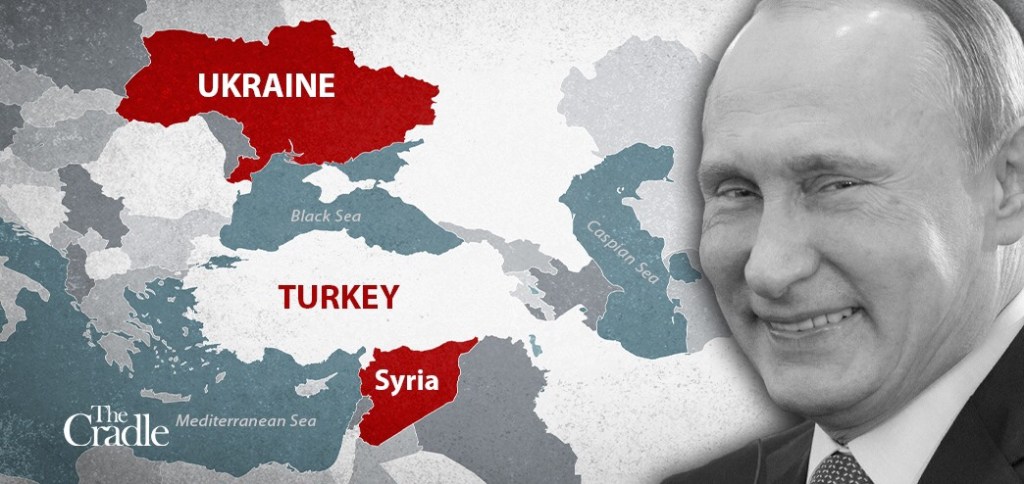
From the Black Sea to the East Med, don’t poke The Russian Bear. The US shouldn’t have poked the Russian Bear. Now it is fully awake: after Ukraine, the Russians are likely to do a clean sweep of foreign belligerents poking around the East Med and the Black Sea. By Pepe Escobar February 24 2022
This is what happens when a bunch of ragged hyenas, jackals and tiny rodents poke The Bear: a new geopolitical order is born at breathtaking speed.
From a dramatic meeting of the Russian Security Council to a UN history lesson delivered by Russian President Vladimir Putin and the subsequent birth of the Baby Twins – the People’s Republics of Donetsk and Luhansk – all the way to the breakaway republics’ appeal to Putin to intervene militarily to expel the NATO-backed Ukrainian bombing-and-shelling forces from Donbass, it was a seamless process, executed at warp speed.
The (nuclear) straw that (nearly) broke the Bear’s back – and forced it to pounce – was Comedian/Ukrainian President Volodymy Zelensky, back from the Russophobia-drenched Munich Security Conference where he was hailed like a Messiah, saying that the 1994 Budapest memorandum should be revised and Ukraine should be nuclear-rearmed.
That would be the equivalent of a nuclear Mexico south of the Hegemon.
Putin immediately turned Responsibility to Protect (R2P) upside down: an American construct invented to launch wars was retrofitted to stop a slow-motion genocide in Donbass.
First came the recognition of the Baby Twins – Putin’s most important foreign policy decision since inserting Russian jets into Syria’s airspace in 2015. That was the preamble for the next game-changer: a “special military operation…aimed at demilitarization and denazification of Ukraine,” as Putin defined it.
Up to the last minute, the Kremlin was trying to rely on diplomacy, explaining to Kiev the necessary imperatives to prevent heavy metal thunder: recognition of Crimea as Russian; abandoning any plans to join NATO; negotiating directly with the Baby Twins – an anathema for the Americans since 2015; finally, demilitarizing and declaring Ukraine as neutral.
Kiev’s handlers, predictably, would never accept the package – as they didn’t accept the Master Package that really matters, which is the Russian demand for “indivisible security.”
The sequence, then, became inevitable. In a flash, all Ukrainian military forces between the so-called line of contact and the original borders of Donetsk and Luhansk oblasts were re-framed as an occupying army in Russian-allied territories that Moscow had just sworn to protect.
Get Out – Or Else
The Kremlin and the Russian Ministry of Defense were not bluffing. Timed to the end of Putin’s speech announcing the operation, the Russians decapitated with precision missiles everything that mattered in terms of the Ukrainian military in just one hour: Air force, navy, airfields, bridges, command and control centers, the whole Turkish Bayraktar drone fleet.
And it was not only Russian raw power. It was the Donetsk People’s Republic (DPR) artillery that hit the Armed Forces of Ukraine headquarters in Donbass, which actually housed the entire Ukrainian military command. This means that the Ukrainian General Staff instantly lost control of all its troops.
This was Shock and Awe against Iraq, 19 years ago, in reverse: not for conquest, not as a prelude for an invasion and occupation. The political-military leadership in Kiev did not even have time to declare war. They froze. Demoralized troops started deserting. Total defeat – in one hour.
The water supply to Crimea was instantly re-established. Humanitarian corridors were set up for the deserters. Ukrainian forces remnants now include mostly surviving Azov batallion Nazis, mercenaries trained by the usual Blackwater/Academi suspects, and a bunch of Salafi-jihadis.
Predictably, western corporate media has already gone totally berserk, branding it as the much-awaited Russian ‘invasion.’ A reminder: when Israel routinely bombs Syria and when the House of One Saudi routinely bombs Yemeni civilians, there is never any peep in NATO’s media.
As it stands, realpolitik spells out a possible endgame, as voiced by Donetsk’s head, Denis Pushilin: “The special operation in Donbass will soon be over and all the cities will be liberated.”
We could soon witness the birth of an independent Novorossiya – east of the Dnieper, south along Sea of Azov/Black Sea, the way it was when attached to Ukraine by Lenin in 1922. But now it would be totally aligned with Russia, and providing a land bridge to Transnistria.
Ukraine, of course, would lose any access to the Black Sea. History loves playing tricks: what was a ‘gift’ to Ukraine in 1922 may become a parting gift a hundred years later.
It’s creative destruction time
It will be fascinating to watch what Prof. Sergey Karaganov masterfully described, in detail, as the new Putin doctrine of constructive destruction, and how it will interconnect with West Asia, the Eastern Mediterranean and further on down the Global South road.
Turkish President Recep Tayyip Erdogan, the ceremonial NATO Sultan, denounced the recognition of the Baby Twins as “unacceptable.” No wonder: that shift smashed all his elaborate plans to pose as privileged mediator between Moscow and Kiev during Putin’s upcoming visit to Ankara. The Kremlin – as well as the Foreign Ministry – don’t waste time talking to NATO minions.
Russian Foreign Minister Sergey Lavrov, for his part, had a recent, very productive entente with Syrian Foreign Minister Faisal Mekdad. Russia, this past weekend, has staged a spectacular strategic missile display, hypersonic and otherwise, featuring Khinzal, Zircon, Kalibr, Yars ICBMs, Iskander and Sineva – irony of ironies, in synch with the Russophobia-fest in Munich. In parallel, Russian Navy ships of the Pacific, Northern and Black Sea fleets performed a series of submarine search drills in the Mediterranean.
The Putin doctrine privileges the asymmetrical – and that applies to the near abroad and beyond. Putin’s body language, in his last two crucial interventions, spell out nearly maximum exasperation. As in realizing, not auspiciously, but rather in resignation, that the only language Beltway Neo-conservatives and ‘humanitarian imperialists’ understand is heavy metal thunder. They are definitely deaf, dumb and blind to history, geography and diplomacy.
So, one can always game the Russian military – for instance, imposing a no-fly zone in Syria to conduct a series of visits by Mr. Khinzal not only to the Turk-protected shady jihadist umbrella in Idlib but also the jihadists protected by the Americans in Al-Tanf base, near the Syria-Jordan border. After all, these specimens are all NATO proxies.
The US government barks non-stop about “territorial sovereignty.” So let’s game the Kremlin asking the White House for a road map on getting out of Syria: after all the Americans are illegally occupying a section of Syrian territory and adding extra disaster to the Syrian economy by stealing their oil.
NATO’s stultifying leader, Jens Stoltenberg, has announced the alliance is dusting off its “defense plans.” That may include little more than hiding behind their expensive Brussels desks. They are as inconsequential in the Black Sea as in the East Med – as the US remains quite vulnerable in Syria.
There are now four Russian TU-22M3 strategic bombers in Russia’s Hmeimim base in Syria, each capable of carrying three S-32 anti-ship missiles that fly at supersonic Mach 4.3 with a range of 1,000 km. No Aegis system is able to handle them.
Russia also has stationed a few Mig-31Ks in Syria’s coastal region in Latakia equipped with hypersonic Khinzals – more than enough to sink any kind of US surface group, including aircraft carriers, in the East Med. The US has no air defense mechanism whatsoever with even a minimal chance of intercepting them.
So the rules have changed. Drastically. The Hegemon is naked. The new deal starts with turning the post-Cold War set-up in Eastern Europe completely upside down. The East Med will be next. The Bear is back, hear him roar.
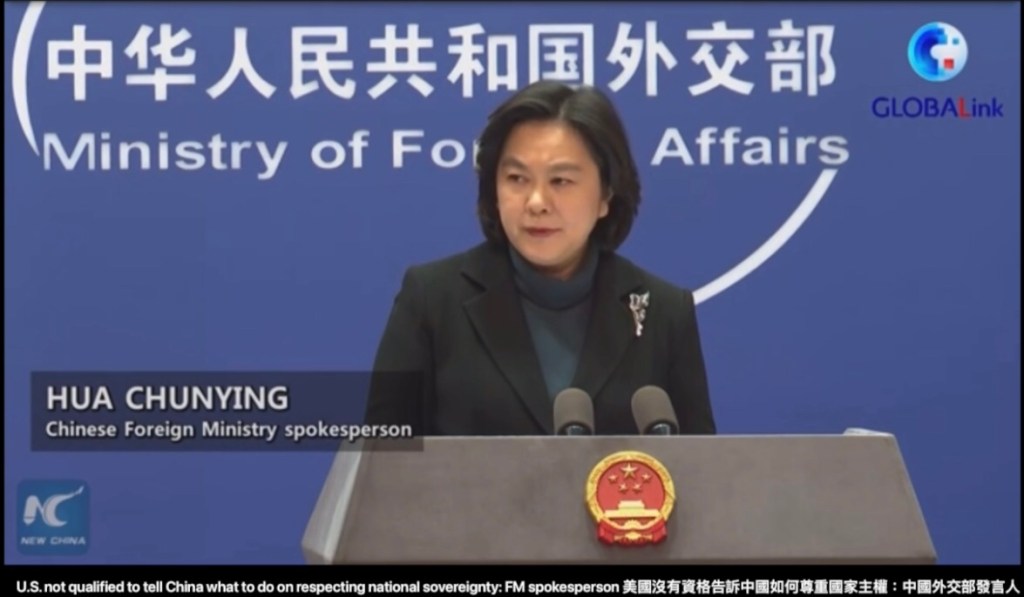
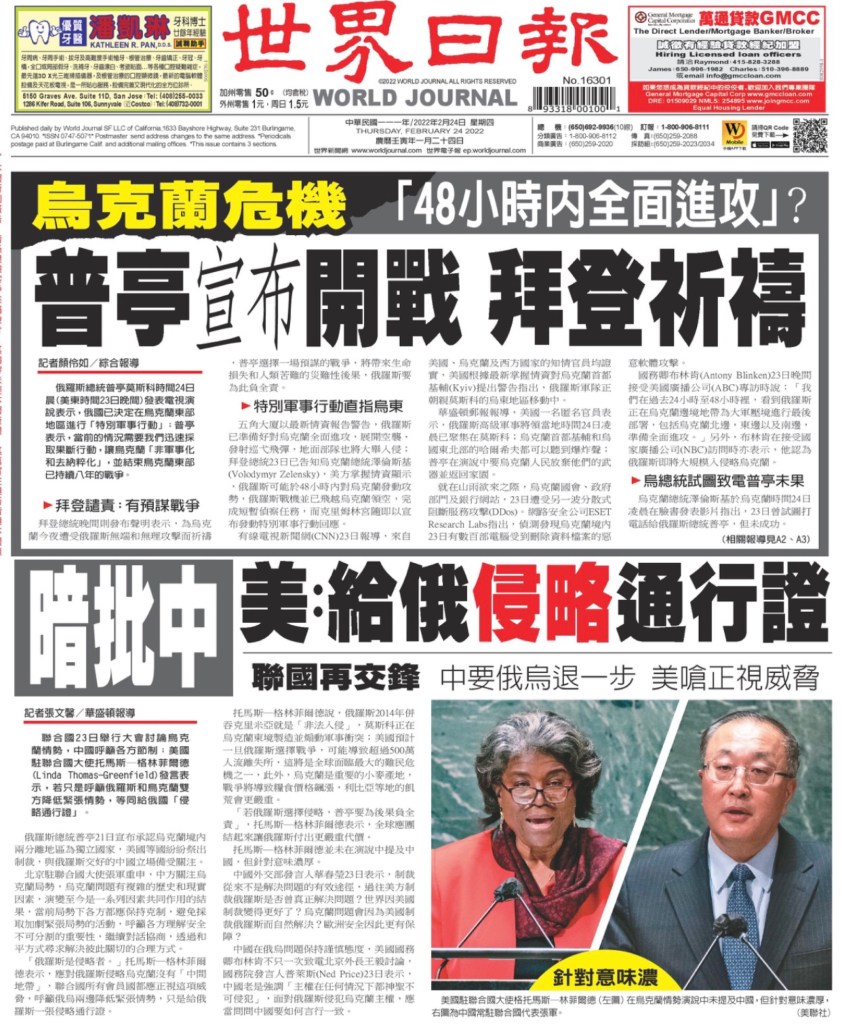
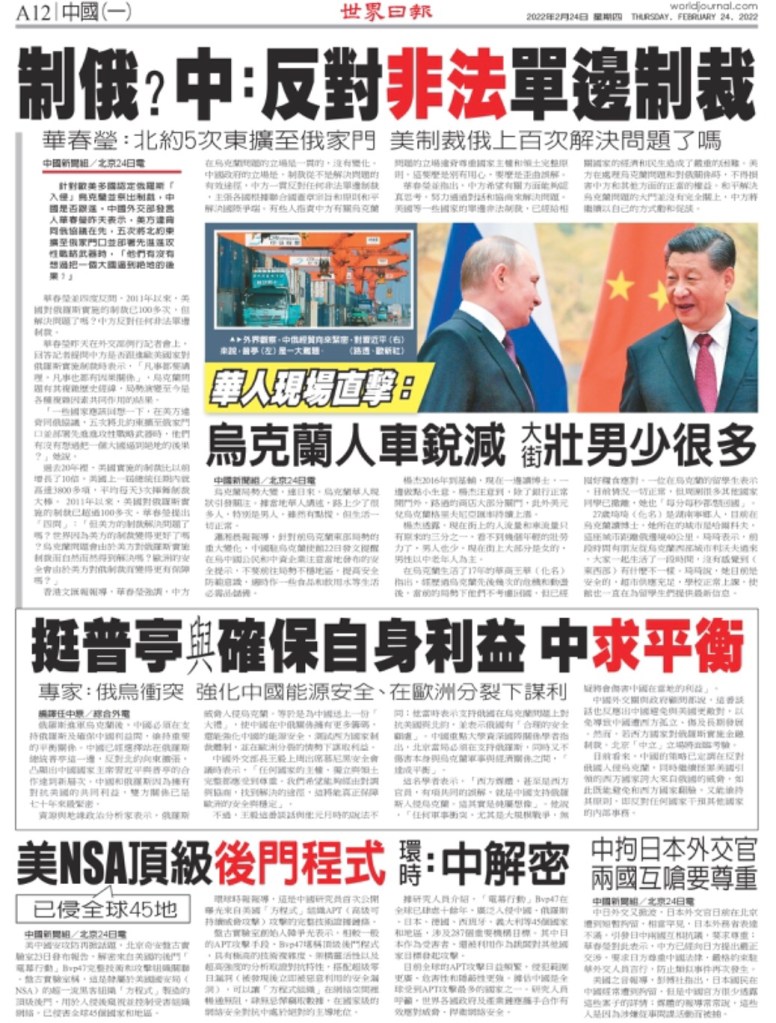
Video: U.S. not qualified to tell China what to do on respecting national sovereignty: FM spokesperson 美國沒有資格告訴中國如何尊重國家主權:中國外交部發言人
The U.S. is not qualified to tell China what to do on the issue of respecting national sovereignty and territorial integrity, said a Chinese Foreign Ministry spokesperson in response to U.S. State Department spokesperson’s remarks on Ukraine. 針對美國國務院發言人就烏克蘭問題發表的言論,中國外交部發言人表示,在尊重國家主權和領土完整的問題上,美方沒有資格告訴中方該怎麼做


 Johnson Choi Biz