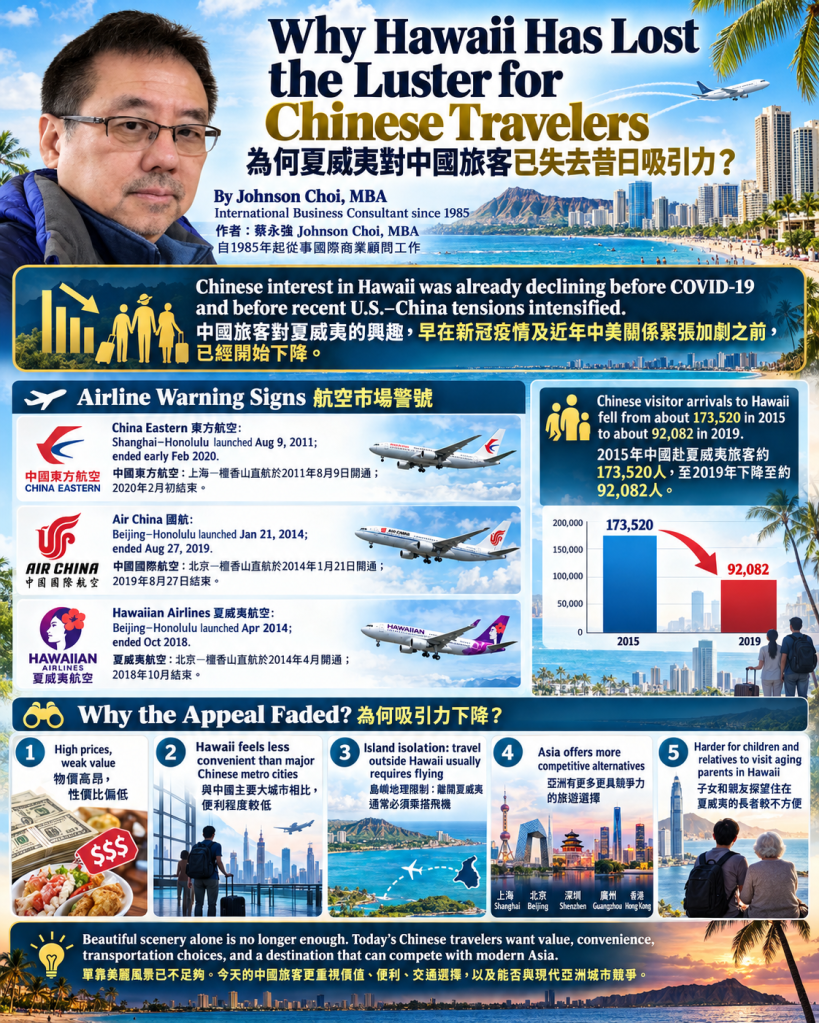
WHY CHINESE TOURISTS WERE LOSING INTEREST IN HAWAII LONG BEFORE THE PANDEMIC
Hawaii’s Declining Appeal to Affluent Chinese Travelers: High Prices, Limited Transportation Choices, and Growing Competition from Asia
By Johnson Choi, MBA
International Business Consultant since 1985
For decades, Hawaii has promoted itself as a world-class tropical paradise, attracting visitors from around the globe. However, an important question deserves serious consideration:
Why did Chinese tourists begin losing interest in Hawaii years before the COVID-19 pandemic, and why did three major airlines eventually discontinue their nonstop China–Hawaii services?
為何中國遊客早在疫情及近年中美關係緊張之前,就已逐漸對夏威夷失去興趣?
夏威夷對中國富裕旅客的吸引力為何逐漸下降?物價高昂、交通選擇有限,以及亞洲旅遊目的地競爭日益激烈
作者:蔡永強 Johnson Choi, MBA. 自1985年起從事國際商業顧問工作
數十年來,夏威夷一直以世界級熱帶度假天堂自居,吸引全球各地的遊客前往觀光旅遊。
然而,有一個重要問題值得深入探討:
為甚麼中國遊客早在新冠疫情爆發之前,就已經逐漸對夏威夷失去興趣?為甚麼三家主要航空公司最終相繼取消中國與夏威夷之間的直航服務?
根據我四十多年從事國際商業顧問工作的經驗,尤其是長期在中國開展業務,並與中國企業家、專業人士及其家人交流的親身觀察,我認為原因遠遠不止於中美政治關係緊張。
問題的核心在於:
夏威夷的旅遊成本越來越高,但與此同時,中國及亞洲其他旅遊城市和度假勝地正迅速現代化,為中國旅客提供更多選擇、更方便的交通、更完善的服務,以及更具競爭力的價格。
一、三家主要航空公司先後取消中國與夏威夷之間的直航服務
中國與夏威夷之間的直航歷史,本身已經說明了一些值得關注的問題。
- 中國東方航空(China Eastern Airlines)
中國東方航空於2011年8月9日開通上海浦東國際機場至夏威夷檀香山國際機場的直航服務。
這是中國內地航空公司最早開辦的主要定期中國至夏威夷直航航線之一。
該航線營運約八年半,直到2020年2月初,因新冠疫情爆發而停止服務。
- 中國國際航空(Air China)
中國國際航空於2014年1月21日開通北京首都國際機場至檀香山的直航服務。
然而,這條航線在2019年8月27日正式停航,比新冠疫情爆發還要早數個月。
- 夏威夷航空(Hawaiian Airlines)
美國夏威夷航空於2014年4月開辦檀香山與北京之間的直航服務。
但該公司在2018年10月便終止了北京航線,營運時間只有約四年半。
最值得注意的是,夏威夷航空和中國國際航空都在新冠疫情爆發之前,就已取消北京與夏威夷之間的直航服務。
因此,不能簡單地把這些航線的停辦全部歸咎於疫情。
夏威夷航空曾表示,中國市場的乘客需求增長未如預期。
另一方面,中國國際航空北京至檀香山航線在2018年的載客率約為66.37%,低於該公司國際航線整體約76.69%的載客率。
這些數字反映,航空公司在吸引足夠乘客、維持航線商業效益方面,確實面對挑戰。
二、疫情之前,中國赴夏威夷的遊客人數已經持續下降
根據夏威夷官方旅遊統計數據,中國訪客人數在2015年達到約173,520人。
到了2016年,人數下降至164,326人。
2017年進一步下降至141,232人。
2018年減少至123,246人。
2019年更跌至只有92,082人。
換言之,從2015年至2019年,中國赴夏威夷的遊客人數減少約47%。
這是在新冠疫情爆發之前已經發生的現象。
值得注意的是,中美貿易摩擦在2018年之後明顯升級,但中國訪客減少的趨勢早在2016年已經開始。
因此,夏威夷中國旅遊市場的萎縮,不能完全歸因於疫情或近年的中美政治緊張局勢。
三、我在中國的客戶,為甚麼對夏威夷感到失望?
多年來,我在中國從事國際商業顧問工作期間,曾與不少中國企業家、客戶、朋友、同事,以及他們的親戚和家人,討論過到夏威夷旅遊的經驗。
其中一些人的意見,令我印象非常深刻。
部分人士告訴我,他們最初對夏威夷產生興趣,其中一個原因,是中國過去曾有國家領導人到訪夏威夷。
這些高層訪問提高了夏威夷在中國的知名度,也令一些中國旅客對這個美國太平洋島州產生好奇。
然而,當他們真正到訪夏威夷之後,部分人士卻感到失望。
他們並不是認為夏威夷沒有漂亮的自然風景。
相反,大多數人都承認,夏威夷擁有美麗的海灘、宜人的氣候,以及獨特的自然環境。
真正令部分中國旅客失望的,是夏威夷的生活配套、城市設施、交通便利程度和消費價格,與他們在中國大城市日常享受到的水平存在明顯差異。
這些人士不少來自上海、北京、深圳、廣州,以及香港特別行政區。
他們早已習慣大型現代化商場、數之不盡的餐廳、便利的電子支付、高效率的公共交通、高鐵網絡、豪華酒店,以及各種娛樂設施。
當他們抵達夏威夷後,卻發現除了陽光、海灘和自然風景之外,城市生活及娛樂選擇相對有限,而且很多服務的價格比中國大城市更加昂貴。
部分客戶向我提出一個很實際的問題:
「為甚麼我們要花這麼多錢,坐這麼長時間的飛機,跑到太平洋中間的夏威夷度假?我們在中國或亞洲其他地方,不是可以用更少的錢,享受同樣甚至更方便的度假生活嗎?」
當然,這些是我接觸過的特定中國客戶和旅客的親身意見,並不能代表所有中國遊客的看法。
但這些經驗,確實反映了中國富裕旅客消費觀念的轉變。
四、中國富裕旅客為甚麼會認為夏威夷物價高昂、不值得?
四五十年前,對不少亞洲旅客而言,能夠到美國夏威夷度假,是一種令人羨慕的奢華享受。
但今日的世界已經完全不同。
中國富裕旅客可以選擇海南三亞、廈門、深圳、香港、澳門,也可以前往泰國、馬來西亞、印尼、日本,以及亞洲其他著名度假勝地。
這些地方不少擁有五星級酒店、豪華購物中心、國際級餐廳、海濱度假村、現代化交通設施,以及豐富的娛樂選擇。
對於早已習慣上海、深圳、廣州或香港繁華生活的旅客而言,夏威夷可能顯得比較寧靜。
對喜歡自然環境、沙灘和戶外活動的人來說,這是優點。
但對喜歡購物、美食、夜生活和多元化娛樂的旅客而言,這未必有足夠吸引力。
更重要的是,夏威夷的酒店、餐飲、交通、稅項和小費等費用,往往會令整體旅遊開支大幅增加。
我接觸過的一些中國客戶便認為,自己付出的價錢與實際享受到的服務和便利程度並不相稱。
國際旅遊市場的競爭,已經不再單靠漂亮風景取勝。價格、交通、服務、便利程度和娛樂選擇,同樣是決定旅客是否願意再次到訪的重要因素。
五、夏威夷地理位置孤立,對退休人士尤其不方便
另一個經常被忽略的重要問題,是夏威夷的地理位置。
夏威夷位於太平洋中央,距離美國本土及亞洲主要城市都有數千公里。
對一般居民而言,要離開夏威夷州前往其他州或國家,實際上主要依靠飛機。
年輕的時候,坐飛機可能不是甚麼問題。
但當一個人逐漸年老,情況就不同了。
有些退休人士即使財力雄厚,完全負擔得起商務艙甚至頭等艙,也不代表他們喜歡經常坐飛機。
長途飛行、機場安檢、行李搬運、候機、轉機,以及長時間的旅途,對部分長者來說是一種負擔。
相比之下,居住在中國內地或香港特別行政區,交通選擇便靈活得多。
居民可以乘坐高鐵、普通火車、長途巴士、私人汽車、渡輪,或者飛機。
以中國粵港澳大灣區為例,居住在深圳、廣州、珠海、香港或澳門的人,可以透過高鐵、高速公路、跨境巴士或其他交通工具,方便地前往周邊城市。
對年紀漸長的人來說,可以自由選擇不坐飛機出行,本身就是一種重要的生活優勢。
六、選擇退休地點,不只是考慮自己喜歡甚麼,更要考慮子女和孫兒是否願意來探望
我一直認為,退休人士在選擇居住地點時,應該認真思考一個問題:
當你年紀越來越大,你的子女、孫兒、親戚和朋友,是否仍然願意經常來探望你?
退休居所再漂亮,如果家人因為交通不便、費用高昂而很少來探望,這樣的退休生活是否真正理想?
假如退休後居住在夏威夷,而子女和孫兒都住在美國本土或亞洲,每次家庭探訪可能需要購買機票、安排住宿、請假,以及花費大量交通時間。
相比之下,如果退休後居住在中國交通便利的大城市,附近城市的親戚朋友可能只需要乘坐高鐵或開車,便能前來吃午餐、晚餐,甚至週末團聚。
這種便利,在退休初期未必顯得特別重要。
但是,到了七十歲、八十歲甚至九十歲,家人能否方便地探望和照顧自己,可能比海景、泳池和花園更加重要。
當然,如果子女和孫兒本來就住在夏威夷,或者退休人士特別重視當地的氣候、文化和自然生活環境,夏威夷仍然可能是理想的退休地方。
真正明智的退休規劃,不應只考慮自己喜歡住在哪裏,也應該考慮醫療、交通、生活便利,以及家人能否經常相聚。
七、習近平反腐運動之前,中國部分商務和公務訪美的特殊情況
另一個值得討論的問題,是過去中國部分商務旅遊、公務代表團,以及企業招待活動與赴美旅遊之間的關係。
在中國加強反腐敗及公務開支監管之前,部分由企業資助的出國考察、商務訪問和官方交流活動,曾經包含旅遊觀光、娛樂和其他招待安排。
這類活動有時會引起公務開支是否合理、企業是否藉招待建立特殊關係等問題。
根據我多年在中國與企業界接觸的經驗,商業關係、公務考察團和企業招待,確實曾經影響部分人士的出國旅遊安排。
隨着習近平主政後加強反腐敗工作,以及對公款出國、公務接待和企業招待活動實施更嚴格監管,這類旅遊安排也受到更多限制。
我相信,這些政策轉變可能影響了部分中國人士的出境旅遊模式。
不過,究竟有多少中國赴美旅遊是由企業不當資助,或者實際涉及公務人員的私人娛樂活動,目前並沒有足夠可靠的統計數據,可以從我的個人觀察推算出具體百分比。
但有一點值得思考:
過去某些被稱為「商務考察」或「公務交流」的出國行程,未必完全以實際商業活動為主要目的。
八、為甚麼洛杉磯長期是中國旅客赴美的重要門戶?
洛杉磯長期以來一直是中國旅客前往美國的重要入境城市之一。
洛杉磯國際機場擁有廣泛的國際航線,加上龐大的華人社區、中美商業往來,以及成熟的旅遊服務,令洛杉磯成為不少中國訪美人士的第一站。
根據我過去從事國際商業顧問工作的經驗,一些中國商務旅客會把洛杉磯的商業活動與拉斯維加斯的觀光娛樂行程結合起來。
我也曾接觸過一些旅客,雖然以洛杉磯作為美國入境和離境城市,但實際上在拉斯維加斯停留的時間更長。
這種情況也引出一個值得研究的問題:
究竟旅客是純粹商務訪問,還是商務和私人旅遊兼有?
一個人可能因為商務理由飛抵洛杉磯,卻同時安排到拉斯維加斯觀光、購物和娛樂。
不過,不能因為個別人士有這些安排,就推斷大部分中國官方代表團都採取相同做法。
九、夏威夷旅遊業應該從中國市場的變化學到甚麼?
我認為夏威夷旅遊業必須明白一個現實:
單靠過去的國際知名度,以及「美國熱帶天堂」的形象,已經不能保證中國富裕旅客會繼續前來消費。
自1980年代以來,中國社會和經濟發生了翻天覆地的變化。
中國旅客的收入、國際旅遊經驗、消費能力,以及對服務品質的要求,都與過去大不相同。
今日的中國富裕旅客,有更多旅遊目的地可以選擇。
不少人亦不再理所當然地認為,美國在城市基建、購物、酒店、餐飲或日常生活便利程度方面,一定比中國優越。
對這些消費者而言,旅遊最重要的是實際體驗,而不是目的地是否位於美國。
因此,夏威夷如果希望重新吸引中國富裕旅客,就必須提供足夠有吸引力的旅遊體驗,讓旅客覺得長途飛行和高昂開支確實物有所值。
夏威夷當然有其不可取代的特色,包括原住民文化、火山地貌、美麗海灘、海洋活動、熱帶氣候,以及獨特的島嶼自然環境。
這些都是亞洲其他城市難以完全複製的優勢。
但在現代國際旅遊市場中,獨特風景只是競爭力的一部分。
真正能夠吸引旅客再次到訪的,是整體旅遊體驗能否符合他們的期望,以及所付出的價格是否值得。
十、結論:中國的崛起,已經改變中國旅客對世界的期待
回顧中國與夏威夷之間的航空歷史,可以看到一個值得深思的現象。
夏威夷航空在2018年10月停止北京直航。
中國國際航空在2019年8月停止北京至檀香山的航線。
中國東方航空則在2020年2月初停止上海至檀香山的服務。
更重要的是,中國赴夏威夷的遊客人數,早在2016年便已經開始下降。
因此,夏威夷中國旅遊市場面對的困難,不能全部歸咎於新冠疫情,也不能單純用近年的中美政治關係緊張來解釋。
根據我四十多年來在國際商業領域的經驗,以及與中國客戶、企業家、專業人士和他們家人交流的觀察,我認為夏威夷的高昂物價、地理隔離、交通選擇有限,以及亞洲現代化旅遊城市的激烈競爭,都是值得重視的因素。
今日的中國,已經不是四十年前的中國。
中國的大城市迅速現代化,交通基建不斷改善,消費市場日益成熟,人民對生活質素和服務水平的要求也越來越高。
中國富裕旅客如今可以選擇的旅遊目的地,比過去任何時候都更多。
他們不一定需要遠赴美國,才能享受豪華酒店、優質餐飲、現代購物設施,以及舒適便利的生活。
夏威夷仍然是一個美麗的旅遊勝地,但美麗的陽光與海灘,已經不足以說服每一位富裕中國旅客,願意付出高昂的金錢、漫長的飛行時間,以及交通上的不便,專程前往夏威夷度假。
國際旅遊市場已經改變。中國旅客的眼界、生活水平和消費選擇,也早已今非昔比。
⸻
作者:蔡永強 Johnson Choi, MBA. 自1985年起從事國際商業顧問工作
Based on my more than four decades of international business experience, including extensive consulting work in China, I believe the explanation goes far beyond U.S.–China political tensions.
The fundamental issue is that Hawaii has become an increasingly expensive destination competing against rapidly modernizing Asian cities and world-class resorts that often offer Chinese travelers greater convenience, better value, and more choices.
- Three Major Airlines Discontinued Their China–Hawaii Nonstop Flights
The history of nonstop airline service between China and Hawaii tells an important story.
China Eastern Airlines (中國東方航空) launched nonstop service between Shanghai and Honolulu on August 9, 2011. It continued operating the route until early February 2020, when flights were suspended during the initial COVID-19 outbreak.
Air China (中國國際航空) launched its Beijing–Honolulu nonstop service in January 2014 and discontinued the route effective August 27, 2019, several months before the pandemic.
Hawaiian Airlines (夏威夷航空) began operating nonstop flights between Honolulu and Beijing in April 2014 but terminated the service in October 2018.
The most revealing fact is that Hawaiian Airlines and Air China both discontinued their Beijing–Honolulu services before COVID-19.
Their decisions were not simply the result of pandemic-related travel restrictions.
Hawaiian Airlines cited disappointing growth in passenger demand, while Air China’s Beijing–Honolulu route had a passenger load factor of approximately 66.37% in 2018, compared with 76.69% across its international network.
These figures indicate that the airlines were struggling to attract sufficient passenger demand to justify maintaining their services.
- Chinese Visitor Arrivals Were Already Declining
Hawaii’s official tourism statistics provide further evidence.
Chinese visitor arrivals reached approximately 173,520 in 2015 but declined to 164,326 in 2016, 141,232 in 2017, 123,246 in 2018, and just 92,082 in 2019.
That represents a decline of approximately 47% between 2015 and 2019, even before the pandemic.
It is important to recognize that U.S.–China trade tensions intensified during this period, particularly from 2018 onward. However, Hawaii’s decline in Chinese visitor arrivals had already begun in 2016.
The downward trend cannot be explained by the pandemic or recent political tensions alone.
- What My Chinese Clients Told Me About Hawaii
During my international consulting work in China, I have had numerous conversations with Chinese clients, their friends, business associates, colleagues, and relatives about their experiences visiting Hawaii.
Their opinions were remarkably consistent in several respects.
Some told me that they initially became interested in Hawaii because prominent Chinese leaders had visited the islands. Those high-profile visits helped create curiosity and gave Hawaii considerable publicity in China.
However, after visiting Hawaii themselves, a number of these travelers told me they were disappointed.
Their complaints were not necessarily about Hawaii’s natural beauty. Most acknowledged that its beaches, climate, scenery, and outdoor environment were attractive.
The disappointment came from the comparison with their everyday lives in China’s major metropolitan areas.
Many of these individuals were accustomed to living in Shanghai, Beijing, Shenzhen, Guangzhou, or Hong Kong SAR.
They already enjoyed modern shopping centers, extensive restaurant choices, high-speed transportation, convenient digital services, sophisticated hotels, and entertainment facilities.
From their perspective, Hawaii offered beautiful scenery but fewer urban conveniences and significantly higher prices.
Their question was simple: Why spend considerably more money traveling halfway across the Pacific when comparable or more convenient vacation experiences are available much closer to home?
These conversations reflect my personal experience with a particular group of Chinese travelers, rather than a scientific survey of all Chinese tourists.
- Why Affluent Chinese Travelers May Find Hawaii Overpriced
Forty or fifty years ago, Hawaii represented a luxurious destination for many Asian travelers.
Today, the competitive environment has changed dramatically.
Affluent Chinese travelers can choose among numerous destinations in China and throughout Asia, including Hainan Island, Sanya, Xiamen, Shenzhen, Hong Kong, Macau, Thailand, Malaysia, Indonesia, Japan, and other resort locations.
Many of these destinations offer upscale hotels, excellent restaurants, shopping, beaches, entertainment, and modern transportation infrastructure.
For Chinese travelers accustomed to large metropolitan cities, Hawaii can feel comparatively quiet, particularly after the initial excitement of sightseeing and visiting the beaches.
In addition, visitors to Hawaii face high accommodation costs, restaurant prices, transportation expenses, and, in many circumstances, additional taxes and gratuities.
Some of my clients expressed the opinion that what they received simply did not justify the total expense.
In international tourism, beautiful scenery alone does not guarantee repeat customers. Price, convenience, service, accessibility, and entertainment choices matter just as much.
- Hawaii’s Geographic Isolation Becomes a Disadvantage, Especially for Retirees
Another issue frequently overlooked is Hawaii’s geographic isolation.
Hawaii is an island state located thousands of miles from the continental United States and major Asian population centers.
For practical purposes, residents traveling outside Hawaii must rely on air transportation.
This can become increasingly inconvenient as people grow older.
Some retirees, including wealthy individuals who can afford business-class or first-class tickets, simply do not enjoy lengthy flights, airport security procedures, baggage handling, and long travel days.
By contrast, residents of mainland China and Hong Kong have multiple transportation options.
They can travel by high-speed rail, conventional rail, private automobile, intercity coach, ferry, or airplane.
A retiree living in a major Chinese metropolitan area can often travel to neighboring cities without setting foot in an airport.
For example, someone living in China’s Greater Bay Area can conveniently visit Guangzhou, Shenzhen, Zhuhai, Hong Kong, Macau, and other cities using interconnected transportation networks.
The freedom to travel without flying is an increasingly important quality-of-life consideration for many older people.
- Retirement Is Not Just About Where You Want to Live — It Is Also About Whether Your Children and Grandchildren Will Visit
One of the most important questions retirees should consider is how easily their children, grandchildren, relatives, and friends can visit them.
A beautiful retirement home means much less if family members find it inconvenient or expensive to travel there.
For someone living in Hawaii, visiting family members may need to purchase airline tickets, arrange accommodation, take time away from work, and spend many hours traveling.
For someone living in a well-connected Chinese metropolitan area, relatives in nearby cities may be able to visit by high-speed train or automobile, sometimes even for lunch, dinner, or a weekend.
This difference can become increasingly important as retirees age.
Of course, Hawaii remains attractive to people whose families already live there or who prioritize its climate, scenery, culture, and quieter lifestyle.
Nevertheless, retirement planning should consider family accessibility, medical services, transportation, and everyday convenience—not simply ocean views and beautiful weather.
- Business-Sponsored Travel and China’s Anti-Corruption Campaign
Another factor worth discussing is the historical relationship between Chinese business travel, government delegations, and travel to the United States.
Before China’s intensified anti-corruption campaign under President Xi Jinping, some business-sponsored trips and official visits included entertainment, sightseeing, and other activities that raised questions about the appropriate use of corporate or public resources.
During my years working with Chinese businesses, I observed how business relationships, official delegations, and hospitality arrangements could influence international travel patterns.
As anti-corruption enforcement and scrutiny of official expenditures increased, such travel arrangements faced greater restrictions.
I believe these changes also influenced certain categories of outbound Chinese travel.
However, the precise percentage of Chinese trips funded improperly by businesses or involving official leisure travel cannot be established from my personal observations alone.
The broader point is that not every international trip described as business travel was necessarily motivated entirely by business needs.
- Why Los Angeles Was Often a Gateway for Chinese Visitors
Los Angeles has historically been one of the most important U.S. gateways for visitors arriving from China.
Its international airport, extensive flight connections, Chinese-speaking communities, commercial relationships, and tourism infrastructure made it a logical entry point.
From my professional experience, some travelers combined legitimate business visits to Los Angeles with leisure trips to Las Vegas.
In certain cases, I observed that Los Angeles served as the formal entry and departure point while much of the traveler’s time was spent elsewhere.
This raises a broader question about how international travel should be classified.
A person arriving through Los Angeles for business purposes may spend part of the trip sightseeing, shopping, or visiting Las Vegas.
However, such individual experiences should not be interpreted as proof that most official Chinese delegations operated in this manner.
- What Hawaii’s Tourism Industry Should Learn
Hawaii cannot assume that its international reputation alone will attract affluent Chinese tourists indefinitely.
China has changed tremendously since the 1980s.
Modern Chinese travelers have more disposable income, greater international travel experience, higher expectations, and more destinations competing for their spending.
Many no longer automatically associate the United States with superior infrastructure, shopping, hotels, or consumer services.
For Hawaii to become more competitive in the Chinese travel market, it must offer visitors a compelling reason to pay for the long journey and the higher expenses.
Hawaii has unique strengths: its Hawaiian culture, natural environment, ocean recreation, climate, national parks, and distinctive island experiences.
Those are advantages that Asian cities cannot simply duplicate.
However, Hawaii must compete on the quality and uniqueness of the entire visitor experience, not merely its reputation as an American tropical paradise.
Conclusion: China’s Transformation Has Changed What Its Travelers Expect
The history of China–Hawaii air service should be understood in the context of changing Chinese consumer expectations.
Hawaiian Airlines discontinued Beijing service in October 2018. Air China followed in August 2019. China Eastern’s Shanghai service ended in February 2020.
More importantly, Chinese visitor arrivals to Hawaii had already been declining since 2016.
These developments demonstrate that Hawaii’s difficulty in attracting Chinese travelers cannot be attributed exclusively to COVID-19 or U.S.–China geopolitical tensions.
Based on my decades of international business experience and conversations with Chinese clients, I believe Hawaii’s high prices, geographic isolation, limited transportation alternatives, and competition from modern Asian destinations are important underlying issues.
The world has changed. China’s cities have modernized, its consumers have become more sophisticated, and its travelers have more choices than ever before.
Hawaii remains a beautiful destination. But beautiful scenery alone is no longer enough to convince every affluent Chinese traveler that Hawaii is worth the expense, distance, and inconvenience.
By Johnson Choi, MBA
International Business Consultant since 1985