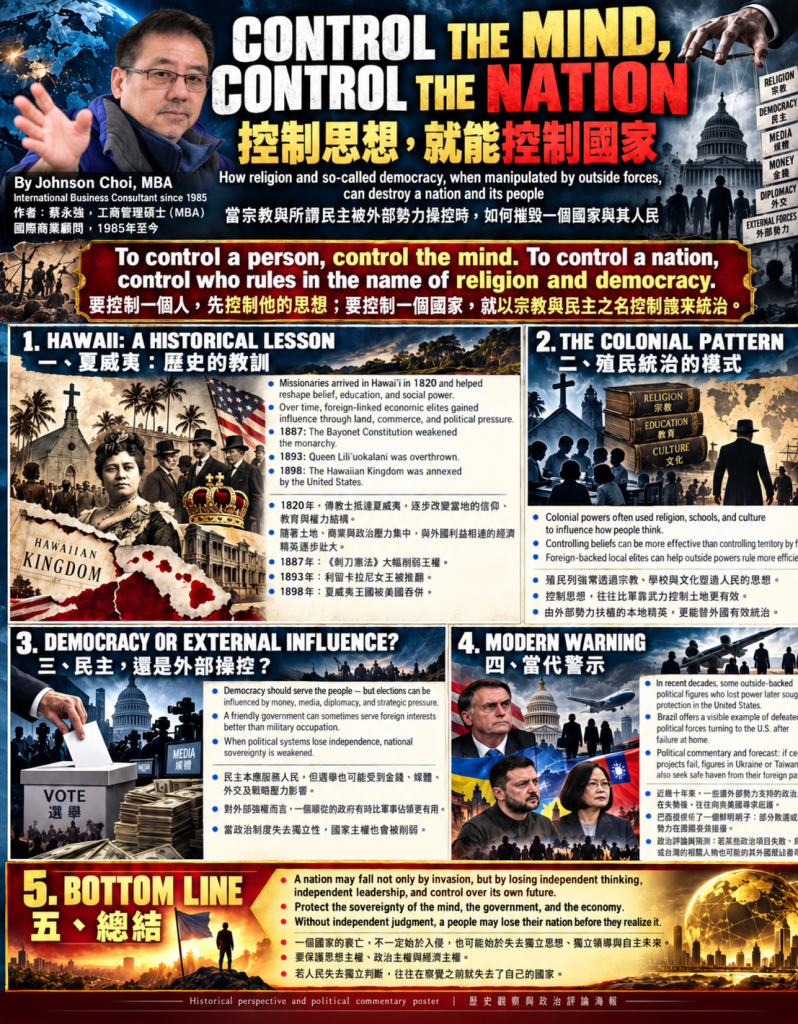
CONTROL THE MIND, CONTROL THE NATION: HOW RELIGION, DEMOCRACY, AND FOREIGN INFLUENCE CAN BECOME TOOLS OF POWER
From the Overthrow of the Hawaiian Kingdom to Modern-Day Ukraine, Taiwan, and Brazil
By Johnson Choi, MBA
International Business Consultant since 1985
Control the narrative, and you influence the mind.
Control the political system, and you influence the government.
Control the economy, and you influence the nation’s choices.
But when a people surrender their independent judgment, they risk surrendering their sovereignty long before they realize it.
控制思想,就能控制國家!宗教、民主與外國勢力如何成為操控權力的工具?
從美國推翻夏威夷王國,到當今烏克蘭、台灣及巴西的政治局勢
作者:蔡永強,工商管理碩士(MBA)國際商業顧問,1985年至今
控制輿論,就能影響人民的思想!
控制政治制度,就能影響誰來掌握政權!
控制經濟命脈,就能影響一個國家的重大決策!
但是,當一個民族主動放棄獨立思考與自主判斷時,他們可能在尚未察覺之前,就已經逐步失去自己的國家主權!
如果你想控制一個人,最有效的方法之一,就是影響他的思想與信仰;如果你想控制整個國家,就要影響誰能掌握政權,並讓人民相信,這一切都是他們自由選擇的結果!
縱觀世界歷史,強國早已明白,單靠軍事力量佔領土地,不但代價高昂,而且難以長期維持統治。
相比之下,更有效的方法,是透過宗教信仰、教育制度、政治宣傳、經濟利益及當地權貴階層,逐步影響人民的思想,並扶植符合外國戰略利益的政治人物。
宗教與民主本身並非壓迫人民的工具。兩者都可以發揮正面作用,促進社會發展及保障人民權利。
然而,歷史同樣證明,當宗教權威與民主制度被強大的政治及經濟利益集團利用時,便有可能成為殖民擴張、政治滲透及外國干預的工具。
一、夏威夷王國的悲劇:宗教、經濟利益與外國勢力如何摧毀一個獨立王國?
夏威夷的歷史,正是一個值得世人深思的例子。
1820年,美國基督新教傳教士抵達夏威夷群島,開始傳播基督教,並逐步建立宗教、教育及文化機構,對夏威夷社會產生深遠影響。
隨着時間推移,部分傳教士的後代逐漸進入商業、銀行、甘蔗種植、土地開發及政治領域。
透過家族聯姻、商業合作、土地積累及財富集中,一些傳教士家族的後代逐漸形成具有龐大經濟及政治影響力的利益網絡。
這是一個十分值得注意的歷史轉變。
最初以傳播宗教為目的的傳教活動,經過數代人的發展,部分相關家族及其商業利益逐漸成為影響夏威夷王國政治與經濟的重要力量。
隨着甘蔗種植業擴張、土地所有權制度改變、國際貿易利益增加,以及外國商人對政府施加政治壓力,夏威夷王國的經濟命脈逐漸受到外國商業勢力的深刻影響。
1887年,夏威夷國王卡拉卡瓦(King Kalākaua)在政治威脅下,被迫接受所謂的《刺刀憲法》(Bayonet Constitution)。
這部憲法大幅削弱王室權力,並使富裕土地持有人及與外國利益有聯繫的政治勢力獲得更大的政治影響力。
1893年1月17日,夏威夷女王利留卡拉尼(Queen Liliʻuokalani)遭到一批商人及政治人物推翻,其中包括美國傳教士的後代,而美國外交及軍事人員亦在事件中發揮了作用。
1898年,美國正式吞併夏威夷。
一個原本擁有主權的獨立王國,最終失去了國家自主權。這並不是夏威夷人民透過自由公投,主動決定放棄自己的國家,而是經濟利益、政治脅迫、外國干預及軍事力量共同作用的結果。
當然,這並不意味着所有基督教傳教士都參與了推翻王國的政治行動。許多夏威夷原住民同樣信奉基督教,並運用自己的宗教信仰捍衛夏威夷的獨立與文化。
真正值得警惕的是:
當宗教影響力、經濟財富與外國政治利益逐漸結合,並集中在少數權貴手中時,一個獨立國家的政治制度便可能受到侵蝕,最終失去主權。
二、西方殖民主義:為何控制思想,比軍事佔領更有效?
回顧過去數百年的殖民歷史,西方列強並非單純依靠軍艦、大炮及軍隊統治殖民地。
在不同的殖民環境中,宗教傳教、教育制度、文化同化、經濟依賴及與地方權貴結盟,都曾被用來建立或鞏固殖民統治。
當一個民族逐漸被灌輸外國文化、制度及領導者天然優越的觀念時,人民對外來統治的抵抗意識便可能受到削弱。
如果人民從思想深處認為外國統治具有道德上的正當性,殖民者就不必時刻依靠武力維持權力。
這正是殖民主義最值得警惕的一面。
真正的控制,不一定來自軍隊。
它也可能來自學校、宗教機構、文化傳播、經濟制度,以及人民對自己歷史與民族身份的認知。
因此,研究殖民主義,絕不能只看軍事戰爭與領土佔領。
我們更應研究誰掌握教育、誰控制土地、誰擁有經濟資源,以及誰有能力決定人民應該相信甚麼。
三、民主制度:究竟是人民當家作主,還是外國勢力影響政權的工具?
民主制度的基本理念,是讓人民透過選舉決定誰來治理自己的國家。
然而,如果外國政府透過政治資金、外交壓力、經濟利益、媒體宣傳、情報關係,以及扶植特定政治派系來影響選舉,又會出現甚麼情況?
一場選舉即使在程序上符合民主原則,也可能受到國內外強大政治及經濟勢力的影響。
這就帶來一個值得所有國家思考的重要問題:
民主制度是否必然保障國家真正獨立?還是民主選舉在某些情況下,也可能被外國勢力利用,成為推動其戰略利益的工具?
依我多年從事國際商業及觀察國際政治的經驗,我認為強國通常更願意看到與自己保持友好關係的政府在其他國家執政。
原因非常簡單。
如果一個外國政府願意主動配合某個強國的軍事部署、外交政策、經濟利益及地緣政治戰略,那麼這種政治影響力,往往比直接軍事佔領更加有效,而且成本更低。
最有效的外國政治影響,不一定是派兵佔領別人的國家,而是讓當地政府主動配合你的戰略利益。
當然,並非所有與美國結盟的政府都是傀儡政權。國際聯盟也可能建立在真正的民意支持、共同價值及國家利益之上。
但我們同樣不應天真地認為,所有國際政治聯盟都完全不受外國壓力與戰略計算影響。
四、當親美政治人物失去權力,他們最後會去哪裏?
過去數十年,世界各地部分政治領袖在失去政權、面臨司法調查,或失去國內政治支持之後,選擇前往外國居住、尋求政治支持,甚至尋求庇護。
美國便是其中一個目的地。
巴西的例子值得關注。
2022年巴西總統選舉結束後,前總統雅伊爾・博索納羅(Jair Bolsonaro)在敗選後前往美國佛羅里達州,並停留數月,之後才返回巴西。
至於2026年10月,亦有報道指出,弗拉維奧・博索納羅(Flávio Bolsonaro)在選舉失利後前往美國。
這些人的政治處境並不完全相同,而前往美國也不能單憑這一行為,就證明某人是美國政府的政治傀儡。
然而,這些事件仍然令人思考一個重要問題:
當某些政治人物失去國內民意支持,甚至失去政權時,他們究竟會留下來承擔政治後果,還是選擇前往與自己關係密切的外國尋找退路?
在國際政治中,政治人物與外國強權之間的關係,往往不只是公開的外交合作那麼簡單。
其中可能涉及長期建立的政治、經濟、人脈及戰略利益網絡。
五、我的政治預測:烏克蘭與台灣,未來是否可能出現類似情況?
展望未來,我認為烏克蘭與台灣的政治發展值得密切關注。
兩者在美國與其他大國的戰略競爭中,都具有重要地緣政治地位。
不過,烏克蘭與台灣的歷史背景、政治制度、安全局勢及對美關係並不相同,不能簡單視為完全一致的案例。
我的個人預測是:如果某些與華盛頓關係密切的政治領袖,未來遭遇重大政治或戰略失敗,他們當中可能有人最終選擇前往美國居住,甚至尋求保護。
在烏克蘭,長期戰爭、政治動盪,或未來政府更替,都有可能促使部分政治人物考慮離開國家。
在台灣,如果未來出現重大政治重新洗牌,或兩岸關係發生根本性變化,也可能有部分政治人物選擇移居海外。
如果有一天,烏克蘭或台灣的重要政治人物在失去政治權力後,前往美國尋求安全庇護,我一點也不會感到意外。
這是我對未來國際政治發展的個人判斷,而不是已經發生的事實,更不能據此認定相關政府必然受到美國操控。
最終結果仍將取決於未來選舉、當地人民的政治選擇、國際談判,以及地緣政治局勢的變化。
六、最重要的歷史教訓:一個國家的真正獨立,必須從思想獨立開始!
夏威夷王國的歷史告訴我們,一個國家不一定會在一夜之間失去主權。
國家自主權有可能在漫長的歷史過程中,因經濟依賴、土地及財富集中、外國政治關係,以及政府機構逐漸受到外部利益影響而不斷削弱。
當最後的政治衝突爆發時,真正的權力可能早已轉移。
宗教可以教導人民慈悲、道德、教育與社會責任。
民主可以保障人民自由、監督政府,以及維護政治問責。
但是,如果宗教或民主制度受到強大利益集團操控,原本應該服務人民的制度,就可能被扭曲成維護少數人利益的工具。
一個國家最大的危險,不一定是外國軍事力量有多強大,而是人民逐漸失去獨立思考、獨立治理,以及自主決定國家未來的能力。
我的結論非常簡單:
控制輿論,就能影響人民的思想!
控制政治制度,就能影響誰來掌握政權!
控制經濟命脈,就能影響一個國家的重大決策!
但是,當一個民族主動放棄獨立思考與自主判斷時,他們可能在尚未察覺之前,就已經逐步失去自己的國家主權!
歷史最大的教訓是:一個民族可以接受不同的宗教,可以採用不同的政治制度,也可以與世界各國建立友好關係;但絕不能放棄獨立思考,更不能讓自己的國家命運完全掌握在外國勢力手中!
⸻
作者:蔡永強,工商管理碩士(MBA)國際商業顧問,1985年至今
本文屬歷史分析與個人政治評論。涉及未來烏克蘭及台灣政治人物動向的內容,均為作者個人預測,並非已獲證實的事實。
If you want to control an individual, influence the way that person thinks and believes. If you want to control an entire nation, influence who governs it—and convince its people that the outcome represents their own free choice.
Throughout history, powerful nations have understood that controlling territory through military force alone is expensive, difficult, and often unsustainable.
A more effective strategy is to influence people’s beliefs, shape their political institutions, cultivate local elites, and support leaders whose interests align with those of foreign powers.
Religion and democracy are not inherently instruments of oppression. Both can serve important and legitimate purposes. But history demonstrates that powerful interests have sometimes exploited religious authority and democratic institutions to advance economic ambitions, political influence, and imperial expansion.
- Hawai‘i: How Religion, Economic Power, and Foreign Influence Helped Destroy an Independent Kingdom
The history of Hawai‘i provides a particularly important example.
When American Protestant missionaries arrived in the Hawaiian Islands in 1820, they introduced Christianity and established religious, educational, and cultural institutions that profoundly influenced Hawaiian society.
Over subsequent generations, the descendants of some missionary families became increasingly involved in commerce, sugar plantations, banking, landownership, and politics.
Family relationships, marriages, business partnerships, and accumulated wealth helped create influential networks that connected religious institutions, private enterprise, and political power.
The transformation was significant.
What began as a religious missionary presence eventually contributed to the emergence of powerful business and political interests, some of which sought to reshape the Hawaiian Kingdom according to their own economic priorities.
Through changes in landownership, expanding plantation interests, favorable trade arrangements, and political pressure, foreign commercial interests gradually acquired substantial influence over Hawai‘i’s economy.
In 1887, King Kalākaua was forced to accept the so-called Bayonet Constitution, which substantially weakened the monarchy and transferred greater political power to wealthy property holders and foreign-connected interests.
The final blow came on January 17, 1893, when a group of businessmen and political figures, including descendants of American missionaries, overthrew Queen Liliʻuokalani with the involvement of American diplomatic and military representatives.
In 1898, the United States annexed Hawai‘i.
An independent Hawaiian Kingdom lost its sovereignty—not through a popular decision by the Hawaiian people to surrender their nation, but through a combination of economic interests, political coercion, foreign intervention, and military power.
The lesson is not that every Christian missionary participated in a conspiracy. Many Native Hawaiians also embraced Christianity and used their faith to defend Hawaiian independence.
Rather, the lesson is that religious influence, economic concentration, and foreign political interests can become dangerously interconnected when powerful elites are able to influence the institutions of an independent nation.
- Colonialism: Why Controlling Beliefs Can Be More Effective Than Controlling Territory
Western colonial powers did not always depend exclusively on military occupation.
In various colonial settings, religious missions, educational institutions, cultural assimilation, economic dependency, and political alliances helped establish or reinforce imperial influence.
When a colonial population is encouraged to regard foreign values, institutions, or leaders as inherently superior, resistance to outside domination can become more difficult.
A population that accepts foreign authority as morally legitimate may be easier to govern than one that must constantly be controlled by force.
This is why the history of colonialism cannot be understood solely through battles, armies, and territorial conquest.
It must also be examined through education, religion, economic ownership, social hierarchy, and the gradual reshaping of political identity.
- Democracy: The Difference Between Genuine Self-Government and Foreign Political Influence
Democracy is supposed to give citizens the power to choose their own leaders.
But what happens when foreign governments attempt to influence those choices through political financing, diplomatic pressure, economic incentives, media campaigns, intelligence relationships, or support for favored political factions?
An election can be procedurally democratic while still taking place in an environment shaped by powerful domestic and international interests.
This raises an important question:
Does democracy always guarantee genuine national independence, or can democratic institutions sometimes be influenced to advance the strategic interests of foreign powers?
In my view, powerful countries often prefer friendly governments abroad because political influence can achieve objectives that military intervention would accomplish only at enormous cost.
A government that voluntarily supports a foreign power’s military, diplomatic, and economic priorities may be more strategically valuable than a territory held by occupation.
That does not mean every government aligned with Washington is a puppet. Political alliances can also reflect genuine public support and shared national interests.
But neither should we assume that every alliance is entirely free from external pressure or strategic calculation.
- When Foreign-Aligned Leaders Lose Power, Where Do They Go?
Over the past several decades, political leaders who have lost power, faced investigations, or fallen out of favor at home have sometimes sought refuge, residence, or political support abroad.
The United States has been one such destination.
Brazil offers an interesting example.
Following his defeat in the 2022 presidential election, former Brazilian President Jair Bolsonaro traveled to Florida, where he remained for several months before returning to Brazil.
More recently, reports in October 2026 indicated that Flávio Bolsonaro traveled to the United States following his own electoral defeat.
Their circumstances are not identical, and traveling to the United States does not by itself establish that someone was acting as an American political proxy.
Nevertheless, such developments raise questions about the relationships between political elites and powerful foreign countries.
When political leaders lose domestic support, will they remain to face the consequences at home, or seek protection and political opportunities abroad?
- My Prediction: Ukraine and Taiwan Could Face Similar Political Scenarios
Looking ahead, I believe developments in Ukraine and Taiwan deserve close attention.
Both occupy strategically important positions in the broader competition between Washington and Beijing or Moscow, although their political systems, histories, security situations, and relationships with the United States differ considerably.
My prediction is that if political leaders strongly aligned with Washington suffer major strategic or political defeats, some may eventually seek residence or protection in the United States.
In Ukraine, prolonged conflict, political instability, or a future change of government could create circumstances in which certain leaders choose to leave the country.
In Taiwan, a major political realignment or a fundamental change in cross-strait relations could likewise lead some political figures to relocate overseas.
I would not be surprised if prominent political leaders from Ukraine or Taiwan eventually sought a safe haven in the United States after losing political power.
This is my personal political forecast, not an established outcome or evidence that their governments are controlled by Washington.
Whether such developments occur will depend on future elections, domestic political choices, international negotiations, and broader geopolitical developments.
- The Ultimate Lesson: Political Independence Begins with Independent Thinking
The history of Hawai‘i teaches a lesson that should never be forgotten.
A country does not necessarily lose its independence overnight.
Its sovereignty can be weakened gradually through economic dependency, concentrated ownership, foreign political relationships, and institutions that become increasingly responsive to outside interests.
By the time the final political confrontation arrives, much of the underlying power may already have shifted.
Religion can inspire compassion, education, and moral responsibility. Democracy can protect freedom and public accountability.
But when either is manipulated by powerful interests, institutions intended to serve the people can become instruments of control.
The greatest danger to a nation is not simply foreign military power. It is the gradual loss of its ability to think independently, govern independently, and determine its own future.
My conclusion is simple:
Control the narrative, and you influence the mind.
Control the political system, and you influence the government.
Control the economy, and you influence the nation’s choices.
But when a people surrender their independent judgment, they risk surrendering their sovereignty long before they realize it.
— Johnson Choi, MBA
International Business Consultant since 1985