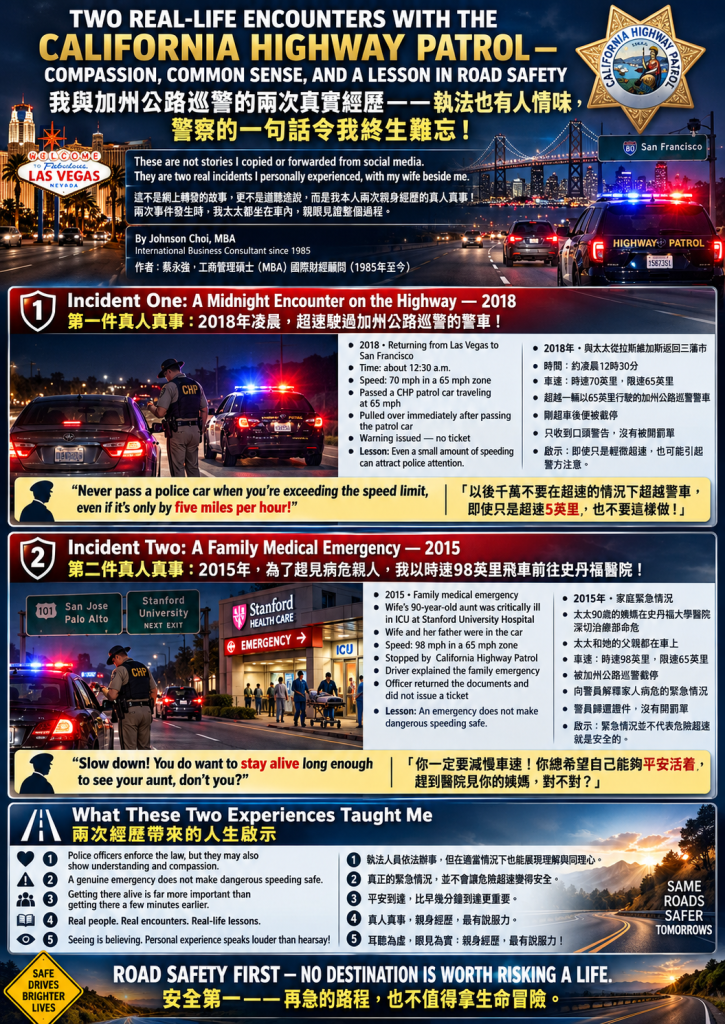
TWO REAL-LIFE ENCOUNTERS WITH THE CALIFORNIA HIGHWAY PATROL — COMPASSION, COMMON SENSE, AND A LESSON IN ROAD SAFETY
These are not stories I copied or forwarded from social media. They are two real incidents I personally experienced, with my wife beside me.
By Johnson Choi, MBA
International Business Consultant since 1985
我與加州公路巡警的兩次真實經歷——執法也有人情味,警察的一句話令我終生難忘!
這不是網上轉發的故事,更不是道聽途說,而是我本人兩次親身經歷的真人真事!兩次事件發生時,我太太都坐在車內,親眼見證整個過程。
作者:蔡永強,工商管理碩士(MBA)國際財經顧問(1985年至今)
第一件真人真事:2018年凌晨,超速駛過加州公路巡警的警車!
2018年,我與太太從拉斯維加斯(Las Vegas)開車返回三藩市。
當時已經是凌晨十二時三十分左右。
公路的法定最高時速是65英里(65 mph),而我當時的車速約為70英里,超速5英里。
行駛途中,我發現前方有一輛加州公路巡警(California Highway Patrol,簡稱CHP)的警車,正以每小時65英里的速度行駛。
由於我的車速比他快,我便直接超車,從他的警車旁邊駛過。
想不到,我剛剛超過他的警車,他便立即亮起警燈、響起警笛,示意我靠邊停車!
我乖乖把車停在路旁。
警員走過來,我交出自己的夏威夷州駕駛執照、汽車登記證,但當時沒有帶備汽車保險證明卡。
警員問我:
「這輛車的車主是誰?」
我回答:
「我太太,就是坐在我旁邊的這位女士。」
警員了解情況後,決定不向我開罰單,只給我一個口頭警告。
他提醒我:
「你已經超過法定速度限制。這次我放你走,但你要記住,以後千萬不要在超速的情況下超越警車,即使只是超速5英里,也不要這樣做!」
我向他道謝後,繼續駕車回家。
這件事令我印象深刻。
原來,即使只是輕微超速,也有可能被警察截停。警員這次選擇警告而不開罰單,並不代表超速是合法的。
第二件真人真事:2025年,為了趕見病危親人,我以時速98英里飛車前往史丹福醫院!
另一件更加令我終生難忘的事情,發生在2025年。
當時,我太太的一位姨媽已經90歲高齡,正在史丹福大學醫院(Stanford University Hospital)的深切治療部(ICU)接受治療。
她的情況非常危急,生命垂危,隨時可能離開人世。
我太太和她的父親心急如焚,希望能夠趕到醫院,在親人離世之前見她最後一面。
當時由我負責開車。
因為心急,我在法定限速65英里的公路上,竟然開到每小時98英里!
換句話說,我當時超速整整33英里!
結果,不出所料,我被加州公路巡警截停。
警員走到車旁,嚴肅地質問我:
「你為甚麼要開得這麼快?」
我立即向他解釋:
「警官,我太太90歲的姨媽,現在正在史丹福醫院深切治療部,生命垂危!我太太和她的父親都坐在車上。我們非常擔心趕不及見她最後一面,所以才如此心急趕路!」
警員靜靜聽我解釋。
我把自己的夏威夷州駕駛執照、汽車登記證及保險卡交給他。
他了解我們的情況後,竟然把全部證件還給我,沒有開罰單!
接着,他對我說了一句令我至今難忘的話:
「這次我放你走!但是,你一定要減慢車速!你總希望自己能夠平安活着,趕到醫院見你的姨媽,對不對?」
聽完這句話,我立即明白他的意思。
他說得完全正確!
我們急着去醫院見病危的親人,這種心情完全可以理解。
但是,如果我因為超速而發生嚴重交通意外,不但可能永遠見不到姨媽,甚至會令車上的太太、岳父和自己失去生命。
那麼,開得再快,又有甚麼意義呢?
兩次經歷,令我明白甚麼叫「執法有原則,做人有同理心」!
從事國際商業顧問工作超過四十年,我走過不少地方,亦接觸過不同背景的人。
這兩次與加州公路巡警的親身經歷,使我更加明白一個道理:
法律固然重要,但執法人員除了依法辦事,也可以在法律容許的範圍內,根據實際情況作出合理判斷,展現理解與同情心。
第一次,我只是輕微超速,警員提醒我守法,給我一次警告。
第二次,我因為家人病危而嚴重超速,警員不但願意聽我解釋,更以一句簡單而深刻的話,提醒我生命安全的重要。
他沒有鼓勵我超速,也沒有認為家庭緊急情況可以凌駕交通安全。
相反,他用最有人情味的方法,教會我一個非常重要的道理:
「趕路再急,也要平安到達!為了見親人最後一面,更不能拿自己和家人的生命冒險!」
直到今天,我仍然非常感謝這兩位加州公路巡警。
他們的處理方式,讓我看見執法人員既有維護法律的責任,也可以在適當情況下展現人性的溫暖。
我寫下這兩件事,不是要替任何地方的警察作全面評價,更不是說遇到緊急情況便可以任意超速。
我只是希望把自己親身經歷的真人真事,與大家分享。
這不是轉發!不是聽人說!更不是網上編造的故事!
而是我本人親身經歷,太太亦在現場的兩件真人真事!
耳聽為虛,眼見為實;親身經歷,最有說服力!
Incident One: A Midnight Encounter on the Highway — 2018
In 2018, my wife and I were driving back to San Francisco from Las Vegas. It was approximately 12:30 a.m., and I was traveling at 70 mph on a highway with a posted speed limit of 65 mph.
Ahead of me was a California Highway Patrol (CHP) officer driving at exactly 65 mph.
Since I was traveling slightly faster, I decided to pass his patrol car.
Almost immediately after I overtook him, the officer switched on his emergency lights and siren and pulled me over.
I handed him my Hawaii driver’s license and vehicle registration. Unfortunately, I did not have my insurance card available.
The officer asked, “Who owns this vehicle?”
I replied, “My wife. She’s sitting right beside me.”
After speaking with me, the officer decided to let me go with a warning.
He said, in effect:
“You’re driving over the posted speed limit. I’m going to let you go this time, but remember something: Never pass a police car when you’re exceeding the speed limit, even if it’s only by five miles per hour!”
I thanked him and continued our journey.
It was a memorable reminder that even a small amount of speeding can attract the attention of law enforcement.
Incident Two: A Family Medical Emergency — 2025
Three years earlier, in 2025, I experienced another unforgettable encounter with the California Highway Patrol.
My wife’s aunt, who was approximately 90 years old, was critically ill in the intensive care unit at Stanford University Hospital. Her condition was touch and go, and the family feared she might not survive.
My wife and her father were extremely anxious to reach the hospital, hoping to see her one last time.
I was behind the wheel.
In my urgency, I was driving at approximately 98 mph in a 65 mph zone — 33 mph over the speed limit.
A California Highway Patrol officer stopped me.
He approached my vehicle and demanded to know why I was driving so fast.
I explained:
“Officer, my wife’s 90-year-old aunt is dying in the intensive care unit at Stanford Hospital. My wife and her father are in the car with me. We’re rushing to the hospital because we’re afraid we may not get there in time to see her alive.”
The officer listened.
I handed him my Hawaii driver’s license, vehicle registration, and proof of insurance.
After hearing our circumstances, he returned my documents and decided not to issue a ticket.
Then he said something I have never forgotten:
“I’m going to let you go this time. But slow down! You do want to stay alive long enough to see your aunt, don’t you?”
Those words stayed with me.
He was absolutely right.
Speeding dangerously would not help my family if we ended up in a serious accident before reaching the hospital.
What These Two Experiences Taught Me
Over the years, I have encountered many law enforcement officers in the United States. These two experiences reminded me that police officers are human beings too.
They have the authority to enforce the law, but they may also exercise discretion, judgment, understanding, and compassion when circumstances permit.
In the first incident, the officer gave me a warning about a minor speeding violation.
In the second, despite my much more serious speeding violation, the officer listened to our family emergency, showed compassion, and reminded me that protecting human life must always come first.
The lesson is simple: A genuine emergency does not make dangerous speeding safe. Getting there alive is far more important than getting there a few minutes earlier.
I remain grateful to both officers for their understanding and the lessons they taught me.
These are my personal experiences, not secondhand stories, political arguments, or something forwarded from the internet.
Real people. Real encounters. Real-life lessons.
Seeing is believing. Personal experience speaks louder than hearsay!