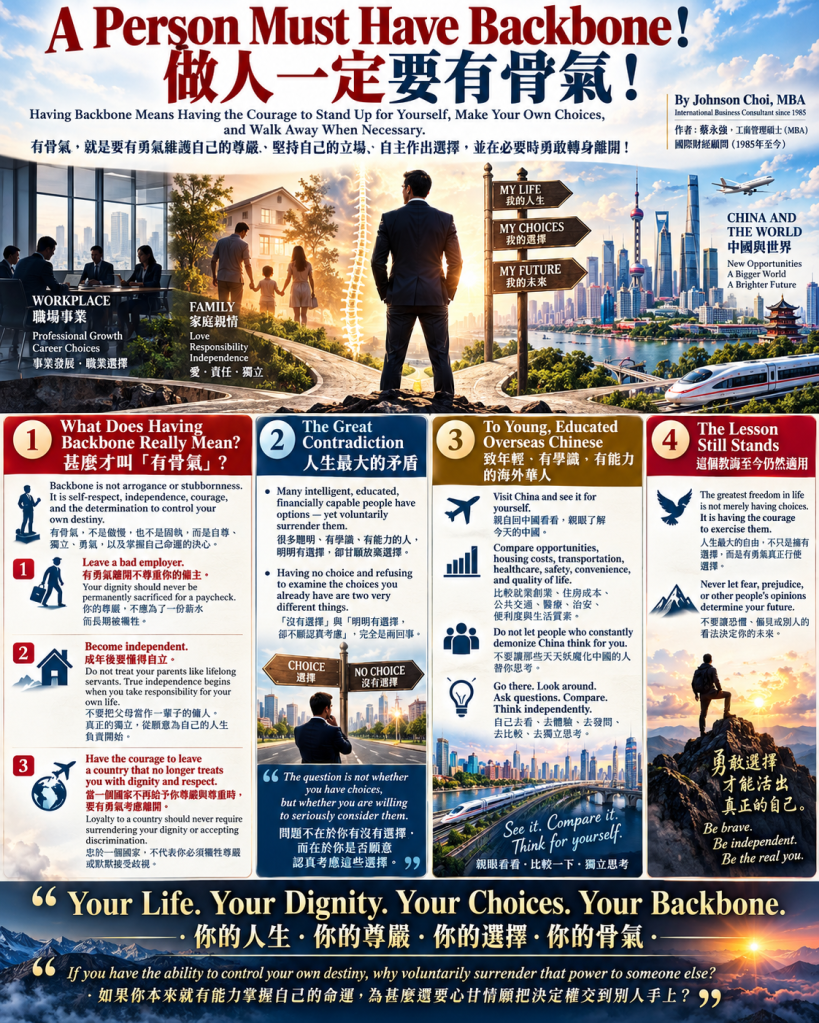
My Grandfather and Father Taught Me: “A Person Must Have Backbone!” Having Backbone Means Having the Courage to Stand Up for Yourself, Make Your Own Choices, and Walk Away When Necessary.
By Johnson Choi, MBA
International Business Consultant since 1985
我的祖父和父親從小教導我:「做人一定要有骨氣!」 有骨氣,就是要有勇氣維護自己的尊嚴、堅持自己的立場、自主作出選擇,並在必要時勇敢轉身離開!
作者:蔡永強,工商管理碩士(MBA)國際財經顧問(1985年至今)
從小到大,祖父和父親經常教導我一個非常重要的人生道理:
「做人一定要有骨氣!」
這句看似簡單的教誨,卻一直伴隨着我的人生,成為我做人處事的重要原則。
然而,隨着年齡增長,加上多年來接觸世界各地不同國家、社會與文化的人,我不禁經常思考一個問題:
「骨氣」這種做人原則,在西方文化中是否同樣受到重視?更重要的是,究竟有多少人真正有勇氣把骨氣付諸行動?
當然,要有骨氣,說起來容易,真正做到卻未必簡單。
一個人能否獨立自主,往往受到許多因素影響,包括教育程度、經濟能力、家庭責任、個人處境,以及是否擁有其他發展機會。
一般而言,那些頭腦聰明、受過良好教育、經濟獨立,又具備專業能力的人,理應比其他人擁有更多選擇。
然而,最令我感到驚訝的是,竟然有不少明明擁有選擇權的人,卻甘願主動放棄自己的選擇權!
一、究竟甚麼才叫「有骨氣」?
在我看來,有骨氣並不是傲慢自大、喜歡與人爭吵,更不是固執己見、不肯妥協。
真正的骨氣,是一個人懂得尊重自己、保持獨立人格、有勇氣面對現實,並有決心掌握自己的命運。
- 有骨氣,就是有勇氣離開一個不尊重你的僱主。
如果你的僱主長期對你不公平,甚至羞辱、欺壓或剝削你,而你本身又有足夠的專業資格、工作能力及經濟條件,可以尋找其他更好的發展機會,那麼,你為甚麼還要繼續忍氣吞聲?
難道一份薪水,就值得你長期犧牲自己的尊嚴嗎?
一個人的尊嚴,不應該為了一份薪水而無限期地被犧牲!
- 有骨氣,就是成年後懂得自立,而不是把父母當作一輩子的傭人。
年輕人完成大學教育,踏入社會之後,如果已經有能力養活自己,就應該學習獨立生活,靠自己的雙腳站起來。
父母花了幾十年時間,把子女養育成人,付出了無數心血、金錢和青春。
當子女長大成人之後,父母理應有機會享受自己的晚年生活,而不是繼續被一些不願長大的成年子女,當作免費的管家、廚師、清潔工人,甚至私人傭人。
真正的獨立,從願意為自己的人生負責開始。
- 有骨氣,就是當一個國家不再給予你應有的尊嚴與尊重時,你有勇氣考慮離開。
這一點,尤其值得長期居住在西方國家的海外華人深思。
假如你已經在一個國家生活了幾十年,把它視為自己的第二個家,甚至把大半生的青春、努力和財富都貢獻給這個國家。
然而,當這個國家的某些政客、政策或社會輿論,開始因為你的華人血統、亞洲面孔,或者不是白人,而懷疑你的忠誠、把你視為潛在威脅,甚至令你感覺自己永遠都是外人時——
難道你不應該認真考慮,自己是否還有其他更好的選擇嗎?
任何人都不應該為了證明自己對一個國家的忠誠,就被迫無止境地忍受歧視與不公平待遇。
愛一個國家,不代表你必須犧牲自己的尊嚴;忠於一個國家,更不代表你必須默默接受歧視!
二、人生最大的矛盾:明明有選擇,卻不敢作出選擇!
最令我百思不得其解的是,有些人明明具備獨立自主的一切條件。
他們頭腦聰明,接受過高等教育,擁有專業資格、經濟能力、國際視野,甚至在其他國家也有發展機會。
照道理,他們應該比一般人更有能力掌握自己的命運。
然而,當他們遇到不公平待遇、種族歧視,或者身處一個已經不再符合自己利益與理想的生活環境時,卻只懂得不斷抱怨,始終不願意採取實際行動。
他們明明有能力改變自己的處境,卻選擇繼續留在原地,甚麼也不做!
為甚麼?
究竟是因為無知?
還是害怕改變?
是受到社會壓力影響?
是捨不得已經習慣的生活環境?
還是受到經濟負擔、家庭責任等現實因素限制?
又或者,有些人已經習慣了長期忍受現狀,以致逐漸忘記自己其實仍然擁有選擇的權利?
我當然明白,人生並不是說走就走那麼簡單。
不是每一個人都可以隨時收拾行李,離開工作、家庭和自己生活多年的地方。
家庭責任、經濟條件及現實環境,往往令一些看似簡單的決定變得十分複雜。
但是,我始終認為:
「沒有選擇」與「明明有選擇,卻不願意認真考慮」,完全是兩回事!
三、致年輕、有學識、有能力的海外華人:何不親自回中國看看?
如果你還年輕,頭腦聰明,受過良好教育,又有專業技能和發展能力,我認為你應該認真考慮一件事:
是時候走出去,擴闊自己的視野,重新認識世界,也重新認識自己的祖籍國——中國!
為甚麼不親自到中國走一趟,看看今天的中國究竟發展成甚麼模樣?
親身走訪中國的現代化城市,體驗當地的交通網絡、科技發展、商業環境和日常生活。
與當地居民、企業家、專業人士及年輕人直接交流。
認真比較中國與你目前居住的西方國家,在以下方面究竟有甚麼不同:
- 就業與創業機會
- 住房及生活成本
- 公共交通與基礎建設
- 醫療服務與費用
- 社會治安與人身安全
- 日常生活便利程度
- 整體生活質素與未來發展空間
你可能會發現許多以前從未想像過的優點。
當然,你也可能發現中國仍然存在一些問題、限制和挑戰。
這都沒有關係!
最重要的是,你的判斷應該建立在自己親眼所見、親身經歷的事實之上,而不是建立在別人的偏見、政治宣傳,或者道聽途說之上。
不要讓那些天天妖魔化中國、逢中必反的人,替你決定自己應該怎樣看待中國。
同樣地,也不要盲目相信任何一面倒的正面宣傳。
自己去看看!
自己去體驗!
自己去發問!
自己去比較!
自己獨立思考!
你有頭腦!
你受過教育!
你有能力!
你有選擇!
那麼,為甚麼不好好運用這些條件,親自尋找最適合自己的未來?
四、祖父和父親的教誨,至今仍然適用
我始終認為,有骨氣,並不一定代表你必須辭職、搬離父母的家,或者離開已經生活多年的移居國家。
有時候,真正的骨氣,反而是選擇留下來,勇敢面對不公義,堅持自己認為正確的事情。
但是,無論你選擇留下還是離開,有骨氣都代表你必須具備獨立思考的能力,懂得維護自己的尊嚴,並根據自己的原則、利益和實際情況作出決定,而不是任由恐懼、偏見或社會壓力左右自己的人生。
從事國際商業及財經顧問工作超過四十年,我對一個人生道理的體會越來越深刻:
「人生最大的自由,不只是你擁有多少選擇,而是當選擇擺在你面前時,你有沒有勇氣真正行使自己的選擇權!」
我的祖父和父親說得對:
「做人一定要有骨氣!」
而今天,我希望在他們的教誨之上,再補充一句:
「如果你本來就有能力掌握自己的命運,為甚麼還要心甘情願,把決定自己人生的權力交到別人手上?」
不要讓恐懼決定你的未來。
不要讓偏見限制你的眼界。
更不要讓別人的政治立場、言論或看法,替你決定自己應該走哪一條人生道路。
你的人生,由你自己負責!
你的尊嚴,由你自己維護!
你的選擇,由你自己決定!
你的骨氣,更要靠你自己活出來!
做人,一定要有骨氣!
Growing up, my grandfather and father repeatedly taught me one important lesson:
“A person must have backbone!”
That simple principle has guided me throughout my life.
But as I have grown older and observed people across different countries and cultures, I have often wondered:
Is having backbone equally valued in Western culture? And more importantly, how many people actually have the courage to demonstrate it?
Of course, having backbone is not always easy. A person’s ability to stand independently depends on many factors, including education, financial security, family responsibilities, personal circumstances, and available opportunities.
Those who are intelligent, well-educated, financially independent, and professionally capable generally have more choices than others.
What surprises me most is how many people who actually have those choices voluntarily surrender them.
What Does Having Backbone Really Mean?
To me, backbone is not about being arrogant, confrontational, or stubborn.
It is about having self-respect, independence, courage, and the determination to control your own destiny.
- Backbone means having the courage to leave a bad employer.
If your employer repeatedly mistreats, humiliates, or exploits you, and you have the qualifications and financial ability to find better opportunities, why continue accepting such treatment?
Your dignity should never be permanently sacrificed for a paycheck.
- Backbone means becoming independent instead of treating your parents like lifelong servants.
After graduating from college, young adults who have the ability to support themselves should learn to stand on their own feet.
Parents spend decades raising and supporting their children. They deserve the opportunity to enjoy their later years rather than being treated as unpaid housekeepers, cooks, and personal assistants by adult children who refuse to grow up.
True independence begins when you take responsibility for your own life.
- Backbone means having the courage to leave a country that no longer treats you with dignity and respect.
This is particularly relevant to overseas Chinese living in Western countries.
If the country you have called home for decades increasingly treats people of Chinese ancestry as suspicious, questions their loyalty, or makes them feel like outsiders simply because they are not white, shouldn’t you at least consider your alternatives?
Nobody should be expected to tolerate discrimination indefinitely simply to prove their loyalty.
Loyalty to a country should never require surrendering your dignity or accepting discrimination.
The Great Contradiction: Having Options but Refusing to Exercise Them
What amazes me is that many people appear to possess everything necessary to stand independently.
They are intelligent. They are educated. They have professional qualifications, financial resources, international experience, and opportunities elsewhere.
Yet when confronted with unfair treatment, discrimination, or an environment that no longer serves their interests, they continue complaining without taking meaningful action.
They have the ability to change their circumstances, but choose to remain exactly where they are.
Why?
Is it ignorance? Fear of change? Social pressure? Attachment to familiar surroundings? Financial or family obligations?
Or have some people become so accustomed to their circumstances that they no longer recognize the choices available to them?
I understand that not everyone can simply pack a suitcase and leave. Real-life responsibilities can make even the most reasonable decisions complicated.
But there is a fundamental difference between having no choice and refusing to examine the choices you already have.
To Young, Educated Overseas Chinese: Discover China for Yourself!
If you are young, intelligent, educated, and professionally capable, perhaps it is time to broaden your horizons.
Why not visit China, your ancestral homeland, and see with your own eyes what the country has become?
Explore its modern cities, transportation networks, technological developments, business opportunities, and everyday lifestyle.
Speak directly with local residents, entrepreneurs, professionals, and young people.
Compare employment opportunities, housing costs, public transportation, healthcare, personal safety, and overall quality of life with what you currently experience abroad.
You may discover advantages you never imagined. You may also find shortcomings and challenges.
Either way, form your conclusions from firsthand experience rather than inherited prejudices or political propaganda.
Do not allow people who constantly demonize China to make your decisions for you.
And do not blindly accept positive stories either.
Go there. Look around. Ask questions. Compare. Think independently.
You have a brain. You have an education. You have choices. Use them!
My Grandfather and Father’s Lesson Still Stands
Having backbone does not necessarily mean leaving your employer, your family home, or your adopted country.
Sometimes it means staying and standing up for what is right.
But it always means having the courage to think independently, defend your dignity, and make decisions based on your own interests and principles rather than fear or social pressure.
After more than forty years in international business, I have become increasingly convinced of one thing:
The greatest freedom in life is not merely having choices. It is having the courage to exercise them.
My grandfather and father were right:
“A person must have backbone!”
And I would add one more lesson:
“If you have the ability to control your own destiny, why voluntarily surrender that power to someone else?”
Never let fear, prejudice, or other people’s opinions determine your future.
Your life. Your dignity. Your choices. Your backbone.