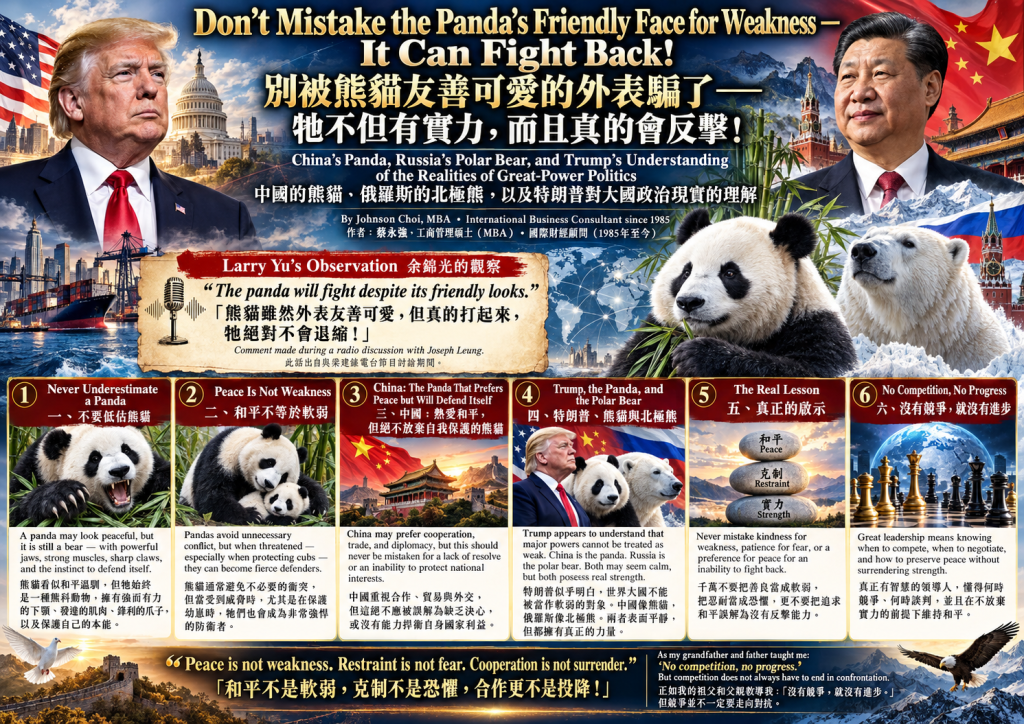
Don’t Mistake the Panda’s Friendly Face for Weakness — It Can Fight Back! China’s Panda, Russia’s Polar Bear, and Trump’s Understanding of the Realities of Great-Power Politics
By Johnson Choi, MBA
International Business Consultant since 1985
別被熊貓友善可愛的外表騙了——牠不但有實力,而且真的會反擊! 中國的熊貓、俄羅斯的北極熊,以及特朗普對大國政治現實的理解
作者:蔡永強,工商管理碩士(MBA)國際財經顧問(1985年至今)
最近,我的好朋友余錦光(Larry Yu)在與梁建鋒(Joseph Leung)的一個電台節目中,提出了一個非常有意思、值得深思的觀點。
Larry 說:
「熊貓雖然外表友善可愛,但真的打起來,牠絕對不會退縮!」
這句看似簡單的話,立即引起了我的注意。
我越想越覺得,Larry 的觀察不僅道出了大熊貓的真實本性,更揭示了一個值得深入思考的國際政治道理——當一個大國感到自身安全、主權或核心利益受到威脅時,究竟會作出甚麼反應?
因此,我決定親自做一些資料搜集和研究。
結果如何?
Larry 說得有道理!熊貓看起來溫馴可愛,但絕對不是任人欺負的動物!
一、千萬不要因為熊貓可愛,就低估牠的真正實力
提起大熊貓,大部分人首先想到的,都是和平、友善、竹子,以及那張令人喜愛的黑白色圓臉。
牠們看起來溫馴無害,動作緩慢,每天花大量時間吃竹子,給人的印象就是一種與世無爭、和平友善的動物。
但是,外表往往會令人產生錯覺!
大熊貓始終是一種熊科動物。
牠擁有強而有力的下顎、發達的肌肉、鋒利的爪子,以及與生俱來的自我防衛本能。
一般情況下,大熊貓傾向避免不必要的衝突。
但是,這絕不代表牠們沒有攻擊能力,更不代表牠們遇到威脅時只會逃跑。
尤其是一隻正在保護幼崽的熊貓媽媽,更可能成為一個不容小覷的強悍對手。
當熊貓媽媽察覺自己的孩子受到嚴重威脅時,牠可能會發出警告聲、揮動利爪、猛烈撲擊,甚至直接用牙齒咬向對方,以保護自己的幼崽。
換句話說:
「熊貓天性愛好和平,但千萬不要把牠的和平本性,錯誤理解為軟弱無能!」
二、熊貓不需要虛張聲勢——因為牠真的有能力反擊!
在研究過程中,最令我感興趣的,是大熊貓面對威脅時所展現的防衛行為。
一隻大熊貓,不需要整天張牙舞爪,也不需要故意擺出兇惡的姿態,才能證明自己擁有強大的力量。
牠可以在前一分鐘還安靜地吃竹子,看起來人畜無害;但當牠認為自己或幼崽受到威脅時,卻可能立即展現完全不同的一面。
這不僅是野生動物世界的一個重要現象,更是人與人相處、商業競爭,以至國際政治值得借鑑的一個道理。
「千萬不要把一個人的和平性格,誤以為他沒有保護自己利益的能力!」
美國史密森尼國家動物園(Smithsonian’s National Zoo)的資料指出,大熊貓本質上是獨居的熊科動物,在某些情況下也會展現攻擊性。
母熊貓更會投入大量精力,照顧和保護極其脆弱的幼崽。
因此,我們不能因為熊貓外表可愛,就忽略牠真正的力量和防衛本能。
三、中國就像大熊貓——熱愛和平,但絕不代表不會保護自己!
這讓我再次想起 Larry Yu 在梁建鋒電台節目中的那番話。
幾十年來,大熊貓一直是中國在國際社會上的重要友好象徵。
熊貓外交代表着友誼、善意、和平與國際交流。
但是,我認為,熊貓還帶給我們另一個值得深思的啟示。
中國重視經濟合作、國際貿易、互相投資,以及透過外交方式解決分歧。
然而,這種重視合作的態度,不應被錯誤理解為中國不願意或沒有能力保護自己的國家利益。
正如大熊貓不會每天四處尋找對手打架,一個擁有強大實力的國家,也不一定需要透過不斷製造衝突,來證明自己的力量。
但是,當一個國家認為自身安全、主權或核心利益受到威脅時,其反應可能與平時截然不同。
我認為,國際政治上一個常見的誤判,就是:
「以為別人願意和平相處,就代表別人害怕打仗;以為別人不主動挑釁,就代表別人沒有能力反擊!」
這種錯誤判斷,有時可能帶來非常嚴重的後果。
四、特朗普、中國熊貓與俄羅斯北極熊——大國外交的現實
說到這裡,我便想到了美國總統特朗普(Donald Trump)對中國與俄羅斯的外交態度。
不論你喜歡特朗普,還是討厭特朗普,我認為他的外交思維有一個值得研究的地方:
「與世界大國打交道,不能先假設對方軟弱,更不能認為只要不斷施加壓力,對方最終就一定會屈服!」
中國,可以比喻為大熊貓。
俄羅斯,可以比喻為北極熊。
這兩種動物在一般情況下都不需要無時無刻展現攻擊性,但牠們同樣擁有強大的力量,以及在受到威脅時保護自己的能力。
當然,國際政治遠比動物世界複雜得多,我們不可能單憑動物的本能,便完全解釋國家之間的關係。
然而,這個比喻仍然為我們提供了一個很有意思的思考角度。
特朗普願意與中國及俄羅斯領導人保持直接對話,在我看來,至少反映出他願意嘗試透過談判與外交接觸,處理一些複雜的國際問題。
因為有時候,談判能夠取得的成果,可能比無休止的威脅、制裁及對抗更多。
當然,特朗普的外交政策一直存在爭議,尤其是在俄羅斯與烏克蘭問題上,各方有不同的看法。
而且,願意談判並不代表一定能夠達成協議,更不保證世界就此和平。
但是,他與莫斯科保持外交接觸的做法,仍然值得我們從現實政治的角度加以觀察。
我從事國際商業及財經顧問工作已經超過四十年,長期關注國際經濟、商業競爭與政治發展。
這些年的經驗,讓我深深體會到一個道理:
「尊重別人的實力,不代表自己軟弱;恰恰相反,這是一種智慧!」
在商業世界裡,你不可能一方面不斷侮辱一個實力雄厚的競爭對手,另一方面卻期望對方坐下來,與你達成一份對自己有利的合作協議。
在國際政治舞台上,道理其實也有相似之處,只是涉及的利益與風險更加重大。
有時候,最聰明的決定不是向別人發起挑戰,而是先了解對方的真正實力,再尋找雙方可以接受的共同利益。
五、不論你喜不喜歡特朗普,至少應該認真研究他對大國實力的理解!
我知道,很多人非常不喜歡特朗普。
這是他們的權利。
我自己也不是對特朗普所說的每一句話、所做的每一件事都表示贊同。
但是,在處理中國與俄羅斯這兩個世界大國的關係時,我認為,真正理解大國競爭的現實,是制定外交政策時不可忽視的重要因素。
特朗普似乎願意直接面對中國這隻「熊貓」,以及俄羅斯這隻「北極熊」,而不是簡單地低估或無視對方的實力。
這種外交策略最終是否成功,仍然要由實際成果來判斷。
但對我而言,這件事背後有一個更重要的啟示:
「一位有智慧的領導人,應該知道甚麼時候需要競爭、甚麼時候應該談判,以及甚麼時候必須避免代價高昂、沒有必要的衝突!」
這讓我再次想起我的好朋友 Larry Yu。
他在與梁建鋒的電台節目中,輕描淡寫地說了一句:
「熊貓雖然外表友善可愛,但真的打起來,牠絕對不會退縮!」
當時聽起來,只是一句很有趣的評論。
但是,經過進一步研究和思考,我才發現這句話背後,其實包含着一個值得深入探討的大道理。
Larry,你這個觀察確實非常精彩!
而經過這次研究,我還想再補充一個人生體會:
「千萬不要把善良當成軟弱,把忍耐當成恐懼,更不要把別人追求和平的意願,誤以為對方沒有反擊的能力!」
熊貓看起來非常友善。
北極熊在平靜時,也未必會主動展現攻擊性。
但是,兩者的真正力量,都不應被低估。
在錯綜複雜的國際政治世界裡,我認為,真正有遠見的領導人,應該在付出沉重代價之前,就已經明白這個道理,而不是等到發生衝突之後,才發現自己當初嚴重低估了對手。
六、祖父和父親從小教導我的人生智慧:「沒有競爭,就沒有進步!」
寫到這裡,我又想起祖父和父親在我年輕時,經常教導我的一句話:
「沒有競爭,就沒有進步!」
這句教誨陪伴我走過四十多年的國際商業顧問生涯。
我一直相信,競爭可以推動科技進步、促進經濟發展、改善人民生活,並鼓勵人類不斷追求卓越。
但是,競爭並不一定需要演變成敵對,更不應該必然走向戰爭。
中國與美國可以競爭。
中國與俄羅斯可以合作。
美國與俄羅斯也可以透過外交對話,尋找減少衝突的機會。
不同國家可以有不同制度、不同文化、不同發展道路,也可以存在不同的國家利益。
然而,這不代表彼此一定要成為永遠的敵人。
「競爭的最高境界,不是把對手打倒,而是在競爭中共同進步,在分歧中尋求合作,在維護自身利益的同時,盡可能維持世界和平!」
最後,我想以 Larry Yu 那句令人印象深刻的話,作為本文的總結:
「不要被熊貓可愛友善的外表騙了!牠不喜歡打架,不代表牠不會打架;牠不主動挑釁,更不代表牠沒有反擊的力量!」
在今天的大國競爭時代,這或許是一個值得所有國家領導人認真思考的道理。
真正的智慧,不是永遠準備與別人開戰,而是擁有足夠的實力保護自己,同時懂得以和平、尊重和談判,避免不必要的戰爭。
和平不是軟弱,克制不是恐懼,合作更不是投降!
作者:蔡永強,工商管理碩士(MBA)國際財經顧問(1985年至今)
Recently, my good friend Larry Yu made a fascinating observation during a radio discussion with Joseph Leung.
Larry said: “The panda will fight despite its friendly looks.”
That simple statement caught my attention.
The more I thought about it, the more I realized that Larry had made a powerful observation—not only about the giant panda, but also about international politics and the way major powers respond when they feel threatened.
So I decided to do some research.
And guess what? Larry was right about the panda!
Never Underestimate a Panda Because It Looks Cute. Most people associate giant pandas with peace, friendliness, bamboo, and adorable black-and-white faces.
They look harmless. They move slowly. They spend much of their day eating bamboo.
But appearances can be deceiving.
A giant panda is still a bear, equipped with powerful jaws, strong muscles, sharp claws, and the natural instincts to defend itself.
Pandas generally avoid unnecessary confrontation, but that does not mean they are incapable of aggression.
In particular, a mother panda protecting her cub can be a formidable opponent.
She may bite, swipe, vocalize, or aggressively defend her offspring when she perceives a serious threat.
In other words: A panda prefers peace, but peace should never be mistaken for helplessness.
The Panda Doesn’t Have to Bluff
What interested me most was the panda’s defensive behavior.
A giant panda does not need to look ferocious to possess the strength to fight.
It can appear peaceful one moment and respond aggressively when threatened.
That is an important lesson in both wildlife behavior and human relationships:
Never confuse a peaceful temperament with an inability to defend one’s interests.
The Smithsonian’s National Zoo confirms that giant pandas are naturally solitary bears and that aggression can occur under certain circumstances. Mothers also devote considerable effort to protecting and raising their vulnerable cubs.
China, the Panda That Prefers Peace but Will Defend Itself
This brings me back to Larry Yu’s observation.
For decades, China has been internationally represented by the giant panda—an animal associated with goodwill, friendship, and peaceful diplomacy.
But I believe the panda also provides another important lesson.
China may prefer economic cooperation, trade, investment, and diplomatic engagement, but that preference should not be interpreted as an unwillingness to protect its national interests.
Just as a panda does not spend its day looking for a fight, a powerful country does not necessarily seek confrontation.
However, when it believes its security, sovereignty, or vital interests are threatened, its response may be very different.
The mistake is assuming that because someone prefers peace, they are afraid to fight.
Trump, China’s Panda, and Russia’s Polar Bear
This is where I find President Donald Trump’s approach to China and Russia particularly interesting.
Whether you like Trump or dislike him, I believe he understands something that many politicians underestimate:
You cannot negotiate successfully with major powers by assuming they are weak or that they will always retreat under pressure.
China is the panda.
Russia is the polar bear.
Both animals may appear relatively calm under normal circumstances, but both possess tremendous defensive capabilities.
Of course, international politics is far more complicated than animal behavior. Nevertheless, I believe the comparison offers an interesting perspective on diplomacy.
Trump’s willingness to maintain direct dialogue with Chinese and Russian leaders suggests a recognition that diplomacy and negotiation can sometimes achieve more than endless threats and confrontation.
His approach remains controversial, particularly regarding Russia and Ukraine, and diplomatic engagement does not guarantee peace. Still, his recent dealings with Moscow show that he is prepared to negotiate even amid serious geopolitical disagreements.
I have followed international business and politics for more than four decades, and one lesson has remained consistent throughout my career:
Respecting the strength of others is not weakness. It is intelligence.
In business, you don’t insult a powerful competitor and then expect a favorable deal.
In international relations, the stakes are even higher.
Sometimes, the smartest decision is not to challenge someone to a fight but to recognize their capabilities and find common ground.
Like Trump or Not, at Least Give Him Credit for Understanding Power
I know many people strongly disagree with Trump.
That is their right.
I don’t agree with everything he says or does either.
But when it comes to dealing with China and Russia, I believe that recognizing the realities of great-power competition is a sign of political intelligence.
Trump appears willing to deal directly with the panda and the polar bear rather than simply dismissing them.
Whether this strategy succeeds will ultimately depend on the results.
For me, the larger lesson is simple:
A wise leader knows when to compete, when to negotiate, and when confrontation would be unnecessarily costly.
And that brings me back to Larry Yu.
His seemingly simple comment during Joseph Leung’s radio program carried a much deeper message than I initially realized.
“The panda will fight despite its friendly looks.”
Larry, you made an excellent point!
After doing my research, I would add one more observation:
Never mistake kindness for weakness, patience for fear, or a preference for peace for an inability to fight back.
The panda may look friendly.
The polar bear may appear calm.
But neither should be underestimated.
And in the complicated world of international politics, perhaps the smartest leaders are those who understand that reality before learning it the hard way.
As my grandfather and father taught me: “No competition, no progress.” But competition does not always have to end in confrontation. Sometimes, the greatest achievement is knowing how to compete while preserving peace.