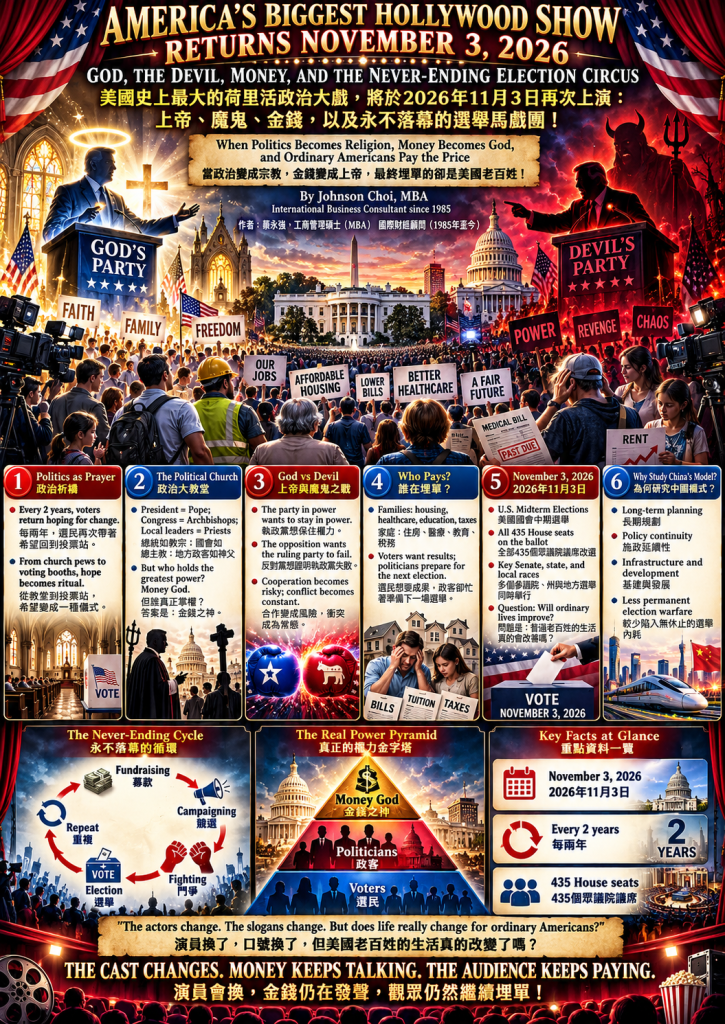
AMERICA’S BIGGEST HOLLYWOOD SHOW RETURNS NOVEMBER 3, 2026: GOD, THE DEVIL, MONEY, AND THE NEVER-ENDING ELECTION CIRCUS
When Politics Becomes Religion, Money Becomes God, and Ordinary Americans Pay the Price
By Johnson Choi, MBA
International Business Consultant since 1985
美國史上最大的荷里活政治大戲,將於2026年11月3日再次上演:上帝、魔鬼、金錢,以及永不落幕的選舉馬戲團!
當政治變成宗教,金錢變成上帝,最終埋單的卻是美國老百姓!
作者:蔡永強,工商管理碩士(MBA)國際財經顧問(1985年至今)
每隔兩年,美國便會上演一場我認為堪稱全球最盛大、最精彩、最昂貴的荷里活政治大製作。
下一場精彩大戲,已定於 2026年11月3日——美國國會中期選舉 正式上演!
這場政治大戲,英雄與奸角俱全,精彩演說、煽情承諾、政治醜聞、天價廣告,以及無休止的互相指責,樣樣齊備。
政客與政治利益集團將花費數以十億美元計的巨額資金,試圖說服美國人民:
「今次真的不同!只要選我們,美國就會變得更好!」
演員可能換了。
政治服裝可能換了。
口號肯定換了。
但我想問一個最簡單、也最重要的問題:
美國普通老百姓的生活,真的會因此變得更好嗎?
這才是我認為每一位選民都應該認真思考的問題。
一、美國民主與基督教:一個耐人尋味的比較
許多西方民主國家的歷史發展,都與基督教有深厚淵源。
我自己是一名受過洗禮的天主教徒,也是基督徒。多年以來,我一直留意宗教信仰、人類行為與政治制度之間的關係。
祈禱,是基督徒生活中非常重要的一部分。
順境時,我們祈禱感恩。
逆境時,我們祈禱尋求指引、力量與上帝的幫助。
我們相信,上帝會聆聽我們的祈禱,即使結果未必完全符合我們的期望。
但我發現,美國的選舉制度,某程度上竟然與這種宗教儀式有幾分相似。
每隔兩年,美國人民就會參加一次全國性的政治儀式。
只不過,他們不是走進教堂,而是走進投票站。
他們不是雙手合十祈禱,而是拿起選票投票。
他們滿懷希望,祈求這一次終於能選出一位聰明、能幹、誠實、有良心的政治領袖,真正改善自己的生活。
但如果選舉結束後,政客承諾的奇蹟始終沒有出現,怎麼辦?
沒有關係!
兩年後,再回來祈禱一次!
選舉變成了一場政治祈禱,選票成為人民寄託希望的工具。
懷抱希望,本來沒有甚麼問題。
但如果政治制度缺乏真正有意義的改革,光靠每兩年重複一次的希望,最終可能只會變成一個永無止境的失望循環。
二、美國政治大教堂:總統、紅衣主教、神父,以及真正的「金錢之神」
現在,讓我們用一點政治諷刺的想像力,把美國民主制度看成一座巨大的教堂。
美國總統,就是這座政治教堂的「教宗」。
美國參議員與眾議員,就是「總主教」與「主教」。
州長、市長,以及各級地方政治人物,就是大大小小的「神父」。
每一位政治人物,都有自己的講道內容。
每一位都向信徒作出承諾。
每一位都聲稱自己最了解老百姓的痛苦。
每一位都要求選民繼續信任、支持、奉獻與追隨。
但問題來了:
究竟誰才是這座政治大教堂背後最有影響力的力量?
在我這個政治諷刺故事中,答案就是:
「金錢之神」(Money God)!
龐大的競選捐款者、億萬富豪、企業利益集團、政治遊說組織,以及各種擁有巨大財力的特殊利益團體,往往能夠在美國政治制度中取得非一般的影響力。
當然,我並不是說每一位政客都受金錢控制,也不是說每一筆政治捐款都能買到政治利益。
但無可否認,金錢在美國選舉中扮演着極其重要的角色。
它影響誰有能力參選、誰的廣告可以鋪天蓋地出現在電視及網絡上、誰的政治聲音能夠被更多人聽見,以及哪些利益團體更容易接觸掌權者。
普通選民手上只有一張選票。
但有錢人可能擁有足夠財力,資助整個政治廣告宣傳活動。
兩者都有發言權。
但兩者的聲音,在現實政治中真的具有同等影響力嗎?
這正是美國金錢政治最值得深入思考的問題。
當金錢成為政治世界中最強大的力量,換掉幾個政客,未必就能改變整個制度!
政治教堂可能換了一位新牧師。
講道內容改變了。
但那些長期出錢支持這座大教堂的人,仍然可能繼續發揮巨大影響力。
三、上帝與魔鬼之戰:美國永無休止的政治內戰
現在,來到整場荷里活政治大戲最精彩的部分!
在基督教信仰中,我們都熟悉善與惡之間的鬥爭。
而在美國政治舞台上,民主黨與共和黨之間的競爭,經常也被雙方描繪成一場近乎善惡決戰的政治戰爭。
為了方便這個政治諷刺故事,我們不妨把控制白宮的執政黨稱為:
「上帝黨」!
而把在野的反對黨稱為:
「魔鬼黨」!
請注意,這只是政治舞台上的比喻,並不是對任何政黨作出宗教或道德判決。
執政黨自然會宣稱,自己才是美國的真正守護者。
反對黨則會告訴選民,只有把現任政府趕下台,才能拯救美國。
但大家有沒有發現一個非常有趣的現象?
反對黨往往有強烈的政治動機,向選民證明執政黨治理失敗。
原因很簡單。
如果執政黨真的做得非常成功,經濟繁榮、社會安定、人民安居樂業,反對黨下次選舉時,又怎樣說服人民一定要換政府?
於是,一種非常危險的政治誘惑便出現了。
原本應該問:
「我們如何合作,令美國人民生活得更好?」
結果變成:
「我們如何令對方失敗?」
執政黨想保住權力。
反對黨想奪取權力。
妥協變成政治風險。
合作可能被自己的支持者視為背叛。
原本應該造福整個國家的政策成果,最後都可能變成下一次選舉的政治武器。
當然,並不是所有政客都會這樣做,美國兩黨仍然有可能在一些重要議題上合作。
但現實政治制度中的競爭誘因,確實容易使政治衝突不斷延續。
上帝與魔鬼忙着互相攻擊,卻可能忘記了自己最重要的責任:照顧人民。
四、政治大戰最大的輸家,永遠是美國老百姓
當民主黨與共和黨為了控制華盛頓而打得不可開交時,美國普通老百姓又在做甚麼?
他們仍然要供樓。
仍然要支付昂貴的醫療費用。
仍然要面對住房負擔、教育開支、退休保障、稅務,以及日常生活成本上升等問題。
普通家庭想要甚麼?
安全的居住環境。
良好的學校。
穩定的工作。
負擔得起的醫療。
有尊嚴、有保障的退休生活。
這些要求,其實一點也不過分。
但華盛頓的政治人物,卻經常把大量時間和精力花在國會調查、政治指控、競選籌款、政黨對抗,以及準備下一場選舉之上。
每隔兩年,又來一次政治大決戰。
每隔四年,總統選舉的戲碼更加精彩、更加昂貴。
勝利的一方歡天喜地。
失敗的一方發誓下次一定要報仇雪恨。
然後,整場政治大戲重新開始。
政客們忙着爭論誰應該掌權,普通老百姓卻只希望政府能夠好好做事!
這就是為甚麼我把美國選舉稱為:
全球最大、永不落幕的荷里活政治大製作!
娛樂效果一流。
政治廣告費用天文數字。
兩黨支持者情緒高漲。
但到了最後,為這場政治大戲付出代價的,往往還是美國老百姓。
五、2026年11月3日:無論誰勝出,制度真的會改變嗎?
2026年11月3日,美國選民將再次走進投票站。
這次是國會中期選舉,眾議院全部435個有投票權的議席,以及部分參議院議席,都將面臨選舉。
全國人民將密切留意結果。
電視台政治評論員會逐區分析選情。
勝利的政黨會大肆慶祝。
失敗的政黨會努力為敗選尋找理由。
大型政治捐款者和利益集團,則會重新計算下一步如何部署。
選民又會被告知:
「這次選舉決定美國未來的命運!」
但我想問一個不同的問題。
無論民主黨還是共和黨勝出,美國政治制度最根本的利益結構,真的會改變嗎?
億萬富豪及政治捐款者的影響力,會突然消失嗎?
國會兩黨對立與政治僵局,會從此成為歷史嗎?
政客會停止花費大量時間為下一次選舉籌款嗎?
兩黨會突然放下政治鬥爭,全心全意合作改善人民生活嗎?
對此,我實在有所懷疑。
在我看來,美國政治的深層問題,不只是總統由誰擔任,也不是國會由哪一個政黨控制。
更重要的是,整個政治制度往往讓競選籌款、政黨利益、權力競爭,以及特殊利益團體的影響力,凌駕於長遠國家發展規劃之上。
這並不代表所有政治人物都貪污腐敗,也不代表每一項政治決定背後都有秘密交易。
真正值得研究的,是整個制度如何影響政治人物的行為。
演員可以換,舞台依然存在,而那些在幕後擁有巨大影響力的金主,也未必會隨着選舉結束而消失!
六、為甚麼我認為中國的治理制度值得研究?
現在,讓我們看看另一種完全不同的政治制度。
中國把自己的政治與經濟發展模式稱為:
「中國特色社會主義」。
與美國每隔數年便進行全國性多黨競爭選舉的制度不同,中國更加強調長期政策規劃、施政連續性、經濟發展、基礎建設,以及通過現有政治體制推動政策執行。
當然,中國的政治制度也有其局限,包括政治反對力量、公共言論空間,以及人民透過競爭性選舉更換國家最高領導人的權利受到限制。
這些制度差異,不應該被忽略。
但我認為,西方政治討論中經常忽視了一個非常重要的問題:
我們評價一個政府的好壞,究竟應該只看領導人是如何產生,還是也應該看政府實際為人民帶來甚麼成果?
請看看普通人民最關心的事情:
- 交通系統是否方便?基礎建設是否完善?
- 房屋價格與生活成本是否負擔得起?
- 醫療與公共服務是否容易取得?
- 經濟是否有發展機會?科技是否持續進步?
- 社區是否安全?生活是否方便舒適?
- 國家是否有長遠規劃,而不是永遠忙着準備下一場選舉?
這些,都是衡量政府治理能力的實際標準。
中國當然也面對不少挑戰,包括經濟壓力、人口老化,以及政治問責制度等問題。
但是,中國能夠在不舉行美式全國競爭性選舉的情況下,持續推動某些長期發展目標,確實是一項值得研究的制度差異。
對於我這個從事國際商業及財經顧問工作超過四十年、親身接觸不同國家和社會制度的人來說,這種差異尤其值得深思。
坦白說,我寧願把自己的時間用來享受人生、探望親朋好友、體驗新科技、欣賞城市發展,以及享受安全舒適的生活。
總好過每天打開電視,就看到兩大政黨互相攻擊、互相指責,永遠吵個不停!
我相信,無論來自哪一個國家,不少普通老百姓都會認同這種想法。
七、民主的真正價值,應該看施政成果,而不是政治表演
在這裡,我想特別說明一點。
我並不是質疑基督教祈禱的意義。
宗教信仰是一件非常個人的事情,而我自己的天主教成長背景,始終是我人生的一部分。
我也不是說投票沒有意義。
投票權是一項重要的政治權利,讓公民有機會影響領導人的選擇,並要求政府承擔責任。
我真正批評的,是一種逐漸把政治變成娛樂表演,而不是認真治理國家的政治文化。
一個國家,不可能單靠政治戲劇來建設自己的未來。
民主制度不應該淪為一場永無止境的競賽:
誰能籌集最多政治捐款?
誰能製作最有效的抹黑廣告?
誰能把對手的名聲破壞得最徹底?
政府存在的真正目的,應該是改善人民生活。
無論一個政治制度自稱民主、社會主義,還是其他名稱,這都應該是衡量其施政成效的重要標準。
因為世界各地的普通老百姓,真正想要的東西其實都差不多。
一個舒適的家。
健康的身體。
穩定的經濟生活。
安全的社區。
子女有良好的發展機會。
退休後有尊嚴、有保障。
以及不必每天為無休止的政治鬥爭而煩惱,能夠自由自在、開開心心地享受人生。
八、我的結論:同一座荷里活舞台,不同的一批政治演員!
2026年11月3日,美國將再次上演一場盛大的政治表演。
有人勝利。
有人失敗。
有人歡呼。
有人失望。
有人承諾美國將迎來新的開始。
但是,當電視攝影機關掉、競選海報拆下、政治廣告停止播放之後,美國普通老百姓第二天仍然要起床工作、繳交帳單、支付醫療費用,以及照顧自己的家庭。
作為一名基督徒,我尊重祈禱的重要性。
但作為一名從1985年開始從事國際商業及財經顧問工作的人,我同樣相信實際表現、成果與問責的重要性。
單靠祈禱,建不成一座大橋!
單靠競選口號,建不出負擔得起的房屋!
單靠政治攻擊,改善不了醫療制度!
換掉幾個政治演員,也不代表整個政治制度就會自動改變!
我個人更欣賞一個能夠把更多時間和精力,用在改善人民生活、推動社會發展,以及取得實際施政成果上的政府。
而不是一個永遠把大量時間浪費在政治鬥爭之中的制度。
因此,我認為中國的治理模式值得與西方民主制度作認真比較,同時客觀研究兩者各自的優點與缺點。
美國人民當然應該有自由選擇自己領導人的權利。
但他們同樣應該要求這些領導人:
少花一點時間準備下一場選舉,多花一點時間為下一代準備更好的未來!
美國最大的問題,並不是每兩年舉行一次選舉。
而是政治人物往往把準備下一場選舉,放在認真治理國家之前。
這才是我真正想指出的問題。
各位女士、先生,這也就是為甚麼我把美國政治制度稱為:
「全球最精彩、永不落幕的荷里活政治大戲!」
演員每兩年換一批,金錢之神始終掌權,而觀眾——美國老百姓——卻永遠要繼續埋單!
作者:蔡永強,工商管理碩士(MBA)國際財經顧問(1985年至今)
Every two years, America stages what I consider the greatest political Hollywood production on Earth.
The next spectacular performance is scheduled for November 3, 2026 — the U.S. midterm elections.
There will be heroes and villains, dramatic speeches, emotional promises, political scandals, expensive advertising, and endless accusations.
Billions of dollars will be spent convincing Americans that this time, everything will be different.
The actors may change. The political costumes may change. The slogans certainly will change.
But will the lives of ordinary Americans really change for the better?
That is the question I believe every voter should ask.
- American Democracy and Christianity: A Fascinating Comparison
Many Western democracies have deep historical connections to Christianity.
As a baptized Catholic and a Christian myself, I have spent much of my life observing the relationship between faith, human behavior, and political institutions.
Prayer is an important part of Christian life.
In good times, we pray with gratitude. In difficult times, we pray for guidance, strength, and divine assistance.
We believe our prayers will be heard, even when the answers are not what we expect.
American elections sometimes remind me of a similar ritual.
Every two years, Americans participate in a national political ceremony.
Instead of entering a church, they enter a voting booth.
Instead of offering prayers, they cast ballots.
They hope that somehow, somewhere, an intelligent, capable, honest, and compassionate leader will emerge to improve their lives.
And when the promised miracles fail to materialize?
They return two years later and perform the ritual all over again.
The election becomes a political prayer, and the ballot becomes an expression of hope.
There is nothing wrong with hope.
But hope without meaningful institutional change can become an endless cycle of disappointment.
- The Political Church: Presidents, Archbishops, Priests — and the Money God
For the sake of political satire, imagine American democracy as a giant church.
The President occupies the position of the Pope.
Senators and members of Congress resemble archbishops and bishops.
Governors, mayors, and local politicians play the roles of parish priests.
Each delivers sermons.
Each promises salvation.
Each claims to understand the suffering of ordinary people.
And each asks the congregation for continued faith and support.
But here is my question:
Who exercises the greatest influence over this political church?
In my satirical version of American politics, the answer is the Money God.
Campaign financiers, wealthy donors, corporate lobbying organizations, and powerful special interests enjoy extraordinary opportunities to influence the political process.
Of course, not every politician is controlled by money, and not every donation purchases a political favor.
Nevertheless, money undeniably plays an enormous role in determining who can compete effectively, whose messages dominate television screens, and which interests gain access to elected officials.
The ordinary voter may possess one ballot.
A wealthy donor may possess the resources to finance an entire political advertising campaign.
Both have a voice.
But do both voices carry equal practical influence?
That is the uncomfortable question at the heart of American political financing.
When money becomes the supreme political power, changing the politicians may not change the system.
The congregation gets a new preacher.
The sermon changes.
But the people financing the cathedral remain influential.
- God Versus the Devil: America’s Never-Ending Political War
Now comes the most entertaining part of the Hollywood production.
In Christianity, we recognize the struggle between good and evil.
In American politics, the two major political parties frequently portray their rivalry in similarly dramatic terms.
For purposes of this satire, let us call the party occupying the White House God’s Party and the opposition the Devil’s Party.
These labels are theatrical metaphors, not religious judgments about either party.
The party in power naturally portrays itself as the defender of America.
The opposition frequently describes itself as the force that must rescue America from disastrous leadership.
But notice something interesting.
The opposition has an enormous political incentive to demonstrate that the governing party has failed.
After all, if the government becomes successful, popular, and widely respected, how does the opposition convince voters that a change of leadership is urgently necessary?
This creates a dangerous temptation.
Instead of asking, “How can we work together to improve the lives of Americans?”
Both sides can become obsessed with asking:
“How can we make the other side lose?”
The governing party wants to retain power.
The opposition wants to capture power.
Compromise becomes politically risky.
Cooperation can be portrayed as betrayal.
And achievements that should benefit the entire country become weapons in the next election.
Not all politicians behave this way, and bipartisan achievements remain possible. But the incentives toward permanent confrontation are difficult to ignore.
- The Greatest Losers Are the American People
While the two political armies fight for control of Washington, ordinary Americans must deal with the consequences.
They still have mortgages to pay.
They still worry about healthcare expenses.
They still struggle with housing affordability, education costs, retirement security, taxes, and the rising cost of everyday necessities.
Families want safe neighborhoods.
Parents want good schools.
Workers want stable employment.
Retirees want dignity, security, and peace of mind.
But instead of concentrating on these everyday concerns, Washington repeatedly becomes consumed by investigations, political accusations, fundraising battles, partisan obstruction, and preparations for the next election.
Every two years, another political showdown arrives.
Every four years, the presidential drama becomes even more spectacular.
One party celebrates victory.
The other promises revenge at the ballot box.
And the cycle begins again.
The politicians argue about who deserves power. Ordinary Americans simply want government to work.
This is why I call American elections the greatest recurring Hollywood political production.
The entertainment is extraordinary.
The advertising budget is astronomical.
The political emotions are intense.
But the admission price is ultimately paid by the American people.
- November 3, 2026: Will the Winner Really Change the System?
On November 3, Americans will once again go to the polls.
The country will watch the results with enormous anticipation.
Television commentators will analyze every congressional district.
Political parties will celebrate their victories and explain away their defeats.
Financial donors and lobbying organizations will reassess their strategies.
And Americans will be told that the nation’s future has reached another historic turning point.
But I would ask a different question.
Regardless of which party wins, will America’s underlying political incentives fundamentally change?
Will the influence of wealthy donors suddenly disappear?
Will congressional gridlock become a thing of the past?
Will politicians stop spending enormous amounts of time raising money for their next campaigns?
Will partisan competition finally give way to a sustained commitment to improving ordinary people’s lives?
I have my doubts.
The deeper problem, in my opinion, is that both political parties operate within a system where fundraising, electoral advantage, institutional power, and special-interest influence can become more important than long-term national planning.
This does not mean every politician is corrupt or that every political decision results from a secret bargain.
It means that the structural incentives deserve far more scrutiny than the personalities appearing on television.
The actors may be replaced. The stage remains. And the powerful interests behind the production do not necessarily disappear when the curtain falls.
- Why I Find China’s System Worth Studying
Now let us consider a completely different political model.
China describes its political and economic system as socialism with Chinese characteristics.
Rather than organizing national governance around regular multiparty contests for control of the central government, China emphasizes long-term planning, policy continuity, economic development, infrastructure investment, and implementation through its existing political institutions.
China’s political system has genuine limitations, including restrictions on political opposition, public expression, and the ability of citizens to replace national leaders through competitive elections.
Those differences should not be ignored.
Nevertheless, I believe an important question is often missing from Western political discussions:
Should we judge a government primarily by how its leaders are chosen, or also by what its institutions actually deliver to the people?
Consider the areas that matter most in everyday life:
- Transportation systems and infrastructure.
- Housing affordability and living costs.
- Access to healthcare and public services.
- Economic opportunities and technological development.
- Public safety, convenience, and quality of life.
- Long-term national development instead of permanent election campaigning.
These are practical measurements of governance.
China has substantial challenges of its own, including economic pressures, demographic changes, and questions of political accountability.
However, its ability to maintain certain long-term development priorities without holding American-style national election campaigns is a meaningful institutional difference.
For someone like me, who has spent more than four decades working in international business and observing different societies, it is a difference worth examining.
I would much rather spend my time enjoying life, visiting friends, experiencing new technology, and watching communities develop than following another endless cycle of political mudslinging.
And I suspect many people, regardless of nationality, would agree with that sentiment.
- Democracy Should Be Judged by Results, Not Political Theater
Let me make one point clear.
I am not questioning the sincerity of Christian prayer.
Faith is a deeply personal matter, and my own Catholic upbringing remains part of who I am.
Nor am I suggesting that voting is meaningless.
The right to vote is an important political right, one that enables citizens to influence leadership and hold governments accountable.
My criticism is directed at a political culture that increasingly resembles entertainment rather than responsible governance.
A country cannot build its future on political drama alone.
Democracy should not become a never-ending competition over who can raise the most money, produce the most effective attack advertisements, or destroy the reputation of an opponent.
The purpose of government should be to improve people’s lives.
That ought to be the ultimate measurement of political success, whether the system calls itself democratic, socialist, or something else.
After all, ordinary people everywhere want remarkably similar things:
A decent home.
Good health.
Financial security.
Safe communities.
Opportunities for their children.
And the freedom to enjoy their lives without constantly worrying about political conflict.
My Final Thoughts: Same Hollywood, Different Actors
On November 3, 2026, America will stage another magnificent political performance.
There will be winners and losers.
There will be celebration and disappointment.
There will be promises of a new beginning.
But when the television cameras disappear and the campaign posters come down, Americans will still have to wake up the next morning, go to work, pay their bills, and take care of their families.
As a Christian, I respect the importance of prayer.
As someone who has worked in international business since 1985, I also believe in performance, results, and accountability.
Prayer alone does not build a bridge.
Campaign slogans do not create affordable housing.
Political attacks do not improve healthcare.
And changing the actors does not automatically change the system.
My preference is for a society where governments spend more time delivering measurable improvements and less time fighting endless political wars.
That is why I believe the Chinese model deserves serious attention alongside the Western democratic model, with the strengths and weaknesses of both examined fairly.
Americans should be free to choose their leaders.
But they should also demand that those leaders spend less time preparing for the next election and more time preparing for the next generation.
America’s greatest problem is not that elections happen every two years. It is that governing too often becomes secondary to campaigning for the next one.
And that, ladies and gentlemen, is why I call it:
THE GREATEST HOLLYWOOD SHOW ON EARTH — WHERE THE CAST CHANGES, THE MONEY KEEPS TALKING, AND THE AUDIENCE KEEPS PAYING.
By Johnson Choi, MBA
International Business Consultant since 1985