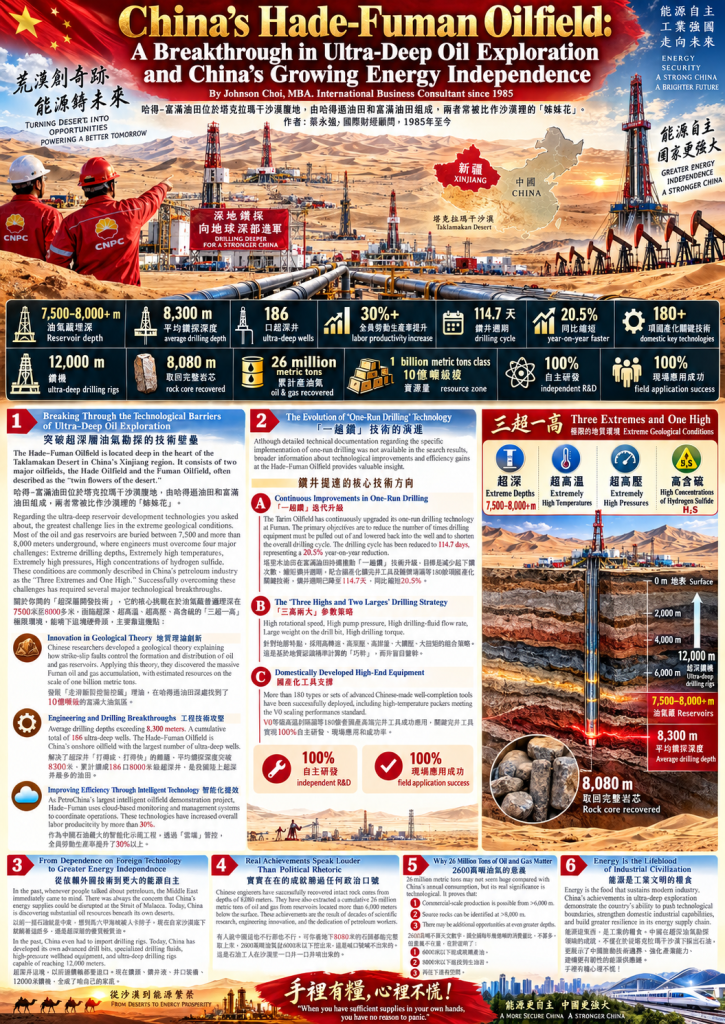
China’s Hade–Fuman Oilfield: A Breakthrough in Ultra-Deep Oil Exploration and China’s Growing Energy Independence. By Johnson Choi, MBA. International Business Consultant since 1985
哈得-富滿油田位於塔克拉瑪干沙漠腹地,由哈得遜油田和富滿油田組成,兩者常被比作沙漠裡的「姊妹花」。 作者: 蔡永強,國際財經顧問,1985年至今
The Hade–Fuman Oilfield is located deep in the heart of the Taklamakan Desert in China’s Xinjiang region. It consists of two major oilfields, the Hade Oilfield and the Fuman Oilfield, often described as the “twin flowers of the desert.”
- Breaking Through the Technological Barriers of Ultra-Deep Oil Exploration
Regarding the ultra-deep reservoir development technologies you asked about, the greatest challenge lies in the extreme geological conditions.
Most of the oil and gas reservoirs are buried between 7,500 and more than 8,000 meters underground, where engineers must overcome four major challenges:
Extreme drilling depths
Extremely high temperatures
Extremely high pressures
High concentrations of hydrogen sulfide
These conditions are commonly described in China’s petroleum industry as the “Three Extremes and One High.”
Successfully overcoming these challenges has required several major technological breakthroughs.
Innovation in Geological Theory
Chinese researchers developed a geological theory explaining how strike-slip faults control the formation and distribution of oil and gas reservoirs.
Applying this theory, they discovered the massive Fuman oil and gas accumulation deep within the Hade Oilfield area, with estimated resources on the scale of one billion metric tons.
Engineering and Drilling Breakthroughs
Chinese petroleum engineers successfully addressed two major challenges in ultra-deep drilling: how to drill wells successfully and how to drill them efficiently.
Major achievements include:
Average drilling depths exceeding 8,300 meters.
A cumulative total of 186 ultra-deep wells reaching approximately 8,000 meters.
The Hade–Fuman Oilfield becoming China’s onshore oilfield with the largest number of ultra-deep wells.
Improving Efficiency Through Intelligent Technology
As PetroChina’s largest intelligent oilfield demonstration project, Hade–Fuman uses cloud-based monitoring and management systems to coordinate operations.
These technologies have increased overall labor productivity by more than 30%. - The Evolution of “One-Run Drilling” Technology
Although detailed technical documentation regarding the specific implementation of one-run drilling was not available in the search results, broader information about technological improvements and efficiency gains at the Hade–Fuman Oilfield provides valuable insight.
Key Technologies Accelerating Drilling Operations
A. Continuous Improvements in One-Run Drilling
The Tarim Oilfield has continuously upgraded its one-run drilling technology at Fuman.
The primary objectives are to reduce the number of times drilling equipment must be pulled out of and lowered back into the well and to shorten the overall drilling cycle.
Combined with more than 180 domestically developed key technologies, including Chinese-made drilling and completion equipment and lost-circulation control while drilling, these improvements have produced significant results.
The drilling cycle has been reduced to 114.7 days, representing a 20.5% year-on-year reduction.
B. The “Three Highs and Two Larges” Drilling Strategy
To address challenging geological formations, engineers employ a combination of:
High rotational speed
High pump pressure
High drilling-fluid flow rate
Large weight on the drill bit
High drilling torque
This approach is not simply about applying more mechanical force.
Instead, it represents precision engineering based on sophisticated geological analysis and carefully calculated operating parameters.
C. Domestically Developed High-End Equipment
More than 180 types or sets of advanced Chinese-made well-completion tools have been successfully deployed, including high-temperature packers meeting the V0 sealing performance standard.
According to the reported achievements, critical well-completion tools have reached:
100% independent domestic research and development.
100% successful field deployment and application.
These technological advancements demonstrate China’s growing ability to develop and deploy sophisticated equipment for some of the world’s most challenging drilling environments. - From Dependence on Foreign Technology to Greater Energy Independence
In the past, whenever people talked about petroleum, the Middle East immediately came to mind.
There was always the concern that China’s energy supplies could be disrupted at the Strait of Malacca, a strategically important maritime passage through which large volumes of imported oil are transported.
Today, however, China is discovering substantial oil resources beneath its own deserts, including high-quality, light crude oil buried at extraordinary depths.
The significance is difficult to overstate.
In the past, China even had to import drilling rigs for ultra-deep exploration.
Today, China has developed its own:
Advanced drill bits
Specialized drilling fluids
High-pressure wellhead equipment
Ultra-deep drilling rigs capable of reaching 12,000 meters
These technologies are increasingly part of China’s own industrial capabilities. - Real Achievements Speak Louder Than Political Rhetoric
Some people repeatedly claim that China is incapable of developing advanced technologies or overcoming major engineering challenges.
But consider the facts presented here.
Chinese engineers have successfully recovered intact rock cores from depths of 8,080 meters underground.
They have also extracted a cumulative 26 million metric tons of oil and gas from reservoirs located more than 6,000 meters below the surface.
These achievements cannot be accomplished by shouting political slogans.
They are the result of decades of scientific research, engineering innovation, industrial development, and the extraordinary dedication of China’s petroleum workers.
In the middle of one of the world’s most challenging desert environments, Chinese engineers and oilfield workers have overcome obstacles one well at a time.
Every successful well represents years of accumulated scientific knowledge, practical experience, and technological progress. - Why 26 Million Tons of Oil and Gas Matter
At first glance, 26 million metric tons may not seem like an astronomical amount.
Compared with China’s annual petroleum consumption of several hundred million metric tons, it represents a relatively modest quantity.
But the real significance is not simply the volume of oil and gas produced. It is what these achievements prove technologically.
They demonstrate that:
First: Commercial-scale petroleum production is possible from reservoirs located more than 6,000 meters underground.
Second: Petroleum source rocks can be identified at depths exceeding 8,000 meters.
Third: There may be additional exploration and development opportunities at even greater depths.
This represents an important expansion of the technological and geological boundaries of China’s domestic oil and gas industry.
It also strengthens China’s long-term energy security by reducing technological dependence on foreign suppliers and expanding domestic resource-development capabilities. - Energy Is the Lifeblood of Industrial Civilization
There is an old Chinese saying:
「手裡有糧,心裡不慌!」
“When you have sufficient supplies in your own hands, you have no reason to panic.”
Energy is the food that sustains modern industry.
Without reliable energy supplies, manufacturing, transportation, infrastructure, national defense, and economic development cannot function effectively.
China’s achievements in ultra-deep petroleum exploration are therefore about much more than simply extracting oil from beneath the Taklamakan Desert.
They demonstrate the country’s ability to push technological boundaries, strengthen domestic industrial capabilities, and build greater resilience in its energy supply chain.
The deeper China drills, the further it advances the technological frontier of its energy industry.
And every successful ultra-deep well is another reminder that technological progress is not achieved through rhetoric, but through scientific research, engineering excellence, and the determination of the people who make it happen.
關於你問的「超深層開發技術」,它的核心挑戰在於油氣藏普遍埋深在 7500米至8000多米,面臨超深、超高溫、超高壓、高含硫的「三超一高」極限環境。能啃下這塊硬骨頭,主要靠這幾點:
· 地質理論創新:發展「走滑斷裂控儲控藏」理論,在哈得遜油田深處找到了10億噸級的富滿大油氣區。
· 工程技術攻堅:解決了超深井「打得成、打得快」的難題,平均鑽探深度突破8300米,累計鑽成186口8000米級超深井,是我國陸上超深井最多的油田。
· 智能化提效:作為中國石油最大的智能化示範工程,透過「雲端」管控,全員勞動生產率提升了 30%以上。
當前沒有搜到關於「一趟鑽」技術具體細節的詳細資料,但搜索到了哈得-富滿油田在提速提效方面的整體進展和核心技術方向,可以供你參考:
鑽井提速的核心技術方向
· 「一趟鑽」迭代升級:塔里木油田在富滿油田持續推動「一趟鑽」技術升級,目標是減少起下鑽次數、縮短鑽井週期。配合國產化鑽完井工具及隨鑽堵漏等 180餘項國產化關鍵技術,鑽井週期已降至 114.7天,同比縮短 20.5%。
· 「三高兩大」參數策略:針對地層特點,採用高轉速、高泵壓、高排量、大鑽壓、大扭矩的組合策略。這是基於地質認識精準計算的「巧幹」,而非盲目蠻幹。
· 國產化工具支撐:V0等級高溫封隔器等 180餘套國產高端完井工具成功應用,關鍵完井工具實現 100% 自主研發、現場應用和成功率。
以前一提石油就是中東,想到馬六甲海峽被人卡脖子。現在自家沙漠底下就躺着這麼多,還是超深層的優質輕質油。
超深井這塊,以前連鑽機都要進口。現在鑽頭、鑽井液、井口裝備、12000米鑽機,全成了咱自己的家底。
有人說中國這也不行那也不行。可你看地下8080米的石頭都能完整取上來,2600萬噸油氣從6000米以下挖出來,這是喊口號喊不出來的。這是石油工人在沙漠里一口井一口井啃出來的。
2600萬噸不算天文數字,跟全國每年幾億噸的消費量比,不算多。但意義不在量,在於證明了:6000米以下能成規模產油,8000米以下能找到生油岩,再往下還有空間。能源這東西,是工業的糧食,手裡有糧心裡不慌!