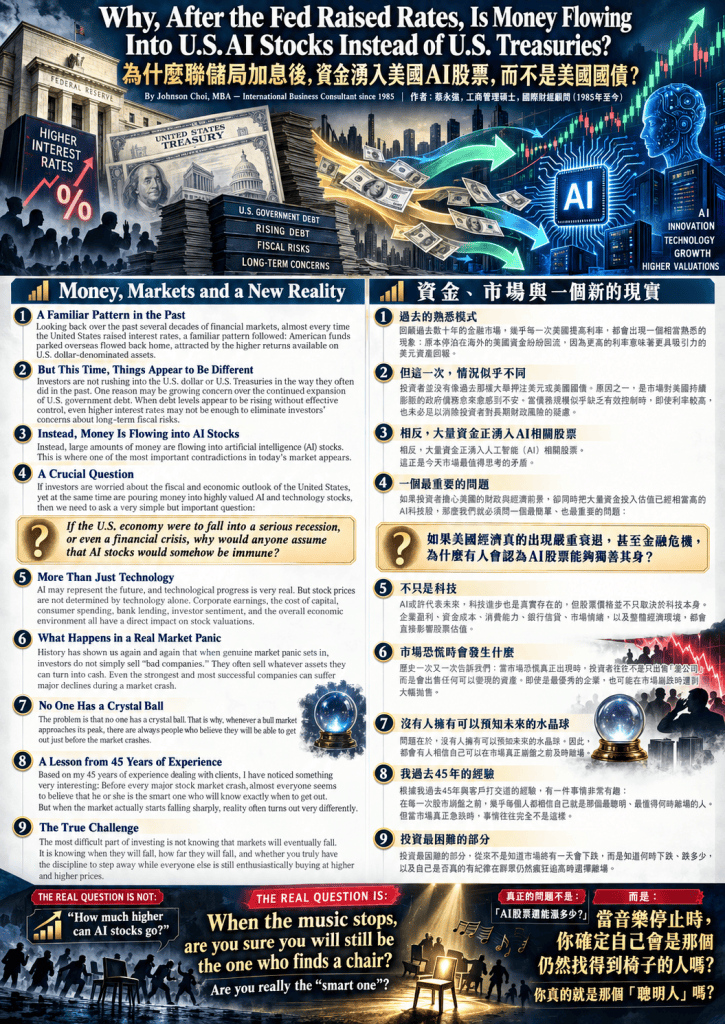
Why, After the Fed Raised Rates, Money Flowing Into U.S. AI Stocks Instead of U.S. Treasuries? By Johnson Choi, MBA — International Business Consultant since 1985
為什麼聯儲局加息後,資金湧入美國AI股票,而不是美國國債?作者:蔡永強,工商管理碩士,國際財經顧問(1985年至今)
回顧過去數十年的金融市場,幾乎每一次美國提高利率,都會出現一個相當熟悉的現象:原本停泊在海外的美國資金紛紛回流,因為更高的利率意味著更具吸引力的美元資產回報。
但這一次,情況似乎不同。
https://weixin.qq.com/sph/AuHtg3KQ9o
https://www.tiktok.com/t/ZPLNpY24b/
https://m.facebook.com/story.php?story_fbid=pfbid0PWuj4rm2VjGRmsUsG6F1bF5D6YkXU4wNiffKCUwTgb4VnWYdBB6MZtWK7MyiCKUsl&id=100036400039778&mibextid=wwXIfr
投資者並沒有像過去那樣大舉押注美元或美國國債。原因之一,是市場對美國持續膨脹的政府債務愈來愈感到不安。當債務規模似乎缺乏有效控制時,即使利率較高,也未必足以消除投資者對長期財政風險的疑慮。
相反,大量資金正湧入人工智能(AI)相關股票。
這正是今天市場最值得思考的矛盾。
如果投資者擔心美國的財政與經濟前景,卻同時把大量資金投入估值已經相當高的AI科技股,那麼我們就必須問一個最簡單、也最重要的問題:
如果美國經濟真的出現嚴重衰退,甚至金融危機,為什麼有人會認為AI股票能夠獨善其身?
AI或許代表未來,科技進步也是真實存在的,但股票價格並不只取決於科技本身。
企業盈利、資金成本、消費能力、銀行信貸、市場情緒,以及整體經濟環境,都會直接影響股票估值。
歷史一次又一次告訴我們:當市場恐慌真正出現時,投資者往往不是只出售「差公司」,而是會出售任何可以變現的資產。即使是最優秀的企業,也可能在市場崩跌時遭到大幅拋售。
問題在於,沒有人擁有可以預知未來的水晶球。
因此,每一次牛市接近高峰時,都會有人相信自己可以在市場真正崩盤之前及時離場。
根據我過去45年與客戶打交道的經驗,有一件事情非常有趣:
在每一次股市崩盤之前,幾乎每個人都相信自己就是那個最聰明、最懂得何時離場的人。
但當市場真正急跌時,事情往往完全不是這樣。
投資最困難的部分,從來不是知道市場終有一天會下跌,而是知道何時下跌、跌多少,以及自己是否真的有紀律在群眾仍然瘋狂追高時選擇離場。
所以,真正的問題不是:
「AI股票還能漲多少?」
而是:
當音樂停止時,你確定自己會是那個仍然找得到椅子的人嗎?
你真的就是那個「聰明人」嗎?
Looking back over the past several decades of financial markets, almost every time the United States raised interest rates, a familiar pattern followed: American funds parked overseas flowed back home, attracted by the higher returns available on U.S. dollar-denominated assets.
But this time, things appear to be different.
Investors are not rushing into the U.S. dollar or U.S. Treasuries in the way they often did in the past. One reason may be growing concern over the continued expansion of U.S. government debt. When debt levels appear to be rising without effective control, even higher interest rates may not be enough to eliminate investors’ concerns about long-term fiscal risks.
Instead, large amounts of money are flowing into artificial intelligence (AI) stocks.
This is where one of the most important contradictions in today’s market appears.
If investors are worried about the fiscal and economic outlook of the United States, yet at the same time are pouring money into highly valued AI and technology stocks, then we need to ask a very simple but important question:
If the U.S. economy were to fall into a serious recession, or even a financial crisis, why would anyone assume that AI stocks would somehow be immune?
AI may represent the future, and technological progress is very real. But stock prices are not determined by technology alone.
Corporate earnings, the cost of capital, consumer spending, bank lending, investor sentiment, and the overall economic environment all have a direct impact on stock valuations.
History has shown us again and again that when genuine market panic sets in, investors do not simply sell “bad companies.” They often sell whatever assets they can turn into cash. Even the strongest and most successful companies can suffer major declines during a market crash.
The problem is that no one has a crystal ball.
That is why, whenever a bull market approaches its peak, there are always people who believe they will be able to get out just before the market crashes.
Based on my 45 years of experience dealing with clients, I have noticed something very interesting:
Before every major stock market crash, almost everyone seems to believe that he or she is the smart one who will know exactly when to get out.
But when the market actually starts falling sharply, reality often turns out very differently.
The most difficult part of investing is not knowing that markets will eventually fall. It is knowing when they will fall, how far they will fall, and whether you truly have the discipline to step away while everyone else is still enthusiastically buying at higher and higher prices.
So the real question is not:
“How much higher can AI stocks go?”
The real question is:
When the music stops, are you sure you will still be the one who finds a chair?
Are you really the “smart one”?