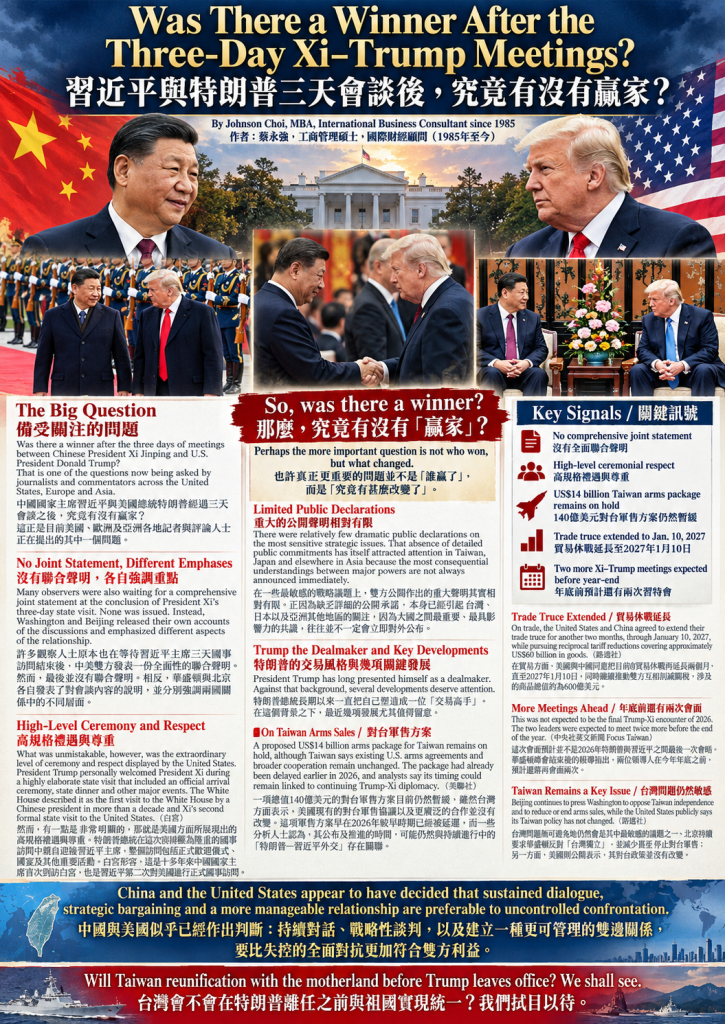
Was There a Winner After the Three-Day Xi–Trump Meetings? By Johnson Choi, MBA, International Business Consultant since 1985
習近平與特朗普三天會談後,究竟有沒有贏家?作者:蔡永強,工商管理碩士,國際財經顧問(1985年至今)
「中國國家主席習近平與美國總統特朗普經過三天會談之後,究竟有沒有贏家?」
這正是目前美國、歐洲及亞洲各地記者與評論人士正在提出的其中一個問題。
許多觀察人士原本也在等待習近平主席三天國事訪問結束後,中美雙方發表一份全面性的聯合聲明。然而,最後並沒有聯合聲明。相反,華盛頓與北京各自發表了對會談內容的說明,並分別強調兩國關係中的不同層面。
然而,有一點是非常明顯的,那就是美國方面所展現出的高規格禮遇與尊重。特朗普總統在這次安排極為隆重的國事訪問中親自迎接習近平主席,整個訪問包括正式歡迎儀式、國宴及其他重要活動。白宮形容,這是十多年來中國國家主席首次到訪白宮,也是習近平第二次對美國進行正式國事訪問。(白宮)
那麼,究竟有沒有「贏家」?
也許真正更重要的問題並不是「誰贏了」,而是「究竟有甚麼改變了」。
在一些最敏感的戰略議題上,雙方公開作出的重大聲明其實相對有限。正因為缺乏詳細的公開承諾,本身已經引起台灣、日本以及亞洲其他地區的關注,因為大國之間最重要、最具影響力的共識,往往並不一定會立即對外公布。
特朗普總統長期以來一直把自己塑造成一位「交易高手」。在這個背景之下,最近幾項發展尤其值得留意。
一項總值 140億美元的對台軍售方案目前仍然暫緩,雖然台灣方面表示,美國現有的對台軍售協議以及更廣泛的合作並沒有改變。這項軍售方案早在2026年較早時期已經被延遲,而一些分析人士認為,其公布及推進的時間,可能仍然與持續進行中的「特朗普—習近平外交」存在關聯。(美聯社)
在貿易方面,美國與中國同意把目前的貿易休戰再延長兩個月,直至2027年1月10日,同時繼續推動雙方互相削減關稅,涉及的商品總值約為 600億美元。(路透社)
這些發展本身並不足以證明華盛頓對北京的政策已經出現完整的「180度大轉彎」。但是,這些跡象的確顯示,特朗普政府目前更加重視談判、討價還價,以及與中國保持持續的高層接觸。
同樣值得注意的是,這次會面預計並不是2026年特朗普與習近平之間最後一次會晤。華盛頓峰會結束後的報導指出,兩位領導人在今年年底之前,預計還將再會面兩次。(中央社英文新聞 Focus Taiwan)
這也意味著,華盛頓這次會談或許不應該被視為一次談判的結束,而更應該被看作是一個持續發展中的談判進程其中一個階段。
台灣問題無可避免地仍然會是其中最敏感的議題之一。北京持續要求華盛頓反對「台灣獨立」,並減少甚至停止對台軍售;另一方面,美國則公開表示,其對台政策並沒有改變。(路透社)
這些持續進行中的談判,最終是否會為兩岸關係帶來重大改變,甚至出現某種形式的和平統一安排,今天沒有人能夠確定。任何這樣的結果,都不僅取決於華盛頓與北京的決定,也會受到台灣自身局勢發展及相關決策的影響。
就目前而言,這三天會談所釋放出來最重要的訊號,也許是:
中國與美國似乎已經作出判斷:持續對話、戰略性談判,以及建立一種更可管理的雙邊關係,要比失控的全面對抗更加符合雙方利益。
今年年底之前,預計特朗普與習近平仍然會有另外兩次會面。
因此,整個故事距離結束仍然很遠。
台灣會不會在特朗普離任之前與祖國實現統一?
我們拭目以待。
“Was there a winner after the three days of meetings between Chinese President Xi Jinping and U.S. President Donald Trump?”
That is one of the questions now being asked by journalists and commentators across the United States, Europe and Asia.
Many observers were also waiting for a comprehensive joint statement at the conclusion of President Xi’s three-day state visit. None was issued. Instead, Washington and Beijing released their own accounts of the discussions and emphasized different aspects of the relationship.
What was unmistakable, however, was the extraordinary level of ceremony and respect displayed by the United States. President Trump personally welcomed President Xi during a highly elaborate state visit that included an official arrival ceremony, state dinner and other major events. The White House described it as the first visit to the White House by a Chinese president in more than a decade and Xi’s second formal state visit to the United States. (The White House)
So, was there a “winner”?
Perhaps the more important question is not who won, but what changed.
There were relatively few dramatic public declarations on the most sensitive strategic issues. That absence of detailed public commitments has itself attracted attention in Taiwan, Japan and elsewhere in Asia because the most consequential understandings between major powers are not always announced immediately.
President Trump has long presented himself as a dealmaker. Against that background, several developments deserve attention.
A proposed US$14 billion arms package for Taiwan remains on hold, although Taiwan says existing U.S. arms agreements and broader cooperation remain unchanged. The package had already been delayed earlier in 2026, and analysts say its timing could remain linked to continuing Trump-Xi diplomacy. (AP News)
On trade, the United States and China agreed to extend their trade truce for another two months, through January 10, 2027, while pursuing reciprocal tariff reductions covering approximately US$60 billion in goods. (Reuters)
These developments do not by themselves establish that Washington has made a complete “180-degree turn” toward Beijing. But they do indicate that the Trump administration is giving greater emphasis to negotiation, bargaining and continued high-level engagement with China.
Equally significant, this was not expected to be the final Trump-Xi encounter of 2026. Reporting following the Washington summit indicated that the two leaders were expected to meet twice more before the end of the year. (Focus Taiwan – CNA English News)
That means the Washington meetings should probably be viewed not as the conclusion of a negotiation, but as one stage in a continuing process.
Taiwan will inevitably remain one of the most sensitive issues. Beijing continues to press Washington to oppose Taiwan independence and to reduce or end arms sales, while the United States publicly says its Taiwan policy has not changed. (Reuters)
Whether these continuing negotiations eventually produce a major change in cross-Strait relations—or even some form of peaceful reunification arrangement—is impossible to know today. Any such outcome would depend not only on decisions in Washington and Beijing but also on developments and decisions involving Taiwan itself.
For now, the most important signal from these three days may be this:
China and the United States appear to have decided that sustained dialogue, strategic bargaining and a more manageable relationship are preferable to uncontrolled confrontation.
There are still two more expected Xi-Trump meetings before the end of the year.
The story is therefore far from finished.
Will Taiwan reunification with the motherland before Trump leaves office? We shall see.