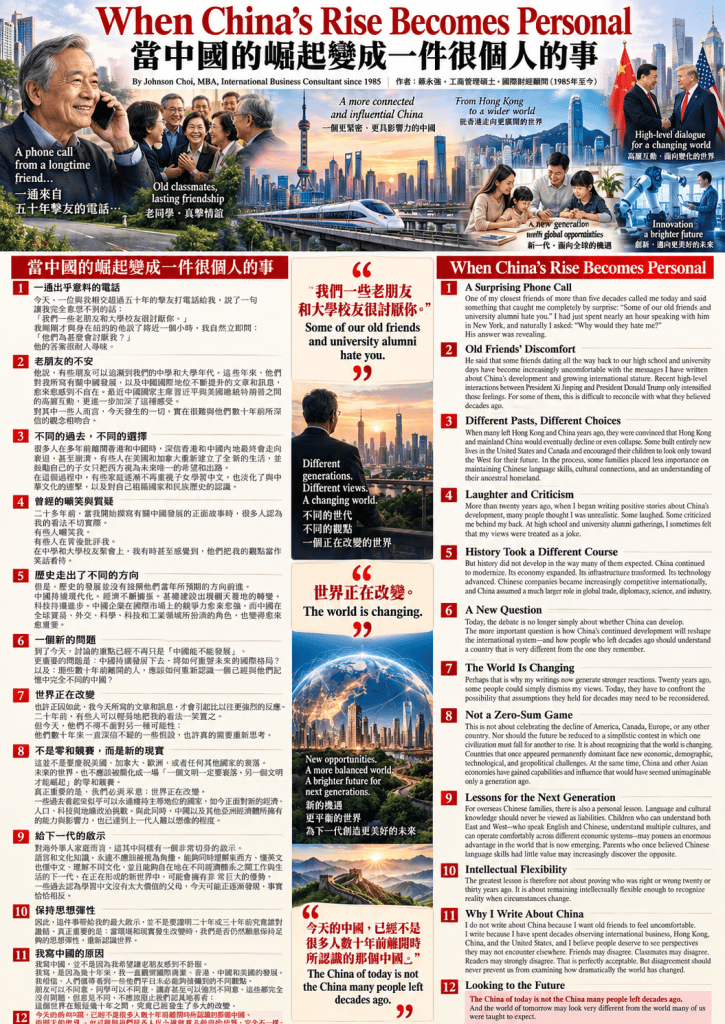
When China’s Rise Becomes Personal. By Johnson Choi, MBA, International Business Consultant since 1985
當中國的崛起變成一件很個人的事. 作者:蔡永強,工商管理碩士,國際財經顧問(1985年至今)
今天,一位與我相交超過五十年的摯友打電話給我,說了一句讓我完全意想不到的話:
「我們一些老朋友和大學校友很討厭你。」
我剛剛才與身在紐約的他談了將近一個小時,我自然立即問:
「他們為甚麼會討厭我?」
他的答案很耐人尋味。
他說,有些朋友可以追溯到我們的中學和大學年代。這些年來,他們對我所寫有關中國發展,以及中國國際地位不斷提升的文章和訊息,愈來愈感到不自在。最近中國國家主席習近平與美國總統特朗普之間的高層互動,更進一步加深了這種感受。
對其中一些人而言,今天發生的一切,實在很難與他們數十年前所深信的觀念相吻合。
很多人在多年前離開香港和中國時,深信香港和中國內地最終會走向衰退,甚至崩潰。有些人在美國和加拿大重新建立了全新的生活,並鼓勵自己的子女只把西方視為未來唯一的希望和出路。
在這個過程中,有些家庭逐漸不再重視子女學習中文,也淡化了與中華文化的連繫,以及對自己祖籍國家和民族歷史的認識。
二十多年前,當我開始撰寫有關中國發展的正面故事時,很多人認為我的看法不切實際。
有些人嘲笑我。
有些人在背後批評我。
在中學和大學校友聚會上,我有時甚至感覺到,他們把我的觀點當作笑話看待。
但是,歷史的發展並沒有按照他們當年所預期的方向前進。
中國持續現代化。
經濟不斷擴張。
基礎建設出現翻天覆地的轉變。
科技持續進步。
中國企業在國際市場上的競爭力愈來愈強,而中國在全球貿易、外交、科學、科技和工業領域所扮演的角色,也變得愈來愈重要。
到了今天,討論的重點已經不再只是「中國能不能發展」。
更重要的問題是:
中國持續發展下去,將如何重塑未來的國際格局?
以及:
那些數十年前離開的人,應該如何重新認識一個已經與他們記憶中完全不同的中國?
也許正因如此,我今天所寫的文章和訊息,才會引起比以往更強烈的反應。
二十年前,有些人可以輕易地把我的看法一笑置之。
但今天,他們不得不面對另一種可能性:
他們數十年來一直深信不疑的一些假設,也許真的需要重新思考。
這並不是要慶祝美國、加拿大、歐洲,或者任何其他國家的衰落。
未來的世界,也不應該被簡化成一場「一個文明一定要衰落,另一個文明才能崛起」的零和競賽。
真正重要的是,我們必須承認:
世界正在改變。
一些過去看起來似乎可以永遠維持主導地位的國家,如今正面對新的經濟、人口、科技與地緣政治挑戰。
與此同時,中國以及其他亞洲經濟體所擁有的能力與影響力,也已達到上一代人難以想像的程度。
對海外華人家庭而言,這其中同樣有一個非常切身的啟示。
語言和文化知識,永遠不應該被視為負擔。
能夠同時理解東西方、懂英文也懂中文、理解不同文化,並且能夠自在地在不同經濟體系之間工作與生活的下一代,在正在形成的新世界中,可能會擁有非常巨大的優勢。
一些過去認為學習中文沒有太大價值的父母,今天可能正逐漸發現,事實恰恰相反。
因此,這件事帶給我的最大啟示,並不是要證明二十年或三十年前究竟誰對誰錯。
真正重要的是:
當環境和現實發生改變時,我們是否仍然願意保持足夠的思想彈性,重新認識世界。
我寫中國,並不是因為我希望讓老朋友感到不舒服。
我寫,是因為幾十年來,我一直觀察國際商業、香港、中國和美國的發展。
我相信,人們值得看到一些他們平日未必能夠接觸到的不同觀點。
朋友可以不同意。
同學可以不同意。
讀者甚至可以強烈不同意。
這些都完全沒有問題。
但意見不同,不應該阻止我們認真地看看:
這個世界在短短幾十年之間,究竟已經發生了多大的改變。
今天的中國,已經不是很多人數十年前離開時所認識的那個中國。
而明天的世界,也可能與我們很多人從小被教育去相信的世界,完全不一樣。
One of my closest friends of more than five decades called me today and said something that caught me completely by surprise:
“Some of our old friends and university alumni hate you.”
I had just spent nearly an hour speaking with him in New York, and naturally I asked:
“Why would they hate me?”
His answer was revealing.
He said that some friends dating all the way back to our high school and university days have become increasingly uncomfortable with the messages I have written about China’s development and growing international stature. Recent high-level interactions between President Xi Jinping and President Donald Trump only intensified those feelings.
For some of them, this is difficult to reconcile with what they believed decades ago.
When many left Hong Kong and China years ago, they were convinced that Hong Kong and mainland China would eventually decline or even collapse. Some built entirely new lives in the United States and Canada and encouraged their children to look only toward the West for their future. In the process, some families placed less importance on maintaining Chinese language skills, cultural connections, and an understanding of their ancestral homeland.
More than twenty years ago, when I began writing positive stories about China’s development, many people thought I was unrealistic.
Some laughed.
Some criticized me behind my back.
At high school and university alumni gatherings, I sometimes felt that my views were treated as a joke.
But history did not develop in the way many of them expected.
China continued to modernize. Its economy expanded. Its infrastructure transformed. Its technology advanced. Chinese companies became increasingly competitive internationally, and China assumed a much larger role in global trade, diplomacy, science, and industry.
Today, the debate is no longer simply about whether China can develop.
The more important question is how China’s continued development will reshape the international system—and how people who left decades ago should understand a country that is very different from the one they remember.
Perhaps that is why my writings now generate stronger reactions.
Twenty years ago, some people could simply dismiss my views.
Today, they have to confront the possibility that assumptions they held for decades may need to be reconsidered.
This is not about celebrating the decline of America, Canada, Europe, or any other country. Nor should the future be reduced to a simplistic contest in which one civilization must fall for another to rise.
It is about recognizing that the world is changing.
Countries that once appeared permanently dominant face new economic, demographic, technological, and geopolitical challenges. At the same time, China and other Asian economies have gained capabilities and influence that would have seemed unimaginable only a generation ago.
For overseas Chinese families, there is also a personal lesson.
Language and cultural knowledge should never be viewed as liabilities.
Children who can understand both East and West—who speak English and Chinese, understand multiple cultures, and can operate comfortably across different economic systems—may possess an enormous advantage in the world that is now emerging.
Parents who once believed Chinese language skills had little value may increasingly discover the opposite.
The greatest lesson is therefore not about proving who was right or wrong twenty or thirty years ago.
It is about remaining intellectually flexible enough to recognize reality when circumstances change.
I do not write about China because I want old friends to feel uncomfortable.
I write because I have spent decades observing international business, Hong Kong, China, and the United States, and I believe people deserve to see perspectives they may not encounter elsewhere.
Friends may disagree.
Classmates may disagree.
Readers may strongly disagree.
That is perfectly acceptable.
But disagreement should never prevent us from examining how dramatically the world has changed.
The China of today is not the China many people left decades ago.
And the world of tomorrow may look very different from the world many of us were taught to expect.