The Signal Behind the White House State Dinner: China-U.S. Relations Are Searching Again for “Manageable Stability” By Johnson Choi, MBA, International Business Consultant since 1985
白宮國宴背後的訊號:中美關係正在重新尋找「可管理的穩定」作者:蔡永強,商科碩士,國際財經顧問(1985年至今)
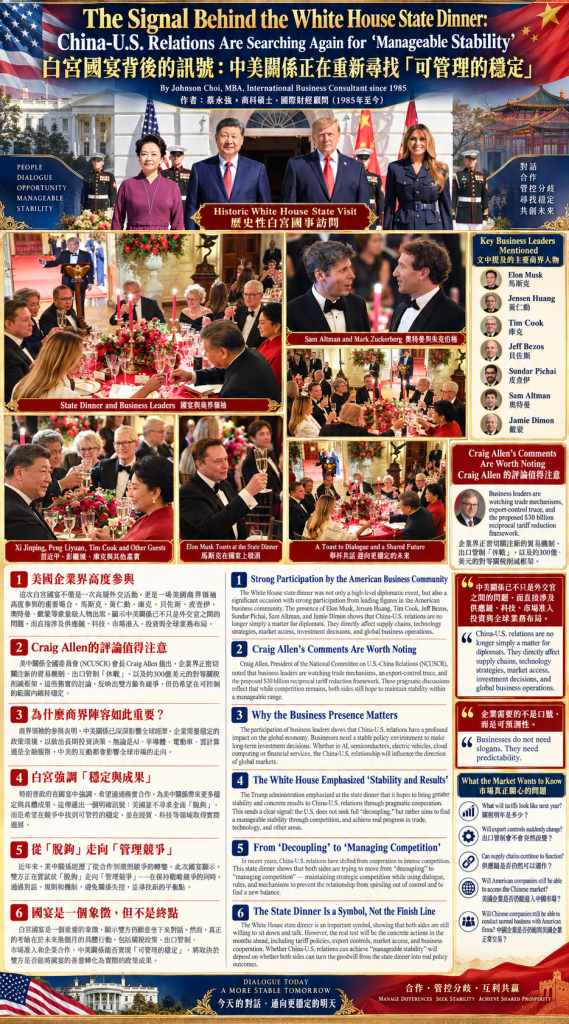
2026年9月24日,中國國家主席習近平與夫人彭麗媛赴白宮進行國事訪問,美國總統特朗普與第一夫人梅拉尼婭舉行正式歡迎儀式及國宴。白宮形容這是一次具有歷史意義的國事訪問,也是中國國家主席十多年來再次正式到訪白宮。歡迎儀式包括美軍儀仗、軍樂表演,以及B-2轟炸機和F-22戰機飛越等安排。
但如果只把這次訪問看成一場外交禮儀活動,可能低估了它真正值得注意的地方。
一個尤其值得觀察的訊號,是美國企業界對這次訪問的高度參與。
路透社在國宴前報道,受邀出席者包括多位美國科技、金融及大型企業領袖,包括Tesla的Elon Musk、Nvidia的Jensen Huang、Apple的Tim Cook、Amazon的Jeff Bezos、Alphabet的Sundar Pichai、OpenAI的Sam Altman、JPMorgan Chase的Jamie Dimon等。白宮也明確表示,國宴賓客包括政府官員以及商界領袖。
這個陣容本身說明了一件事:中美關係已不只是外交官之間的問題,而直接涉及美國大型企業的供應鏈、科技、市場准入、投資與全球業務布局。
Craig Allen的評論值得注意
美中貿易全國委員會前會長Craig Allen(譚森)在習近平此次訪美前,曾就特朗普—習近平峰會公開分析企業界最關注的問題。
他指出,企業將密切關注新的美中貿易與投資機制、雙方公布的商業協議,以及出口管制「休戰」能否延續。對於此前討論中的約300億美元「對等關稅削減框架」,Allen認為其具體商品範圍可能直接影響企業供應鏈。
值得注意的是,Allen的原始評論比較審慎。他並沒有公開宣稱「美國離不開中國」或者「中國已經完全掌握主動權」之類的結論。
因此,網上流傳的一句中文:
「美中貿易全國委員會會長譚森的一段公開表態,把這場白宮歡迎國宴的真實分量,徹底攤在了台面上。」
比較合理的理解是:這是文章作者對Allen觀點的評論性概括,而不是目前能查證到的Allen英文逐字原話。
然而,這種解讀並非毫無背景。Allen真正強調的核心確實是:對企業而言,中美政治關係是否穩定,最終會轉化成非常具體的關稅、出口管制、市場准入和供應鏈成本問題。
為什麼這次國宴的商界陣容如此重要?
從企業角度來看,美中經濟關係的規模,使得單純「脫鉤」並不是一個沒有成本的選項。
科技公司關注中國市場、製造能力以及供應鏈;金融機構關注跨境資金、投資和企業融資;消費品牌關注中國龐大的消費市場;而美國農業界則長期關注中國對農產品的需求。
因此,當大量美國企業最高層出現在同一場國宴上時,更適合把它理解為一個現實訊號:
即使兩國在科技、國家安全、台灣、貿易以及地緣政治問題上仍存在嚴重分歧,美國企業界依然希望兩國關係保持足夠穩定,使商業活動可以繼續進行。
這和此前部分「全面脫鉤」的政治論述之間,形成了一種非常值得注意的張力。
白宮本身也強調「穩定與成果」
訪問結束後,白宮表示,雙方會談涉及經濟、禁毒合作以及其他雙邊問題。特朗普形容此次會面「非常有成效」,並表示雙方取得了進展。白宮同時公布,中國在部分芬太尼前體化學品管制方面採取新措施;2026年8月,中國根據美方執法信息拘捕了21名涉嫌製造及分銷相關前體化學品的中國公民。
在外交層面,白宮國宴亦刻意加入歷史象徵。宴會使用了1972年尼克松訪華期間曾使用的Schramsberg氣泡酒,以呼應當年中美關係破冰時的「和平祝酒」。
這個細節頗有象徵意義。
五十多年來,中美關係經歷合作、競爭、衝突與重新接觸。今天的中美關係顯然已經與1972年完全不同,但一個基本現實仍然存在:
兩個世界最大經濟體若完全失去溝通,代價不只由兩國承擔,也會直接影響全球金融市場、供應鏈、能源、科技及貿易。
從「脫鉤」走向「管理競爭」
因此,這次白宮歡迎儀式與國宴真正值得關注的地方,不應只看軍樂隊有多少人、紅地毯有多長,或者哪一位企業家坐在哪一張桌子。
更重要的是,中美雙方似乎正在嘗試建立另一種相處方式:
競爭仍然存在;分歧沒有消失;但雙方同時希望建立某些制度化渠道,把競爭控制在不至於演變成全面衝突的範圍內。
Craig Allen在峰會前談到的「Board of Trade」、「Board of Investment」、出口管制休戰以及關稅框架,其重要性就在這裡。
企業需要的不是口號,而是可預測性。
市場真正關心的問題是:
關稅明年是多少?
出口管制會不會突然改變?
供應鏈是否仍然可以運作?
美國企業是否仍能進入中國市場?
中國企業是否仍能與美國企業正常交易?
只要這些問題沒有答案,美中商界就很難真正安心。
國宴是一個象徵,但不是終點
所以,這次白宮國宴最值得注意的,可能不是「誰受到最高禮遇」,而是美中兩國政治領導層與美國企業界都在傳遞一個相近的現實訊號:即使競爭加劇,兩國仍需要對話、交易與危機管理。
這並不代表中美關係已經重回過去,也不代表所有矛盾都得到解決。
相反,它更像是一個新的階段:
不是回到全面合作,也不是走向全面脫鉤,而是在競爭之中尋找一種可以長期運作的穩定框架。
對中美兩國而言,真正的考驗並不是一場國宴,而是今後數月和數年,這些對話機制、貿易安排、科技溝通和危機管理措施能否真正落實。
如果能夠落實,這次白宮國事訪問的重要性可能會超越禮儀本身。
如果不能,那麼再盛大的紅地毯,也只能成為一幅漂亮的歷史照片。
On September 24, 2026, Chinese President Xi Jinping and First Lady Peng Liyuan paid a state visit to the White House, where U.S. President Donald Trump and First Lady Melania Trump hosted an official welcoming ceremony and state dinner. The White House described the occasion as a historic state visit and the first formal White House visit by a Chinese president in more than a decade. The welcoming ceremony included a U.S. military honor guard, military band performances, and flyovers by B-2 bombers and F-22 fighter jets.
But viewing the visit merely as a diplomatic ceremony may underestimate what was truly significant about it.
One especially important signal was the high level of participation by the American business community.
Before the state dinner, Reuters reported that the guest list included a number of leading figures from the U.S. technology, financial, and corporate sectors, including Tesla’s Elon Musk, Nvidia’s Jensen Huang, Apple’s Tim Cook, Amazon’s Jeff Bezos, Alphabet’s Sundar Pichai, OpenAI’s Sam Altman, and JPMorgan Chase’s Jamie Dimon. The White House also made clear that the dinner’s guests included both government officials and business leaders.
The presence of this group makes one point clear: China-U.S. relations are no longer simply a matter for diplomats. They directly affect the supply chains, technology strategies, market access, investment decisions, and global business operations of major American corporations.
Craig Allen’s Comments Are Worth Noting
Before Xi Jinping’s visit to the United States, Craig Allen, former president of the U.S.-China Business Council, publicly discussed the issues that mattered most to the business community ahead of the Trump-Xi summit.
He noted that companies would be watching closely for new China-U.S. trade and investment mechanisms, commercial agreements announced by both sides, and whether the existing “truce” on export controls could be extended. Regarding the roughly $30 billion “reciprocal tariff reduction framework” that had previously been discussed, Allen suggested that the specific products covered could have a direct impact on corporate supply chains.
It is important to note that Allen’s original comments were relatively cautious. He did not publicly declare that “the United States cannot do without China” or that “China has completely seized the initiative.”
Therefore, a Chinese sentence circulating online—
“A public statement by Craig Allen, president of the U.S.-China Business Council, completely laid bare the true significance of this White House welcome and state dinner.”
—is more reasonably understood as the author’s interpretive summary of Allen’s views, rather than a verbatim English quotation that can currently be verified.
That interpretation, however, is not without context. The central point Allen did emphasize was that, for businesses, the stability of the China-U.S. political relationship ultimately translates into very concrete issues involving tariffs, export controls, market access, and supply-chain costs.
Why Was the Business Presence at This State Dinner So Important?
From a corporate perspective, the sheer scale of China-U.S. economic ties means that simple “decoupling” is not a cost-free option.
Technology companies care about the Chinese market, manufacturing capacity, and supply chains. Financial institutions care about cross-border capital flows, investment, and corporate financing. Consumer brands care about China’s enormous consumer market. U.S. agriculture has long paid close attention to Chinese demand for American farm products.
Therefore, when so many top American corporate executives appear together at the same state dinner, it is better understood as a practical signal:
Even though the two countries continue to have serious disagreements over technology, national security, Taiwan, trade, and geopolitics, the American business community still wants the relationship to remain stable enough for commercial activity to continue.
This creates a notable tension with some of the earlier political rhetoric surrounding “full decoupling.”
The White House Also Emphasized “Stability and Results”
After the visit, the White House said the discussions covered economic issues, counternarcotics cooperation, and other bilateral matters. President Trump described the meeting as “very productive” and said progress had been made. The White House also announced that China had taken new measures regarding controls on certain fentanyl precursor chemicals. In August 2026, according to U.S. law-enforcement information, China arrested 21 Chinese citizens suspected of manufacturing and distributing related precursor chemicals.
At the diplomatic level, the state dinner also deliberately incorporated historical symbolism. Schramsberg sparkling wine—the same brand served during President Richard Nixon’s 1972 visit to China—was used at the dinner, recalling the “toast to peace” associated with the breakthrough in China-U.S. relations at that time.
That detail carried considerable symbolic meaning.
Over more than five decades, China-U.S. relations have gone through cooperation, competition, conflict, and renewed engagement. Today’s relationship is clearly very different from that of 1972, but one basic reality remains:
If the world’s two largest economies completely lose the ability to communicate, the costs will not be borne by the two countries alone. Global financial markets, supply chains, energy, technology, and trade would all be directly affected.
From “Decoupling” to “Managing Competition”
For that reason, the real significance of the White House welcoming ceremony and state dinner should not be judged simply by how many musicians were in the military band, how long the red carpet was, or which business leader sat at which table.
More importantly, China and the United States appear to be trying to develop another way of managing their relationship:
Competition remains. Disagreements have not disappeared. But both sides also appear to want institutionalized channels that can keep competition from escalating into full-scale confrontation.
This is where Craig Allen’s pre-summit references to a “Board of Trade,” a “Board of Investment,” an export-control truce, and tariff frameworks become important.
Businesses do not need slogans. They need predictability.
What the market really wants to know is:
What will tariffs look like next year?
Will export controls suddenly change?
Can supply chains continue to function?
Will American companies still be able to access the Chinese market?
Will Chinese companies still be able to conduct normal business with American firms?
As long as these questions remain unanswered, the business communities in both China and the United States will find it difficult to feel truly secure.
The State Dinner Is a Symbol, Not the Finish Line
The most important aspect of this White House state dinner, therefore, may not be “who received the highest level of ceremonial treatment,” but rather the similar practical signal being sent by the political leadership of both countries and by the American business community:
Even as competition intensifies, the two countries still need dialogue, trade, and crisis management.
This does not mean that China-U.S. relations have returned to the past, nor does it mean that all disagreements have been resolved.
Instead, it appears to represent a new stage:
Not a return to comprehensive cooperation, and not a move toward complete decoupling, but an effort to find a stable framework that can operate over the long term within an environment of competition.
For both China and the United States, the real test is not a state dinner. The real test will come over the months and years ahead: whether these dialogue mechanisms, trade arrangements, technology channels, and crisis-management measures can actually be implemented.
If they can, the significance of this White House state visit may ultimately extend far beyond diplomatic ceremony.
If they cannot, then even the grandest red carpet will remain nothing more than a beautiful historical photograph.