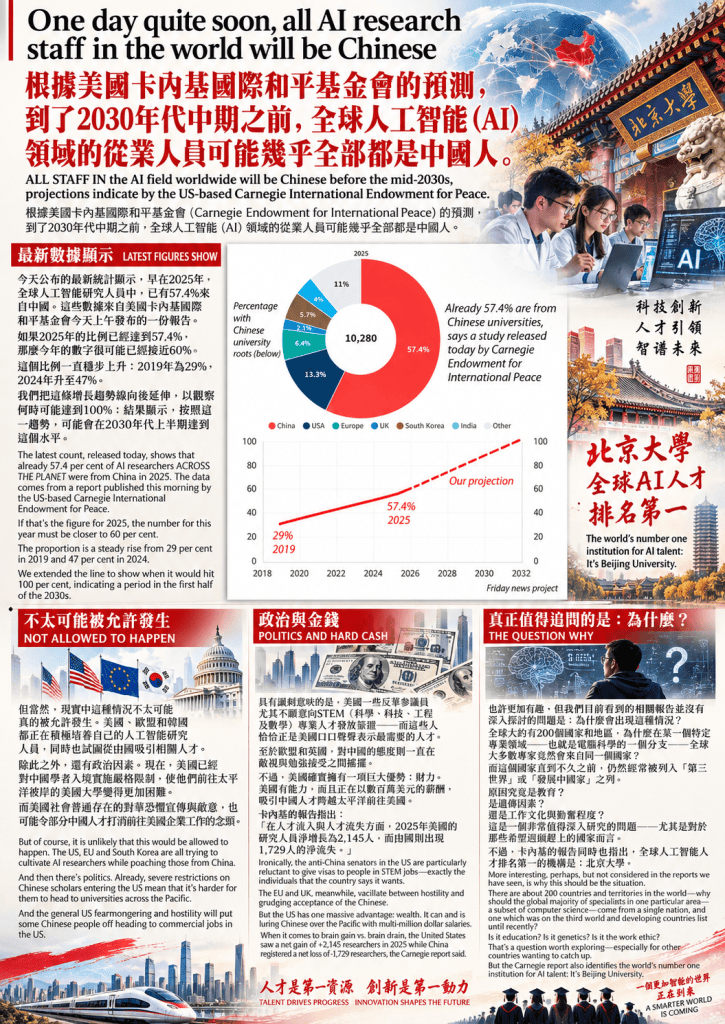
ALL STAFF IN the AI field worldwide will be Chinese before the mid-2030s, projections indicate by the US-based Carnegie International Endowment for Peace.
根據美國卡內基國際和平基金會(Carnegie Endowment for International Peace)的預測,到了2030年代中期之前,全球人工智能(AI)領域的從業人員可能幾乎全部都是中國人。
今天公布的最新統計顯示,早在2025年,全球人工智能研究人員中,已有57.4%來自中國。這些數據來自美國卡內基國際和平基金會今天上午發布的一份報告。
如果2025年的比例已經達到57.4%,那麼今年的數字很可能已經接近60%。
這個比例一直穩步上升:2019年為29%,2024年升至47%。
我們把這條增長趨勢線向後延伸,以觀察何時可能達到100%;結果顯示,按照這一趨勢,可能會在2030年代上半期達到這個水平。
https://www.tiktok.com/t/ZP8TCWUPQ/
https://m.facebook.com/story.php?story_fbid=pfbid0he3u31VJTg2xZzYkvFKxV7PZtvbXTAijosUzQb93ZKNPpGpM7YqpD8nkYxET3Jwgl&id=100036400039778&mibextid=wwXIfr
不太可能被允許發生
但當然,現實中這種情況不太可能真的被允許發生。美國、歐盟和韓國都正在積極培養自己的人工智能研究人員,同時也試圖從中國吸引相關人才。
除此之外,還有政治因素。現在,美國已經對中國學者入境實施嚴格限制,使他們前往太平洋彼岸的美國大學變得更加困難。
而美國社會普遍存在的對華恐懼宣傳與敵意,也可能令部分中國人才打消前往美國企業工作的念頭。
政治與金錢
具有諷刺意味的是,美國一些反華參議員尤其不願意向STEM(科學、科技、工程及數學)專業人才發放簽證——而這些人恰恰正是美國口口聲聲表示最需要的人才。
至於歐盟和英國,對中國的態度則一直在敵視與勉強接受之間搖擺。
不過,美國確實擁有一項巨大優勢:財力。
美國有能力,而且正在以數百萬美元的薪酬,吸引中國人才跨越太平洋前往美國。
卡內基的報告指出:
「在人才流入與人才流失方面,2025年美國的研究人員淨增長為2,145人,而中國則出現1,729人的淨流失。」
真正值得追問的是:為什麼?
也許更加有趣、但我們目前看到的相關報告並沒有深入探討的問題是:為什麼會出現這種情況?
全球大約有200個國家和地區,為什麼在某一個特定專業領域——也就是電腦科學的一個分支——全球大多數專家竟然會來自同一個國家?
而這個國家直到不久之前,仍然經常被列入「第三世界」或「發展中國家」之列。
原因究竟是教育?
是遺傳因素?
還是工作文化與勤奮程度?
這是一個非常值得深入研究的問題——尤其是對於那些希望迎頭趕上的國家而言。
不過,卡內基的報告同時也指出,全球人工智能人才排名第一的機構是:北京大學。
The latest count, released today, shows that already 57.4 per cent of AI researchers ACROSS THE PLANET were from China in 2025. The data comes from a report published this morning by the US-based Carnegie International Endowment for Peace.
If that’s the figure for 2025, the number for this year must be closer to 60 per cent.
The proportion is a steady rise from 29 per cent in 2019 and 47 per cent in 2024.
We extended the line to show when it would hit 100 per cent, indicating a period in the first half of the 2030s.
NOT ALLOWED TO HAPPEN
But of course, it is unlikely that this would be allowed to happen. The US, EU and South Korea are all trying to cultivate AI researchers while poaching those from China.
And then there’s politics. Already, severe restrictions on Chinese scholars entering the US mean that it’s harder for them to head to universities across the Pacific.
And the general US fearmongering and hostility will put some Chinese people off heading to commercial jobs in the US.
POLITICS AND HARD CASH
Ironically, the anti-China senators in the US are particularly reluctant to give visas to people in STEM jobs—exactly the individuals that the country says it wants.
The EU and UK, meanwhile, vacillate between hostility and grudging acceptance of the Chinese.
But the US has one massive advantage: wealth. It can and is luring Chinese over the Pacific with multi-million dollar salaries.
“When it comes to brain gain vs. brain drain, the United States saw a net gain of +2,145 researchers in 2025 while China registered a net loss of -1,729 researchers,” the Carnegie report said.
THE QUESTION WHY
More interesting, perhaps, but not considered in the reports we have seen, is why this should be the situation.
There are about 200 countries and territories in the world—why should the global majority of specialists in one particular area—a subset of computer science—come from a single nation, and one which was on the “third world” and “developing countries” list until recently?
Is it education? Is it genetics? Is it the work ethic?
That’s a question worth exploring—especially for other countries wanting to catch up.
But the Carnegie report also identifies the world’s number one institution for AI talent: It’s Beijing University.