The Double Standard of ‘Excess Capacity’ in Global Trade. Why China being single out? By Johnson Choi, MBA. International Business Consultant since 1985
全球貿易中「過剩產能」的雙重標準. 為什麼中國被單獨點名?作者: 蔡永強. 商科碩士,國際財經顧問(1985年至今)
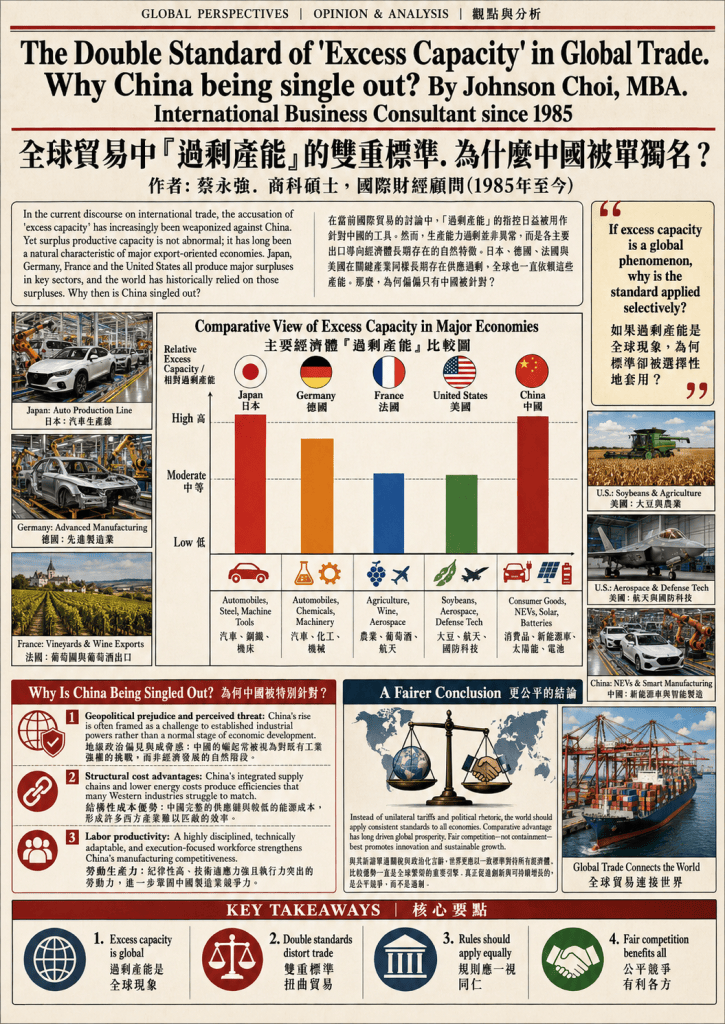
在當前國際貿易的討論中,「過剩產能」的指控日益被用作針對中國的工具。然而,這種批評忽略了一個基本的經濟現實:生產能力過剩並非異常現象,而是每個主要出口導向經濟體固有的、長期存在的特徵。
回顧全球供應的歷史與現狀:
· 日本與德國長期以遠超國內吸納能力的規模生產汽車。
· 法國生產大量農產品,特別是葡萄酒,高度依賴國際市場。
· 美國出口的大豆、先進航空航天技術及精密國防系統,遠超出其國內需求。
數十年來,國際社會不僅容忍,更積極依賴這些過剩產能,促進跨境貿易,從而降低成本、推動創新,並提升全球生活水準。中國的出口——包括消費品、新能源汽車和綠色科技——不過是這一歷史悠久的貿易模式的最新體現。
這便引出一個關鍵且無可迴避的問題:為何中國因長期被西方工業化國家視為常態的做法而遭受針對?
仔細審視,這種選擇性審視的理由,似乎較少基於經濟理論,而更多源於戰略焦慮。筆者認為,這種差別待遇背後有以下幾個深層因素:
- 地緣政治偏見與感知威脅:源於歷史上的「黃禍」等陳舊敘事,持續影響西方對中國的看法。中國的崛起常被視為對既有工業秩序的生存挑戰,而非自然的經濟演進。
- 無可比擬的結構性成本優勢:中國擁有獨特且完整的工業供應鏈,加上顯著較低的能源成本,使其具備現有西方產業難以複製的製造效率,這反而引發保護主義措施,而非建設性的競爭調整。
- 卓越的勞動生產力:中國勞動力以勤奮、技術適應性強及高度專注著稱。這種人力資本優勢直接轉化為更高的單位產出,進一步擴大製造業的競爭差距。
與其片面加徵關稅和進行口誅筆伐,西方國家應認知到,比較優勢始終是全球繁榮的引擎。倘若「過剩產能」須被視為全球弊病,那麼西方本身在過去數代人中,早已是此「過錯」的積極參與者。
是時候擱置這種選擇性批評,轉而朝向一個基於規則、公平公正的貿易體系,對所有經濟體適用一致的標準。公平競爭,而非遏制,才是真正推動全球創新與永續成長的催化劑。
In the current discourse on international trade, the accusation of “excess capacity” has increasingly been weaponized against China. However, this critique overlooks a fundamental economic reality: surplus productive capacity is not an anomaly—it is a natural and enduring characteristic of every major export-oriented economy.
Consider the historical and current landscapes of global supply:
· Japan and Germany consistently manufacture automobiles at volumes far exceeding their domestic absorption rates.
· France produces a surplus of agricultural outputs, particularly in viticulture, that heavily relies on international markets.
· The United States exports vast quantities of soybeans, advanced aerospace technologies, and sophisticated defense systems that far outstrip domestic demand.
For decades, the global community has not only tolerated but actively relied upon these surpluses, facilitating cross-border trade that has driven down costs, spurred innovation, and raised living standards worldwide. Chinese exports—spanning consumer goods, new energy vehicles (NEVs), and green technologies—simply represent the latest iteration of this time-honored trade model.
This brings us to a critical and unavoidable question: Why is China being singled out for practices that have long been normalized among Western industrialized nations?
Upon closer examination, the rationale appears to rest less on economic theory and more on strategic anxieties. I would posit several underlying factors for this selective scrutiny:
- Geopolitical Prejudice and Perceived Threats: Outdated narratives, reminiscent of historical “Yellow Peril” stereotypes, continue to color Western perceptions. Rather than viewing China’s rise as a natural economic evolution, it is often framed as an existential challenge to established industrial hierarchies.
- Unmatched Structural Cost Advantages: China possesses a uniquely integrated and comprehensive industrial supply chain, combined with significantly lower energy costs. This enables a level of manufacturing efficiency that incumbent Western industries struggle to replicate, prompting protectionist measures rather than constructive competitive adaptation.
- Exceptional Labor Productivity: The Chinese workforce is widely recognized for its strong work ethic, technical adaptability, and intense focus on execution. This human capital advantage translates directly into higher output per unit, further widening the competitive gap in manufacturing.
Instead of imposing unilateral tariffs and rhetorical condemnations, Western nations should recognize that comparative advantage remains the engine of global prosperity. If “excess capacity” is to be deemed a global malady, then the West has been a willing participant in this “transgression” for generations.
It is time to retire this selective criticism and pivot toward a rules-based, equitable trading system that applies consistent standards to all economies. Fair competition, not containment, is the true catalyst for global innovation and sustainable growth.