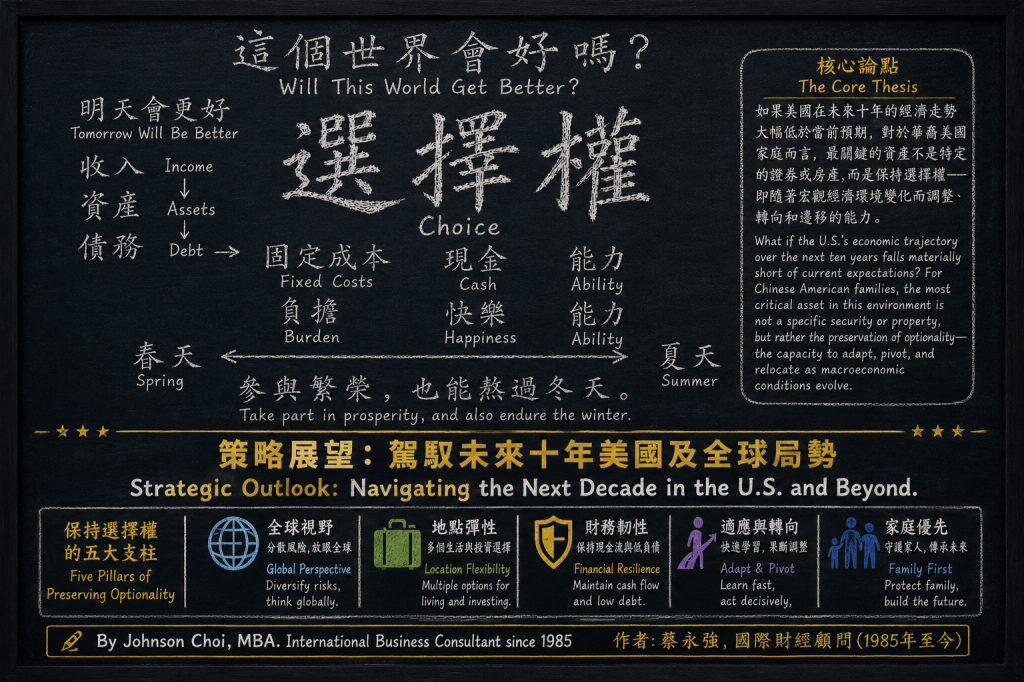
Strategic Outlook: Navigating the Next Decade in the U.S. and Beyond. By Johnson Choi, MBA. International Business Consultant since 1985
策略展望:駕馭未來十年美國及全球局勢. 作者: 蔡永強,國際財經顧問(1985年至今)
核心論點
倘若美國未來十年的經濟走勢,大幅低於當前普遍預期,該如何應對?對華裔美國家庭而言,此環境下最關鍵的資產,並非特定證券或房產,而是選擇彈性的保全——亦即隨著總體經濟條件演變,能夠調整、轉向及遷移的能力。
https://www.tiktok.com/t/ZP8vwRvn2/
https://m.facebook.com/story.php?story_fbid=pfbid02ypUfDKH5xpogdHNppPuZaThkSvsEJTPEgJRNRjDSnEaZMk6QWUiWsd64wv8pjYUPl&id=100036400039778&mibextid=wwXIfr
分散投資原則
我自幼習得的一項基本原則——承襲自父親,並經由一九八二年投資課程正式確立——即分散投資的絕對必要性。真正的風險管理,不僅需在不同資產類別之間進行策略性配置,更應跨越不同地理區域及主權管轄範圍。無論當下多麼令人安心,過度集中終究是動盪世界中的一項負債。
財政壓力與主權風險
美國當前的財政軌跡,值得審慎檢視。國債正以每年二至四兆美元的速度擴張,對整體金融體系構成顯著壓力。這引發了長期的合理疑慮:美國能否在不訴諸通膨手段或排擠民間投資的情況下,履行其償債義務?值得注意的是,全球央行正出現重大轉向:許多央行不再增持美國國債,反而轉為淨賣方。官方部門需求的退場,顯示日益加深的觀望態度,可能進一步對債券殖利率及美元穩定性形成壓力。
勞動市場轉型
與此同時,我們正處於勞動力結構性變革的深淵邊緣。人工智慧、機器人及自動化的快速整合,勢必使眾多現有職位逐步消失。然而,歷史經驗顯示,技術顛覆同時也會創造新的、待遇優渥的工作機會。關鍵的分水嶺,在於能否獲得優質教育,以及是否致力於持續、終身的技能提升。
結論
面對上述財政逆風與技術變遷的交疊,「把所有雞蛋放在同一個籃子裡」的心態,日益難以立足。透過維持地理靈活性和多元化資產基礎,我們方能掌握新興機會,同時降低集中於單一主權或產業風險的曝險。在不確定的時代中,保有選擇權——以及調整路線的能力——始終是最終極的避險策略。
The Core Thesis
What if the US’ economic trajectory over the next ten years falls materially short of current expectations? For Chinese American families, the most critical asset in this environment is not a specific security or property, but rather the preservation of optionality—the capacity to adapt, pivot, and relocate as macroeconomic conditions evolve.
The Principle of Diversification
A foundational principle instilled in me early on—reinforced by my father and formalized through investment coursework as far back as 1982—is the absolute necessity of diversification. True risk management requires strategic allocation not only across various asset classes but also across distinct geographic regions and sovereign jurisdictions. Concentration, no matter how comfortable, is a liability in a volatile world.
Fiscal Pressures and Sovereign Risk
The current fiscal trajectory of the United States warrants cautious scrutiny. The national debt is expanding at a pace of $2 to $4 trillion annually, exerting significant strain on the broader financial system. This raises legitimate, long-term questions regarding the nation’s capacity to service its obligations without resorting to inflationary measures or crowding out private investment. Notably, a significant shift is occurring among global central banks: rather than accumulating U.S. Treasuries, many are now net sellers. This withdrawal of official-sector demand signals a growing hesitancy that may further pressure yields and dollar stability.
The Labor Market Transition
Simultaneously, we are on the precipice of a profound structural transformation in the workforce. The rapid integration of AI, robotics, and automation will inevitably render numerous current roles obsolete. However, history suggests that technological disruption also creates new, well-compensated opportunities. The critical differentiator will be access to quality education and a commitment to continuous, lifelong upskilling.
Conclusion
Given these intersecting fiscal headwinds and technological shifts, the “all eggs in one basket” mentality is increasingly untenable. By maintaining geographic flexibility and a diversified asset base, one ensures the ability to capitalize on emerging opportunities while mitigating exposure to concentrated sovereign or sector-specific risks. In an era of uncertainty, the ability to choose—and to change course—remains the ultimate hedge.