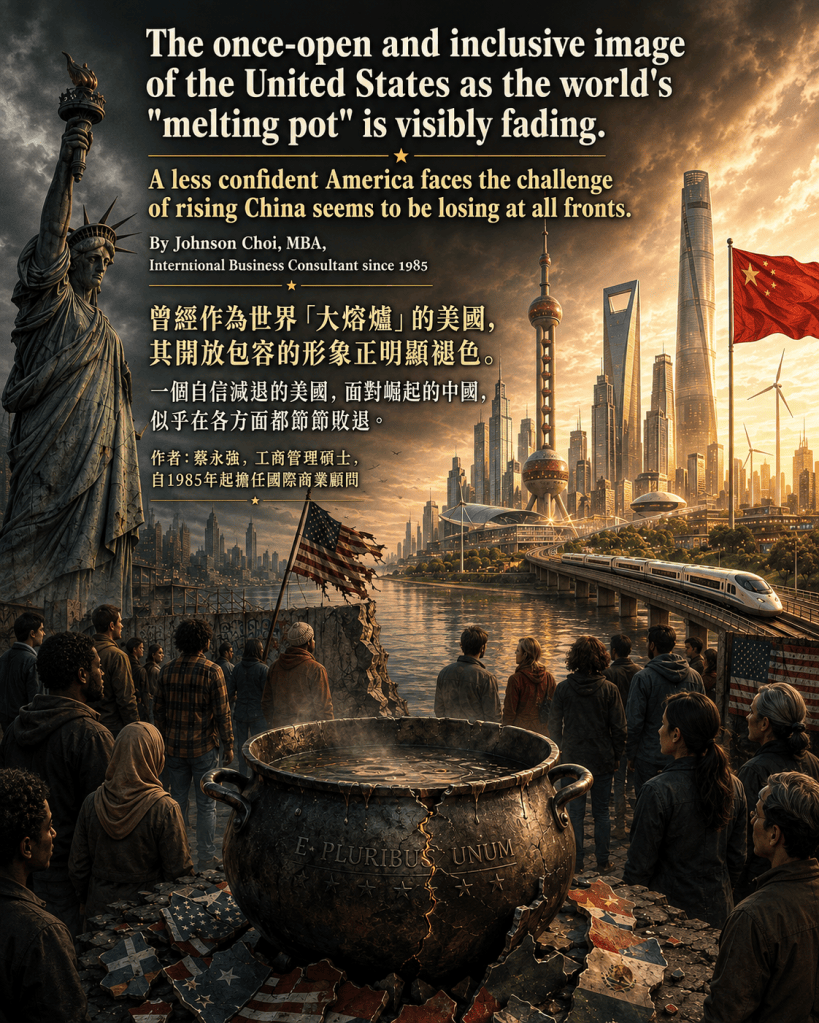
The once-open and inclusive image of the United States as the world’s “melting pot” is visibly fading. A less confident America faces the challenge of rising China seems to be losing at all fronts. By Johnson Choi, MBA, International Business Consultant since 1985
曾經作為世界「大熔爐」的美國,其開放包容的形象正明顯褪色。一個自信減退的美國,面對崛起的中國,似乎在各方面都節節敗退。作者:蔡永強,工商管理碩士,自1985年起擔任國際商業顧問
https://www.tiktok.com/t/ZP8vxWJYq/
https://m.facebook.com/story.php?story_fbid=pfbid02KQoq2Mdqirv2toCBteiJiM4N2dGgN3vvvoyfD88jCZc9xuJpUVKi6DEA2xAT2Kk5l&id=100036400039778&mibextid=wwXIfr
一、政策轉向:從「歡迎」到「審查」
近年來,美國移民政策的核心邏輯已從吸引全球人才,轉向以「國土安全」與「技術保護」為名進行嚴格審查。此一轉變在針對特定國家學生的簽證政策上尤為明顯。
二、對中國學生的限制:以「國家安全」之名
· 簽證數量銳減: 2025年5月至8月,美國向中國公民簽發的F-1學生簽證數量較去年同期下降34%,整體拒簽率更達到近十年新高的35%。與2017年同期相比,降幅高達46%。
· 「關鍵領域」受嚴密審查: 美國政府宣布將「積極撤銷」部分中國學生的簽證,特別聚焦於人工智慧、量子資訊、航太、半導體及生物工程等關鍵科技領域的理工科(STEM)專業學生。
· 審查範圍擴大: 篩查不再僅限於被指稱與中國政府有關聯的個人,而是加強對所有來自中國及香港的申請者審核。據報已有超過6,000名國際學生簽證被撤銷。
三、對穆斯林國家的限制:「旅行禁令」重啟與擴大
針對穆斯林國家的限制透過行政命令重新啟動並擴大實施。
· 初始禁令: 2025年6月,該禁令全面禁止阿富汗、伊朗、利比亞、索馬利亞、蘇丹、葉門等12國公民入境。
· 持續擴大: 此後禁令多次擴展,受影響國家總數已達39個。估計每年可能阻止超過12.5萬人進入美國。
四、學術「脫鉤」:聯合研究被勸阻或全面禁止
中美學術合作亦面臨系統性阻撓,聯合研究遭到積極勸阻或 outright 禁止。
· 大學終止合作: 2025年1月,密西根大學宣布終止與上海交通大學長達20年的合作關係。喬治亞理工學院及加州大學柏克萊分校也終止了與中國機構的合作項目。
· 立法層面「全面凍結」: 納入美國《國防授權法案》中的《安全法案》(SAFE Act,即「透過出口管制確保美國未來法案」),擬全面禁止與中國有任何合作關係的科學家獲得聯邦資助,且限制可追溯至法案生效前五年內。遭禁止的活動包括聯合研究、合著論文,甚至指導中國研究生。
· 學術界反彈: 該提案引發近800位美國學者聯名抗議。美國大學協會(AAU)警告,此舉實質上將涵蓋幾乎所有形式的國際合作。耶魯大學細胞生物學家林海帆表示:「這將加速瓦解科學合作中至關重要的人文信任。」
五、結論
曾經作為世界「大熔爐」的美國,其開放包容的形象正明顯褪色。無論在學生簽證、移民准入還是學術合作層面,美國都展現出更深的不信任感與防衛姿態。此一發展軌跡對全球人才流動、科學創新及長期國際關係,都將帶來深遠而複雜的影響。
I. Policy Shift: From “Welcome” to “Screening”
In recent years, the core logic of U.S. immigration policy has shifted from attracting global talent toward strict vetting under the banners of “homeland security” and “technology protection.” This transformation is most evident in visa policies targeting students from specific nations.
II. Restrictions on Chinese Students: In the Name of “National Security”
· Sharp Decline in Visas: Between May and August 2025, U.S. F-1 student visas issued to Chinese citizens dropped by 34% year-over-year, while the overall refusal rate reached a near-decade high of 35%. Compared to the same period in 2017, the decline is a striking 46%.
· “Critical Fields” Under Scrutiny: The U.S. government has announced it will “aggressively revoke” certain Chinese student visas, with a particular focus on STEM majors in critical technology sectors, including artificial intelligence, quantum information, aerospace, semiconductors, and bioengineering.
· Expanded Scope: Screening is no longer limited to individuals with alleged ties to the Chinese government. Reviews have intensified for all applicants from China and Hong Kong, with over 6,000 international students reportedly having their visas revoked.
III. Restrictions on Muslim-Majority Countries: The Revival and Expansion of the “Travel Ban”
Restrictions on Muslim-majority nations have been revived and expanded through executive action.
· Initial Ban: In June 2025, the ban fully prohibited entry for citizens of 12 countries, including Afghanistan, Iran, Libya, Somalia, Sudan, and Yemen.
· Ongoing Expansion: The ban has since been extended multiple times, bringing the total number of affected countries to 39. Estimates suggest this could block over 125,000 individuals from entering the U.S. annually.
IV. Academic “Decoupling”: Joint Research Discouraged or Outright Banned
Sino-American academic collaboration has also faced systemic obstruction, with joint research being actively discouraged or prohibited outright.
· University Terminations: In January 2025, the University of Michigan announced the termination of its 20-year partnership with Shanghai Jiao Tong University. Georgia Tech and UC Berkeley have also ended cooperative programs with Chinese institutions.
· Legislative “Total Freeze”: The “SAFE Act” (Securing America’s Future Through Export Control Act), included in the U.S. National Defense Authorization Act, proposes a total ban on federal funding for scientists with any collaborative ties to China. The restriction is retroactive, covering activities up to five years prior to the bill’s enactment. Prohibited activities include joint research, co-authored publications, and even the supervision of Chinese graduate students.
· Academic Backlash: The proposal has drawn fierce opposition, with nearly 800 American scholars signing joint letters of protest. The Association of American Universities (AAU) has warned that the measure would effectively cover virtually all forms of international collaboration. Yale cell biologist Hai-Fan Lin commented: “This will accelerate the disintegration of the human trust that is so essential for scientific cooperation.”
V. Conclusion
The once-open and inclusive image of the United States as the world’s “melting pot” is visibly fading. Across student visas, immigration access, and academic partnerships, the U.S. is demonstrating heightened distrust and a defensive posture. This trajectory carries profound and complex implications for global talent mobility, scientific innovation, and long-term international relations.