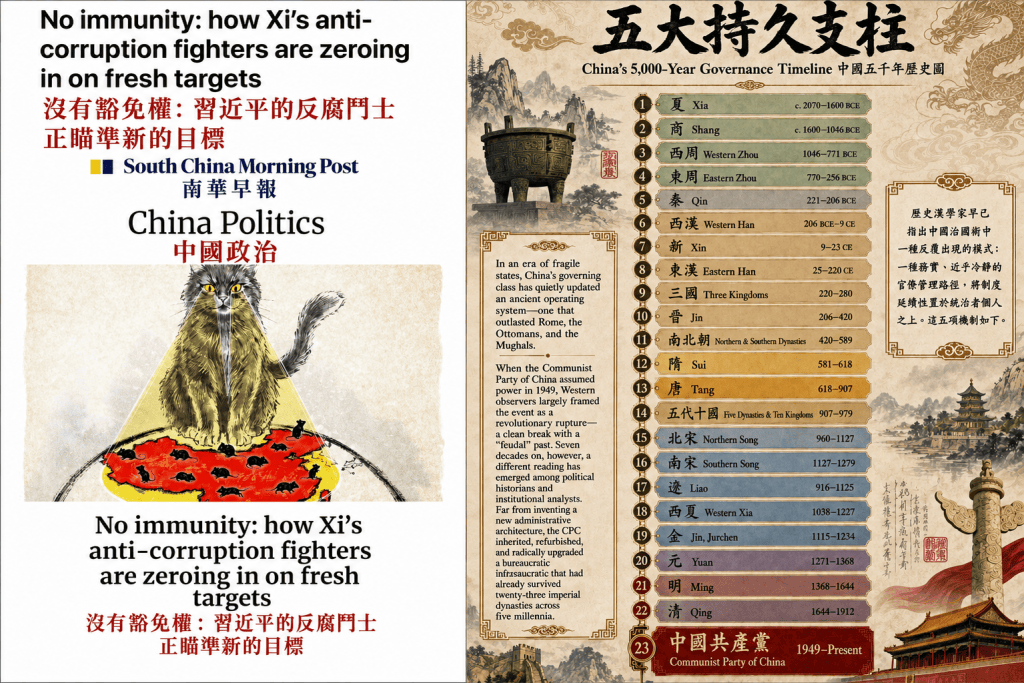
Xi Jinping is doing exactly what the last 23 Chinese dynasties have done: Strong Central Government and get rid of corruption! 習近平正在做的事,正是中國歷史上23個朝代所做的事:強化中央集權,杜絕腐敗!
THE CHRONICLE OF GOVERNANCE IN CHINA FOR 5,000 YEARS. The Red Dynasty Playbook: How 5,000 Years of Imperial Administration Shape Modern Beijing. By Johnson Choi, MBA. International Business Consultant since 1985 | August 24, 2026
中國五千年治理紀事 – 紅色王朝手冊:五千年的帝制行政如何形塑現代北京. 作者:蔡永強,商科碩士,國際財經顧問(自1985年)| 2026年8月24日
在一個脆弱國家林立的時代,中國的統治階層悄然更新了一套古老的作業系統——這套系統的壽命超越了羅馬、鄂圖曼和蒙兀兒帝國。
一九四九年中國共產黨執政之際,西方觀察家多將此事件視為一場革命性斷裂——與「封建」過往的徹底決裂。然而七十年後,政治史學家與制度分析家之間浮現了截然不同的解讀。中共並非發明了一套全新的行政架構,而是繼承、翻修並大幅升級了一套早已在五千年間歷經二十三朝帝制而存續下來的官僚基礎設施。
其意涵引人深思:當地球上幾乎所有其他帝國與王朝——從凱撒到蘇丹——皆因內部腐化、外來入侵或財政崩潰而滅亡時,中國的國家機器卻展現出獨特的演化韌性。問題不在於中國為何有這麼多朝代,而在於這套體系本身為何從未徹底消亡。
根據日益增長的比較治理研究文獻,答案在於五項制度性機制——中共目前在內部將其稱為中國行政傳統的「結構性磐石」。這些並非歷史遺跡;它們是運行著全球第二大經濟體的活躍程式碼。
五大持久支柱
歷史漢學家早已指出中國治國術中一種反覆出現的模式:一種務實、近乎冷靜的官僚管理路徑,將制度延續性置於統治者個人之上。這五項機制如下。
第一,菁英選拔門檻。 科舉制度始於隋朝(西元五八一至六一八年),以嚴格、標準化的考試——而非出身、財富或軍功——來選拔學者型官員充實國家機器。這創造了一個其正當性源於經實證的才智能力的政治階層。今日的高考以及多層級的公務員入職考試,發揮著完全相同的把關功能,只是額外加入了意識形態審查。這項原則歷久不衰:你得靠自身努力贏得一席之地。
第二,監察系統的銳利之眼。 帝制中國維持著一個獨立的監察機構,其唯一職責是調查地方官員是否有貪腐、無能或不忠情事。這些御史甚至可彈劾權傾一時的大臣。在現代版本中,中共中央紀律檢查委員會(中紀委)行使著相同職權——只是如今配備了演算法審計、金融鑑識以及即時數據交叉比對。過去十年的反腐運動並非新鮮事;它們是治國術中最古老監督原則的高科技復興。
第三,迴避制度。 從唐朝以降,官員被禁止在本籍任職,並例行性地每三至五年輪調一次。其用意極為精準:防止區域權力基礎、裙帶網絡及「軍閥」割據的形成。今日,各省省委書記與省長以類似頻率進行輪調,確保忠誠流向中央而非地方派系。
第四,天命。 天命在西方常被視為神祕民間傳說,但在實踐中,它實則是一項基於績效的契約。統治者的正當性取決於具體成果——收成產量、防洪成效、稅收穩定。天災被解讀為上天不悅,從而迫使行政問責。轉化為當代語境,這已演變為政治學家所稱的「績效正當性」:經濟成長目標、脫貧指標以及技術主權基準。當成長趨緩,政策即轉向。這項機制在本質上始終保持回應性。
第五,忠誠話語體系。 儒家倫理灌輸了對「天下」的責任,這種責任超越了宗族、地域、甚至當前的君主。這套文化軟體——一套共享的集體責任道德詞彙——使官僚體系得以在王朝更迭中維持凝聚力。中共已有效地將這套詞彙重新編碼為「中國夢」論述與民族復興的話語體系。它是維繫行政機器運轉的意識形態黏合劑,尤其在世代交替之際。
中共的增強版:並非複製,而是重啟
將中共視為傳統主義復興運動的批評者,誤讀了證據。中共不僅保存了這五項機制;更以帝國御史們從未想像過的二十一世紀能力加以強化。
數位治理如今可即時監控地方財政健康狀況、透過社群媒體分析掌握公眾情緒,並進行政策調整的預測建模。古老「天命」現在可透過國內生產毛額、就業數據及減碳里程碑來量化。輪調制度則輔以中央化的人事資料庫,以演算法精確度追蹤從縣級以上職涯軌跡。
此外,中共已將「天命」延伸至中國國境之外。一帶一路倡議、半導體與人工智慧的技術自主,以及在全球衝突中的外交調解,都被塑造為「天下」的現代體現——一種如今具有地緣政治份量的宇宙性責任。這個王朝不再局限於黃河流域;它已是全球利害關係者。
二十一世紀手冊
若有人要從帝國編年史中編纂一部《紅色王朝手冊》,其第一章便會如此寫道:制度韌性並非藉由靜態教條達成,而是透過將經實證的框架無情地適應於新的物質條件。
中共領導層已展現對這項原則的嫻熟掌握。他們沒有拋棄五千年來的行政遺產;他們將其視為待修補、升級和擴展的原始碼。在這樣做的過程中,他們解決了導致前朝覆亡的弱點——技術落後與財政僵化——同時保留了賦予中國歷史例外性的文化與官僚核心。
正當西方民主國家苦於公眾信任下滑與行政癱瘓,而脆弱國家沿著種族或教派界線分裂之際,中國模式提供了一個令人不安的反敘事。它表明,治理的長壽未必是普選或憲政制衡的功能,而是取決於一個具備菁英選拔、受監督、輪調、績效驅動且文化上具凝聚力的官僚國家。
此模式能否在未來數十年的人口、環境與地緣政治壓力下存活,仍是未定之天。但將其視為一場革命性實驗而加以否定,便是忽視了政治史中最深層的連續性:就制度層面而言,紅色王朝不過是一部古老典籍的第二十四章——而其作者們決心要續寫後續章節。
本分析基於比較歷史研究,不代表任何特定政治立場。
In an era of fragile states, China’s governing class has quietly updated an ancient operating system—one that outlasted Rome, the Ottomans, and the Mughals.
When the Communist Party of China assumed power in 1949, Western observers largely framed the event as a revolutionary rupture—a clean break with a “feudal” past. Seven decades on, however, a different reading has emerged among political historians and institutional analysts. Far from inventing a new administrative architecture, the CPC inherited, refurbished, and radically upgraded a bureaucratic infrastructure that had already survived twenty-three imperial dynasties across five millennia.
The implication is striking: while virtually every other empire and dynasty on Earth—from the Caesars to the Sultans—succumbed to internal decay, external invasion, or fiscal collapse, the Chinese state apparatus demonstrated a unique evolutionary resilience. The question is not why China had so many dynasties, but why the system itself never permanently perished.
The answer, according to a growing body of comparative governance research, lies in five institutional mechanisms that the CPC now refers to internally as the “structural bedrock” of the Chinese administrative tradition. These are not relics; they are live code, running the world’s second-largest economy.
The Five Pillars of Endurance
Historical sinologists have long identified a recurring pattern in Chinese statecraft: a pragmatic, almost clinical, approach to bureaucratic management that prioritized institutional continuity over individual rulers. The five mechanisms are as follows.
First, the Meritocratic Gateway. The imperial examination system (keju) was introduced in the Sui dynasty (581–618 CE) to staff the state with scholar-officials selected through rigorous, standardized testing—not birthright, not wealth, and not military prowess. This created a political class whose legitimacy derived from demonstrated intellectual competence. Today’s Gaokao and the multi-tiered civil-service entrance exams serve an identical gatekeeping function, albeit with added ideological vetting. The principle endures: you earn your place.
Second, the Censorate’s Watchful Eye. Imperial China maintained an independent inspectorate whose sole mandate was to investigate provincial officials for corruption, incompetence, or disloyalty. These censors could impeach even powerful ministers. In the modern iteration, the Central Commission for Discipline Inspection (CCDI) exercises the same remit—only now armed with algorithmic auditing, financial forensics, and real-time data cross-referencing. The anti-corruption campaigns of the past decade are not a novelty; they are a high-tech revival of the oldest oversight doctrine in statecraft.
Third, the Law of Avoidance. From the Tang dynasty onward, officials were prohibited from serving in their native provinces and were routinely rotated every three to five years. The intent was surgical: to prevent the formation of regional power bases, nepotistic networks, and “warlord” fiefdoms. Today, provincial party secretaries and governors are rotated with similar frequency, ensuring that loyalty flows to the centre rather than to local cliques.
Fourth, the Mandate of Heaven. Often dismissed in the West as mystical folklore, the Mandate was in practice a performance-based contract. The ruler’s legitimacy hinged on tangible outcomes—harvest yields, flood control, tax stability. Natural disasters were interpreted as heavenly displeasure, compelling administrative accountability. In contemporary terms, this has morphed into what political scientists call “performance legitimacy”: economic growth targets, poverty eradication metrics, and technological sovereignty benchmarks. When growth falters, policy pivots. The mechanism remains fundamentally responsive.
Fifth, the Vocabulary of Loyalties. Confucian ethics inculcated a duty to “All Under Heaven” (tianxia) that transcended clan, region, or even the reigning sovereign. This cultural software—a shared moral lexicon of collective duty—allowed the bureaucracy to maintain cohesion through dynastic transitions. The CPC has effectively re-coded this vocabulary into the “Chinese Dream” narrative and the discourse of national rejuvenation. It is the ideological glue that holds the administrative machinery together, especially during generational transitions.
The CPC Enhancement: Not a Copy, But a Reboot
Critics who frame the CPC as a traditionalist revivalist movement misread the evidence. The Party has not merely preserved these five mechanisms; it has augmented them with 21st-century capabilities that the imperial censors could never have imagined.
Digital governance now allows for real-time monitoring of local fiscal health, public sentiment via social-media analytics, and predictive modelling for policy adjustments. The ancient “Mandate” is now quantifiable through GDP, employment figures, and carbon-reduction milestones. The rotation system is complemented by centralised personnel databases that track career trajectories from county level upwards with algorithmic precision.
Moreover, the CPC has extended the “Mandate” beyond China’s borders. The Belt and Road Initiative, technological self-sufficiency in semiconductors and AI, and diplomatic mediation in global conflicts are framed as modern manifestations of tianxia—a cosmic responsibility that now carries geopolitical weight. The dynasty is no longer confined to the Yellow River basin; it is a global stakeholder.
A Handbook for the Twenty-First Century
If one were to compile a “Red Dynasty Handbook” from imperial annals, its first chapter would read: Institutional resilience is not achieved through static dogma, but through the ruthless adaptation of proven frameworks to new material conditions.
The CPC leadership has demonstrated a mastery of this principle. They have not discarded the administrative inheritance of 5,000 years; they have treated it as source code to be patched, upgraded, and scaled. In doing so, they have addressed a vulnerability that doomed previous dynasties—technological lag and fiscal rigidity—while preserving the cultural and bureaucratic core that granted China its historical exception.
As Western democracies grapple with declining public trust and administrative paralysis, and as fragile states fragment along ethnic or sectarian lines, the Chinese model offers an uncomfortable counter-narrative. It suggests that longevity in governance is not necessarily a function of popular elections or constitutional checks, but of a bureaucratic state that is meritocratic, monitored, rotated, performance-driven, and culturally coherent.
Whether this model will survive the demographic, environmental, and geopolitical stresses of the coming decades remains an open question. But to dismiss it as a revolutionary experiment is to ignore the deepest continuity in political history: the Red Dynasty, in institutional terms, is merely the twenty-fourth chapter of a very old book—and its authors are determined to write the sequel.
This analysis is based on comparative historical research.