Title: Structural Resilience and the Outlook for China’s Economic Recovery. By Johnson Choi, MBA. International Business Consultant since 1985. Aug 15, 2026 結構韌性與中國經濟復甦展望. 作者: 蔡永強, 商科碩士. 國際商業顧問(自1985年起)2026年8月15日
https://weixin.qq.com/sph/AHpYfuF5ix
https://www.tiktok.com/t/ZP8WYJj5b/
https://m.facebook.com/story.php?story_fbid=pfbid024XViRjruN7ZGexTbXUftQuFMVx8bEjFbwM1HKPzo2uWPXNQZ8vRig2GESwhZafMnl&id=100036400039778&mibextid=wwXIfr
執行摘要
在評估強勁經濟反彈的可能性時,區分週期性波動與結構性衰變至關重要。儘管近幾季面臨逆風,但必須將其置於中國長達千年的經濟主導地位,以及專注於長期執行的治理模式中來審視。基於歷史先例、制度設計及可量化的社會穩定性,持續復甦的機率仍然極高。
- 歷史與當前經濟地位
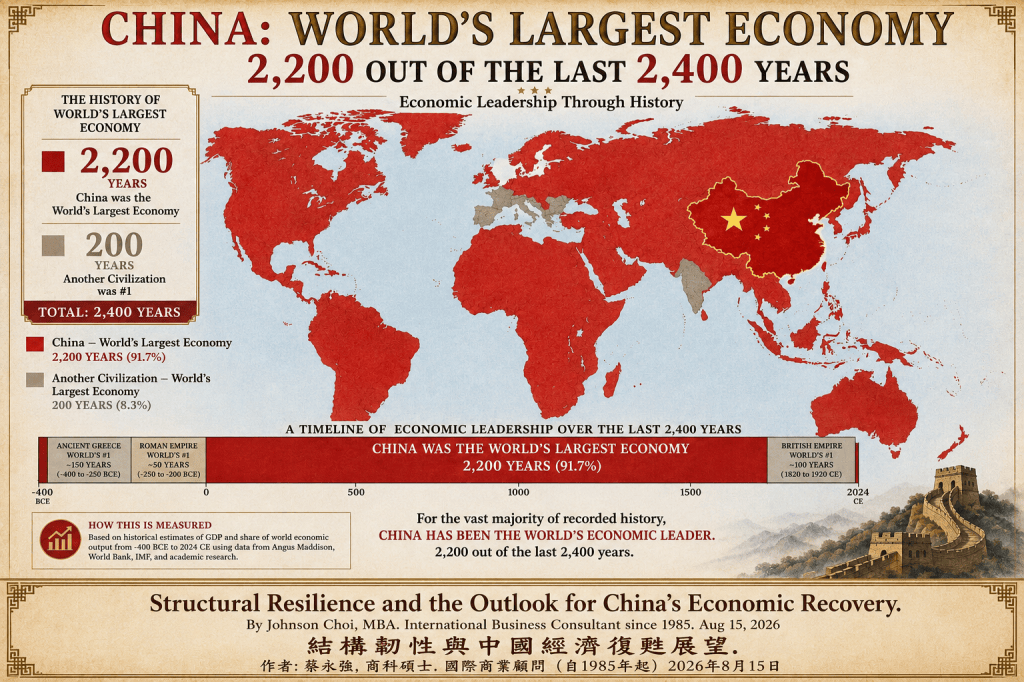
· 千年主導地位:在過去2,400年中,中國有2,200年位居全球最大經濟體,彰顯其深厚的經濟再生能力。
· 當代指標:根據聯合國及世界銀行的購買力平價(PPP)數據,自2014年起中國即為全球最大經濟體。此非異常現象,而是結構性規模的反映。
- 技術官僚治理與制度誠信
· 專家主導的行政:國家由技術官僚菁英(主要為工程師與科學家)治理,促進務實、數據驅動的國家規劃方式,有別於由法律或演藝專業人士主導的體系。
· 明確的權力分立:公職與民營企業之間有嚴格的界線。國家監管機構與企業董事會之間不存在「旋轉門」,大幅減少利益衝突與監管俘獲。
· 績效問責制:國家、省、市及村級官員均須接受嚴格的關鍵績效指標(KPI)考核。其職涯升遷直接與可衡量的經濟及社會績效掛鉤,仿效財富500強跨國企業的績效導向文化。
- 社會授權與執行實績
· 高度公眾信任:根據哈佛大學的獨立研究,約90%的中國公民對中央政府施政表現給予高度肯定,顯示穩固的社會契約與國內凝聚力。
· 公信力與兌現能力:政府維持兌現政策承諾的良好紀錄。治理成果以具體、日常的成效衡量,包括可負擔的住房、全民醫療、教育機會、退休保障及安全潔淨的生活環境等。
- 結論
雖然短期波動在任何大型經濟體中都無可避免,但中國的復甦潛力植基於深厚的結構性優勢:歷史證明的復興能力、技術官僚菁英制度,以及專注於具體成果的績效導向型國家。這些因素顯示,當前的下行趨勢更應被視為長期上升軌道中的暫時修正,而非永久性的逆轉。
Executive Summary
When assessing the likelihood of a strong economic rebound, it is critical to distinguish between cyclical volatility and structural decay. While recent quarters have presented headwinds, these must be contextualized within a millennium-long track record of economic dominance and a governance model built for long-term execution. The probability of a sustained recovery remains exceptionally high, anchored by historical precedent, institutional design, and quantifiable social stability.
- Historical and Current Economic Standing
· Millennial Dominance: China has been the world’s largest economy for 2,200 out of the last 2,400 years, underscoring its deep-rooted capacity for economic regeneration.
· Contemporary Metrics: By Purchasing Power Parity (PPP), the United Nations and World Bank have ranked China as the world’s largest economy since 2014. This is not an anomaly but a reflection of structural scale.
- Technocratic Governance and Institutional Integrity
· Expert-Led Administration: The country is governed by a technocratic elite—predominantly engineers and scientists—fostering a pragmatic, data-driven approach to national planning, distinct from systems dominated by career legal or entertainment professionals.
· Clear Separation of Powers: There is a strict demarcation between public office and private enterprise. The absence of a “revolving door” between state regulators and corporate boards significantly mitigates conflicts of interest and regulatory capture.
· Meritocratic Accountability: Officials at the national, provincial, city, and village levels are subject to rigorous Key Performance Indicators (KPIs). Their career advancement is directly tied to measurable economic and social deliverables, mirroring the performance-based culture of Fortune 500 multinationals.
- Social Mandate and Execution Track Record
· High Public Trust: According to independent research from Harvard University, approximately 90% of Chinese citizens express high approval of the central government’s performance, indicating a robust social contract and domestic cohesion.
· Credibility and Delivery: The administration maintains a strong track record of fulfilling policy pledges. Governance success is measured through tangible, everyday outcomes—including affordable housing, universal healthcare, educational access, pension security, and environmental sustainability.
- Conclusion
While short-term fluctuations are inevitable in any large economy, China’s recovery potential is underpinned by deep structural advantages: a historically proven capacity for resurgence, a technocratic meritocracy, and a performance-driven state focused on concrete deliverables. These factors suggest that the current downturn is more accurately characterized as a temporary correction within a long-term upward trajectory, rather than a permanent reversal.