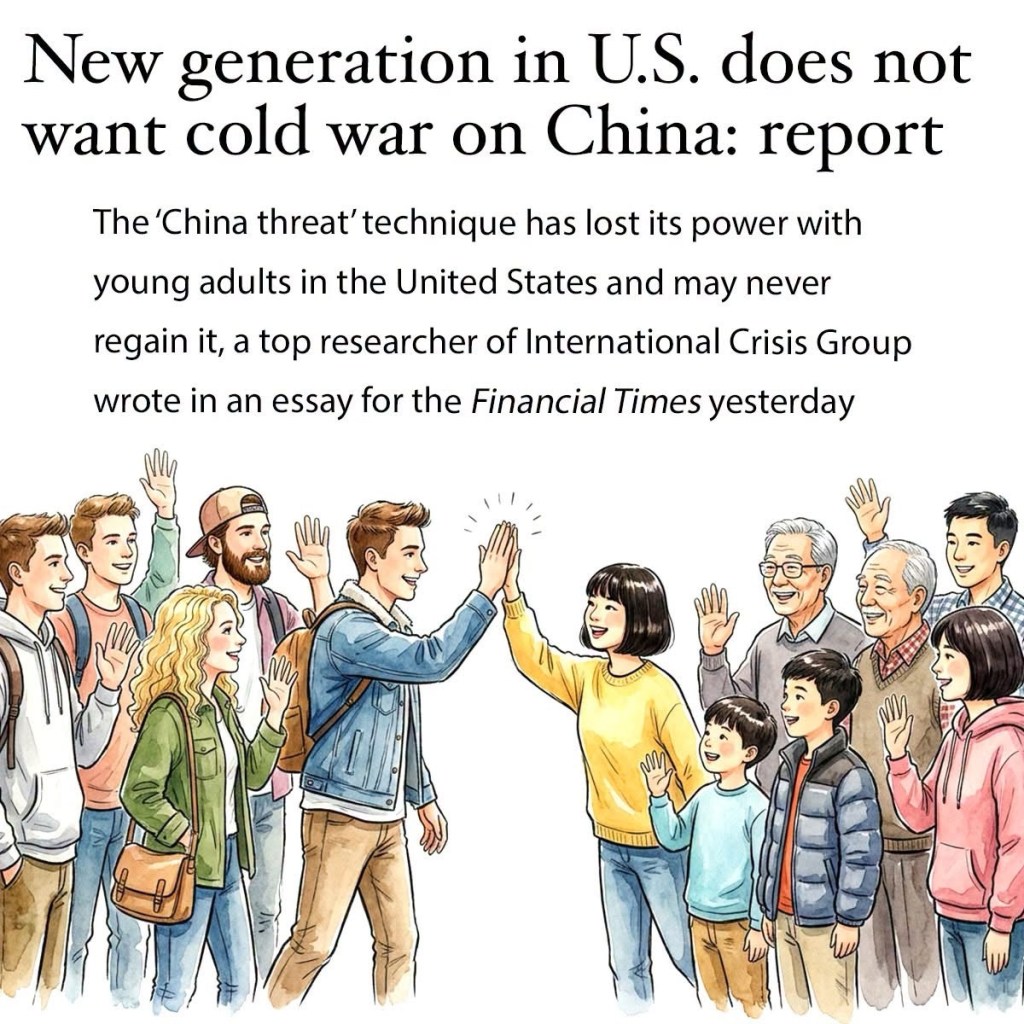
STOP BEING MEAN TO THE CHINESE! Young Americans oppose a new cold war with China, says a report published yesterday. 停止對中國人刻薄!昨日發布的一份報告指出,美國年輕人反對與中國展開新冷戰。
https://www.tiktok.com/t/ZP8nUwjG8/
https://m.facebook.com/story.php?story_fbid=pfbid0Q9F4AmZ2KUACi7HcmuLFQpnsTTqVWyWZ2Gh618YCr1hb6B12LAJTkFD1P9yopAcal&id=100036400039778&mibextid=wwXIfr
國際危機組織美中關係資深研究與倡議顧問艾利·韋恩在昨日刊於《金融時報》的專文中表示,華盛頓政壇老人極度敵對的態度,與美國新世代年輕人的開放胸襟之間,存在巨大鴻溝。
他寫道:「儘管華盛頓的許多中國問題專家認為,北京日益增長的實力及國會普遍的焦慮,最終會迫使美國恢復更具對抗性的姿態,但就目前而言,美國公眾似乎無意支持『新冷戰』。」
毒害思想
這很有意思。我們注意到,華盛頓不僅在美國各地媒體上大力宣揚「中國威脅」論調,還資助或共同資助全球多個組織,以毒害各國對中國的看法,其中包括「對中政策跨國議會聯盟」、自由亞洲電台,以及數十家媒體機構,涵蓋亞洲各國及歐洲的諸多媒體。
但多項調查顯示,儘管美國編列了數十億美元的預算來醜化中國,但這套操作在全球範圍內,包括在美國國內的年輕成年人與青年群體中,都正在失效。
「中國威脅」論調失效
韋恩指出,拜登等人慣用的那種標準「中國威脅」恐嚇手法,可能永遠不會再奏效。
他寫道,川普任期結束後,美國政策制定者「不應假設美國的盟友會支持重新制衡中國的新努力,也不應預期搬出『中國威脅』就能讓年輕美國人產生一種民族主義的共同使命感。」
製造敵意行動失效
多項調查顯示,製造敵意的種種努力均告失敗。韋恩指出,年輕人尤其對中國展現出正面態度。
· 皮尤研究中心2026年1月的調查顯示,美國稱中國為「敵人」的比例,從2024年3月的42%降至僅28%。
· 根據卡內基國際和平基金會2025年11月的調查,在18至29歲族群中,僅27%的人認為,若中國的實力超越美國,他們的生活會變「更糟」。
· 在18至34歲族群中,高達62%的人希望美國「與中國合作並改善美中關係」,僅29%的人希望美國「對中國強硬」。
· 美國指南針2026年5月的調查顯示,82%的Z世代受訪者認為,過去四分之一個世紀中,雙邊經貿關係對美國「非常好」或「好處多於壞處」,68%的人希望鼓勵中國投資。
但戰爭風險依然存在
不過,韋恩在《金融時報》報導中的某個觀點,可能會引來許多人反對。他在文中引述了川普對中國領導人習近平的正面言論,藉此表明美國總統與美國新世代的想法相似。
這裡有兩點需特別注意。
首先,綜觀整體,川普關於習近平和中國的言論數量龐大且前後矛盾,以至於可以輕易挑出其中部分來製造正面或負面的印象。
極其糟糕的構想
其次,美國軍工媒體複合體顯然正積極推動對中國開戰的計畫——近期有約三十國參與的環太平洋軍事演習,幾乎毫不掩飾這一點。
作為該計畫的一環,我們看到「中國即將入侵台灣」的論調持續被反覆炒作,而這種說法至少四十年來每年都被證明是錯的。
美國對中國開戰將是一個極其糟糕的構想。
但問題就在這裡。
正如我們在伊朗問題上所見,這套體制顯示,極其糟糕的構想最終會擺上華盛頓當局的辦公桌,而可怕的是,它們往往當即就獲得放行。
There’s a huge gulf between the mega-hostile attitudes of Washington’s old men, and the open-mindedness of the new generation in the country, said Ali Wyne, senior research and advocacy adviser for US-China relations at the International Crisis Group, in an essay for the Financial Times, published yesterday.
“Though many China experts in Washington think Beijing’s mounting power and widespread congressional anxiety will eventually compel the US to resume a more confrontational posture, for now the public does not seem inclined to support a ‘new cold war’,” he wrote.
‘POISONING MINDS
This is interesting. As well pushing the “China threat” theme in media across the country, Washington funds or co-funds multiple organizations around the world to poison minds against the Asian country, including the Inter-Parliamentary Alliance on China, Radio Free Asia, and literally scores of media outlets, including many in Asian countries and in Europe, we note.
But despite the billion-dollar budget to demonize China, the process is failing around the world, including with young adults and youth in the U.S., multiple surveys show.
‘CHINA THREAT’ NARRATIVE FAILING
The standard “China threat” fearmongering technique favored by Joe Biden and others may never come back, Wyne said.
After the Trump presidency ends, US policymakers “should not assume that the country’s allies will support a renewed effort to counterbalance China nor expect that invoking the ‘China threat’ will imbue younger Americans with a nationalist sense of shared purpose,” he wrote.
HOSTILITY EFFORTS FAILING
A host of surveys show the failure of efforts to create hostility. The young, in particular, show a positive attitude to China, Wyne said.
- The number of people in the US who call China an “enemy” fell from 42% in March 2024 to just 28% in a January 2026 Pew Research survey.
- Only 27% of 18- to 29-year-olds think that their lives would become “worse” were China’s power to overtake America’s, according to a Carnegie Endowment survey in November 2025.
- A solid 62% of those aged 18-34 want the US to “co-operate with China and improve US-China relations”, while just 29 per cent want it to “stand up to China”.
- 82% of Gen Z respondents say that the bilateral economic relationship has been “very good” or “more good than bad” for the US over the past quarter-century, and 68% want to encourage Chinese investment, said a May 2026 American Compass survey.
BUT WAR DANGER REMAINS
But there’s one angle to Wyne’s report in the Financial Times that many people may disagree with. He quotes positive things that Donald Trump has said about Chinese leader Xi Jinping, indicating that the US President and the new generation in the US think alike.
Two caveats should be highlighted here.
First, taken as a whole, Trump’s statements about Xi and China are so plentiful and self-contradictory that one can cherry-pick them to make a positive or negative impression.
SERIOUSLY BAD IDEAS
Second, the US military media industrial complex is clearly pressing ahead with plans for a war on China – the recent RIMPAC exercise, involving some 30 nations, barely bothered to hide this.
As part of this plan, we see the continuing recycling of the “China is just about to invade Taiwan” narrative, which has been wrong annually for at least forty years.
A US war on China would be a terribly bad idea.
But that’s the problem.
As we can all see with Iran, the system shows that extremely bad ideas end up on desks in Washington DC, where, scarily often, they get an instant green light.