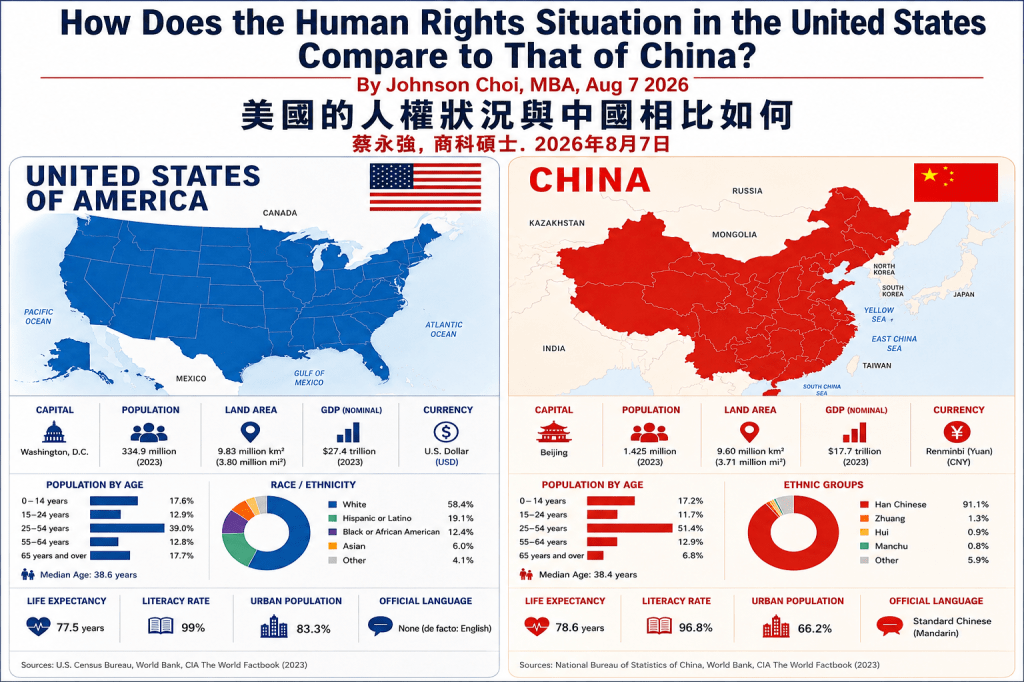
How Does the Human Rights Situation in the United States Compare to That of China? By Johnson Choi, MBA, Aug 7 2026 美國的人權狀況與中國相比如何. 蔡永強, 商科碩士. 2026年8月7日
China Human Rights, Measured in Everyday Life
https://weixin.qq.com/sph/ARA5y2RUsI
https://m.facebook.com/story.php?story_fbid=pfbid023S3HEQKjkHFmusn4QnYZ779b6qTTmC8APDyD6MZNjB17mEo1pFe8GsxzfN7TEttTl&id=100036400039778&mibextid=wwXIfr
- Basic Livelihood Guarantees (Water, Housing, Healthcare)
Safe Drinking Water
China plans to raise the penetration rate of rural tap water to 98 percent by 2030 and renovate approximately 175,000 kilometers of urban water supply networks. Although urban tap water in the United States is essentially universally available, some older areas (such as Flint, Michigan) still have lead pipe contamination issues that affect public health.
Housing Security
China plans to renovate about 500,000 units of unsafe housing and 115,000 aging residential communities to improve living conditions. The United States has federal housing subsidies such as Section 8, but the number of homeless people reached about 650,000 in 2023, and the problem of excessive rent burdens in major cities continues to worsen.
Life Expectancy and Maternal Mortality
China aims to raise average life expectancy to 80 years by 2030 (approximately 78.6 years in 2025) and reduce the maternal mortality rate to fewer than 12 deaths per 100,000 live births (about 15.1 in 2023). In the United States, average life expectancy in 2023 was about 77.4 years, which has declined in recent years due to drug overdoses and chronic diseases. The maternal mortality rate in 2021 was about 32.9 per 100,000 live births – the highest among developed countries – and the rate for Black women is 2.6 times that of white women, reflecting significant racial disparities.
- Digital Inclusion and Labor Rights
China’s new action plan pays special attention to working hours, pay, and social security for gig workers such as food delivery riders and ride-hailing drivers, and strengthens algorithm registration and security assessments. It also holds 100,000 digital literacy training sessions each year for older people to help them adapt to online medical appointments, ticket purchases, and other services.
In the United States, there is no unified federal framework for protecting the social security rights of gig economy workers (such as Uber and DoorDash drivers), most of whom are classified as “independent contractors.” Only a few states, such as California, have attempted to reclassify them through legislation. Regarding the digital divide, about 15 percent of adults aged 65 and older do not have broadband internet, and funding for the government’s Affordable Connectivity Program has been unstable. Algorithmic discrimination has drawn attention, but federal regulation is still in its early stages.
- Judicial System and Public Participation
China’s plan emphasizes strengthening judicial oversight, expanding legal aid, and promoting public consultation on draft laws. The United States has an independent judicial system and a jury system, but long-standing issues include inequities in the bail system, racial disparities in sentencing, and prison overcrowding. Public participation in legislation mainly occurs through hearings and lobbying mechanisms.
- Protection of Vulnerable Groups
Elderly People
China promotes digital training and the expansion of elderly care service facilities. In the United States, Medicare covers most seniors, but long-term care costs are high, and many elderly people rely on Medicaid.
Persons with Disabilities
China focuses on accessibility renovations and employment support. The United States has the Americans with Disabilities Act (ADA) to protect accessibility rights, but the employment rate for people with disabilities remains far below that of non-disabled individuals.
Children
China promotes educational equity and nutrition improvement programs. In the United States, public education is free, but disparities in school district funding lead to unequal distribution of educational resources.
- Overall Comparative Observations
The two countries have notable differences in their approaches to human rights practice. China emphasizes using economic development and infrastructure construction to underpin the “right to subsistence,” advancing various goals through national planning. The United States relies more on legal remedies and market regulation, with a relatively fragmented social safety net, but it offers stronger protections for individual freedoms and freedom of expression.
Both countries face new challenges in the digital age (such as privacy protection and algorithmic fairness) and the pressures of an aging population, but their responses differ – China adopts a top-down planning approach, while the United States relies more on local pilot programs and litigation.
It is worth noting that whether China’s announced targets will be fully achieved remains to be tested by 2030. U.S. statistics often show huge gaps across racial and urban-rural lines, with national averages frequently masking localized deterioration.
If we use “improvements in daily life” as the yardstick, China has specific quantitative goals and strong implementation capacity in hardware areas such as drinking water, healthcare coverage, and renovation of old communities. The United States has advantages in individual choice, information transparency, and judicial remedies, but social inequality and aging infrastructure constrain the actual experience of disadvantaged groups.
Both models have their strengths and weaknesses. A true comparison should transcend ideological labels and return to whether ordinary people can feel the protection of their rights in their daily lives – and that is precisely the value of this kind of dialogue.
美國的人權狀況與中國相比如何
- 基本生活保障(飲水、住房、醫療)
安全飲用水
中國計畫在2030年前將農村自來水普及率提升至98%,並改造約17.5萬公里城市供水管網。美國城市自來水雖基本全覆蓋,但部分老舊地區(如密西根州弗林特市)仍存在鉛管污染問題,影響民眾健康。
住房安全
中國規劃改造約50萬套危房及11.5萬個老舊社區,改善居住條件。美國有Section 8聯邦住房補貼,但無家可歸者人數在2023年約達65萬,且大城市租金負擔過重問題持續惡化。
預期壽命與孕產婦死亡率
中國目標2030年將平均預期壽命提升至80歲(2025年約78.6歲),並將孕產婦死亡率降至每10萬活產少於12例(2023年約15.1例)。美國2023年平均預期壽命約77.4歲,近年因藥物過量和慢性病有所下降;孕產婦死亡率2021年約32.9例,為已開發國家中最高,且黑人女性死亡率是白人的2.6倍,種族差異顯著。
- 數位包容與勞工權益
中國的新行動計畫特別關注外送員、網約車司機等零工勞工的工時、薪酬和社會保障,並加強算法註冊與安全評估,同時每年為老年人舉辦10萬場數位素養培訓,協助他們適應線上掛號、購票等服務。
美國方面,聯邦層級尚未統一保障零工經濟勞工(如Uber、Doordash司機)的社保權益,多數被歸類為「獨立承包商」,僅部分州(如加州)嘗試立法重新分類。數位鴻溝方面,約15%的65歲以上成年人沒有寬頻網路,政府的「可負擔連線計畫」資金不穩定。算法歧視問題雖受關注,但聯邦監管尚在初期階段。
- 司法與公眾參與
中國的計畫強調加強司法監督、擴大法律援助、推動法律草案的公眾徵詢。美國擁有獨立的司法體系和陪審團制度,但長期存在保釋制度不公、種族量刑差異、監獄過度擁擠等問題;公眾參與立法主要透過聽證會和遊說機制。
- 弱勢群體保護
老年人:中國推動數位培訓和養老服務設施擴建。美國聯邦醫療保險(Medicare)覆蓋大部分老人,但長期護理費用高昂,許多老年人需依賴Medicaid。
殘障人士:中國著重無障礙環境改造與就業支持。美國有《美國殘疾人法案》(ADA)保障無障礙權益,但殘障人士就業率仍遠低於非殘障人士。
兒童:中國推動教育公平與營養改善計畫。美國公立教育免費,但學區經費差異導致教育資源分配不均。
- 總體比較觀察
兩國在人權實踐路徑上存在明顯差異。中國側重以經濟發展和基礎建設托底「生存權」,透過國家規劃逐步推進各項目標;美國則更依賴法律救濟和市場調節,社會安全網相對零散,但個人自由和言論表達的保障更為突出。
雙方共同面臨數位時代的新挑戰(如隱私保護、算法公平)和人口老化壓力,但應對方式不同——中國採用自上而下的計畫推進,美國則更多依靠地方試點和訴訟推動。
值得注意的是,中國公布的目標是否完全達成,需待2030年檢驗;美國的統計數據常因種族、城鄉差異而呈現巨大落差,全國平均數往往掩蓋了局部惡化的現實。
如果以「日常生活改善」為尺規,中國在飲水、醫療覆蓋、老舊社區改造等硬體層面具體量化目標且執行力較強;美國則在個人選擇權、資訊透明度和司法救濟管道上更具優勢,但社會不平等和基礎設施老化問題制約了底層民眾的實際體驗。
兩種模式各有所長,也各有不足。真正的比較應超越意識形態標籤,回歸到普通人能否在每天的生活中感受到權利保障——而這正是此類對話的價值所在。