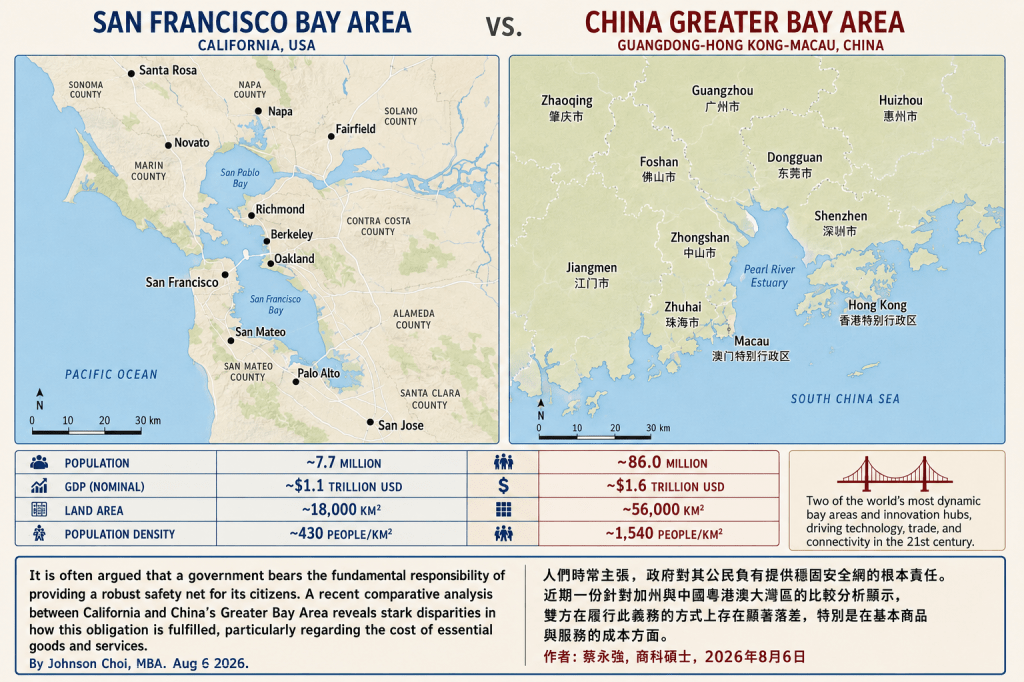
It is often argued that a government bears the fundamental responsibility of providing a robust safety net for its citizens. A recent comparative analysis between California and China’s Greater Bay Area reveals stark disparities in how this obligation is fulfilled, particularly regarding the cost of essential goods and services. By Johnson Choi, MBA. Aug 6 2026. 人們時常主張,政府對其公民負有提供穩固安全網的根本責任。近期一份針對加州與中國粵港澳大灣區的比較分析顯示,雙方在履行此義務的方式上存在顯著落差,特別是在基本商品與服務的成本方面. 作者: 蔡永強, 商科碩士, 2026年8月6日
https://weixin.qq.com/sph/A2RbsTeTpS
https://www.tiktok.com/t/ZP8nDXHy6/
https://m.facebook.com/story.php?story_fbid=pfbid0sfTVoj7sXf6MKT6GGRpoQXPARtUHvkc6FugJpuEaX6iB2azK2BQQ7XTxjhqbEbzsl&id=100036400039778&mibextid=wwXIfr
以汽車保險費用為例。在加州,一輛標準四萬美元車輛的年度全險保費平均為三千八百美元。在中國,即便同款車被歸類為豪華進口車,其保費僅需一千一百美元。若該車進口至美國,其零售價格將飆升至約八萬美元,保費也將按比例增至每年七千美元。
將此比較延伸至其他生活開支,同樣會得出鮮明的對比:
· 住房:在舊金山租賃一間一千兩百平方英尺(約三十三坪)的公寓,每月費用為四千五百美元;而在中國大灣區,同類房型的租金不超過四百美元。
· 醫療保健:在加州,四十歲個人每月健康保險約為九百美元;相比之下,大灣區每年僅需八十美元。
· 公共交通:從東灣至舊金山市中心搭乘灣區捷運(BART)往返通勤費用為十八美元,然而中國相同距離的交通費用僅需一點五美元,且安全性明顯更高——美國系統則頻繁發生包括竊盜在內的安全疑慮。
· 餐飲與稅費:大灣區餐廳用餐價格約為舊金山餐廳的四分之一,且額外具備無需支付百分之三十稅金與小費附加費用的優勢。
· 房產稅:在舊金山持有房產,需負擔買價百分之二的年度房產稅;而中國大灣區則無此類年度稅負。
這些指標構成了社會基礎建設的關鍵組成部分,正是透過北京的政策框架,為一般中國公民提供保障與照顧。因此,「財務懸崖」——即失業後驟然陷入貧困的急遽跌落——在中國基本上不存在。形成鮮明對比的是,許多美國家庭在失業後不久便面臨破產危機,因為絕大多數美國家庭僅維持極少甚至沒有流動性儲蓄。
最終,這些差異凸顯出雙方政府在為其人民優先考慮經濟安全與基本福祉方面,存在根本性的分歧。
Consider, for instance, the cost of automobile insurance. In California, annual full-coverage insurance for a standard $40,000 vehicle averages $3,800. In China, even though the same vehicle is classified as a luxury import, its insurance premium is merely $1,100. Should that vehicle be imported to the U.S., its retail price would escalate to roughly $80,000, with insurance premiums scaling proportionally to 7,000 per year.
Extending this comparison to other living expenses yields equally pronounced contrasts:
· Housing: Renting a 1,200-square-foot apartment costs $4,500 per month in San Francisco, whereas a comparable unit in China’s Greater Bay Area costs no more than $400.
· Healthcare: Health insurance for a 40-year-old individual is approximately $900 per month in California, compared to just $80 per year in the Greater Bay Area.
· Public Transit: A round-trip commute from the East Bay to downtown San Francisco via BART costs $18, yet similar-distance transit in China costs only $1.50—and is notably safer, whereas the U.S. system frequently experiences security concerns, including theft.
· Dining and Taxes: Restaurant meals in the Greater Bay Area are roughly one-quarter the price of those in San Francisco, with the additional advantage of no 30% tax-and-tip surcharge.
· Property Taxes: Homeownership in San Francisco incurs an annual property tax of 2% of the purchase price, while China’s Greater Bay Area imposes no such annual levy.
These metrics represent critical components of the social infrastructure that protects and provides for the average Chinese citizen through Beijing’s policy framework. Consequently, the “financial cliff”—the precipitous descent into destitution following job loss—is largely absent in China. In stark contrast, many American families face imminent bankruptcy shortly after unemployment, given that the majority of U.S. households maintain minimal to no liquid savings.
Ultimately, these disparities underscore a fundamental divergence in how each government prioritizes economic security and basic welfare for its populace.