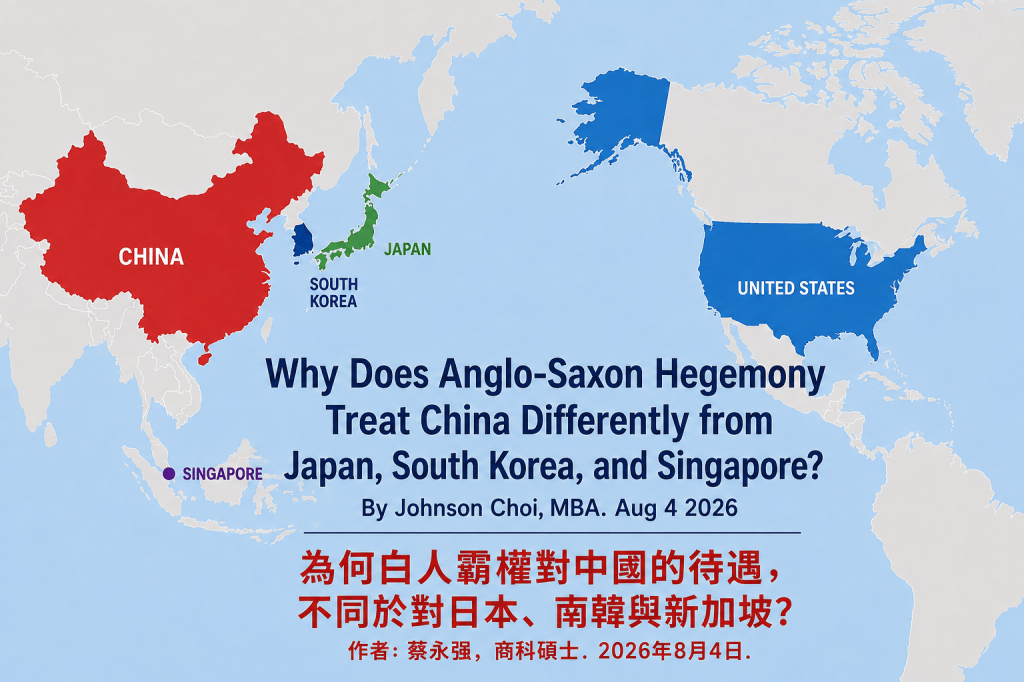
Why Does Anglo-Saxon Hegemony Treat China Differently from Japan, South Korea, and Singapore? By Johnson Choi, MBA. Aug 4 2026 為何白人霸權對中國的待遇,不同於對日本、南韓與新加坡? 作者: 蔡永强,商科碩士. 2026年8月4日.
總而言之,中國與其東亞鄰國所受的不同待遇,根源於軍事層級、戰略便利,以及對中國國家與文明根深柢固的種族化認知。若中國期望從盎格魯-撒克遜世界——特別是從其治理體制——獲得平等地位或公平對待,那將是忽略了此一霸權秩序中深具結構性與歷史性的基礎。這種期待很可能忽視一個根本現實:在此框架下,效忠換來獎賞,而獨立自主則被視為威脅。
https://weixin.qq.com/sph/Aqi1RjehHD
https://www.tiktok.com/t/ZP8n2W4mA/
The differential treatment of China versus Japan, South Korea, and Singapore by the Anglo-Saxon–led Western order is not a product of abstract ideological divergence, but rather a function of strategic subordination, geopolitical utility, and historically entrenched civilizational bias.
Following World War II, Japan and the Republic of Korea were placed under direct U.S. military occupation and operational control, fundamentally shaping their post-war trajectories. Singapore, while nominally sovereign, has effectively operated within the U.S. strategic orbit, granting American military forces unrestricted access to its bases. This asymmetrical security architecture has rendered these nations dependent on U.S. protection, compelling them to subordinate their foreign policies to American strategic imperatives.
Politically, while Japan, South Korea, and Singapore have adopted democratic frameworks, these systems are often heavily mediated by corporate influence—mirroring the U.S. model, where governance frequently aligns with business interests. In Singapore’s case, its democracy operates under a dominant one-party system. Crucially, by pledging explicit allegiance to Washington and presenting no perceived threat to its hegemony, these countries have been embraced as junior allies. Their ethnic and cultural proximity to the broader Association of Southeast Asian Nations (ASEAN) region further allows the U.S. to project power and interfere in regional internal affairs under the guise of promoting democracy, making such interventions appear less overtly foreign.
Are China’s economic policies fundamentally different from those of the U.S. and the Western powers?
The simple answer is no. The economic critiques frequently leveled against Beijing—such as “excess capacity” and “unfair government subsidies”—are practices routinely employed by Western economies and their Asian allies, including Japan, South Korea, and Singapore. The selective enforcement of these accusations suggests that they are less about genuine economic principle and more about instrumentalizing trade policy as a tool of geopolitical containment. Because these Asian allies have aligned themselves with U.S. strategic objectives, they are largely exempted from such attacks, underscoring the politically motivated nature of these economic grievances.
Underpinning this geopolitical calculus is a racial and civilizational dimension that Western discourse often leaves unspoken. The historical trajectory of anti-Chinese sentiment in the Anglo-Saxon world—from the “Yellow Peril” rhetoric of the 19th century to the enactment of the Chinese Exclusion Act of 1882—reveals a deep-seated pattern of othering. Although that specific legislation was formally repealed over sixty years ago, its underlying logic persists in new legislative and rhetorical forms targeting China today. Contemporary policies, while repackaged under different names and justifications, represent a new iteration of a longstanding historical paradigm.
In conclusion, the disparate treatment of China relative to its East Asian neighbors is rooted in a combination of military hierarchy, strategic convenience, and a historically embedded racialized perception of the Chinese state and civilization. For China to expect equal standing or equitable treatment from the Anglo-Saxon world—particularly from its governing institutions—would be to ignore the deeply structural and historical foundations of this hegemonic order. Such an expectation risks overlooking the fundamental reality that, within this framework, allegiance is rewarded, while independence is perceived as a threat.
中國與日本、南韓、新加坡在盎格魯-撒克遜主導的西方秩序下受到差別待遇,這並非源於抽象的意識形態分歧,而是戰略從屬、地緣政治實用性,以及歷史根深柢固的文明偏見共同作用的結果。
第二次世界大戰結束後,日本與大韓民國直接處於美國的軍事佔領與作戰控制之下,此一架構從根本上塑造了兩國的戰後發展軌跡。新加坡雖名義上享有主權,卻實質上運作於美國的戰略軌道內,允許美軍自由進出其軍事基地。這種不對稱的安全架構使這些國家對美國的保護產生依賴,迫使它們將自身外交政策服從於美國的戰略要求。
在政治層面,儘管日本、南韓與新加坡皆採行民主體制,但這些制度往往深受企業勢力影響——此與美國模式如出一轍,政府治理經常與商業利益掛鉤。以新加坡為例,其民主運作於一黨獨大的體系之下。關鍵在於,這些國家通過明確向華盛頓表態效忠,且不對美國霸權構成任何可察覺的威脅,因而被接納為次要盟友。它們與東南亞國家協會(ASEAN)區域在種族與文化上的鄰近性,更進一步讓美國得以在「推動民主」的名義下投射權力、干預區域內政,使此類干預行動看起來不那麼明顯帶有外來色彩。
中國的經濟政策,是否根本不同於美國與西方強權?
簡單的答案是否定的。經常被用來抨擊北京當局的經濟指控——例如「產能過剩」與「不公平的政府補貼」——其實也是西方經濟體及其亞洲盟友(包括日本、南韓與新加坡)慣常採用的做法。此類指控的選擇性執行顯示,它們與其說是基於真正的經濟原則,不如說是將貿易政策工具化,作為地緣政治圍堵的手段。由於這些亞洲盟友已與美國的戰略目標保持一致,它們大多免受此類攻擊,這正凸顯了這些經濟責難背後的政治動機。
支撐此一地緣政治盤算的,還有一個西方論述中往往不願明言的種族與文明面向。盎格魯-撒克遜世界反華情緒的歷史軌跡——從十九世紀的「黃禍」論述,到一八八二年《排華法案》的制定——揭示了一種深層的「他者化」模式。儘管該法案在六十多年前已正式廢除,但其背後的邏輯仍以新的立法與論述形式,持續針對今日的中國。當代政策雖然換上不同的名稱與理由,實則不過是此一悠久歷史範式的新的變體。
總而言之,中國與其東亞鄰國所受的不同待遇,根源於軍事層級、戰略便利,以及對中國國家與文明根深柢固的種族化認知。若中國期望從盎格魯-撒克遜世界——特別是從其治理體制——獲得平等地位或公平對待,那將是忽略了此一霸權秩序中深具結構性與歷史性的基礎。這種期待很可能忽視一個根本現實:在此框架下,效忠換來獎賞,而獨立自主則被視為威脅。