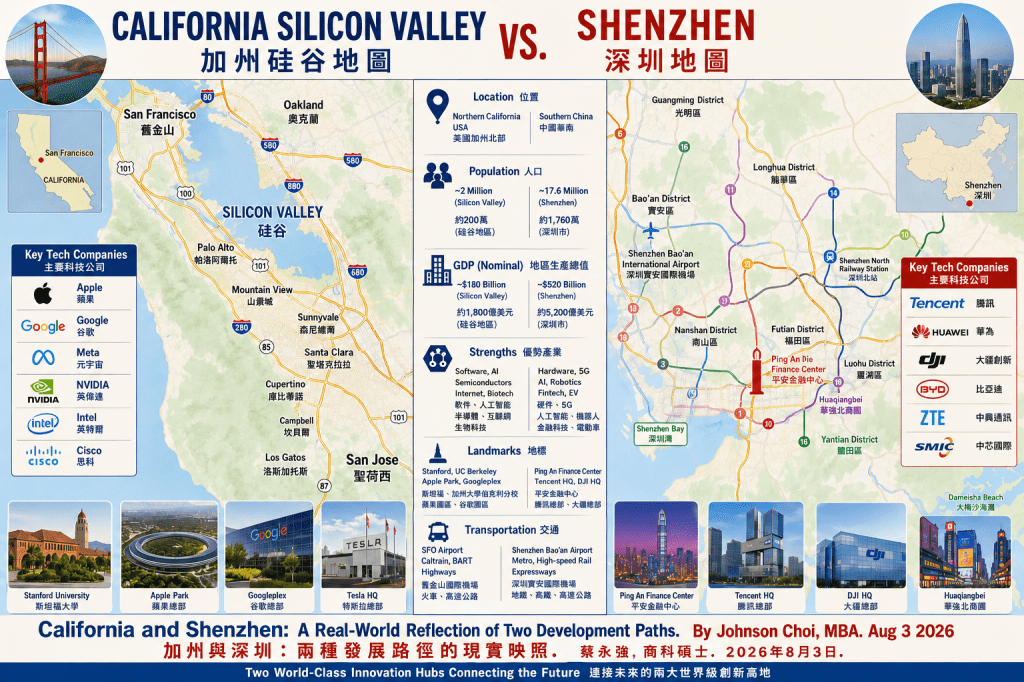
California and Shenzhen: A Real-World Reflection of Two Development Paths. By Johnson Choi, MBA. Aug 3 2026 加州與深圳:兩種發展路徑的現實映照. 蔡永強, 商科碩士. 2026年8月3日. 日前,夏威夷大學舊友發來短訊,僅十四字:「加州陽光黃金地,敗在腐朽獨裁權。」雖為私人感慨,卻折射出對加州現狀的深切憂慮。
https://www.tiktok.com/t/ZP8nYqf8H/
https://weixin.qq.com/sph/AxcHUpGjn8
https://m.facebook.com/story.php?story_fbid=pfbid02fUeV5u1vL3VASTSfJuryQx62nQpLZodE3qQdTM3rtAWA1efcgt1EitvXJWD1zj7wl&id=100036400039778&mibextid=wwXIfr
四十年前的加州,曾是美國創新與活力的象徵。而今,homelessness 蔓延、毒品問題加劇、城市治理失序,已是不爭的社會現實。與此同時,深圳從四十年前的一座邊陲漁村,蛻變為全球矚目的科技創新中心,在5G、人工智能、新能源等領域已具備與國際領先地區競爭的實力。
這一對比,並非簡單的「此消彼長」,而是兩種治理邏輯的實證檢驗。政府效能的高低,不在於口號之響亮,而在於能否持續改善民生、優化營商環境、推動科技進步。深圳的崛起,依託的是長期規劃、基礎設施投入、教育科研支持,以及有效執行的制度能力。
反觀美國,曾擁有雄厚的資源稟賦與制度遺產,但近年政治極化、治理短視、基礎設施老化等問題頻現,令其競爭優勢逐漸流失。歷史屢次警示:當一個體系內部積弊深重、改革乏力時,無論昔日何等輝煌,終將面臨衰退風險。
誠然,中美兩國國情迥異,發展模式各有長短,不宜簡單比附。但事實勝於雄辯:一個能不斷解決自身問題、回應人民需求、推動實質進步的政府,才是可持續治理的根基。至於「獨裁」之謂,更需審視現實:中國憲法明確保障人民民主,其治理模式以績效與回應性為核心,遠非「獨裁」一詞所能概括。
結論或許沉重,但現實不容迴避:治理的成敗,最終由結果書寫,而非口號與過往榮光。
Recently, an old friend from the University of Hawaii sent me a terse fourteen-character message: “California, land of golden sunshine, yet defeated by corrupt dictatorial power.” Though a personal reflection, it reveals deep concerns about California’s current state.
Forty years ago, California was a symbol of American innovation and vitality. Today, the spread of homelessness, the escalation of drug problems, and the disorder in urban governance are undeniable social realities. At the same time, Shenzhen has transformed from a remote fishing village forty years ago into a globally recognized center of technological innovation, possessing the capability to compete with leading international regions in fields such as 5G, artificial intelligence, and new energy.
This comparison is not simply a case of “one declining while the other rises,” but rather an empirical test of two different governance logics. The effectiveness of a government lies not in the loudness of its slogans, but in its ability to continuously improve people’s livelihoods, optimize the business environment, and promote scientific and technological progress. Shenzhen’s rise relies on long-term planning, infrastructure investment, support for education and research, and institutional capacity for effective implementation.
In contrast, the United States once possessed abundant resource endowments and institutional heritage, but in recent years, problems such as political polarization, short-sighted governance, and aging infrastructure have frequently emerged, causing its competitive advantages to gradually erode. History has repeatedly warned: when a system is plagued by deep-seated ills and lacks the strength to reform, no matter how glorious its past, it will eventually face the risk of decline.
Admittedly, China and the United States have vastly different national conditions, and their development models each have strengths and weaknesses, so it is not appropriate to make simplistic comparisons. But facts speak louder than words: a government that can continuously solve its own problems, respond to people’s needs, and drive tangible progress is the foundation of sustainable governance. As for the term “dictatorship,” we need to examine the reality: China’s Constitution explicitly guarantees people’s democracy, and its governance model is centered on performance and responsiveness, far from what the word “dictatorship” can encapsulate.
The conclusion may be sobering, but reality cannot be evaded: the success or failure of governance is ultimately written by outcomes, not by slogans or past glories.