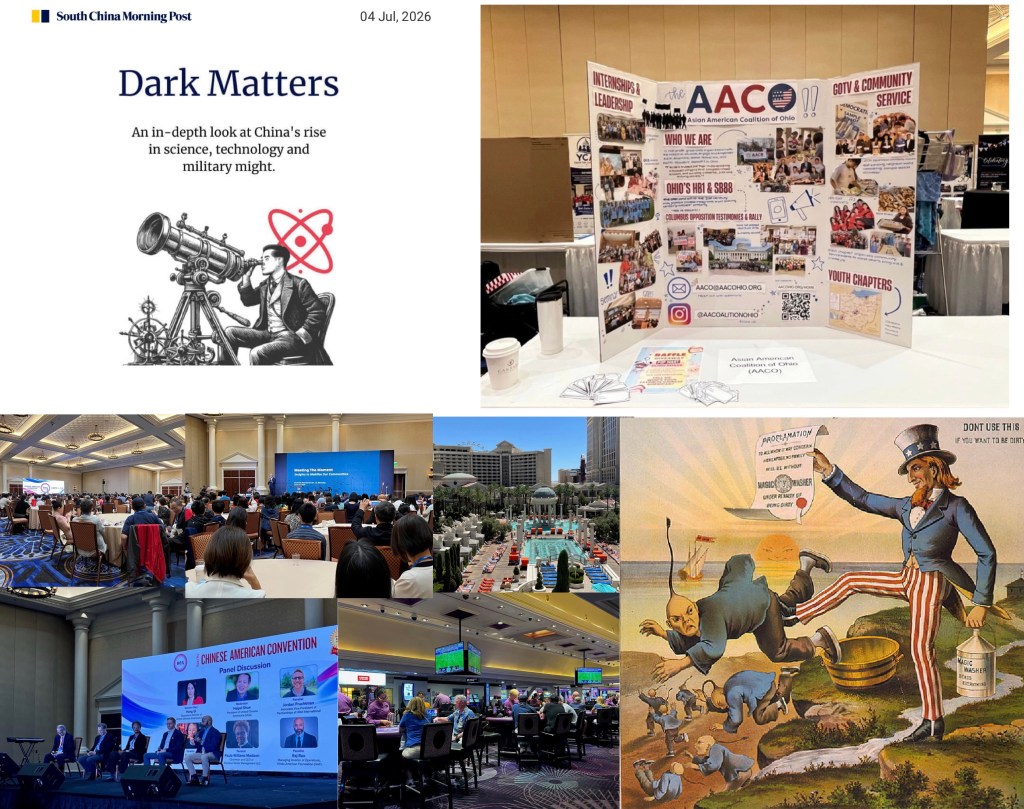
This may be the perfect time for Chinese American to return to their motherland. The foster home in US no longer welcome them! South China Morning Post: A new Chinese Exclusion era in the US: what’s the future for Chinese-Americans? 這可能是美籍華人回歸祖國的最佳時機。美國這個寄養家庭不再歡迎他們《南華早報》:美國迎來新的排華時代:美籍華人的未來何去何從?By Ling Xin
This week I was in Las Vegas, where nearly 1,000 Chinese-Americans from 41 states gathered under the shimmering desert heat for a high-stakes summit. 這週我人在拉斯維加斯,來自41個州的近千名美籍華人聚集在閃爍的沙漠熱浪下,參加一場高風險峰會。
Inside the massive Caesars Palace conference centre, the Chinese American Convention 2026 was under way. Civil rights lawyers, entrepreneurs, researchers, educators and artists all packed the same halls. The corridors hummed with Mandarin in various regional accents, a comforting kind of chaos. 在龐大的凱撒宮會議中心內,2026年美籍華人大會正在進行。民權律師、企業家、研究人員、教育工作者和藝術家齊聚一堂。走廊裡迴盪著夾雜各地口音的普通話,呈現出一種令人安心的混亂氛圍。
Attendees from 41 US states arrive at the grand opening of the 5th Chinese American Convention at Caesars Palace, Las Vegas, on June 29.
But beneath the warm reunion vibe was real anxiety: as America approaches its 250th anniversary, what does the future hold for its Chinese diaspora?
From the stage, though, the news was largely grim. Speaker after speaker described how Chinese-Americans have become political scapegoats – increasingly singled out and restricted from buying property, running businesses or even holding certain jobs. Some are calling it the start of a new Chinese Exclusion era.
It’s already happening. Florida and Texas have banned Chinese citizens who lack green cards from buying property near military bases and critical infrastructure, or any real estate beyond a single-family home.
In Iowa, a law taking effect today explicitly bars any citizen of the People’s Republic of China, including green card holders, from “owning, establishing, or operating healthcare facilities”.
“The lawmakers in Iowa offered no justification for this,” Haipei Shue, president of the United Chinese Americans (UCA), told me at the conference. “If they can lock us out of healthcare, how long before the bans extend to agriculture, construction or any other sector? What’s left for us?”
These bills don’t even pretend to be subtle. Another proposed Iowa bill sought to ban Chinese H-1B visa holders from teaching at any public, private or community college.
Community organisations showcase activism and history books while artists and entrepreneurs connect.
When Shue and other advocates went to the State Capitol to challenge it, lawmakers told them bluntly: “We do not trust CCP-educated kids to teach our kids.”
That bill was eventually killed after hundreds of professors from the University of Iowa and Iowa State signed protest letters and marched on the statehouse. But the sentiment behind it hasn’t gone anywhere.
Lawmakers justify most of this with “national security”, and the arguments quickly become absurd.
Keynote data: nearly half of the Chinese-Americans surveyed said they carry legal documents daily due to federal scrutiny fears.
Nearly 30 states have now banned Chinese nationals from buying private farmland. Texas State Representative Gene Wu pointed to one of the wilder theories floating around statehouses: that Chinese buyers will hoard land and refuse to grow corn, threatening the US food supply.
It’s economically absurd, Wu said. Corn is a globally traded commodity; the US is a massive net food exporter and one unplanted plot isn’t going to threaten anyone’s dinner. But logic doesn’t stand much of a chance against a good scapegoat.
On the second morning, news broke that a controversial executive attempt by the Trump administration to end birthright citizenship had been struck down. The meeting room erupted.
Outside the conference rooms: a glimpse of the sprawling Caesars Palace pool complex and the shimmering Las Vegas desert heat.
From the podium, the moderator reminded everyone: birthright citizenship’s landmark legal precedent traced back to a Chinese-American man – the 1898 case United States v. Wong Kim Ark.
While Wong Kim Ark made just one dollar a day as a cook, San Francisco Chinatown’s Zhonghua Huiguan – the unofficial city hall of the Chinese-American community – stepped in to fund his astronomical $10,000 legal battle, turning a single man’s fight into a collective effort that built a lasting civil rights milestone for the nation.
That history cuts against a belief common in the diaspora: that civil rights were something Black and Hispanic communities fought for and won, while Chinese-Americans just quietly benefited.
Cross-community solidarity in the desert: Chinese, African, Jewish and Indian leaders explore preserving cultural roots at a panel discussion.
As Paula Madison, a member of the Committee of 100 and a former NBC journalist whose grandfather was Hakka, said, the Confucian humility of “keep your head down, don’t make waves” does not work in American society.
When your rights can be legislated away, staying quiet won’t protect you. Only showing up will. Representatives from 61 Chinese-American organisations and over 200 youth leaders at the Vegas conference made one thing clear: staying quiet is no longer an option.
As California-based civil rights attorney Clay Zhu put it: “We must stand up and speak up in one voice – this is our land. We belong here.”
Also happening in fabulous Las Vegas: iconic casinos hum with life just steps away from the summit.
來自美國41個州的與會者於6月29日出席在拉斯維加斯凱撒宮舉行的第五屆美籍華人大會開幕式。
然而,在溫馨的重聚氛圍之下,隱藏著真實的焦慮:在美國即將迎來建國250週年之際,其華裔 diaspora 的未來究竟何去何從?
不過,從舞台上傳來的消息多半令人沮喪。一位又一位演講者描述美籍華人如何成為政治代罪羔羊——越來越常被針對,在購置房產、經營企業,甚至從事某些工作方面都受到限制。有些人稱這是一個新排華時代的開端。
這已經在發生了。佛羅里達州和德克薩斯州已禁止缺乏綠卡的中國公民在軍事基地和關鍵基礎設施附近購買房產,或購買獨棟住宅以外的任何不動產。
在愛荷華州,一項於今日生效的法律明確禁止任何中華人民共和國公民——包括綠卡持有者——「擁有、設立或經營醫療保健設施」。
「愛荷華州的立法者對此沒有提出任何正當理由,」美國華人聯合會(UCA)會長薛海培在大會上告訴我。「如果他們能把我們排除在醫療保健之外,那麼禁令要過多久才會擴展到農業、建築或任何其他行業?我們還剩下什麼?」
這些法案甚至連裝模作樣都懶得裝。愛荷華州另一項擬議中的法案試圖禁止中國H-1B簽證持有者在任何公立、私立或社區大學任教。
社區組織展示行動主義與歷史書籍,藝術家和企業家在此交流。
當薛海培和其他倡權人士前往州議會大廈挑戰該法案時,立法者直白地告訴他們:「我們不信任受中共教育的孩子來教我們的孩子。」
該法案最終在數百名愛荷華大學和愛荷華州立大學教授簽署抗議信並在州議會大廈遊行後被否決。但背後的那種情緒並未消失。
立法者大多以「國家安全」為由來為此辯護,而這些論點很快就變得荒謬。
主題數據:近半數受訪美籍華人表示,由於擔心聯邦政府的審查,他們每天隨身攜帶法律文件。
目前已有近30個州禁止中國公民購買私人農地。德州州眾議員吳元之提到州議會流傳的一種更離譜的說法:中國買家會囤積土地且拒絕種植玉米,從而威脅美國的糧食供應。
吳元之說,這在經濟上是荒謬的。玉米是全球交易的商品;美國是龐大的糧食淨出口國,一塊未種植的土地不會威脅任何人的晚餐。但在一個好用的代罪羔羊面前,邏輯幾乎沒有勝算。
第二天早上,川普政府一項終止出生公民權的爭議性行政嘗試被駁回的消息傳出。會議室頓時沸騰。
會議廳外:一窺廣闊的凱撒宮泳池園區與拉斯維加斯閃爍的沙漠熱浪。
在講台上,主持人提醒大家:出生公民權的標誌性法律先例可追溯至一位美籍華人——1898年的「美國訴黃金德案」。
儘管黃金德當時只是個日薪一美元的廚師,舊金山唐人街的中華會館——美籍華人社區的非官方市政廳——卻出面資助了他高達一萬美元的訴訟費用,將一個人的抗爭轉化為集體行動,為這個國家樹立了一座持久的民權里程碑。
那段歷史打破了 diaspora 中一種普遍認知:即民權是黑人和西語裔社區奮鬥得來的,而美籍華人只是默默受益。
跨社區團結在沙漠中:非洲裔、猶太裔、印度裔領袖與華裔領袖在一場座談中探討如何保存文化根源。
正如百人會成員、前NBC記者、祖母為客家人的 Madison Paula 所說,「低調、不惹事」的儒家謙遜在美國社會行不通。
當你的權利可以透過立法被剝奪時,保持沉默並不會保護你。只有站出來才有用。來自61個美籍華人組織的代表和超過200位青年領袖在拉斯維加斯會議上明確表示:保持沉默不再是選項。
正如加州民權律師朱偉所說:「我們必須團結一致,大聲發聲——這是我們的土地。我們屬於這裡。」
同樣在華麗的拉斯維加斯:標誌性的賭場在峰會咫尺之外熙熙攘攘,生機勃勃。