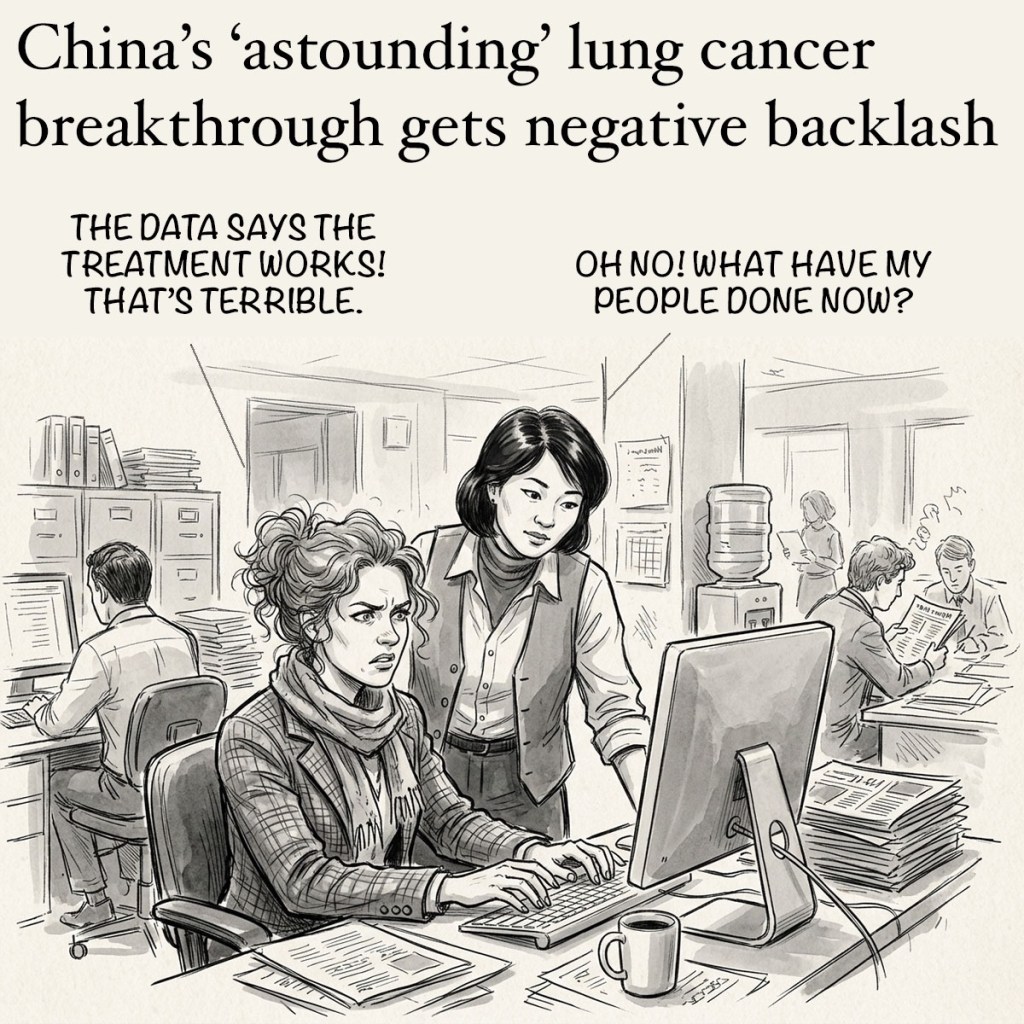
China’s latest threat: lifesaving medications. 中國最新的威脅:救命藥物.
中國科學家研發出一種新藥,被譽為對抗肺癌的重大突破,本週消息曝光。
「我認為這裡的結果相當驚人。」美國臨床腫瘤學會(ASCO)的 Monty Pal 博士在 YouTube 評論影片中表示:「我們看到的是整體存活中位數的改善。」
然而,這種英文名為 ivonescimab 的新藥研發,卻被美國政界與媒體描繪成令人擔憂的消息。為什麼?
美國精英與生俱來的自大狂,讓他們必須在每個領域都爭第一。這種心態引發了極度的偏執——意味著中國能救命的新進展,對他們來說反而是壞消息。
國家安全威脅
「現在就是與中國的戰爭。」美國衛生與公共服務部的 Chris Klomp 最近在保守政治行動會議上表示:「我們正面臨國家安全威脅……不是導彈與坦克,而是實驗室與救命藥物。」
喔,不!竟然是救命藥物!
那些卑鄙的中國人還有什麼事做不出來?
但更糟的還在後頭。前美國食品藥物管理局局長 Peter Marks 博士告訴《紐約時報》,如果美國病人對中國藥品產生依賴,可能會「創造出新的荷姆茲海峽」危機。
這句話耐人尋味。不僅偏執心態表露無遺,而且看看他舉的例子。美國在伊朗製造了一個完全沒必要的問題,導致數千人死亡、數百萬人面臨燃料短缺。
西方的政治操作對雙方——以及無辜的第三方——都會帶來真實世界的後果。
中國科學家拿下頂尖席位
上週,在 ASCO 年度全球腫瘤學家大會上,這個醫療議題進一步升溫。
五大突破性研究成果獲得最高級別發表席位——當其中一個席位由在中國進行試驗的中國醫學科學家拿下時,政客與記者們大吃一驚。
問題所在
讓我們逐一檢視各項問題:
是否有人嚴重質疑這款新藥 ivonescimab 無效,或只對中國人有效?
— 沒有。該藥由中國公司康方生物(Akeso Biopharma)研發,已在中國成功使用。此後也在美國、加拿大和歐洲進行了全球研究,以確保數據多元化。
是否擔心中國可能拒絕向美國人提供這種藥或其他藥品?
— 沒有。中國公司保留自家國家的權利,然後將藥品授權給美國公司在美國銷售。Ivonescimab 在美國是由邁阿密的 Summit Therapeutics 公司生產。
是否擔心數據造假?
— 沒有。醫學學術期刊《柳葉刀》已刊登研究指出,使用新藥的患者死亡率降低了 34%。
問題在於中國抄襲了美國的藥嗎?
— 不是。科學不是這樣運作的。科學進步來自於數據驅動的突破,無論突破發生在何處。
那問題到底是什麼?
老問題:美國需要主宰一切,不管誰會受傷。就中國藥物而言,如果藥品被延遲或禁止,這種無謂敵意的受害者將包括美國公民。
築起高牆
川普總統已簽署法案,禁止美國政府機構與中國生技公司簽訂合約,無論其產品與服務多麼有益。
此外,國會中的政客正試圖通過規則,阻止承認來自中國大陸或香港臨床試驗的數據。
有些美國記者似乎也對誰在創造突破背後的政治,比對科學突破本身更感興趣。《紐約時報》上週關於此話題的報導開頭是這樣寫的:
「數十年來,腫瘤學家的年度會議上,主要展示的是在美國和歐洲醫院進行的藥物試驗。
但在本週末於芝加哥舉行的今年會議上,處處都可見到中國崛起為藥物研發強權的跡象——以及許多人認為這對美國生技產業構成的威脅。」
中國最新的威脅:救命藥物。
CHINESE SCIENTISTS created a new medicine that is being hailed as a breakthrough in the fight against lung cancer, it was revealed this week.
“And the results here, I think, are quite astounding,” said Dr Monty Pal of the American Society of Clinical Oncology (ASCO) in a YouTube video review. “What we see here is an improvement in median overall survival.”
Yet the development of the new drug, called ivonescimab in English, is being portrayed as worrying news by politicians and media in the US. Why?
The US elite’s congenital megalomania means it has to be number one in every field. This need triggers extreme paranoia—and means that Chinese lifesaving advances are bad news.
.
NATIONAL SECURITY THREAT
“It’s a war right now with China,” said United States Department of Health and Human Services Chris Klomp at the recent Conservative Political Action Conference.
“We face a national security threat right now…it’s not one of missiles and tanks. It’s of laboratories and life-saving medications.”
Oh no! Not life-saving medications!
Will the dastardly Chinese stop at nothing?
But it gets worse. If American patients become reliant on the Chinese for drugs, there is a risk of “creating a new Strait of Hormuz”, said former FDA chief Dr. Peter Marks, quoted in the New York Times.
That’s a telling remark. Not only is the paranoia up front and center, but look at the example he chose. The US created an entirely needless problem in Iran, with thousands dead and millions suffering from fuel shortages.
Western political plays have real world consequences for both sides–and innocent parties, too.
CHINA SCIENTISTS GET TOP SPOT
The medical issue escalated last week at the annual ASCO global gathering of oncologists (cancer doctors).
The five biggest breakthroughs are given top-of-the-bill presentation slots—and politicians and journalists were shocked when one of them went to Chinese medical scientists who conducted their trials in China.
THE ISSUES
Let’s look at the issues, one by one:
Are there serious concerns that the new drug, ivonescimab, doesn’t work or only works on Chinese people?
- No. The drug was created by a Chinese firm called Akeso Biopharma, and it is already used successfully in China. There has since been a global study in the United States, Canada and Europe, too, to ensure diversified data.
Are there worries that China may deny sending this and other drugs to Americans?
- No. Chinese companies keep the rights for their own country and then license the drugs in the US to American firms. Ivonescimab in the US is a product of Summit Therapeutics of Miami.
Is there concern that the data is false?
- No. The Lancet, a medical academic journal, has already printed a study saying that people who got the new drug had a 34 percent lower death rate.
Is the problem that the Chinese copied the drug from the US?
- No. That’s not how science works. Science advances through data-driven breakthroughs, irrespective of where they take place.
So what is the problem?
It’s the usual one: the US needs to dominate everything, whoever gets hurt. In the case of medicines from China, the victims of needless hostility will include US citizens, if drugs are delayed or banned.
BUILDING WALLS
President Donald Trump has already signed legislation that prevents US government bodies signing contracts with Chinese biotech firms, however beneficial their products and services may be.
And separately, politicians in Congress are trying to get rules passed that prevent the recognition of data from clinical trials in Mainland China or Hong Kong.
Some US journalists also appear less interested in the scientific breakthroughs than the politics of who is making them. The New York Times report last week on the topic began with these lines:
“For decades, an annual gathering of oncologists has featured drug trials that were run mainly at American and European hospitals.
“But at this year’s meeting, which is being held in Chicago this weekend, the signs are everywhere of China’s ascendance as a powerhouse in drug development — and of the threat that many believe it poses to American biotechnology.”
China’s latest threat: lifesaving medications.