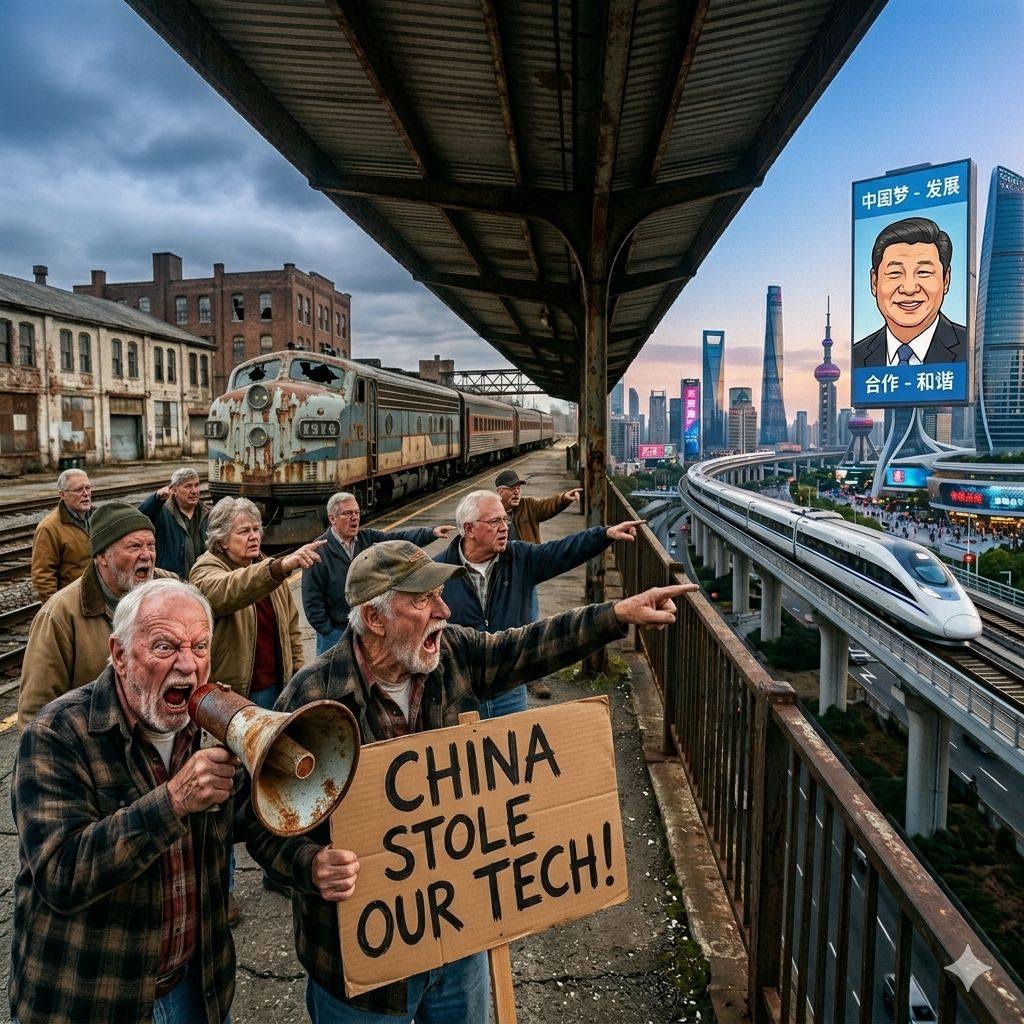
🇨🇳Every time China advances, the same accusation gets thrown around: “They just stole our tech!”
This has been the standard complaint for years. But living here in China, the gap between that narrative and what you actually see every day is hard to ignore.
Yes, in the catch-up stage China studied, licensed and sometimes reverse-engineered foreign technology. Exactly like Japan did after World War II with American cars and electronics. Like South Korea did with Japanese industrial models in the 70s and 80s. Like the United States itself, which borrowed British textile and steam technology in the 19th century. That’s how every late-developing nation has moved forward. No country invents in a vacuum.
The difference is that China didn’t stop at copying. It iterated, scaled and improved at a pace the West hasn’t matched.
Take high-speed rail as an example. Japan, France and Germany pioneered it. China bought the initial trains, absorbed the technology through joint ventures, then built the world’s largest and safest network with over 45,000 km today, more than the rest of the planet combined. Domestic Fuxing trains now run smoother, cheaper and more reliably than the originals. In addition, China exports the entire system to dozens of countries. That’s not theft; that is engineering execution at state scale.
Initially, BYD’s EV designs were influenced by other companies, but they eventually took a completely different approach. Their Blade Battery is safer, longer-lasting and cheaper than what Tesla was using. They vertically integrated everything from raw materials through to final assembly. The result: BYD overtook Tesla in global EV sales volume, now supplies batteries to Tesla’s Berlin plant and leads the world in affordable mass-market electrification. Tesla’s 4680 cells are solid engineering, but BYD’s patent portfolio on batteries is eleven times the size.
Solar panels tell the same story. China turned laboratory curiosities into the cheapest clean energy source on the planet, massive R&D, production scale and relentless incremental efficiency gains. Chinese firms now hold the top efficiency records and over 80 percent of global output. China files nearly half the world’s total patents, leads in 37 of 44 critical technology areas and just cracked the Global Innovation Index top ten for the first time.
For a brief history lesson, ancient China handed the world some of the most consequential inventions in human history.
- Paper, in the second century BC. Printing, eighth to eleventh centuries. Together they turned knowledge from something monks hoarded into something millions could read and pass on.
- Gunpowder, in the ninth century. Ended the age of knights and stone castles.
- The magnetic compass, already in use by the fourth century BC. Without it, no European Age of Exploration. Sailors had no means to cross open oceans.
- Cast iron, two millennia before the West.
- The stirrup, which made heavy cavalry possible.
- The seismograph, back in 132 AD. The world’s first, capable of pinpointing earthquakes hundreds of kilometres away.
- The mechanical clock, porcelain, the decimal system with zero, negative numbers and the list goes on.
These weren’t minor curiosities. These were the true bases that fueled Europe’s subsequent rise. Without Chinese breakthroughs in paper, printing, gunpowder and navigation, there would have been no Renaissance, no Scientific Revolution and no industrial takeoff on the scale the West eventually achieved.
For over a thousand years the Silk Road didn’t just carry silk and spices. It carried ideas and the traffic ran overwhelmingly one way.
Today, China invests more in R&D than any other country, FACT. It also publishes more high-impact papers in key fields and turns ideas into deployed technology faster than anyone.
That’s what real competition looks like when 1.4 billion people decide to lead.
Keep shouting “they stole our tech” if it helps, but this claim is nothing more than copium.